
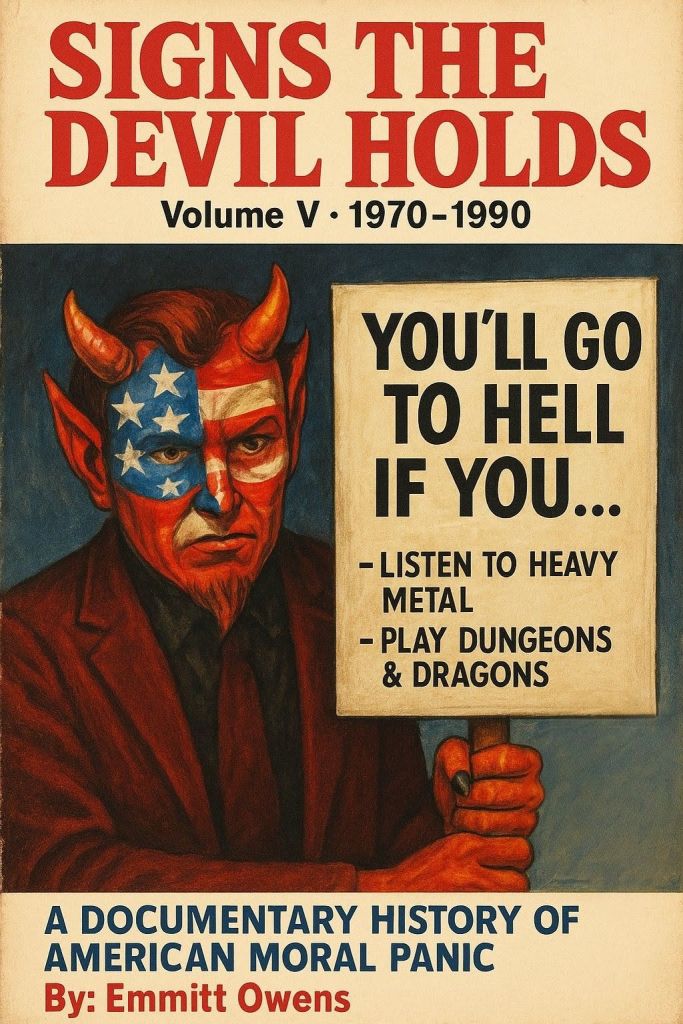
SIGNS THE DEVIL HOLDS: 1970-1990
A Documentary History of American Moral Panic
By: Emmitt Owens
(Index #11062025 – 11102025)
───────────────────────────────
LEGAL & FAIR USE STATEMENT
───────────────────────────────
This book is a work of documentary history and cultural commentary.
It incorporates short quotations from publicly available materials for purposes of analysis, education, and historical discussion under the Fair Use provisions of U.S. copyright law (17 U.S.C. § 107).
Interpretations and conclusions represent the author’s opinion and are protected under the Fair Comment doctrine of the First Amendment.
No statements herein are intended as factual allegations concerning any living person or organization.
This publication is entirely non-commercial.
───────────────────────────────
Signs the Devil Holds: Volume V (1970 to 1990)
By Emmitt Owens
(Index #11062025 – 11102025)
───────────────────────────────
Not for sale or commercial distribution.
Archival documentary publication by Emmitt Owens.
All rights reserved under Fair Use and Fair Comment doctrines.
—
Human nature has a strange reflex: when faced with something we don’t understand, we often accuse it instead of exploring it. Throughout history, curiosity has been replaced by condemnation. The moment a song, a book, or a painting touches a nerve, someone declares it dangerous. They can’t see that what unsettles them isn’t evil — it’s recognition. Art mirrors what’s buried inside us, and some would rather break the mirror than face their own reflection.
Rumors are the modern version of that reflex. They travel faster than understanding, feeding on fear and half-truths. Once spoken, a distortion takes on a life of its own — reshaped, retold, and reinforced by people who never question where it came from. It becomes easier to believe the echo than to seek the source.
This pattern reveals something about us. We crave villains because they make the world simple. It’s easier to assign darkness to a person or a work of art than to admit that confusion and discomfort are part of being human. So we exile what we don’t understand — and call it corrupt. We demonize what challenges us — and call it dangerous.
The devil, as it turns out, was never in the details. He was in the interpretation — in the pride that refuses to learn, in the fear that twists meaning into malice, and in the need to find fault where there was only truth.
—Signs the Devil Holds: Volume V (1970-1990)
—
Between 1970 and 1990, Americans identified Satan’s work in: Dungeons & Dragons, heavy metal music, daycare centers, backward masking on records, video games, rap music, disco, crack cocaine, AIDS, MTV, Cabbage Patch Kids, the Smurfs, Care Bears, rock concerts, Halloween candy, strangers, working mothers, satanic ritual abuse, recovered memories, role-playing games, arcade games, He-Man, secular humanism, New Age spirituality, the Procter & Gamble logo, subliminal advertising (again), and the very concept that children might be telling the truth about abuse that never happened.
This isn’t speculation. It’s documented in the longest criminal trials in American history, congressional hearings on music lyrics, police “occult crime” units, insurance payouts for imaginary abuse, school bans on games and toys, lives destroyed by false accusations, people imprisoned for decades for crimes that literally never occurred, and a moral panic so severe it created an entire infrastructure of “experts,” “therapists,” and “investigators” who profited from fear while destroying families.
This period marked a critical transformation: the panics became systematized. For the first time, moral panic had professional practitioners—people whose careers depended on finding evil everywhere. Not just preachers and concerned parents, but trained professionals with credentials, testifying in court, appearing on national television, writing best-selling books, all claiming specialized knowledge of a vast satanic conspiracy that existed only in their imaginations.
Here’s what happened.
“There is sin and evil in the world, and we’re enjoined by Scripture and the Lord Jesus to oppose it with all our might… We know that living in this world means dealing with what philosophers would call the phenomenology of evil or, as theologians would put it, the doctrine of sin… While America’s military strength is important, let me add here that I’ve always maintained that the struggle now going on for the world will never be decided by bombs or rockets, by armies or military might. The real crisis we face today is a spiritual one; at root, it is a test of moral will and faith.”
—Ronald Reagan “Evil Empire” Speech, March 8, 1983, to the National Association of Evangelicals.
—
1. The Satanic Panic (1980-1995): “Satan Runs the Daycare Centers”
If there’s one panic that defines the 1980s, one panic that destroyed more lives, cost more money, and revealed the absolute depths of collective delusion, it’s the Satanic Panic. This wasn’t just people being afraid of rock music or long hair. This was trained professionals—therapists, police officers, prosecutors, judges—convincing themselves and others that a vast network of satanic cults was operating daycare centers across America, ritually abusing thousands of children, sacrificing babies, and somehow leaving absolutely no physical evidence.
People went to prison for decades. Families were destroyed. Children were psychologically damaged by the investigation process itself. And it was all based on nothing—coerced testimony, leading questions, pseudoscience, and mass hysteria.
You read that correctly: America put people in prison for decades for crimes that never happened. Not crimes that couldn’t be proven—crimes that never occurred. Crimes that were physically impossible. Crimes that defied the laws of physics, geography, and human biology.
And everyone involved—the therapists, the prosecutors, the “experts,” the media—believed it was real.
The Origin: Michelle Remembers (1980)
The Satanic Panic can be traced to a single book: “Michelle Remembers”, published in 1980. Written by Canadian psychiatrist Lawrence Pazder and his patient (later wife) Michelle Smith, the book claimed to document Smith’s “recovered memories” of satanic ritual abuse she suffered as a child in Victoria, British Columbia in the 1950s.
The claims:
– Michelle was abused by a satanic cult led by her mother
– She witnessed human sacrifices and infant murders
– She was locked in cages with snakes and spiders
– She was forced to participate in satanic rituals
– Satan himself appeared to her (yes, literally the devil)
– The abuse lasted 81 consecutive days without anyone noticing she was missing
– The cult had vast power and resources
– They could operate without detection, leaving no evidence, no bodies, no witnesses
The “evidence”:
– Recovered memories from therapy sessions
– Michelle’s emotional reactions during hypnosis
– Pazder’s authority as a psychiatrist
– That’s it. That’s the entire evidence base.
No physical evidence whatsoever. No corroboration from anyone. Many impossibilities in the timeline and logistics. No missing babies or bodies ever found. Many claimed events were physically impossible—including Michelle being sewn into the stomach of a dead baby (she wasn’t) and Satan appearing as a being with a tail (he didn’t).
The reality:
Investigative journalists later found:
– No evidence any abuse occurred
– Michelle’s sisters denied everything
– Timeline didn’t match school records
– No missing babies or bodies were ever found
– Many claimed events were physically impossible
– The “memories” emerged only during therapy with Pazder
– Pazder and Smith began a romantic relationship during therapy (major ethical violation)
– They later married after he left his wife
So to recap: A psychiatrist conducted highly suggestive therapy on a vulnerable patient, implanted false memories of satanic abuse, began a sexual relationship with said patient, left his wife, married the patient, and then co-wrote a book promoting the false memories as real—a book that became the template for destroying thousands of lives.
Why it mattered:
Despite being completely unsubstantiated, “Michelle Remembers” became the template for thousands of subsequent “satanic ritual abuse” claims. Pazder became a leading “expert” on satanic abuse, consulting on cases, training therapists and law enforcement, and spreading the panic internationally.
The book legitimized several dangerous ideas:
– “Recovered memories” were reliable
– Therapists could help victims remember repressed abuse
– Lack of physical evidence didn’t disprove abuse (in fact, it proved how sophisticated the cult was)
– Satanic cults were real and widespread
– Children’s testimony, properly elicited, would reveal the truth
– Bizarre, impossible claims should be believed if emotionally sincere
Every single one of these ideas was wrong. Every single one destroyed lives.
The McMartin Preschool Case (1983-1990)
The McMartin Preschool case became the longest, most expensive criminal trial in American history. It destroyed multiple families, cost $15 million, lasted seven years, and resulted in zero convictions because the abuse never happened.
Not “couldn’t be proven.” Never happened.
How it started:
In August 1983, Judy Johnson reported to Manhattan Beach police that her 2½-year-old son had been sodomized by Ray Buckey, a teacher at McMartin Preschool run by the Buckey family. Johnson was later diagnosed with paranoid schizophrenia and made increasingly bizarre claims: that people at the preschool had drilled holes in her son’s arms and put staples in his ears and nipples, that Ray Buckey could fly, that her son had been taken to local businesses and abused, and that satanic rituals occurred.
Despite Johnson’s obvious mental illness and the impossibility of many claims, police sent a letter to 200 McMartin parents saying their children might have been abused and suggesting they question them.
This was the match to the powder keg.
The investigation:
Parents took their children to Children’s Institute International (CII), where social worker Kee MacFarlane interviewed them using techniques now recognized as completely inappropriate:
– Leading questions (“Can you remember the naked games?”)
– Peer pressure (telling children other kids had already disclosed)
– Repeated interrogation until children said what interviewers wanted
– Anatomically correct dolls used suggestively
– Praise for “disclosures,” disappointment when children denied abuse
– Suggesting that saying “no” meant bad people would go free
– Telling children they were helping catch bad guys if they confirmed abuse
The claims escalated:
Eventually, children made increasingly bizarre allegations:
– Secret underground tunnels under the preschool
– Being flushed down toilets to secret tunnels
– Flying in airplanes to distant locations for abuse
– Satanic rituals with robes and candles
– Animal sacrifices
– Witnessing infant murders
– Being photographed naked (no photos were ever found)
– Hundreds of perpetrators across Los Angeles
– Being abused at churches, car washes, markets, airports
– Chuck Norris participating in abuse (Chuck Norris was very confused when he heard about this)
– Teachers and children flying through the air
Let’s pause here. Children claimed teachers could fly. They claimed Chuck Norris was there. They claimed to be flushed down toilets to secret tunnels. And prosecutors built a case on this.
The defendants:
Seven teachers were charged. Ray Buckey and his mother Peggy McMartin Buckey faced 65 counts of child molestation. Ray Buckey was held in jail for five years before trial—five years imprisoned for crimes that never occurred.
The trial:
The trial began in 1987. Prosecutors presented:
– Children’s testimony about impossible events
– No physical evidence
– No pornographic photos (despite claims of hundreds being taken)
– No witnesses
– No bodies
– No tunnels (extensive excavation found none—contractors dug up the entire area and found nothing)
Defense presented:
– Expert testimony about coerced testimony and false memories
– Video of interrogations showing leading questions
– Evidence of coaching
– Impossibility of many claims
– Complete absence of physical evidence
The verdict:
After three years of trial and nine weeks of deliberation:
– All charges against five defendants were dropped
– Peggy McMartin Buckey was acquitted on all counts
– Ray Buckey was acquitted on 39 counts, hung jury on 13
– Retrial on 8 counts resulted in acquittal
– Total convictions: ZERO
The cost:
– $15 million in prosecution costs (1980s dollars)
– Seven years of trials
– Ray Buckey imprisoned for five years before acquittal
– Buckey family’s lives and reputation destroyed forever
– McMartin Preschool closed, never to reopen
– Children psychologically damaged by repeated interrogations
– Many parents still believe the abuse occurred to this day
What actually happened:
Nothing. No abuse occurred. The case was built entirely on:
– One mentally ill mother’s accusations
– Coerced and coached children’s testimony
– Leading questions from incompetent (or worse) interviewers
– Mass hysteria among parents
– Prosecutors unwilling to admit they had no case
– “Experts” who profited from the panic
The McMartin case became the template. Similar cases exploded across America, all following the same pattern.
The Fells Acres Case (1984-1995)
While McMartin grabbed national attention, the Fells Acres case in Massachusetts showed the panic was nationwide—and that convictions were possible even without evidence.
The accusations:
In 1984, a boy told his uncle that his teacher at Fells Acres Day School, Gerald “Tooky” Amirault, had sexually abused him. Police interviewed other children using the same flawed techniques as McMartin.
The claims:
Children eventually claimed:
– Sexual abuse by Gerald Amirault, his mother Violet, and his sister Cheryl
– Being tied naked to a tree in the school yard (no one noticed)
– Being assaulted with knives and sticks (no injuries)
– Witnessing a clown (later identified as Gerald) kill a blue bird with a magic wand
– Secret rooms in the school (none existed)
– Photographed naked (no photos existed)
– Forced to drink urine (no evidence)
A clown. Killing a blue bird. With a magic wand.
This was testimony in a court of law.
The trial:
Despite no physical evidence, no photographs, no witnesses, and impossible claims:
– Gerald Amirault was convicted and sentenced to 30-40 years
– Violet Amirault was convicted and sentenced to 8-20 years
– Cheryl Amirault LeFave was convicted and sentenced to 8-20 years
The evidence:
Prosecutors presented:
– Children’s testimony obtained through leading questions
– Expert testimony from “ritual abuse” specialists
– Parents’ emotional testimony
– Zero physical evidence
That’s it. That was enough for conviction.
The aftermath:
– Violet and Cheryl were released in 1995 after 8 years in prison
– Gerald was released in 2004 after 18 years in prison
– Wall Street Journal, Boston Globe, and others investigated and concluded the case was a miscarriage of justice
– Dorothy Rabinowitz won a Pulitzer Prize for her reporting exposing the case’s flaws
– Despite overwhelming evidence the convictions were wrong, Massachusetts refused to pardon them
– They remain convicted felons
Lives destroyed:
Three innocent people spent years in prison. Violet Amirault died in 1997, two years after release, her reputation destroyed. Gerald lost 18 years of his life—18 years—for crimes that never happened. Families were torn apart. Children were damaged by the investigation process. The day school was destroyed.
And it was all based on nothing. Children said a clown killed a blue bird with a magic wand, and three people went to prison.
The Kern County Cases (1982-1990s)
Kern County, California became ground zero for some of the worst miscarriages of justice in American history, with multiple families accused and convicted based on children’s coerced testimony about impossible satanic abuse.
The scale:
– At least 36 people were convicted
– Most served 10-20+ years in prison
– Cases involved multiple families
– All based on coerced testimony and prosecutorial misconduct
The Kniffen-McCuan Case:
Brenda and Scott Kniffen and Alvin and Deborah McCuan were convicted in 1982 of molesting their own children and each other’s children. The children’s testimony, obtained through coercive interrogation, described:
– Group sex sessions
– Adult-child orgies
– Satanic rituals
– Forced participation
All four were convicted and sentenced to over 200 years combined. They served 12-14 years before being exonerated and released in 1996 when appellate courts found:
– Sheriff’s interrogation techniques were coercive
– Children were pressured to make false accusations
– Prosecutor Ed Jagels engaged in misconduct
– No physical evidence existed
– Medical exams contradicted abuse claims
Other Kern County cases:
Similar patterns destroyed dozens of families:
– The Pitts Case: Multiple family members convicted
– The Modahl Case: Grandmother convicted of ritualistic abuse
– The Goff Case: Parents accused by coerced children
Ed Jagels:
Kern County District Attorney Ed Jagels was the driving force behind these prosecutions:
– Aggressively pursued satanic abuse cases
– Rejected evidence of innocence
– Used the same flawed interrogation techniques repeatedly
– Destroyed dozens of families
– Faced criticism from legal experts nationwide
– Never faced consequences for the wrongful convictions
– Remained DA until 2009
– Never apologized
– Never admitted error
– Retired with full pension
The exonerations:
Starting in the 1990s, appellate courts began overturning convictions:
– Multiple findings of prosecutorial misconduct
– Recognition that interrogation techniques produced false testimony
– Acknowledgment that the abuse never occurred
– Many defendants released after serving 10-20 years
The damage:
– At least 36 people wrongfully convicted and imprisoned
– Hundreds of thousands in compensation paid (though many received nothing)
– Families permanently destroyed
– Children damaged by being forced to accuse their parents
– Community torn apart by accusations and paranoia
The pattern: Take vulnerable children. Ask leading questions. Reject denial. Reward “disclosure.” Repeat until you get the answer you want. Present in court as truth. Send innocent people to prison.
It worked. Over and over again.
The Techniques: How to Create False Memories
The Satanic Panic succeeded because “experts” developed and promoted interrogation techniques virtually guaranteed to produce false allegations. These techniques were taught to social workers, therapists, and police across America.
Leading questions:
Instead of “Tell me about school,” investigators asked:
– “Can you remember the naked games?”
– “Did the teacher touch you in your private parts?”
– “Where did they take you when they hurt you?”
– “What color were the robes they wore?”
The questions assumed abuse occurred and suggested what children should say.
Repeated interrogation:
Children were interviewed multiple times—sometimes dozens of times—until they said what investigators wanted. Children who consistently denied abuse were told:
– “Other children already told us”
– “We know it happened”
– “You need to help us”
– “Bad people will go free if you don’t tell”
– “Don’t you want to protect other kids?”
Peer pressure:
Children were told other children had “disclosed” abuse, creating pressure to conform. In reality, often no other children had actually disclosed anything—the first child’s coerced statement was used to pressure others.
Rewards and punishment:
Children received praise, stickers, and approval for “disclosing.” Children who denied abuse were met with disappointment, disapproval, or repeated questioning until they changed their story. The message was clear: tell us what we want to hear and we’ll be happy with you.
Anatomically correct dolls:
Therapists and investigators used dolls with exaggerated genitals, then:
– Asked children to “show what happened” with the dolls
– Interpreted any touching of dolls’ genital areas as evidence of abuse
– Suggested sexual activities by positioning dolls
– Treated normal childhood curiosity about anatomy as “disclosure”
The dolls were never validated as assessment tools and often produced false positives. Studies later showed children who had never been abused would touch the dolls’ genitals simply because they were there.
Assuming repression:
The theory of “repressed memories” held that:
– Traumatic abuse was automatically repressed/forgotten
– Therapy could “recover” these memories
– Lack of memory didn’t mean abuse didn’t occur
– Bizarre, impossible memories were actually real
– The more impossible the memory, the more trauma it revealed
This pseudoscientific theory, now thoroughly discredited, allowed therapists to “discover” abuse that never happened.
Refusing to accept denial:
When children said abuse didn’t happen, investigators:
– Insisted it did happen
– Told children they were “in denial”
– Continued questioning
– Suggested children were protecting abusers
– Treated denial as proof of trauma-induced repression
No answer was acceptable except confirmation of abuse.
The result:
These techniques could make almost any child eventually say almost anything. Studies later showed:
– Children as young as 3-4 can be easily led to make false allegations
– Repeated suggestions create false memories that children believe are real
– Children will conform to adult expectations
– Authority figures can override children’s own memories
– The interrogation process itself creates trauma
The investigators thought they were helping children remember. They were actually implanting false memories and creating new trauma.
The “Experts” Who Profited
The Satanic Panic created a cottage industry of “experts” who made careers—and fortunes—from the panic:
Kee MacFarlane:
– Social worker at Children’s Institute International
– Lead interviewer in McMartin case
– Used leading questions and anatomically correct dolls on hundreds of children
– Interviewed hundreds of children, generating hundreds of “disclosures”
– Testified as expert in multiple cases
– Widely criticized for her techniques
– Never faced consequences
– Never apologized
Lawrence Pazder:
– Psychiatrist and author of “Michelle Remembers”
– Became leading “expert” on satanic ritual abuse
– Consulted on cases nationwide
– Trained therapists and law enforcement
– Promoted “recovered memory” therapy
– Made lucrative career from the panic (book sales, speaking fees, consulting)
– His original claims were thoroughly debunked
– Never recanted
“Cult Cops”:
Police officers created specialized “occult crime” units:
– Claimed expertise in satanic crime
– Gave presentations to law enforcement nationwide
– Described vast satanic conspiracies
– Presented “evidence” like heavy metal albums and D&D books
– Trained others to see satanism everywhere
– Never solved an actual satanic crime (because they didn’t exist)
One officer claimed to have identified over 200 “occult symbols” that proved satanic activity. The symbols included: pentacles, crosses, the peace sign, the Nike swoosh, the number 666, heavy metal band logos, and basically any symbol teenagers might doodle.
Therapists:
Countless therapists specialized in:
– “Recovering” repressed memories
– Treating “satanic ritual abuse survivors”
– Using hypnosis to “remember” abuse
– Writing books about their “cases”
– Speaking at conferences
– Charging high fees for specialized treatment
Many of these therapists damaged their clients, implanting false memories and destroying families. Some therapists convinced entire groups of patients they were satanic abuse survivors.
Expert witnesses:
“Experts” testified in court about:
– Satanic cult practices (which didn’t exist)
– How satanists operate (they didn’t)
– Interpreting children’s behavior (incorrectly)
– Validating impossible claims (as real)
– Lending credibility to prosecutions (that had no evidence)
Most had no legitimate expertise and promoted pseudoscience. But they had credentials and confidence, which was enough.
The Evidence That Didn’t Exist
Despite thousands of accusations across hundreds of cases, no evidence of satanic ritual abuse was ever found:
No bodies:
Claims included murder of infants and children, yet:
– No bodies were ever found
– No missing children could be linked to cases
– FBI investigations found no evidence of murdered children
– Morgues and hospitals reported no suspicious infant deaths
– Birth records showed no unexplained infant disappearances
Where were the bodies? The answer: there were no bodies because there were no murders.
No photographs:
Despite claims of extensive child pornography:
– No photographs were ever found in any case
– Raids on defendants’ homes found nothing
– Extensive searches revealed no evidence
– Claims of photographs being destroyed were unfounded
No physical evidence:
Despite claims of:
– Secret rooms and tunnels
– Extensive abuse in specific locations
– Satanic ritual implements
– Blood and remains
Investigations found:
– No secret rooms (extensive excavation at McMartin found nothing)
– No physical evidence of abuse in alleged locations
– No ritual implements
– No biological evidence
At McMartin, archaeologists excavated the entire area. They found old pipes and normal underground infrastructure. No tunnels. No secret rooms. Nothing.
No witnesses:
Despite claims of:
– Hundreds of perpetrators
– Abuse at public locations (churches, airports, car washes)
– Vast conspiracies
Reality:
– No adult witnesses came forward
– Locations showed no evidence
– No conspiracy members were ever identified beyond those accused
– Claims of secret cult networks were never substantiated
No confessions:
Despite:
– Extensive interrogations
– Plea bargain offers
– Promises of leniency
Result:
– No defendants ever confessed
– No corroborating testimony from anyone
– Even those who served years in prison maintained innocence
If satanic cults were real, wouldn’t someone have confessed? Wouldn’t someone have gotten a reduced sentence by testifying against others? Wouldn’t there be some evidence?
The absence of evidence wasn’t proof of innocence to believers. It was proof of how sophisticated and powerful the conspiracy was.
The FBI Investigation
In 1992, FBI Supervisory Special Agent Kenneth Lanning published a comprehensive report on satanic ritual abuse after years of investigation.
The findings:
After investigating thousands of allegations:
– No evidence of any organized satanic cult
– No evidence of ritual murder
– No evidence of widespread conspiracy
– Most cases involved overzealous investigators
– Many involved mentally ill accusers
– Recovered memory therapy created false allegations
– Leading questions produced false testimony from children
Lanning’s conclusions:
“After all the hype and hysteria is put aside, the realization sets in that most satanic/ritualistic abuse cases involve individual perpetrators, not large-scale conspiracies. The numbers of victims are relatively small, and the most prevalent crime is the sexual victimization of children.”
In other words: child abuse exists and is serious, but:
– It’s usually by family members or known individuals
– It doesn’t involve satanic cults
– The satanic ritual abuse panic was unfounded
– The investigation techniques were creating false allegations
The response:
True believers dismissed the FBI report, claiming:
– The FBI was part of the cover-up
– Lanning didn’t understand satanic crimes
– The report proved the conspiracy’s power
– Evidence existed but was being suppressed
The panic continued despite authoritative debunking. Because once you’re convinced of a vast conspiracy, any evidence against it becomes proof of the conspiracy’s reach.
The Therapeutic Harm
The Satanic Panic didn’t just harm those accused—it harmed the “victims”:
Children:
– Subjected to repeated traumatic interrogations
– Forced to make false accusations against loved ones
– Separated from parents
– Placed in foster care
– Developed psychological problems from the investigation
– Some came to believe the false memories were real
– Relationships with parents permanently damaged
– Experienced guilt when realizing they’d falsely accused innocent people
Some of the children from these cases are adults now. Some have spoken out about the damage the investigations caused—damage far greater than any abuse that never occurred.
Adults with “recovered memories”:
– Convinced by therapists they had repressed abuse
– Developed false memories of abuse that never occurred
– Destroyed relationships with families
– Spent years in therapy exploring fake trauma
– Some sued family members
– Faced identity crises when realizing memories were false
– Suffered from the therapy that was supposed to help them
The Retractors:
Many people who “recovered” abuse memories eventually realized the memories were false:
– Lynn Gondolf retracted her accusations against parents after years
– Beth Rutherford “remembered” being raped by her minister father and forced to abort two pregnancies—medical exam showed she was a virgin and had never been pregnant
– Countless others retracted after years of believing false memories
Organizations like the False Memory Syndrome Foundation formed to support families destroyed by false accusations.
What Made It Possible
Several factors converged to create the perfect storm:
1. Fear of child abuse:
Legitimate concern about child sexual abuse (which is real and serious) created urgency to believe children and protect them. This worthy goal was exploited by those seeing abuse everywhere.
2. Belief in repressed memories:
The now-discredited theory that trauma is automatically repressed created permission to “recover” memories through therapy—effectively creating false memories.
3. Satanic imagery in culture:
Heavy metal, horror movies, and occult imagery in popular culture made satanic conspiracies seem plausible to those predisposed to believe.
4. Profit motive:
Therapists, expert witnesses, authors, and consultants made money from the panic. Admitting it was false would end their revenue streams. Books sold. Speaking engagements paid. Consulting fees were lucrative.
5. Unwillingness to admit error:
Once prosecutors invested years in cases, they couldn’t admit the cases were baseless. Once parents believed their children were abused, they couldn’t accept they’d been misled. Once professionals staked their reputations on satanic abuse being real, they couldn’t acknowledge it wasn’t.
6. Moral certainty:
Those involved believed they were protecting children from ultimate evil. This moral certainty blinded them to evidence, logic, and the harm they were causing. They were the heroes. Anyone who questioned them was defending evil.
7. Confirmation bias:
Every piece of evidence was interpreted to confirm the conspiracy:
– Denials proved the trauma caused repression
– Lack of evidence proved how sophisticated the cult was
– Impossible claims proved how traumatized victims were
– FBI debunking proved how powerful the conspiracy was
No evidence could disprove what believers were certain was true.
The Legacy
The Satanic Panic eventually faded, but its consequences persist:
Lives destroyed:
– Dozens imprisoned for decades for crimes that never occurred
– Some died in prison
– Thousands accused and investigated
– Families permanently torn apart
– Reputations destroyed
– Careers ended
– Financial ruin for defendants
Professional consequences:
– Some convictions overturned, but some people died in prison
– Compensation for wrongful conviction inadequate or absent
– Prosecutors who engaged in misconduct rarely faced consequences
– “Experts” who testified were never held accountable
Therapeutic harm:
– Recovered memory therapy discredited
– But damage to those who underwent it remains
– False Memory Syndrome Foundation continues supporting families
Cultural impact:
– Increased skepticism of abuse allegations (unintended consequence that actually harmed real victims)
– Pendulum swung from “believe all children” to “children can be coached”
– Made investigating real abuse more difficult
– Created template for conspiracy theories
Lessons not learned:
Similar panics have emerged:
– Online predator hysteria (with exaggerated statistics)
– Trafficking panic with inflated numbers
– QAnon conspiracy theories about satanic elites (2016-present)
The pattern persists: moral certainty, conspiracy thinking, rejection of evidence, and willingness to destroy lives based on unfounded beliefs.
What It Really Was
The Satanic Panic was about:
Fear of modernity:
Working mothers leaving children in daycare created anxiety. The panic channeled that anxiety into the most extreme imaginable fear. If mothers worked, their children would be ritually abused by satanists.
Religious anxiety:
Growing secularization and loss of Christian cultural dominance created fear that Satan was gaining power. If church attendance declined, Satan must be winning.
Gender roles:
Working mothers were violating traditional gender roles. The panic punished them by suggesting daycare was literally satanic.
Professional hubris:
Therapists, investigators, and prosecutors became convinced their techniques were infallible and their judgments beyond question. They were the experts. Anyone who disagreed was wrong.
Confirmation bias:
Every profession involved—therapy, law enforcement, prosecution—developed investment in satanic abuse being real. Admitting error would mean admitting their careers were built on lies.
Moral panic mechanics:
All the classic elements: fear, scapegoating, authority, expert validation, media amplification, legal sanctioning, and resistance to contradictory evidence.
The Satanic Panic was the purest distillation of moral panic—completely unfounded, utterly destructive, driven by professional experts, and virtually impossible to stop once started because admitting error was unthinkable.
People went to prison for decades for crimes that never happened. Children were psychologically damaged investigating abuse that never occurred. Families were destroyed. Millions of dollars were wasted.
And it was all based on nothing.
The devil wasn’t in the daycare centers.
The devil was in the panic itself.
—
2. Heavy Metal & the PMRC (1984-1990): “Music That Murders”
If the Satanic Panic was the era’s defining hysteria, heavy metal music was its soundtrack—or rather, heavy metal was accused of being Satan’s literal voice, speaking through amplifiers to corrupt America’s youth. The panic about heavy metal crystallized in the Parents Music Resource Center (PMRC) hearings of 1985, created the “Parental Advisory” label still used today, and led to lawsuits blaming bands for suicides and murders.
The pattern should be familiar by now: something new emerges, adults don’t understand it, authorities declare it dangerous, careers are destroyed, and eventually everyone forgets they were ever afraid.
But heavy metal was different. Heavy metal fought back.
The Music
Heavy metal had evolved through the 1970s from bands like Black Sabbath and Led Zeppelin into increasingly harder, faster, and more aggressive styles by the 1980s:
The subgenres:
– Thrash metal: Metallica, Slayer, Megadeth, Anthrax
– Glam metal/Hair metal: Mötley Crüe, Poison, Warrant
– Speed metal: Motorhead, early Metallica
– Death metal: Death, Morbid Angel
– Black metal: Venom, Mercyful Fate
The imagery:
Heavy metal embraced dark imagery:
– Satanic symbols and lyrics
– Violence and death
– Horror movie aesthetics
– Skulls, demons, and pentagrams
– Album covers with disturbing artwork
– Stage shows with pyrotechnics and fake blood
None of this was real. It was theater. Performance art. Halloween turned up to 11.
But to critics, it was proof of satanic corruption.
The appeal:
Teenagers loved it because:
– It was loud, aggressive, and powerful
– Parents hated it (which made it better)
– It expressed adolescent anger and alienation
– It was rebellious and forbidden
– The musicianship was often impressive (contrary to critics’ claims)
– It created community among fans
The PMRC: The Washington Wives Attack
In 1984, Mary “Tipper” Gore (wife of Senator Al Gore) purchased Prince’s “Purple Rain” for her 11-year-old daughter. She was shocked by the sexual lyrics in “Darling Nikki,” which referenced masturbation.
Shocked. By Prince. In 1984.
One wonders what Tipper thought Prince songs were about before this revelation.
Gore, along with Susan Baker (wife of Treasury Secretary James Baker) and other wives of prominent Washington politicians, formed the Parents Music Resource Center (PMRC) in May 1985.
The PMRC’s goals:
– Warning labels on albums with explicit content
– Printed lyrics on album covers
– Keeping explicit albums behind counters
– Pressure on the music industry for self-regulation
– Public hearings to expose dangerous music
The “Filthy Fifteen”:
The PMRC compiled a list of the 15 most offensive songs, including:
1. “Darling Nikki” – Prince (Sex/Masturbation)
2. “Sugar Walls” – Sheena Easton (Sex)
3. “Eat Me Alive” – Judas Priest (Sex/Violence)
4. “Bastard” – Mötley Crüe (Violence/Language)
5. “Let Me Put My Love Into You” – AC/DC (Sex)
6. “Into the Coven” – Mercyful Fate (Occult)
7. “Trashed” – Black Sabbath (Drug/Alcohol)
8. “High ‘n’ Dry (Saturday Night)” – Def Leppard (Drug/Alcohol)
9. “In My House” – Mary Jane Girls (Sex)
10. “Dress You Up” – Madonna (Sex)
11. “Animal (Fuck Like a Beast)” – W.A.S.P. (Sex/Language)
12. “Strap On ‘Robbie Baby’” – Vanity (Sex)
13. “We’re Not Gonna Take It” – Twisted Sister (Violence)
14. “She Bop” – Cyndi Lauper (Sex/Masturbation)
15. “Possessed” – Venom (Occult)
Each song was labeled with objectionable content: X (profanity/sex), V (violence), D/A (drugs/alcohol), O (occult).
Notice something? Madonna and Cyndi Lauper made the list alongside extreme metal bands. Because the panic wasn’t really about heavy metal—it was about any music with sexual content or themes adults found uncomfortable.
The Senate Hearings (September 19, 1985)
The Senate Commerce, Technology, and Transportation Committee held hearings on “record labeling.” The hearings became cultural theater—and one of the great moments in American governmental absurdity.
PMRC testimony:
Tipper Gore and Susan Baker presented:
– The Filthy Fifteen
– Claims that music was growing increasingly explicit
– Concern that children had access to sexual and violent content
– Request for industry self-regulation
– Warnings about heavy metal’s satanic content
The rockstar defendants:
Three musicians testified against the PMRC:
Dee Snider (Twisted Sister):
Appeared in full rock regalia—torn jeans, long blond hair, makeup. Senators expected an inarticulate thug.
Instead, Snider gave articulate, intelligent testimony:
– Defended “We’re Not Gonna Take It” as anti-conformist, not violent
– Pointed out he didn’t drink, smoke, or use drugs
– Noted his wife was a Christian
– Argued parents should parent, not censor
– Made senators look foolish with his intelligence and preparation
The senators’ faces when they realized Snider was smarter than them? Priceless.
Frank Zappa:
The experimental rock musician delivered a blistering critique:
– Called the PMRC “demands” a violation of free speech
– Compared the hearings to Nazi book burning
– Warned of government censorship
– Argued the PMRC represented “bored housewives” with political connections
– Suggested it was a partisan attack on rock music
Zappa’s testimony was confrontational and uncompromising. He treated the hearings as an assault on the First Amendment. Because it was.
John Denver:
The folk singer surprised everyone by opposing the PMRC:
– Denver’s wholesome image made his opposition powerful
– He testified that his song “Rocky Mountain High” had been banned by some stations who thought it was about drugs (it wasn’t)
– Argued that context matters and censorship was dangerous
– Warned against giving anyone power to determine what was appropriate
Denver’s testimony showed that censorship threat extended beyond heavy metal. Today it’s Judas Priest, tomorrow it’s John Denver.
The outcome:
The hearings produced no legislation, but the music industry agreed to:
– Voluntary labeling system
– “Parental Advisory: Explicit Lyrics” labels on albums
– Some retailers refusing to stock labeled albums
– Some chains requiring ID to purchase labeled albums
The “Parental Advisory” sticker became a badge of honor for artists and actually boosted sales among teenagers. Forbidden fruit tastes sweetest.
The Backward Masking Panic (Returns)
The claim that rock albums contained hidden satanic messages when played backward had existed since the 1960s, but it intensified in the 1980s with heavy metal.
You read that correctly. People believed that if you played records backward, you’d hear Satan’s voice telling you to do bad things. And they took this seriously enough to hold legislative hearings about it.
The theory:
– Artists recorded messages backward into songs
– When played in reverse, satanic phrases were audible
– These messages subconsciously influenced listeners even when played forward
– Satan was using backward masking to possess listeners
The examples:
Led Zeppelin – “Stairway to Heaven”:
When the middle section is reversed, believers claimed to hear: “Here’s to my sweet Satan” and “I sing because I live with Satan.”
– Reality: Random sounds that humans pattern-match into words (pareidolia)
– Robert Plant and Jimmy Page denied any backward messages
– Recording technique of the era made intentional backward masking difficult
Judas Priest – “Better By You, Better Than Me”:
Claimed to contain the backward message “Do it” that supposedly caused two teenagers to attempt suicide.
– Reality: Became subject of lawsuit (discussed below)
Slayer:
Multiple songs were claimed to contain backward satanic messages
– Reality: Slayer’s entire image was deliberately satanic—they didn’t need hidden messages
The hearings:
Multiple state legislatures held hearings on backward masking:
Arkansas (1982):
– Bill proposed to require warning labels on albums with backward masking
– Expert testimony about subliminal messages
– Demonstrations playing records backward
– Bill failed, but created publicity
California:
– Similar hearings
– Legislators played records backward for each other
– Technical experts explained that intentional backward masking was difficult
– Psychologists testified that subliminal messages don’t work as claimed
The science:
Research showed:
– Backward speech sounds like gibberish to most people
– People hear what they’re told to hear (power of suggestion)
– No evidence of subliminal influence from backward messages
– The brain doesn’t process backward speech subconsciously
– Most “backward messages” were random sounds interpreted as words (pareidolia)
But here’s the beautiful irony:
The irony:
Some artists, amused by the panic, began including intentional backward messages:
– Electric Light Orchestra included “The music is reversible, but time is not. Turn back, turn back!”
– Styx included backward disclaimer
– These were jokes mocking the panic, but believers took them as proof
The panic was so absurd that artists started trolling the believers—and the believers’ response was “See? We told you!”
The Lawsuits: Blaming Bands for Suicide
The moral panic led to multiple lawsuits attempting to hold artists legally responsible for listeners’ suicides and violent acts.
Judas Priest Trial (1990):
The case:
In December 1985, two teenagers in Reno, Nevada—James Vance (18) and Raymond Belknap (20)—attempted suicide with a shotgun after hours of drinking, marijuana use, and listening to Judas Priest. Belknap died immediately. Vance survived with severe facial injuries but died three years later from complications.
Both had troubled backgrounds:
– Family abuse
– Drug problems
– Unemployment
– Previous suicide attempts
– Depression
But instead of addressing these issues, the families sued Judas Priest and CBS Records, claiming:
– The album “Stainless Steel” contained subliminal messages
– The phrase “Do it” was hidden in “Better By You, Better Than Me”
– These messages caused the suicides
– The band was liable for the deaths
The trial:
The 1990 trial in Reno became a media spectacle:
Prosecution argued:
– Backward masking and subliminal messages existed on the album
– These messages bypassed conscious thought
– The band intended to manipulate listeners
– Judas Priest bore responsibility for the deaths
Defense argued:
– Both teenagers had severe personal problems (family abuse, drug use, unemployment, previous suicide attempts)
– Multiple factors contributed to the suicides
– “Do it” was not intentionally placed on the album
– Even if it was, subliminal messages don’t cause behavior
– Millions listened to the album without attempting suicide
Expert testimony:
Psychologists testified:
– Subliminal messages in music don’t cause specific behaviors
– At most, they might slightly increase positive feelings about a product
– They cannot make someone commit suicide
– The “Do it” phrase was probably random guitar/vocal sounds
Audio experts testified:
– Playing the section repeatedly, different people heard different things
– Once told what to hear, people heard it
– This was power of suggestion, not proof of message
Judas Priest members testified:
– They didn’t put backward messages on albums
– They wanted fans alive to buy more albums (quite sensible)
– The “Better By You, Better Than Me” was a cover song they didn’t write
– They felt terrible about the deaths but weren’t responsible
The verdict:
Judge Jerry Carr Whitehead (the case was bench trial, not jury) ruled:
– The album did contain “Do it” sounds (likely accidental)
– These sounds might be subliminal
– BUT: No evidence they caused the suicides
– The teenagers’ personal problems were the cause
– Judas Priest and CBS Records were NOT LIABLE
The aftermath:
Judas Priest won the case but suffered:
– Enormous legal costs
– Years of negative publicity
– Emotional toll of being blamed for deaths
– Ongoing association with the suicide case
James Vance’s life after surviving:
– Severe facial disfigurement
– Multiple surgeries
– Depression
– Drug problems
– Died in 1988 from methadone overdose
The case became a cautionary tale about scapegoating artists for social problems. Two troubled teenagers with multiple risk factors died tragically. But it was easier to blame a band than address systemic failures.
Ozzy Osbourne Cases:
Ozzy Osbourne faced multiple lawsuits for allegedly causing suicides and violence:
1. John McCollum Case (1984):
19-year-old John McCollum shot himself while listening to Ozzy’s song “Suicide Solution.”
The lawsuit claimed:
– The song encouraged suicide
– Ozzy was negligent
– CBS Records was liable
Ozzy’s defense:
– The song was about dangers of alcoholism (Bon Scott of AC/DC died from alcohol)
– “Solution” referred to liquid, not solving problems
– Lyrics warned against alcohol: “Suicide is slow with liquor”
– Protected by First Amendment
The verdict:
– Case dismissed
– Court ruled the song was protected speech
– No evidence music caused the suicide
2. Other cases:
Multiple families sued Ozzy, claiming his music caused:
– Teenage suicides
– Violent behavior
– Satanic influence
All cases were dismissed on First Amendment grounds.
The pattern:
Lawsuits followed similar pattern:
– Troubled teenager with personal problems
– Suicide or violence
– Family looking for explanation and someone to blame
– Lawsuit claiming music caused the act
– Dismissal based on free speech and lack of causation
The lawsuits revealed more about American litigiousness and inability to address mental health than about music’s dangers.
The Church Burnings: Records and Stakes
Religious groups organized public destruction of heavy metal albums:
Record burnings:
Throughout the 1980s, churches held “crusades” against rock music:
– Youth groups collected rock and metal albums
– Public burnings with preachers denouncing Satan
– Testimonials from teens “saved” from rock music
– Claims that burning freed young people from demonic influence
The rhetoric:
Preachers claimed:
– Heavy metal was literally satanic
– Listening opened you to demonic possession
– The music contained curses and spells
– Destroying the albums broke Satan’s power
– Parents should search children’s rooms and destroy albums
The scale:
Record burnings occurred:
– In church parking lots
– At youth rallies
– On school grounds (until prohibited)
– At rock concert protests
– Organized by youth groups nationwide
The economics:
The irony: to burn the albums, teenagers had to buy them first. Some artists joked that religious groups were their best customers. Fans would buy albums, churches would burn them, fans would buy replacements. Repeat.
The Religious Opposition
The heavy metal panic was driven significantly by religious organizations:
The accusations:
Satanism:
– Heavy metal promoted satanism
– Album covers depicted satanic imagery
– Lyrics praised Satan
– Concerts were satanic rituals
– Fans were being recruited into devil worship
Suicide:
– Heavy metal encouraged suicide
– Depressive lyrics planted suicidal thoughts
– “Suicide Solution,” “Fade to Black,” and others were suicide anthems
– Parents reported children became suicidal after listening
Violence:
– Heavy metal made listeners violent
– Aggressive music created aggressive behavior
– Lyrics about death and killing inspired murders
– Fans committed crimes influenced by songs
Drug use:
– Heavy metal promoted drug use
– Lyrics referenced drugs
– Concert culture involved drugs
– Album art depicted drug paraphernalia
Sexual immorality:
– Glam metal promoted promiscuity
– Lyrics were sexually explicit
– Album covers featured scantily clad women
– Concerts were orgies
Anti-Christian:
– Heavy metal mocked Christianity
– Songs blasphemed God
– Imagery desecrated Christian symbols
– Goal was to turn youth away from Christianity
The ministries:
Bob Larson:
Radio host and author who:
– Wrote books about rock music’s dangers
– Hosted radio show exposing satanic music
– Claimed to be former rock musician (disputed)
– Performed “exorcisms” on teenagers influenced by metal
– Made career from the panic
Jeff Godwin:
Author of books including:
– Dancing With Demons: The Music’s Real Master
– The Devil’s Disciples: The Truth About Rock Music
– What’s Wrong With Christian Rock?
Godwin claimed:
– Virtually all rock music was satanic
– Christian rock was also dangerous
– Only traditional hymns were godly
– Specific bands made contracts with Satan
Eric Holmberg:
Created “Hell’s Bells” video series:
– Documentary claiming to expose rock music’s satanic nature
– Analyzed album covers for satanic symbols
– Interpreted lyrics as satanic
– Claimed rock concerts were literally satanic rituals
– Widely distributed to churches and youth groups
The video became widely used in religious communities to “educate” youth about music’s dangers.
The technique:
Religious opposition followed patterns:
1. Select most extreme examples of imagery/lyrics
2. Present these as representative of all heavy metal
3. Ignore context or artistic expression
4. Interpret everything as literal satanism
5. Claim expert knowledge of satanic practices
6. Terrify parents with worst-case scenarios
7. Offer solutions (books, videos, seminars) for profit
Notice the last step. The panic was profitable.
The Symbols: Finding Satan Everywhere
The panic created an encyclopedia of supposedly satanic symbols:
The pentagram:
Five-pointed star, especially inverted:
– Claimed to be primary satanic symbol
– Actually ancient symbol with many meanings
– Used in many cultures and contexts
– Heavy metal used it for shock value, not satanism
666:
The “Number of the Beast” from Revelation:
– Found on albums, t-shirts, stage props
– Treated as proof of satanic allegiance
– Artists used it because it offended people
– Iron Maiden’s song “Number of the Beast” condemned despite being anti-satanic narrative
Inverted crosses:
Upside-down Christian crosses:
– Seen as mocking Christianity
– Actually, inverted cross (Cross of St. Peter) is legitimate Christian symbol
– But context matters—heavy metal used it for provocation
Goat heads/Baphomet:
Goat-headed figures:
– Associated with satanism and occult
– Used on album covers and stage props
– Actually from 19th century occult imagery
– Heavy metal bands used it for aesthetic, not belief
Lightning bolts:
The SS lightning bolt symbol:
– Used by some metal bands
– Condemned as Nazi symbolism
– Actually, lightning was rock symbolism before Nazi connection
– Kiss used lightning bolts with no Nazi connotation
The interpretation:
Religious critics found satanic meaning in:
– Hand gestures (heavy metal horns – “devil horns”)
– Stage props
– Album art
– Band logos
– Clothing
– Song titles
Everything was evidence of satanic conspiracy. If you looked hard enough, everything proved Satan was winning.
What the Science Showed
Research on heavy metal and behavior found:
No causation with violence:
– Heavy metal fans were no more violent than other teens
– Many aggressive people didn’t listen to metal
– Many metal fans were peaceful
– Music preference didn’t predict behavior
No causation with suicide:
– Suicidal teens might be attracted to dark music
– But the music didn’t cause suicidal ideation
– Troubled teens had multiple risk factors
– Music was correlation, not cause
Subliminal messages don’t work:
– Backward masking couldn’t influence behavior
– Subliminal messaging effectiveness was vastly overstated
– Brain doesn’t process backward speech subconsciously
– Claims were based on pseudoscience
Catharsis theory:
Some research suggested:
– Aggressive music might provide emotional release
– Listening could reduce rather than increase aggression
– Music helped teens process difficult emotions
Identity formation:
Heavy metal provided:
– Community and belonging for alienated teens
– Safe outlet for rebellion
– Identity separate from parents
– Artistic appreciation (musicianship in metal was often excellent)
The Commercial Impact
The panic had mixed effects on the industry:
Parental Advisory labels:
– Required on albums with explicit content
– Many chains refused to stock labeled albums
– Some bands released “clean” versions
– Others embraced the label as badge of authenticity
– Teenagers sought out labeled albums
– Labels probably increased rather than decreased sales to target audience
Walmart and chain stores:
– Refused to stock certain albums
– Required edited versions
– Some artists modified content for chain store distribution
– Others refused to compromise
Censorship effects:
– MTV refused to play certain videos
– Radio stations avoided controversial songs
– Concert venues faced pressure to cancel shows
– Some cities banned heavy metal concerts
Financial success:
Despite (or because of) the controversy:
– Heavy metal album sales increased through 1980s
– Metallica, Megadeth, Slayer became hugely successful
– Controversy created publicity
– Forbidden fruit effect increased appeal
The Defenses
Artists and fans fought back:
First Amendment:
– Music is protected speech
– Courts consistently ruled in favor of artists
– Censorship attempts were unconstitutional
Artistic expression:
– Dark imagery was artistic, not literal
– Horror movie fans didn’t commit murder
– Stephen King readers weren’t violent
– Same logic applied to music
Satire and provocation:
– Many bands used satanic imagery satirically
– Shock value was the point
– Not actual satanic belief
Musical merit:
– Heavy metal required significant technical skill
– Complex compositions
– Talented musicianship
– Legitimate art form
Personal responsibility:
– Parents should parent
– Individuals responsible for behavior
– Blaming music avoided real causes
– Scapegoating artists for social problems
What It Really Was
The heavy metal panic was about:
Generational conflict:
– Parents didn’t understand the music
– Loud, aggressive sound was threatening
– Dark imagery was incomprehensible to those outside the culture
Class anxiety:
– Heavy metal appealed to working-class youth
– Challenged middle-class respectability
– Working-class cultural expression made elites uncomfortable
Gender roles:
– Metal’s aggressive masculinity threatened some
– Glam metal’s androgyny threatened others
– Female metal fans challenged gender expectations
Control:
– Parents unable to control what children listened to
– Music belonged entirely to youth culture
– Adults excluded and threatened by that exclusion
Religious anxiety:
– Growing secularization
– Youth rejecting organized religion
– Loss of Christian cultural dominance
– Heavy metal became scapegoat
Scapegoating:
– Easier to blame music than address real problems
– Teenage depression, suicide, violence have complex causes
– Music provided simple answer to complicated issues
The Legacy
Heavy metal survived and thrived:
Musical evolution:
Metal diversified into countless subgenres, from progressive metal to folk metal to symphonic metal.
Mainstream acceptance:
By the 2000s, heavy metal was respectable:
– Metallica won Grammy Awards
– Metal bands performed at mainstream festivals
– Rock and Roll Hall of Fame inducted metal pioneers
– Classical musicians covered metal songs
The Parental Advisory label:
– Still used today
– Became marketing tool rather than deterrent
– Artists sought the label for credibility
– Completely failed at its intended purpose
Vindication:
The predicted consequences never materialized:
– Listening to metal didn’t cause satanism
– Suicide rates weren’t affected by heavy metal
– Violence wasn’t caused by aggressive music
– The genre became normal part of music landscape
Cultural impact:
Heavy metal influenced:
– Fashion
– Art
– Film
– Video games
– Other music genres
The artists won:
– Lawsuits were dismissed
– Censorship efforts failed
– Bands continued creating controversial content
– Sales increased despite (because of) controversy
The music that was condemned as Satan’s voice became classic rock. The bands that were blamed for destroying youth became respected artists. The imagery that proved satanic conspiracy became museum exhibits and academic studies.
But in the 1980s, listening to heavy metal could mean:
– Being accused of satanism
– Parents destroying your albums
– Religious condemnation
– Being labeled mentally ill
– Schools punishing you
– Being blamed if peers committed suicide
The panic revealed:
– Moral entrepreneurs profit from fear
– Courts protect free speech even when unpopular
– Scapegoating is easier than solving problems
– Teenagers’ autonomy threatens adults
– The pattern never changes, only the target
It was just music.
But it represented freedom.
And for that, it had to be destroyed.
—
3. Dungeons & Dragons (1979-1990): “The Gateway to Witchcraft and Suicide”
If heavy metal was Satan’s music, Dungeons & Dragons was Satan’s game. The role-playing game became the target of an intense moral panic that claimed D&D caused suicide, murder, mental illness, and demonic possession.
Players were accused of practicing actual witchcraft, losing their grip on reality, and being recruited into satanic cults. The panic destroyed lives, led to book burnings, and created a cottage industry of “experts” warning about the game’s dangers.
D&D wasn’t just condemned—it was treated as genuinely supernatural evil.
Which makes sense. Nothing says “supernatural power” like dice, pencils, and books full of charts.
The Game
Dungeons & Dragons (D&D) was created by Gary Gygax and Dave Arneson, published in 1974 by TSR, Inc. It pioneered the role-playing game (RPG) genre.
How it worked:
– One player (the Dungeon Master) creates and narrates a story
– Other players create characters with abilities, skills, and traits
– Players describe what their characters do
– Dice rolls determine success or failure
– Collaborative storytelling with game mechanics
– Campaigns could last months or years
– Heavily influenced by fantasy literature (Tolkien, Howard, Moorcock)
The appeal:
– Creative outlet
– Social activity
– Problem-solving and strategy
– Fantasy escapism
– Community of players
– Endless possibility within game structure
The content:
D&D worlds included:
– Magic spells with names from real occult tradition
– Fantasy gods and religions
– Monsters from mythology (demons, devils, dragons)
– Medieval fantasy settings
– Treasure, quests, and adventure
– Combat and violence (described, not depicted)
– Character death (character sheets torn up, new characters created)
To most players, this was fantasy fiction made interactive—like acting out Lord of the Rings with your friends.
To critics, it was a satanic training manual that taught real witchcraft and caused players to lose their minds.
The Triggering Incident: James Dallas Egbert III (1979)
The D&D panic can be traced to a single teenager’s disappearance and the private investigator who got everything wrong.
The case:
In August 1979, James Dallas Egbert III, a 16-year-old genius attending Michigan State University, disappeared. Egbert was:
– Exceptionally intelligent (child prodigy)
– Socially isolated
– Depressed
– Drug user
– Struggling with sexuality
– Under enormous academic pressure
His parents hired private investigator William Dear to find him.
The D&D connection:
Dear learned Egbert played D&D in the university’s steam tunnels. Dear theorized—with absolutely no evidence—that:
– Egbert had gone into the tunnels to play D&D
– Gotten lost or injured
– Might still be in the tunnels
– May have been so immersed in the game he couldn’t distinguish fantasy from reality
Media ran with the story:
– “Brilliant student lost in D&D fantasy”
– “Can’t distinguish game from reality”
– “Trapped in fantasy world”
The reality:
Egbert had actually:
– Attempted suicide in the tunnels
– Survived
– Run away from school
– Hidden with friends for weeks
The tunnels and D&D were irrelevant—he was suicidal due to depression, drug use, family pressure, and identity struggles. D&D had nothing to do with it.
He was found alive. The story should have ended there.
The aftermath:
Egbert returned to school but:
– Continued struggling with depression
– Attempted suicide again in 1980
– Succeeded in August 1980 (died from gunshot)
His suicide had nothing to do with D&D. But the media narrative was set: D&D was dangerous.
William Dear’s book:
Dear wrote “The Dungeon Master” (1984), perpetuating the false connection between D&D and Egbert’s troubles. The book amplified the panic despite Egbert’s death being completely unrelated to the game.
Dear built his career on a false narrative. The book sold well. The truth didn’t matter.
BADD: Bothered About Dungeons & Dragons
The anti-D&D movement found its leader in Patricia Pulling—a grieving mother who channeled her tragedy into destroying a game.
The tragedy:
In June 1982, Patricia Pulling’s 16-year-old son Irving “Bink” Pulling II died by suicide with a gunshot to the chest.
Bink was:
– Depressed
– Had recently received poor grades
– Struggling socially
– Played D&D at school
The blame:
Patricia Pulling became convinced D&D caused her son’s suicide:
– He had played the game at school
– His character had been “cursed” in the game (a normal game element)
– She believed he couldn’t distinguish fantasy from reality
– She claimed D&D was satanic and had possessed him
The lawsuit:
Pulling sued:
– The school principal (for allowing D&D)
– TSR, Inc. (the game’s publisher)
– Alleging wrongful death
The lawsuit was dismissed:
– No evidence D&D caused the suicide
– Bink had depression and other issues
– The “curse” was just part of the game
– Millions played D&D without committing suicide
BADD is born:
After losing the lawsuit, Pulling founded Bothered About Dungeons & Dragons (BADD) in 1983.
Unable to accept that her son’s death was due to mental illness, Pulling dedicated her life to blaming a game. And people listened.
BADD’s claims:
– D&D caused suicide (she compiled a list of “D&D related deaths”)
– D&D taught real witchcraft and black magic
– D&D was satanic and opened players to demonic possession
– D&D caused mental illness and loss of reality
– Players became obsessed and couldn’t separate game from reality
– D&D was a gateway to occult practices
– Teenagers who played were at risk of suicide, murder, and satanism
BADD’s activities:
– Lobbying schools to ban D&D
– Speaking at churches and parent groups
– Appearing on television talk shows (Phil Donahue, 60 Minutes)
– Consulting with police on “occult crimes”
– Publishing warnings about D&D
– Testifying as “expert” witness
– Compiling lists of “D&D related deaths”
Pulling’s credentials:
Pulling claimed expertise in:
– Occult practices
– Teenage psychology
– Game effects on mental health
– Satanic ritual abuse
Her actual credentials:
– None
– No degree in psychology
– No training in occultism
– No research background
– Grief-stricken mother who blamed game for son’s suicide
She was entirely unqualified but widely accepted as expert. Because she was on television. Because she had credentials (“expert on occult”). Because she spoke with authority.
And because blaming a game was easier than addressing teenage mental health.
The “D&D Deaths” List
Pulling and BADD compiled lists of deaths allegedly caused by D&D:
The claims:
– 100+ teenagers died due to D&D
– Most were suicides
– Some were murders
– Some were accidents that occurred during “extreme” D&D play
– All were attributed to D&D’s influence
The reality:
Investigations of these deaths found:
– Most victims had played D&D at some point (along with millions of others)
– All had multiple risk factors (depression, abuse, drugs, family problems)
– No evidence D&D caused the deaths
– Many cases were misrepresented
– Some weren’t even deaths (missing persons who were later found alive)
– Statistics showed D&D players had lower suicide rates than general population
The Dateline analysis:
When researchers actually investigated the “D&D deaths”:
– Found D&D players had suicide rate lower than national average for teens
– No causation between D&D and suicide
– Claims were based on correlation only
– Many cases on the list weren’t even suicides
The list was propaganda, not evidence. But it was effective propaganda.
The Religious Opposition
Religious organizations led the charge against D&D:
The accusations:
Actual witchcraft:
– D&D’s magic spells used real occult names and terminology
– Players were learning actual spells from grimoires
– Playing the game was practicing witchcraft
– This opened players to demonic influence
Critics pointed to:
– Spell names like “Magic Missile,” “Fireball,” “Charm Person”
– References to real occult figures (Mordenkainen, etc.)
– Use of terms from real magical traditions
Reality:
– Spell names were from fantasy fiction and mythology
– Players weren’t actually casting spells
– It was make-believe, like cowboys and Indians
– No supernatural power involved
– Saying “Magic Missile” doesn’t actually create magic missiles
Satanism:
– D&D promoted satanism
– Devil and demon characters in the game
– “Evil” alignments players could choose
– Dungeons & Dragons = Satan’s game
Reality:
– Fantasy games include good vs. evil conflicts
– Most players were heroes fighting against evil
– Including evil characters doesn’t promote evil (like including Darth Vader doesn’t promote the Empire)
– It’s fiction
Possession:
– Playing D&D opened you to demonic possession
– Losing yourself in character meant demons could enter
– Role-playing weakened spiritual defenses
– Actual cases of possession in D&D players
Reality:
– No evidence of possession
– Claims based on religious belief, not evidence
– “Possession” symptoms were normal teenage behavior or mental illness
– Role-playing doesn’t cause possession
– If role-playing caused possession, every actor would be possessed
Suicide induction:
– D&D caused suicidal thoughts
– Character death in game led to real suicide
– Dark themes caused depression
– The game was a suicide cult
Reality:
– D&D players had lower suicide rates
– Character death is just making new character sheet
– Dark themes are in all fantasy fiction
– No mechanism for game causing suicide
The ministries:
Dr. Thomas Radecki:
Psychiatrist who became leading anti-D&D crusader:
– Founded National Coalition on Television Violence (NCTV)
– Claimed D&D caused violence and suicide
– Testified as expert witness in court cases
– Appeared on television warning about D&D
– Compiled “research” linking D&D to deaths
His credentials seemed legitimate (M.D., psychiatrist). His claims weren’t:
– His research was never peer-reviewed
– His methodology was flawed
– He cherry-picked cases
– He ignored contradictory evidence
Irony: Radecki later lost his medical license for inappropriate sexual conduct with patients and illegal prescription practices. The “expert” warning about D&D’s corrupting influence was himself corrupt.
Pastors and youth ministers:
Countless sermons warned about D&D:
– Youth group sessions on D&D dangers
– Books and pamphlets distributed to parents
– Videos exposing D&D’s satanic nature
– Exorcisms performed on players
– Book burnings of D&D materials
Jack Chick tracts:
Religious comic publisher Jack Chick created several anti-D&D tracts:
“Dark Dungeons” (1984):
A comic tract showing:
– Girl starts playing D&D
– Learns “real” spells
– Gets involved in witchcraft
– Friend commits suicide due to character death
– She discovers D&D is satanic training
– Eventually finds Jesus and burns all D&D materials
The tract became infamous for:
– Hilariously inaccurate portrayal of how D&D works
– Claims players actually learn witchcraft
– Suggestion character death causes real suicide
– Portrayal of normal gaming as satanic ritual
Sample dialogue from the comic: “Your cleric has been raised from the dead! Zombo, you’re alive again!”
Despite being absurd to anyone who’d actually played D&D, the tract was widely distributed and believed by those predisposed to fear the game. It became so notorious that it was eventually made into a parody film.
The School Bans
Schools across America banned D&D:
The justifications:
– D&D was disruptive
– Promoted violence
– Promoted occultism
– Caused obsessive behavior
– Parents complained
– Religious concerns
– Potential liability if student harmed themselves
The scope:
– Individual schools banned D&D clubs
– School districts prohibited D&D on campus
– Students caught with D&D materials faced discipline
– After-school D&D groups were disbanded
– Libraries removed D&D books
– Some bans extended to all fantasy role-playing games
The enforcement:
– Students’ lockers searched for D&D materials
– Confiscation of game books and dice
– Suspension for playing D&D
– Letters sent to parents warning about D&D
– Required parental permission for any fantasy gaming
The legal challenges:
Some bans were challenged:
– First Amendment issues (freedom of expression)
– Religious discrimination (banning due to religious objections)
– Equal treatment (other games allowed but not D&D)
Courts were mixed:
– Some upheld school authority to ban
– Some ruled bans unconstitutional
– Most bans eventually quietly lapsed
The Murder Cases
Several murder cases were blamed on D&D:
The Freeway Phantom Case:
In the early 1980s, a serial killer in the D.C. area murdered several people. When police found D&D materials in a suspect’s home, media linked the murders to D&D.
Reality:
– The suspect played D&D (like millions)
– He also did many other things
– No evidence D&D motivated the murders
– Suspect was mentally ill
– D&D was irrelevant to the crimes
Murder-suicide cases:
When players committed murder or suicide:
– Media immediately mentioned D&D connection
– BADD added cases to their list
– Religious groups cited as evidence
– Ignored that millions played without becoming violent
The pattern:
– Disturbed person commits crime
– Investigation reveals they played D&D at some point
– Media headlines: “D&D Player Commits Murder”
– Ignored: person also watched TV, ate pizza, attended school
– D&D became the explanation despite no causation
It’s like saying: “Murderer drank water! Water causes murder!”
The “Lost in Fantasy” Narrative
The core panic claim: D&D players couldn’t distinguish fantasy from reality.
The theory:
– Players create characters
– Become emotionally invested in characters
– Identify too closely with characters
– Eventually can’t tell where they end and character begins
– Act out character behavior in real life
– Lose touch with reality
The “evidence”:
– Players using game terms in conversation
– Enthusiasm about game events
– Strong emotional reactions to character death
– Continuing to think about game between sessions
– Using game terms as in-jokes
The reality:
This was:
– Normal engagement with hobby
– Same as sports fans discussing games
– Like readers caring about characters in novels
– Not different from children playing pretend
– Completely normal human imagination
The false dichotomy:
Critics assumed:
– You either knew it was fiction OR believed it was real
– No middle ground of imaginative engagement
Reality:
– People can immerse in fiction while knowing it’s fiction
– This is called “suspension of disbelief”
– It’s how all fiction works
– Theater audiences don’t think the play is real
– Movie viewers know it’s actors
– Novel readers know characters are fictional
– D&D players knew it was a game
The research:
Studies of D&D players found:
– Normal psychological profiles
– No confusion between fantasy and reality
– Well-adjusted socially
– Often higher than average intelligence
– Strong problem-solving skills
– Good imaginative capacity
The “lost in fantasy” claim was completely unsupported. But it sounded plausible to people who’d never played.
What the Science Showed
Research on D&D and its effects:
Armando Simon study (1987):
Psychologist studied D&D players:
– Found no evidence of harm
– Players had normal psychological profiles
– No increased risk of suicide
– No reality confusion
– Benefits included: creativity, social skills, problem-solving
CDC Study:
Centers for Disease Control investigated claims of D&D-related suicides:
– Found no evidence D&D caused suicide
– Players who died had multiple risk factors
– Suicide rate among players lower than general population
– No causation between game and suicide
The statistical reality:
– Millions played D&D in 1980s
– Normal suicide rate would predict dozens of deaths among that population
– When those deaths occurred, they were blamed on D&D
– But the deaths were within normal statistical expectation
– Actually, D&D players had lower than expected suicide rate
Why might players have lower suicide rates?
– Social activity (reduces isolation)
– Creative outlet (emotional expression)
– Community (belonging and acceptance)
– Problem-solving (builds coping skills)
– Collaborative storytelling (communication skills)
D&D might have been protective, not harmful.
The Defenses
The D&D community fought back:
TSR’s response:
The company that published D&D:
– Issued statements refuting accusations
– Provided information about actual game content
– Emphasized it was fantasy entertainment
– Pointed to lack of evidence for claims
– Defended artistic and commercial rights
Player testimonials:
Millions of players:
– Shared positive experiences
– Explained how game actually worked
– Demonstrated they weren’t confused or dangerous
– Organized conventions showing normal community
– Defended the hobby publicly
Expert testimony:
Mental health professionals testified:
– D&D was harmless entertainment
– Claims of harm were unfounded
– Role-playing could be therapeutic
– Social benefits of gaming
– No evidence of causation with violence or suicide
First Amendment:
– D&D was protected creative expression
– Banning it violated free speech
– Religious objections couldn’t justify censorship
– Same logic that protected books protected games
Comparative analysis:
Defenders pointed out:
– More people had read Tolkien than played D&D—should ban Tolkien?
– More murders committed by Bible readers than D&D players—ban Bible?
– Chess involves strategic “killing” of opponent’s pieces—ban chess?
The logic against D&D applied to virtually all fiction and games.
The Commercial Impact
The panic had complex effects on D&D sales:
Initial surge:
– Controversy created publicity
– “Forbidden fruit” effect
– Teenagers sought out the game to rebel
– Sales increased through early 1980s
Later decline:
– School bans reduced access
– Parent pressure
– Negative publicity
– Some stores refused to stock
– Chain stores moved D&D from toy section to less visible areas
The satanic aesthetic dilemma:
TSR faced a choice:
– Keep demonic imagery that was part of game fantasy
– Remove it to placate critics
They compromised:
– Toned down some imagery in new editions
– Removed or renamed some demons and devils
– Made game “friendlier” looking
– But kept core fantasy elements
This satisfied no one:
– Critics still condemned it
– Some players felt it was censorship
– The changes didn’t end the panic
Long-term success:
Despite the panic:
– D&D remained popular
– Spawned entire industry of RPGs
– Created lasting fan community
– Influenced video games, fiction, and culture
– Multiple editions published through present
– Hasbro purchased TSR (now owns D&D)
What It Really Was
The D&D panic was about:
Imagination as threat:
– D&D required imagination and creativity
– This was threatening to those who valued conformity
– Encouraging imagination meant encouraging independence
– Imaginative children question authority
Youth culture autonomy:
– D&D belonged entirely to youth culture
– Adults often didn’t understand it
– Children had knowledge and skills adults didn’t have
– This reversed normal power dynamic
Fantasy and religion:
– D&D’s fantasy magic threatened those who believed in literal magic and demonic power
– If you believe demons are real, fantasy demons seem dangerous
– If you believe witchcraft is real, pretend spells seem like real spells
Intelligence and elitism:
– D&D attracted smart, creative, often bookish kids
– These kids were often social outsiders
– The panic targeted intelligent, different children
– Reinforced anti-intellectualism
Lack of understanding:
– Critics had never played D&D
– They imagined what it must be based on limited information
– Their imagination was more disturbing than reality
– Fear of unknown drove panic
Scapegoating grief:
– Patricia Pulling couldn’t accept her son’s suicide
– Blaming D&D was easier than accepting mental illness
– Many parents found D&D a convenient explanation for children’s problems
– Simpler than addressing real issues
Commercial exploitation:
– “Experts” profited from warning about D&D
– Book sales, speaking fees, consulting
– The panic generated income for panic merchants
– Incentive to keep fear alive
The Legacy
D&D survived and thrived:
Mainstream acceptance:
By 2000s-2010s:
– D&D was culturally respectable
– Celebrity players discussed it openly (Vin Diesel, Stephen Colbert, Deborah Ann Woll)
– D&D references in TV shows (Community, Stranger Things, The Big Bang Theory)
– Actual play shows popular online (Critical Role with millions of viewers)
– D&D seen as creative, social, fun
– The panic seemed absurd in retrospect
Fifth Edition success:
– D&D 5th Edition (2014) became most successful version
– Sales records broken
– New generation of players
– No controversy
Influence:
D&D influenced:
– Video game RPGs (massive industry)
– Fantasy literature
– Popular culture
– Game design
– Storytelling methods
Vindication:
All predictions failed:
– D&D didn’t create satanists
– Players didn’t lose touch with reality
– No epidemic of D&D-related suicides
– Game became normal hobby
– Former players became doctors, lawyers, engineers, teachers
Patricia Pulling’s fate:
Pulling died in 1997. BADD dissolved. Her crusade failed. D&D survived and thrived. Her son’s memory became associated with a false panic rather than mental health awareness.
The lesson:
The D&D panic showed:
– Grief can drive destructive crusades
– Pseudoexperts are believed if they confirm fears
– Correlation is confused with causation
– Fear spreads faster than facts
– Commercial panic-mongering is profitable
– Moral panics target youth culture
– Eventually, truth wins (but slowly)
It was just a game—dice, paper, imagination, and friends telling stories together.
But it represented freedom.
And for that, it had to be destroyed.
Until it wasn’t.
—
4. Crack Cocaine (1986-1990): “The Demon Drug”
If the Satanic Panic and D&D represented supernatural fears, the crack cocaine panic represented fears about race, urban decay, violence, and the perceived loss of an entire generation. The crack panic created mandatory minimum sentences that imprisoned hundreds of thousands, devastated communities, and established drug war policies whose effects persist today. Unlike many panics that fade leaving little permanent damage, the crack panic wrote its fears into law—and those laws destroyed lives for decades.
The crack panic was unique: it was a real drug with real harms, but the panic response was so disproportionate, so racially targeted, and so politically motivated that it created more damage than the drug itself.
The Drug
What is crack cocaine:
– Cocaine base (as opposed to cocaine hydrochloride powder)
– Processed with baking soda and water, then heated
– Forms into “rocks” that can be smoked
– Smoking produces intense but brief high
– Highly addictive
– Cheaper per dose than powder cocaine
– More accessible to poor users
Why it emerged:
– Cocaine powder was expensive (1980s: $100+ per gram)
– Crack could be sold in small quantities ($5-10 “rocks”)
– Made cocaine accessible to poor urban communities
– Dealers could profit from smaller sales
– Manufacturing was simple
The effects:
– Intense euphoria lasting 5-15 minutes
– Rapid onset (smoking delivers drug quickly to brain)
– Severe crash afterward (depression, craving)
– Strong compulsion to re-dose
– Can lead to binge use patterns
– Genuinely addictive and harmful
The reality:
Crack cocaine was and is harmful:
– Addiction
– Health consequences
– Social disruption
– Crime
But the panic response was grossly disproportionate to the actual harms and created catastrophic consequences.
The Explosion (1984-1986)
Crack emerged in Los Angeles and Miami in early 1980s, spreading to other cities by 1985-1986.
The media discovers crack:
In 1986, media coverage exploded:
Newsweek (June 16, 1986): “Kids and Cocaine” – cover story
Time (June 2, 1986): “Fighting Back Against Crack”
Network news: Hundreds of crack stories in 1986
Local news: “Crack epidemic” became constant coverage
The narrative:
Media presented crack as:
– Instantly addictive (“one hit and you’re hooked”)
– Spreading like plague through cities
– Destroying entire communities
– Creating armies of violent addicts
– Killing thousands
– Unprecedented danger
The timing:
Several factors drove the 1986 explosion:
– Drug Enforcement Administration pushing the story
– Reagan administration’s War on Drugs needing an enemy
– Len Bias’s death (discussed below)
– Genuine concern about urban drug problems
– Media competition for sensational stories
Len Bias: The Triggering Death
On June 19, 1986, Len Bias, University of Maryland basketball star and Boston Celtics draft pick, died of cardiac arrhythmia induced by cocaine.
The immediate story:
– Bias was second pick in NBA draft
– Celebrated with friends
– Used cocaine
– Died suddenly
– Tragedy of wasted potential
The crack connection:
Initial reports claimed Bias died from crack cocaine. This was:
– Never proven
– Likely false (probably powder cocaine)
– But widely reported as crack death
The impact:
Bias’s death became the symbol of crack’s danger:
– Young
– Athletic
– Successful
– “Good kid”
– One-time use = death
The narrative: “If crack can kill Len Bias instantly, it can kill anyone.”
The political response:
Bias died in June 1986. By October 1986, Congress passed the Anti-Drug Abuse Act.
The speed was unprecedented:
– Four months from death to major legislation
– Minimal hearings
– Little debate
– Bipartisan panic response
The reality:
Bias’s death was tragic but:
– Doesn’t prove crack killed him
– Doesn’t prove instant lethality
– One anecdote isn’t evidence
– Millions used cocaine without dying
But evidence didn’t matter. The story was too powerful. A young Black athlete’s death became the justification for laws that would imprison hundreds of thousands of other young Black men.
The “Crack Baby” Horror
Perhaps the most damaging element of the crack panic was the “crack baby” narrative.
The claims:
Starting in 1985-1986, doctors and media reported:
– Pregnant women using crack
– Babies born exposed to crack
– These “crack babies” would be:
– Permanently brain damaged
– Mentally disabled
– Unable to learn
– Emotionally stunted
– Violent and uncontrollable
– A “biological underclass”
– Lost generation
The scope:
Estimates claimed:
– Hundreds of thousands of crack babies
– Entire generation damaged
– Permanent burden on schools and social services
– “Crack babies” would never be productive citizens
The medical claims:
Doctors reported:
– Specific “crack baby syndrome”
– Distinct symptoms
– Irreversible damage
– Different from other drug exposure
The media coverage:
Stories showed:
– Babies in NICUs trembling and crying
– Doctors warning of permanent damage
– Teachers despairing about crack babies
– Schools creating special ed programs
– Social services overwhelmed
The language:
Crack babies were described:
– “Damaged goods”
– “Bio-underclass”
– “Lost generation”
– “Irreparably harmed”
– “Empty souls”
This language—clinical, dehumanizing, permanent—wrote off an entire generation before they could walk.
The racial component:
Crack babies were implicitly (sometimes explicitly) Black:
– Crack was associated with Black urban communities
– Media images were almost exclusively Black babies
– The “underclass” language was racialized
– White babies exposed to drugs weren’t called “crack babies”
The reality:
Long-term research found:
– No distinct “crack baby syndrome”
– Cocaine exposure in utero has effects, but:
– Not permanent brain damage
– Not destiny of dysfunction
– Similar to alcohol, tobacco exposure
– Mitigated by good prenatal care and environment
– Many “crack babies” developed normally
– Poverty and lack of prenatal care caused more harm than crack
The harm:
The crack baby panic:
– Stigmatized children before they were born
– Created self-fulfilling prophecies (low expectations)
– Justified taking children from mothers
– Led to prosecution of pregnant women
– Terrorized women into avoiding prenatal care
– Created permanent label for affected children
– The stigma itself harmed development
The prosecutions:
Women who used crack while pregnant faced:
– Arrest
– Prosecution for child abuse
– Charges of “delivering drugs to a minor” (via umbilical cord)
– Loss of custody
– Imprisonment
These prosecutions:
– Disproportionately targeted Black women
– Ignored that alcohol and tobacco also harm fetuses
– Discouraged women from seeking prenatal care
– Treated addiction as crime rather than health issue
– Punished poverty (wealthier women could hide use)
The research correction:
By the mid-1990s, research showed:
– Initial claims were vastly overstated
– Many “crack babies” developed normally
– Poverty was stronger predictor of problems
– Prenatal care mitigated most effects
– The panic had created more harm than crack itself
But the damage was done:
– A generation of children stigmatized
– Women imprisoned
– Families destroyed
– Resources misdirected
The “crack baby” became a racist trope—shorthand for a permanent Black underclass that wasn’t worth investing in because they were already damaged beyond repair.
The Sentencing Disparity: 100-to-1
The 1986 Anti-Drug Abuse Act created mandatory minimum sentences with a specific disparity:
The law:
– Possession of 5 grams of crack = 5-year mandatory minimum
– Possession of 500 grams of powder cocaine = 5-year mandatory minimum
– Ratio: 100-to-1
Five grams is about the weight of a nickel. 500 grams is over a pound.
Why the disparity?
Official justifications:
– Crack was more dangerous
– Crack was more addictive
– Crack caused more violence
– Crack was destroying communities
The reality:
– Crack and powder cocaine are the same drug
– Physiological effects are similar
– Only difference is method of use (smoking vs. snorting)
– The disparity had no scientific basis
The racial impact:
The 100-to-1 ratio had devastating racial consequences:
Who used crack:
– Primarily poor, urban users
– Disproportionately Black and Latino
Who used powder cocaine:
– More widespread across races and classes
– More common among white, wealthier users
The result:
– Black Americans imprisoned at vastly higher rates
– For using essentially the same drug
– In 1990s:
– 80%+ of federal crack defendants were Black
– ~60% of powder defendants were white
– Sentences were dramatically different
The numbers:
– Black Americans 13% of population
– Black Americans 13% of drug users
– Black Americans 55% of drug convictions
– Black Americans 74% of sentenced for crack
The examples:
– Black man with 5 grams of crack: 5 years minimum
– White man with 499 grams of powder: probation possible
– Same drug, 100x different treatment
This wasn’t accidental. It was policy.
The Violence Narrative
The crack panic centered on claims of unprecedented violence:
The claims:
– Crack caused violence
– Crack users were violent
– Crack dealers were murderers
– Cities were war zones
– “Crack heads” would kill for another hit
– Crime was exploding
The imagery:
Media showed:
– Urban neighborhoods as war zones
– Drive-by shootings
– Young dealers with guns
– Addicts robbing and killing
– Police outgunned
– Cities losing control
The reality:
Violence did increase in mid-1980s, but:
Causes:
– Not the drug itself
– Drug trade violence (dealers fighting over territory)
– Prohibition enforcement
– Economic desperation in poor communities
– Flood of handguns
– Young dealers with limited conflict resolution skills
– Absence of legal dispute resolution
The pattern:
Violence from drug trade, not drug use:
– Alcohol Prohibition (1920s) caused violence
– Not because alcohol made people violent
– Because illegal trade required violence for dispute resolution
– Same pattern with crack
The pharmacology:
– Crack is stimulant, not violence-inducing
– Users want more crack, not to commit violence
– Crime was to get money for crack, not from crack itself
– Most crack users weren’t violent
The stats:
Crime rates in 1980s:
– Violent crime increased
– But not uniformly across drugs
– And not because crack caused violence
– Because drug trade was violent
When you make a product illegal, you ensure that the only people who can sell it are willing to break the law. And when disputes arise in illegal markets, they can’t be resolved in court—they’re resolved with violence.
The violence wasn’t caused by crack. It was caused by crack prohibition.
The Political Response
Both parties competed to be “tough on crack”:
The 1986 Anti-Drug Abuse Act:
Passed overwhelmingly:
– 392-16 in House
– 97-2 in Senate
– Signed by Reagan
Created:
– Mandatory minimums for crack
– 100-to-1 sentencing disparity
– Death penalty for some drug offenses
– Increased funding for enforcement
– Asset forfeiture expansions
The 1988 Anti-Drug Abuse Act:
Even harsher:
– More mandatory minimums
– “Three strikes” provisions (Joe Biden)
– Federal death penalty for major dealers
– User accountability (losing benefits, public housing)
– Created Office of National Drug Control Policy (“Drug Czar”)
State laws:
States created their own harsh crack laws:
– California’s three strikes
– New York’s Rockefeller Laws (pre-dated crack but intensified)
– Mandatory minimums in most states
– Enhanced sentences in “drug-free zones”
The enforcement:
Focus on street-level dealers and users:
– Massive arrests in poor neighborhoods
– Minimal prosecution of major traffickers
– Heavy police presence in Black neighborhoods
– Selective enforcement by race
The politics:
Why the bipartisan consensus?
Republicans:
– Fit “law and order” message
– Appealed to white suburban fears
– Attacked urban (implicitly Black) communities
– War on Drugs was popular with base
Democrats:
– Couldn’t appear “soft on crime”
– Black lawmakers felt constituent pressure
– Urban communities wanted response to violence
– Believed law enforcement would help
The irony:
– Black communities wanted help with drug-related violence
– Got mass incarceration instead
– Destroyed families and communities
– Made problem worse
The Congressional Black Caucus overwhelmingly supported the 1986 Act. They thought they were protecting their communities. They were inadvertently destroying them.
The Human Cost
The crack panic’s policies destroyed lives:
Mass incarceration:
– Federal prison population: 25,000 (1980) → 200,000 (2000)
– Most increase from drug convictions
– Disproportionately Black and Latino men
– Mostly non-violent offenses
– Sentences of decades for small amounts
The examples:
– First-time offender with 5 grams: 5 years mandatory
– Woman with abusive dealer boyfriend: mandatory sentence for “conspiracy”
– Users prosecuted as heavily as dealers
– No distinction for personal use vs. dealing
Collateral consequences:
Beyond prison time:
– Felony conviction = lifetime consequences
– Loss of voting rights
– Disqualification from public housing
– Ineligibility for student loans
– Employment discrimination
– Loss of custody of children
– Deportation for non-citizens
Family destruction:
– Children growing up without parents
– Multigenerational trauma
– Economic devastation
– Community destabilization
– Concentration of effects in Black neighborhoods
The women:
Particularly harsh impact:
– Women prosecuted for pregnancy
– Loss of children to foster care
– Conspiracy charges for boyfriend’s dealing
– Disproportionate sentences
– Inadequate prison services
The legacy:
By 2010s:
– 2.3 million Americans incarcerated
– Highest rate in world
– Disproportionately Black and Latino
– Massive financial cost
– Destroyed communities
– Intergenerational damage
The Science vs. The Panic
Research contradicted panic claims:
Crack addiction:
– Not “instantly addictive”
– Most users didn’t become addicted
– Most crack use was experimental or occasional
– Heavy addiction was minority of users
Studies showed:
– ~15-20% of users became dependent
– Similar to or less than alcohol
– Not the unstoppable addiction claimed
Crack babies:
As discussed, long-term research found:
– No permanent “crack baby syndrome”
– Effects were overstated
– Poverty and lack of care were bigger factors
– Most exposed children developed normally
Violence:
– Crack itself didn’t cause violence
– Drug trade violence was from prohibition
– Most users weren’t violent
– Crime was for money for crack, not from crack
The epidemic:
– Scale was exaggerated
– “Epidemic” language created false sense of spread
– Use peaked quickly then declined
– Natural market saturation, not enforcement
Effective approaches:
Research showed what actually worked:
– Treatment
– Harm reduction
– Economic opportunity
– Education
– Community investment
Not:
– Mass incarceration
– Mandatory minimums
– Harsh enforcement
– Destroying families
But research doesn’t matter when policy is driven by panic and politics rather than evidence.
The Racial Dimension
The crack panic cannot be understood without its racial component:
The users:
While crack use occurred across races:
– Media portrayed it as Black problem
– Enforcement focused on Black neighborhoods
– Sentencing disparities were racialized
– White users largely escaped harsh consequences
The imagery:
Media showed:
– Black “crack heads”
– Black dealers
– Black neighborhoods
– Black babies
Creating association: Black = crack = dangerous
The language:
Terms used:
– “Urban” (code for Black)
– “Inner city” (code for Black)
– “Underclass” (racialized)
– “Super-predators” (young Black men)
– “Welfare queens” (Black women, crack-using mothers)
The policies:
Every policy decision increased racial disparity:
– Crack vs. powder sentencing
– Where enforcement focused
– Who was prosecuted
– Who got treatment vs. prison
– Who lost children
– Who got harsh sentences
The result:
Mass incarceration of Black Americans:
– Devastated communities
– Removed men from families
– Created criminal records
– Perpetuated poverty
– New form of racial control (Michelle Alexander’s “New Jim Crow”)
The defenders:
Some argue policies weren’t intentionally racist:
– Lawmakers responding to genuine crisis
– Black lawmakers supported tough laws
– Intent was to protect communities
The critics respond:
– Impact matters more than intent
– Policies were predictably racially disparate
– Similar white drug use ignored
– Enforcement choices were racist even if laws weren’t explicitly
– Black lawmakers faced impossible choice (appear “tough on crime” or be attacked)
When the Congressional Black Caucus supported the 1986 Act, they thought they were choosing the lesser of two evils: violence in their communities vs. harsh sentences for dealers. They didn’t realize the sentences would be applied so broadly, or that it would devastate their communities worse than crack itself.
What It Really Was
The crack panic was about:
Racial fear:
– Fear of Black urban communities
– Fear of Black men
– Fear of Black sexuality (crack and sex connection)
– Fear of Black violence
– Convenient scapegoat for racial anxiety
Urban/suburban divide:
– White suburban fears of urban problems
– Crack allowed suburbia to ignore responsibility for urban poverty
– Easy to blame drug, not systemic inequality
Reagan-era politics:
– War on Drugs needed enemy
– Crack perfectly fit the narrative
– Tough on crime politics were popular
– Attacked Democratic urban constituencies
Class war:
– Destroyed poor communities
– Middle-class cocaine use (powder) relatively unpunished
– Rich users faced minimal consequences
– Poor users imprisoned for decades
Moral panic mechanics:
All the elements:
– Genuine problem (addiction, violence) exaggerated beyond reality
– Scapegoat (crack) blamed for complex social problems
– Profit motive (DEA, private prisons, police, politicians)
– Racialized fear
– Media amplification
– Harsh legislation
– Resistance to evidence
Systemic racism:
The crack panic was mechanism of racial control:
– Decimated Black communities
– Removed Black men from families and voting
– Created permanent underclass of felons
– Justified aggressive policing
– Maintained racial hierarchy
The Reform (Too Little, Too Late)
By 2000s-2010s, reform began:
The Fair Sentencing Act (2010):
– Reduced crack/powder disparity from 100:1 to 18:1
– Still not equal, but improvement
– Not retroactive initially
– Thousands still imprisoned under old law
State reforms:
– Some states reduced mandatory minimums
– Treatment programs expanded
– Drug courts created (mixed results)
– Marijuana decriminalization/legalization
Sentence commutations:
– Obama commuted 1,700+ drug sentences
– Trump continued some commutations
– But tens of thousands still imprisoned
The First Step Act (2018):
– Made Fair Sentencing Act retroactive
– Reduced some mandatory minimums
– Modest reform, but some release
The damage:
– Decades of lives destroyed
– Generations lost to prison
– Communities devastated
– Effects persist
The resistance to reform:
Despite evidence of failure:
– Private prison industry fights reform
– Police unions oppose change
– “Tough on crime” politics persist
– Fear of appearing “soft”
The Opioid Comparison
The opioid crisis (2010s-present) reveals the racial double standard:
Opioid crisis:
– Primarily white users
– Middle-class and rural
– Prescription origins
– Fentanyl and heroin
The response:
– Treatment, not imprisonment
– “Epidemic” requires medical response
– Sympathy for addicts
– Focus on pharmaceutical companies
– Good Samaritan laws
– Naloxone distribution
– Harm reduction
– Addiction is disease, not crime
The contrast:
Everything denied to crack users:
– Compassion
– Treatment
– Second chances
– Understanding
– Medical approach
The difference:
Race of the users:
– White users = victims needing help
– Black users = criminals needing prison
Same problem, opposite response based on race.
When white people had a drug crisis, suddenly addiction was a disease requiring treatment. When Black people had a drug crisis, it was a crime requiring prison.
The Legacy
The crack panic’s consequences persist:
Incarceration:
– Hundreds of thousands still imprisoned
– Sentences from 1980s-90s still being served
– Lives destroyed
– Families torn apart
Criminal records:
– Millions with felony records
– Lifetime consequences
– Permanent underclass
– Voting restrictions
– Employment barriers
Community destruction:
– Black communities devastated by mass incarceration
– Economic impacts persist
– Social fabric torn
– Intergenerational trauma
Political effects:
– Voting rights restrictions
– Gerrymandering based on prison populations
– Political power reduced in affected communities
Cultural impact:
– “Crack head” stigma persists
– Stereotypes of Black criminality reinforced
– War on Drugs mindset continues
The cost:
– $1 trillion spent on War on Drugs
– Immeasurable human cost
– Failed to stop drug use
– Created more problems than it solved
What Could Have Been
Alternative approaches existed:
Treatment:
– Addiction is health issue
– Treatment works better than prison
– Cheaper than incarceration
– Preserves families
Harm reduction:
– Safe injection sites
– Needle exchanges
– Testing services
– Reduces death and disease
Decriminalization:
– Portugal model
– Treatment instead of prison
– Reduced addiction, death, crime
Economic investment:
– Address poverty causing desperation
– Create opportunities
– Support communities
– Prevention through prosperity
End prohibition:
– Remove profit from illegal trade
– Eliminate trade violence
– Regulate and tax
– Reduce incarceration
But these approaches weren’t politically viable in panic atmosphere.
The Truth
Crack cocaine was and is harmful. Addiction is real. Violence from drug trade was real. Communities suffered.
But:
– The panic response was vastly disproportionate
– Created more harm than it prevented
– Was racially targeted
– Destroyed communities
– Failed to reduce drug use
– Cost trillions
– Resulted in mass incarceration
– Perpetuated racial inequality
The crack panic achieved:
– Devastation of Black communities
– Mass incarceration
– Prison industry profits
– Political wins for “tough on crime” politicians
– Continued racial control
It failed to achieve:
– Reduced drug use
– Safer communities
– Help for addicts
– Prevention of addiction
– Solution to urban poverty
The panic succeeded at everything except its stated goals.
It was a real drug.
But the response was moral panic.
And the panic destroyed more lives than the drug ever could.
—
5. Disco (1977-1980): “The Music That Destroyed Rock”
If heavy metal was Satan’s music, disco was the genre that threatened to destroy civilization by making people dance. The anti-disco movement culminated in one of the most bizarre cultural moments of the era: tens of thousands of people gathering in a baseball stadium to literally blow up disco records while chanting “Disco sucks!” The movement claimed to be about musical authenticity and the death of “real” rock and roll. But scratch the surface and you find homophobia, racism, and fury at the cultural prominence of Black, Latino, and gay communities—and anxiety about integrated spaces where people of different races mixed freely.
Disco didn’t just fade—it was violently rejected. And that rejection revealed what America was really afraid of.
The Music
Disco emerged in the early 1970s from:
– Black and Latino dance clubs
– Gay clubs in New York and other cities
– Soul, funk, and R&B traditions
– Underground dance culture
– DJ culture and remixing
The sound:
– Four-on-the-floor beat (steady bass drum)
– Synthesizers and electronic production
– Orchestral strings
– Emphasis on rhythm and danceability
– Extended versions for clubs
– Sophisticated production values
The artists:
Major disco acts included:
– Donna Summer
– The Bee Gees
– Chic
– Gloria Gaynor
– KC and the Sunshine Band
– Earth, Wind & Fire
– Sister Sledge
– Village People
The culture:
Disco created its own world:
– Discotheques with elaborate light shows
– Studio 54 and exclusive clubs
– Dance floor as social center
– Fashion (platform shoes, polyester, glitter)
– Emphasis on pleasure, dancing, sexuality
– Integrated spaces (race, sexuality)
– Liberation and hedonism
The commercial success:
By 1978-1979, disco dominated:
– “Saturday Night Fever” soundtrack (1977) became best-selling album
– Disco hits topped charts
– Rock stations added disco
– Major labels signed disco acts
– Fashion influenced by disco aesthetic
– Disco version of Star Wars theme was a hit
– Everything was being “disco-fied”
Disco wasn’t underground anymore. It was mainstream American culture.
And that’s when the backlash began.
The Backlash Builds (1978-1979)
Opposition to disco coalesced around several claimed concerns:
“It’s not real music”:
Critics claimed:
– Disco was manufactured, not authentic
– DJs, not musicians, created it
– It was all production, no artistry
– Synthesizers and drum machines weren’t “real” instruments
– Anyone could make disco (unlike “real” rock)
– It was corporate, not countercultural
– Formulaic and repetitive
The argument: disco lacked the authenticity, rebelliousness, and musicianship of rock.
“It’s killing rock and roll”:
Rock fans claimed:
– Disco was driving rock off the radio
– Rock stations were switching formats
– Record labels were dropping rock acts for disco
– Rock musicians were forced to make disco records
– The counterculture was being replaced by shallow dance music
– Real music was dying
The argument: disco was an existential threat to rock music.
“It’s too commercial”:
Critics complained:
– Disco was corporate and soulless
– Made for profit, not art
– Manufactured by the music industry
– Fans were passive consumers, not active participants
– Everything being disco-fied proved it was just a money grab
– Lacked the authenticity of earlier music
The irony: as if rock and roll hadn’t been commercial from its inception.
“It’s superficial and hedonistic”:
Moral critics claimed:
– Disco promoted shallow materialism
– Focused on pleasure and dancing (not “meaningful” content)
– Drug culture (cocaine specifically associated with disco)
– Sexual promiscuity
– Nightclub culture was decadent
– Represented moral decline
The coded criticisms:
Beneath these stated concerns were the unspoken ones:
Homophobia:
– Disco was associated with gay culture
– Village People were openly gay-themed
– Studio 54 and other clubs were gay-friendly spaces
– Disco fashion was seen as effeminate
– Male disco dancers were suspect
– The “disco sucks” movement was often explicitly homophobic
Racism:
– Disco was Black and Latino music
– The backlash targeted music from communities of color
– Rock fans saw themselves defending white music from Black takeover
– “Authenticity” claims were often racialized
– The violence of the backlash had racial dimensions
Gender anxiety:
– Disco appealed to women
– Dance floors were spaces where women had autonomy
– Women chose partners, controlled space
– Male rock fans resented women’s enthusiasm for disco
– Disco stars (Donna Summer) were powerful female figures
The racial mixing panic:
Perhaps most threatening was disco’s creation of integrated spaces:
– Discos were racially mixed in ways few American spaces were
– Black, white, Latino dancers shared the same floor
– Interracial dancing and socializing
– Romantic and sexual contact across racial lines
– Studio 54 and other famous clubs were deliberately integrated
– The dance floor erased traditional racial boundaries
This integration terrified many white Americans who had accepted (or even embraced) segregated rock concerts but recoiled at integrated disco spaces.
The sexual panic:
Disco’s sexuality was explicitly threatening:
– Donna Summer’s “Love to Love You Baby” (1975) featured simulated orgasmic moaning
– Songs celebrated sexual freedom
– Dance itself was sexualized
– Disco fashion was revealing
– Nightclub culture associated with casual sex
– Studio 54 famous for sexual openness
And critically: this sexuality crossed racial lines in integrated disco spaces.
The pornography connection:
The anti-disco movement explicitly connected disco to pornography in their rhetoric:
References to *Behind the Green Door* (1972):
– The pornographic film featuring Marilyn Chambers (a white woman) in interracial sexual scenarios with Johnny Keyes (a black man)
– The title became shorthand for forbidden interracial sexuality
– Anti-disco rhetoric invoked the film when discussing disco’s “corruption”
– The “green door” metaphor suggested disco clubs were sites of transgressive interracial mixing
– Critics claimed disco was making mainstream what pornography had put “behind the green door”
The message was clear: disco spaces, like the scenarios in “Behind the Green Door”, represented dangerous boundary-crossing—racial, sexual, and moral.
Disco Demolition Night (July 12, 1979)
The anti-disco movement reached its violent climax at Comiskey Park in Chicago.
The setup:
– Chicago White Sox promotion between doubleheader games
– Radio DJ Steve Dahl organized “Disco Demolition Night”
– Admission: 98 cents and a disco record to destroy
– Expected attendance: 20,000
– Actual attendance: 50,000+ (some estimates 90,000)
– Thousands more outside unable to get in
Steve Dahl:
The DJ who organized the event:
– Fired when his rock station switched to disco format
– Moved to WLUP, made anti-disco his brand
– Created “Disco Sucks” movement
– Sold “Disco Sucks” t-shirts and merchandise
– Made career from disco hatred
– Portrayed himself as defender of “real” music
The event:
Between games of the doubleheader:
– Dahl appeared in military helmet
– Drove onto field in Jeep
– Crowd chanted “Disco sucks!”
– Crate filled with disco records placed in center field
– Records blown up with explosives
– Explosion left huge crater in field
– Crowd rushed field
– Riot ensued
The riot:
What followed was chaos:
– Thousands stormed the field
– Tore up the grass
– Stole bases
– Started fires
– Police in riot gear deployed
– 39 arrests
– Second game forfeited (field unplayable)
– White Sox lost the game by forfeit
The demographics:
The crowd was:
– Predominantly white
– Predominantly male
– Predominantly young
– Rock fans
– Many wearing “Disco Sucks” t-shirts
– Described by witnesses as angry, aggressive
The violence:
The event had overtly violent character:
– Explosion as central act
– Military imagery
– Destruction as celebration
– Records as effigy
– Invasion of field
– Mob behavior
– Explicitly destructive intent
This wasn’t just disliking music. This was violent rejection requiring physical destruction.
The records destroyed:
The disco records brought for demolition included:
– Donna Summer (Black woman)
– Chic (Black group)
– Gloria Gaynor (Black woman)
– Village People (gay group)
– Diana Ross (Black woman)
Almost entirely records by Black, Latino, and gay artists.
The immediate response:
Media coverage focused on:
– “Riot” and “chaos”
– Damage to field
– Public safety concerns
– Criticism of promotion
But largely avoided discussing:
– Racial dimension
– Homophobic element
– Violence of the rejection
– What the event revealed about cultural anxiety
The Aftermath
Disco Demolition Night became the symbol of anti-disco sentiment—and its consequences were immediate.
Radio format changes:
– Rock stations that had added disco removed it
– “Disco Sucks” became rallying cry
– DJs attacked disco on-air
– Disco treated as joke, not legitimate music
– Playlist purges of disco
Record label retreat:
– Labels dropped disco acts
– Disco records remaindered
– Marketing shifted away from “disco” label
– Artists denied they were disco
– Genre became commercial poison overnight
Club closures:
– Many discos closed or changed format
– Integrated dance spaces disappeared
– Gay clubs under increased scrutiny
– Studio 54’s legal troubles intensified (tax evasion charges)
Chart decline:
By 1980:
– Fewer disco hits on charts
– Genre fractured (dance, R&B, pop)
– “Disco” became term to avoid
– Artists rebranded
The casualties:
Disco’s decline hurt specific communities:
Black and Latino artists:
– Lost mainstream platform
– Career damage
– Reduced recording opportunities
– Some never recovered commercially
Gay artists and culture:
– Loss of mainstream visibility
– Return to underground status
– Increased marginalization
– Loss of cultural moment
Women artists:
– Donna Summer, Gloria Gaynor, others faced commercial decline
– Female-dominated genre gave way to male-dominated rock resurgence
Integrated spaces:
– Loss of racially integrated social venues
– Return to more segregated nightlife
– Erosion of progress in social integration
What the Critics Claimed vs. What They Meant
They said: “Disco is manufactured and inauthentic”
They meant: “It’s Black music dominating the mainstream”
They said: “Disco is killing rock and roll”
They meant: “White male music is losing cultural dominance”
They said: “Disco is too commercial”
They meant: “It’s succeeding and we want it to fail”
They said: “Disco is superficial and hedonistic”
They meant: “It celebrates sexuality and pleasure we find threatening”
They said: “Disco sucks”
They meant: “We’re threatened by integrated spaces, gay visibility, and Black cultural dominance”
The Evidence of Bigotry
The anti-disco movement’s bigotry wasn’t subtle:
Explicit homophobia:
– “Disco sucks” was often followed by homophobic slurs
– Village People specifically targeted
– Male disco fans called “fags”
– Disco dancing seen as effeminate
– Critics explicitly linked disco to homosexuality
Explicit racism:
– Racial slurs at Disco Demolition Night
– “Death to disco” rhetoric had racial undertones
– Black artists disproportionately attacked
– Coded language about “authentic” (white) vs. “manufactured” (Black) music
– Pattern recognition: backlash targeted Black-created genres (disco, later rap)
The interracial anxiety:
– Complaints about disco clubs being “too mixed”
– Concern about interracial dancing and dating
– References to sexual mixing across racial lines
– The “Behind the Green Door” invocations explicitly about interracial sexuality
– Disco seen as breaking down racial barriers that some wanted maintained
Gender resentment:
– Anger that women preferred disco to rock
– Resentment of female autonomy on dance floors
– Misogynistic attacks on disco divas
– Male rock fans felt displaced
The Musical Irony
The claims about disco’s inauthenticity and lack of musicianship were factually absurd:
Disco musicianship:
– Session musicians were highly skilled
– Chic’s Nile Rodgers was brilliant guitarist
– Complex arrangements and production
– Sophisticated orchestration
– Studio innovation and technical advancement
Rock’s “authenticity”:
– Rock had always been commercial
– Many rock hits were produced in similar ways
– Rock radio was corporate and formatted
– Rock stars lived as lavishly as any disco star
– The “authentic rebellion” was often marketing
The double standard:
– White rock artists could experiment with disco without same criticism
– Rod Stewart, The Rolling Stones, KISS all made disco songs
– When white artists did disco, it was “exploration”
– When Black artists did it, it was “manufactured”
What It Really Was
The disco panic was about:
Racial backlash:
– White resentment at Black cultural dominance
– Fear of integrated social spaces
– Anxiety about interracial relationships
– Desire to reclaim cultural space for whiteness
Homophobic panic:
– Gay visibility threatening heterosexual dominance
– Fear of gay culture influencing mainstream
– Anxiety about gender expression
– Desire to re-closet gay culture
Gender anxiety:
– Women’s autonomy on dance floors
– Female artists dominating charts
– Loss of male rock dominance
– Resentment of women’s preferences
Class tension:
– Working-class white rock fans vs. urban disco culture
– Economic anxiety channeled into cultural resentment
– “Authenticity” as class marker
Sexual panic:
– Disco’s open sexuality
– Interracial sexual mixing
– Non-heteronormative sexuality
– Loss of sexual control and boundaries
Cultural territory:
– Rock fans felt they were losing their music
– Radio format wars
– Generational conflict
– Defense of “their” culture
The Legacy
Immediate effects:
– Disco “died” as mainstream genre
– Artists rebranded or disappeared
– Clubs closed or changed
– Integrated spaces lost
– Gay visibility reduced
– Black artists’ mainstream access limited
Long-term effects:
– Disco evolved into house, techno, dance music
– Underground club culture continued
– Electronic dance music (EDM) is disco’s descendant
– Gay club culture survived underground
– The backlash confirmed to marginalized communities that mainstream acceptance was conditional
The cultural amnesia:
By the 2000s:
– Disco was retro nostalgia
– Violence of rejection forgotten
– “Disco Sucks” became ironic t-shirt slogan
– Racial and homophobic elements ignored
– Sanitized as “just musical preferences”
The pattern:
Disco panic predicted future backlashes:
– Rap music (Black genre, faced similar violent rejection)
– Electronic dance music (repeatedly dismissed)
– Any Black-created genre that achieves mainstream success
The rehabilitation:
Eventually:
– Disco recognized as musically significant
– Nile Rodgers celebrated as guitar innovator
– Donna Summer inducted into Rock Hall of Fame
– Influence on all dance music acknowledged
– Studio 54 became cultural icon
– Saturday Night Fever soundtrack recognized as important
But the violence of the rejection is rarely discussed.
Disco Demolition’s Real Meaning
The event itself reveals everything:
What happened:
Tens of thousands of predominantly white men gathered in a stadium to blow up records made primarily by Black, Latino, and gay artists, then rioted in celebration.
What it meant:
A violent reassertion of white, straight, male cultural dominance in response to perceived loss of territory.
What was destroyed:
Not just records, but:
– Integrated social spaces
– Gay cultural visibility
– Black musical dominance
– Female autonomy
– Sexual openness
– Cultural progress
The explosion:
The literal explosion of disco records in center field was symbolic:
– Military-style attack on culture
– Destruction as entertainment
– Violence as response to cultural change
– Public ritual of rejection
– Mob participation in elimination
It was a lynching of music.
The Questions Never Asked
Why violence?
If you simply dislike a music genre, you don’t listen to it. You don’t organize its destruction. You don’t blow it up. You don’t riot.
The violence revealed this was never about musical preference.
Why those artists?
If it was about commercialism or authenticity, why target almost exclusively Black, Latino, and gay artists? Why not The Bee Gees (white and straight)? They were targeted too, but the violence was directed primarily at records by artists of color.
Why integration was threatening:
Why was the mixed-race dance floor so threatening? Because it represented the breakdown of social boundaries that white America wanted maintained.
Why 1979?
Why did the backlash peak then? Because disco had achieved complete mainstream dominance. As long as it was underground, it was tolerable. When it became American culture, it had to be destroyed.
The Comparison to Other Panics
Disco shares elements with other 1970-1990 panics:
Like heavy metal:
– Music blamed for moral decline
– Youth culture attacked by adults
– “Real” music vs. corrupting influence
Unlike heavy metal:
– Heavy metal fought back and survived
– Disco was successfully destroyed (temporarily)
– Heavy metal was white; disco was Black/Latino/gay
Like crack panic:
– Racialized response
– Disproportionate violence
– Coded language about “real” problems
Unlike crack panic:
– Disco was cultural, not criminal
– No legal consequences
– Recovery was possible (though underground)
The Survivors’ Perspective
Disco artists and fans:
Many who lived through the backlash described:
– Shock at the violence
– Recognition of the bigotry
– Pain at seeing their culture destroyed
– Understanding that it was never about the music
– Continued love for disco despite rejection
– Relief when it evolved into house and dance
Gay community:
– Saw it as attack on their culture
– Loss of mainstream visibility
– Return to marginalization
– But also continuation underground
– Club culture survived
Black and Latino artists:
– Career damage
– Loss of mainstream platform
– Recognition of racial element
– Some successfully transitioned
– Others never recovered
The dancers:
People who loved disco clubs:
– Loss of integrated social spaces
– Return to segregated nightlife
– Nostalgia for the brief moment of freedom
– Recognition that America wasn’t ready
What Could Have Been
If disco hadn’t been violently rejected:
Cultural integration:
– Continued racially integrated social spaces
– Earlier acceptance of mixed-race relationships
– Less segregated nightlife
– Progress in social integration
Gay visibility:
– Continued mainstream presence
– Earlier LGBTQ+ acceptance
– Less return to closet
– Different trajectory for rights movement
Musical evolution:
– Different development of dance music
– More Black artists in mainstream
– Different radio landscape
– Electronic music earlier mainstream
Gender dynamics:
– Continued female artist dominance
– Different music industry power dynamics
– More women in music production
But America chose violence instead.
The Truth
Disco was:
– Musically sophisticated
– Culturally important
– Commercially successful
– Racially integrated
– Sexually open
– Joyfully hedonistic
And for all those reasons, it had to be destroyed.
The explosion at Comiskey Park wasn’t about music.
It was about power.
It was about who got to define American culture.
It was about maintaining boundaries—racial, sexual, social.
It was about fear dressed up as musical criticism.
The records in that crate represented:
– Black cultural dominance
– Gay visibility
– Interracial mixing
– Female autonomy
– Sexual freedom
– Integrated spaces
And white, straight, male America blew them up.
Then called it “just about the music.”
The Pattern Continues
The disco backlash predicted every subsequent panic about Black cultural expression:
– Rap faced similar claims (inauthentic, commercial, corrupting)
– Hip-hop was attacked with similar violence
– Electronic dance music repeatedly dismissed
– Any Black-created genre that achieves mainstream success faces backlash
The pattern:
1. Black artists create new genre
2. Underground success
3. Mainstream breakthrough
4. White adoption
5. Massive commercial success
6. Backlash claiming inauthenticity
7. Violent rejection
8. Genre survives underground or evolves
9. Eventually recognized as important
10. Next Black genre repeats cycle
We’re still doing this.
We just pretend it’s about something else.
The music that supposedly destroyed rock and roll is now played at weddings, used in commercials, and celebrated as a cultural touchstone. The violence that destroyed it has been forgotten or excused as “just musical preferences.”
But the pattern remains: when marginalized communities create culture that becomes mainstream, America finds a way to destroy it. Then, years later, celebrates it as nostalgia.
The devil wasn’t in the disco.
The devil was in the backlash.
—
6. Rap Music (1979-1990): “The Soundtrack to Urban Warfare”
If disco was murdered in a stadium, rap music faced a sustained campaign to strangle it in its crib. From its birth in the Bronx in the late 1970s through its explosive growth in the 1980s, rap faced accusations that it wasn’t real music, promoted violence and cop-killing, degraded women, corrupted youth, and represented the destruction of civilization itself. Politicians condemned it, churches preached against it, police monitored it, stores refused to stock it, radio refused to play it, and critics insisted it would disappear because it lacked any artistic merit.
They were wrong about everything except one thing: rap was dangerous. Not because it caused violence, but because it gave voice to communities that America wanted to keep silent.
The Birth (1973-1984)
Hip-hop culture emerged from the Bronx in the 1970s:
The origins:
– DJ Kool Herc’s parties (1973) – the recognized birth of hip-hop
– Breakbeats and turntablism (isolating and extending drum breaks)
– MCs hyping the crowd (evolved into complex rhyming)
– B-boys/b-girls (breakdancing)
– Graffiti art
– A complete cultural movement, not just music
The context:
Hip-hop emerged from:
– Post-industrial urban decay
– South Bronx devastation (landlords burning buildings for insurance)
– Gang violence and poverty
– Lack of resources and opportunities
– Need for creative expression
– Alternative to violence and crime
The pioneers:
Early hip-hop included:
– DJ Kool Herc (Clive Campbell) – Jamaican immigrant who started it all
– Grandmaster Flash and the Furious Five
– Afrika Bambaataa and the Zulu Nation
– Sugarhill Gang (“Rapper’s Delight,” 1979 – first mainstream rap hit)
– Kurtis Blow – first rapper signed to major label
– Run-DMC – brought rap to mainstream
The early sound:
– Party music and celebration
– Boasting and wordplay (braggadocio)
– Funk and disco samples
– Stories from the streets
– DJ as central figure (music creator)
– MCing as verbal skill and performance art
– Call and response with crowd
– Competitive battling
The four elements:
Hip-hop culture consisted of:
1. DJing (turntablism)
2. MCing (rapping)
3. Breaking (dance)
4. Graffiti (visual art)
Plus knowledge (consciousness, awareness) as fifth element.
The culture:
Hip-hop created:
– Alternative to gang violence (battling with words and dance instead of weapons)
– Creative expression for marginalized youth
– Community building across neighborhoods
– Cultural identity and pride
– Economic opportunity in communities with few options
– Voice for the voiceless
– Artistic innovation from limited resources
The evolution:
Early 1980s saw hip-hop evolve:
– From park parties to clubs
– From independent singles to albums
– From local phenomenon to national
– From underground to commercial
– From one style to multiple approaches
The mainstream breakthrough:
Run-DMC changed everything:
– Self-titled debut album (1984)
– “Rock Box” (1984) – first rap video on MTV
– Hard rock sound with rap vocals
– Collaboration with Aerosmith on “Walk This Way” (1986) – crossover smash
– Wore street clothes (Adidas, leather, gold chains) not costumes
– Stadium tours and major venues
– Major label success (Profile Records to multi-platinum)
– Made rap undeniable
By the mid-1980s, rap couldn’t be ignored. And that’s when the panic intensified.
The Accusations
As rap grew more popular and more political, the attacks multiplied:
“It’s not real music”: (Didn’t we just see this in Disco? )
Critics claimed:
– Rap wasn’t music, just talking over beats
– No melody or harmony
– Sampled (stole) from real musicians
– Required no musical talent or training
– Anyone could do it (no skill involved)
– Wasn’t singing, just speaking rhythmically
– DJs weren’t musicians (just played records)
– It was a fad that would disappear like hula hoops & Disco
– Lacked musicianship of “real” genres
The underlying message: this Black art form didn’t deserve to be called music.
The musicianship dismissal:
Critics ignored or dismissed:
– The skill of DJing and turntablism (beat juggling, scratching, mixing)
– Dismissed the complexity of rhythmic patterns and flow
– Overlooked the artistry of sampling (creating new art from existing)
– Ignored the verbal dexterity, wordplay, and rhyme schemes required
– Refused to recognize MCing as legitimate art form
– Didn’t understand beatboxing, production, arrangement
As if centuries of musical traditions worldwide hadn’t included rhythmic speech, chanting, spoken word, and percussion-based music. As if melody was the only element that defined music.
The sampling as “theft” claim:
– Sampling called stealing, not artistic technique
– Ignored sampling’s creative transformation
– Refused to recognize it as collage art
– Legal battles over sampling rights
– Double standard (rock guitar riffs borrowed constantly without such criticism)
“It promotes violence”:
Claims that rap caused or celebrated violence:
– Lyrics about guns and crime
– Stories from street life portrayed as glorification
– Aggressive delivery and harsh language
– Confrontational stance toward authority
– “Gangsta rap” specifically targeted
– Would create violent youth who imitated what they heard
– Training manual for criminals
The most extreme claim:
Rap was training young Black men to be killers.
The examples cited:
– N.W.A’s aggressive style
– Ice-T’s street narratives
– Schoolly D’s crime stories
– Any lyrics mentioning weapons or violence
The reality ignored:
– Rap was documenting lived experience, not creating it
– Violence existed before rap
– Most rap wasn’t about violence
– When it was, often showed consequences
– Cautionary tales were read as celebration
– Context was stripped away
“It’s cop-killing music”:
The flashpoint: N.W.A’s “Fuck tha Police” (1988)
The song:
From Straight Outta Compton album:
– Explicit criticism of police brutality in Los Angeles
– Raw anger at LAPD treatment of young Black men
– No profanity censored, no apologies
– Structured as court case with members testifying about police abuse
– Direct confrontation with authority
– Voices of young Black men in Compton documenting real experiences
The response:
– FBI sent warning letter to Priority Records and parent company (1989)
– Assistant Director Milt Ahlerich wrote that the song “encourages violence against and disrespect for the law enforcement officer”
– Police organizations nationwide called for ban
– Concerts faced massive police harassment and surveillance
– Some venues refused to host N.W.A shows
– Security companies refused to work shows
– Officers refused security at concerts or showed up to intimidate
– The group faced continuous surveillance and intimidation
– Concerts were monitored for members saying “Fuck tha police”
– Some shows shut down if phrase was spoken
The FBI letter:
The actual FBI—the Federal Bureau of Investigation—got involved in trying to suppress music. Let that sink in. The government agency responsible for investigating federal crimes sent a letter to a record company because they didn’t like song lyrics.
The letter stated the song “encourages violence against and disrespect for the law enforcement officer” and expressed concern about the song’s impact.
The irony:
The song was about actual police brutality experienced by the artists and their community:
– LAPD’s notorious treatment of Black residents
– Racial profiling and harassment
– Physical abuse and excessive force
– Humiliation and dehumanization
– No accountability for police misconduct
It was documentation, not incitement. It was testimony, not instruction manual. But America didn’t want to hear about police brutality from young Black men. Easier to blame the messenger than address the message.
The double standard:
Other artists singing about killing with no panic:
– Eric Clapton’s “I Shot the Sheriff” – covered, celebrated, no controversy
– Bob Marley’s original “I Shot the Sheriff” – reggae classic, no panic
– Marty Robbins’ “Big Iron” (about killing outlaws) – country classic
– Johnny Cash’s entire catalog of murder ballads – outlaw country icon
– “I Fought the Law” (covered by everyone) – rock standard
– Warren Zevon’s “Lawyers, Guns and Money” – critical acclaim
– Thin Lizzy’s “Jailbreak” – rock classic
But when Black artists spoke about police violence they experienced, it was “cop-killing music” that had to be suppressed.
“It degrades women”:
This criticism had real basis and remains valid:
The misogyny:
Rap, especially gangsta rap, contained:
– “Bitches and hoes” language reducing women to sexual objects
– Sexual objectification and degradation
– Violence toward women in lyrics
– Degrading imagery and video content
– Pornographic content and explicit sexual descriptions
– Women as interchangeable conquests
– Madonna/whore dichotomy
– Casual dismissal of women’s humanity
This was real, harmful, and worth criticizing.
The examples:
– NWA’s “One Less Bitch”
– Too $hort’s entire catalog
– 2 Live Crew’s explicit content
– Music videos featuring scantily clad women as props
– Lyrics describing women solely in sexual/demeaning terms
The complexity:
The misogyny was real and problematic, but:
The selective criticism:
When examining the response:
– Rock music had similar content (groupies, sexual conquest, “Cherry Pie,” “Girls Girls Girls”)
– Country music had misogynistic themes (women as possessions, cheating songs blaming women)
– Heavy metal had violent imagery toward women (album covers, lyrics about conquest)
– Classic rock icons had similar content (Rolling Stones “Under My Thumb,” “Brown Sugar”)
– But rap received disproportionate, sustained criticism
The racialized response:
Treatment depended on artist’s race:
When white artists were misogynistic:
– Rock and roll rebellion
– Outlaw country authenticity
– Artistic expression
– Boys will be boys
– Part of the genre
When Black artists were misogynistic:
– Evidence of cultural pathology
– Reason to ban the entire genre
– Proof of inherent violence and disrespect
– Justification for censorship
– Sign of civilizational decline
The valid criticism weaponized:
Legitimate feminist criticism of rap’s misogyny was often co-opted by people who:
– Didn’t actually care about women’s rights in other contexts
– Used it strategically to attack Black culture
– Ignored similar or worse content in other genres they enjoyed
– Wanted to silence rap generally, not address misogyny specifically
– Opposed feminism in every other area
This doesn’t excuse the misogyny in rap—it was real and harmful. But it reveals how valid criticism can be weaponized for racist purposes. People who opposed women’s equality in every other context suddenly became feminists when attacking rap.
“It promotes drug dealing”:
Critics claimed:
– Rap glorified drug dealing and made it attractive
– Made hustling seem glamorous and profitable
– Encouraged youth to sell drugs as career path
– Celebrated criminal lifestyle without consequences
– Made drug money seem appealing
– Taught dealing techniques
– Normalized criminality
The reality:
Most rap about drug dealing was more complex:
The documentation:
– Artists documenting lived experience in communities devastated by crack epidemic
– Often showed the costs (prison, death, betrayal, loss)
– Was more complex than simple “glorification”
– Included warnings about the life and its consequences
– Came from communities devastated by War on Drugs policies
The examples showing complexity:
– Grandmaster Flash “The Message” (1982) – depicted street desperation and poverty
– N.W.A “Dopeman” (1987) – showed drug dealer destroying community
– Ice Cube’s entire catalog – complex portrayal of drug trade’s impact
– Slick Rick’s “Children’s Story” (1988) – cautionary tale
– Schoolly D – showed consequences alongside the hustle
Yes, some rap glorified dealing. But most was more nuanced than critics claimed—showing the appeal (money, status, survival) alongside the reality (violence, prison, death, community destruction).
The ignored context:
– Why were people dealing? (No legitimate economic opportunities)
– What created the drug trade? (Demand, poverty, systemic racism, War on Drugs)
– What were the alternatives? (Often none in devastated communities)
Rap was blamed for documenting the problem rather than addressing the conditions that created it.
“It’s black noise pollution”:
Some critics were explicitly racial:
– Rap was “jungle music” and “tribal”
– Represented cultural regression to primitive state
– Was uncivilized and barbaric
– Showed Black people’s inferiority and inability to create real art
– Proved integration was failing
– Evidence of cultural decay
– Threatened civilization itself
The language was sometimes coded (“urban,” “inner city”), sometimes explicit (racial slurs, monkey sounds at rap shows, “go back to Africa”).
The Political Attacks
Rap faced sustained political assault from elected officials:
Tipper Gore and the PMRC (1985):
While the PMRC (Parents Music Resource Center) targeted multiple genres, rap was heavily featured:
Background:
Formed in 1985 by wives of prominent Washington politicians:
– Tipper Gore (wife of Senator Al Gore)
– Susan Baker (wife of Treasury Secretary James Baker)
– Wives of other senators and officials
– Used political connections for influence
The “Filthy Fifteen”:** (See above in Heavy Metal section)
List of 15 most “offensive” songs:
– One was rap
– Singled out for sexual and violent content
– Used to justify labeling requirements
– Created template for attacking rap
The Senate hearings (September 19, 1985):
Senate Committee on Commerce, Science, and Transportation:
– Focused heavily on rap and rock
– Used rap lyrics as evidence of cultural decline
– Politicians grandstanding against rap
– Frank Zappa, Dee Snider, and John Denver testified against PMRC
– No rappers invited to testify (unlike rock musicians who were allowed to defend themselves)
– Hip-hop had no voice in its own condemnation
The result:
– Parental Advisory stickers became mandatory
– “Explicit Content” labels on albums
– Stores refusing to stock labeled albums
– Chains like Walmart requiring edited/censored versions
– Reduced radio play for labeled artists
– Self-censorship by some artists
The labeling as badge:
Unintended consequence:
– Like with heavy metal, Parental Advisory label became mark of authenticity
– Increased appeal to young buyers (forbidden fruit effect)
– Status symbol and proof of realness
– Artists sought the label as credential
– Completely failed at its intended purpose of reducing youth access
The pattern:
Politicians across spectrum used rap as easy target:
– Required no understanding of music or culture
– Allowed grandstanding
– Cost them nothing politically with base
– Attacked constituency (young Black men) who didn’t vote in large numbers
– Easy scapegoat for complex social problems
The Law Enforcement Response
Police and law enforcement systematically targeted rap:
Concert harassment and surveillance:
– Police monitored rap concerts as potential crime scenes
– Heavy police presence (often in riot gear)
– Venues pressured to cancel shows
– Artists harassed before, during, and after performances
– Fans profiled, searched, and sometimes arrested
– Concert-goers treated as suspected criminals
– Show cancellations due to “security concerns”
The assumption:
Rap concert = violence expected = need for massive police/SWAT presence
Compare to:
– Rock concerts with similar or larger crowds: normal security
– Country concerts: minimal police presence
– Pop concerts: standard security
The self-fulfilling prophecy:
– Massive police presence created tension
– Profiling of Black fans at entrances
– Aggressive searches and confrontations
– Sometimes violence resulted from over-policing itself
– Then used to justify future heavy policing
– Cycle continued and intensified
The 2 Live Crew obscenity case (1990):
The group faced criminal prosecution for their music:
The album:
As Nasty As They Wanna Be (1989):
– Extremely explicit sexual content
– Graphic descriptions of sex acts
– Intentionally provocative and boundary-pushing
– Pushed First Amendment limits deliberately
– Party music with pornographic lyrics
The prosecution:
– Broward County, Florida Sheriff Nick Navarro investigated
– Judge Jose Gonzalez declared album obscene (June 1990)
– First sound recording ever ruled obscene in U.S. history
– Store owner Charles Freeman arrested for selling it
– Band members arrested after live performance of songs
– Criminal charges for performing and selling music
The arrests:
– Freeman convicted for selling album (later overturned)
– Band members arrested after adults-only concert
– Charged with performing obscene material
– Faced jail time for their art
The trial:
Criminal trial in 1990:
Defense argued:
– Artistic expression protected by First Amendment
– Expert witnesses testified about artistic merit
– Literary and cultural value
– Adults’ right to choose entertainment
– No victims of any crime
Prosecution claimed:
– No artistic value whatsoever
– Purely obscene
– Community standards violated
– Needed to be criminally suppressed
The verdict:
– Band members acquitted (October 1990)
– Obscenity ruling eventually overturned on appeal
– But enormous damage done
– Legal fees bankrupting
– Chilling effect on all rap artists
– Message sent: rap can be criminalized
The significance:
– Government using criminal law to prosecute art
– Attempted censorship through prosecution
– Threat to all rap artists (if 2 Live Crew can be arrested, anyone can)
– Established dangerous precedent
– First Amendment under direct attack
The racial element:
– Explicit white rock and comedy albums existed without prosecution (Andrew Dice Clay, Eddie Murphy’s stand-up)
– Similar sexual content in movies and other media
– 2 Live Crew was Black, southern, and successful
– Made an example to intimidate other artists
– Selectively prosecuted
Luther Campbell (Luke Skyywalker):
Leader of 2 Live Crew became First Amendment advocate:
– Fought case on principle
– Defended right to create
– Became symbol of free speech fight
– Won case but at enormous cost
Gang connection assumptions:
Law enforcement systematically assumed:
– Rappers were gang members
– Rap was gang recruitment tool
– Concerts were gang gatherings
– Lyrics were evidence of actual criminal activity
– Hip-hop culture was gang culture
The surveillance:
– FBI files maintained on rappers
– Gang task forces monitoring hip-hop community
– Intelligence gathering at concerts and events
– Treating artists as criminals by default
– Following artists and documenting associates
The consequences:
– Lyrics used as evidence in criminal trials
– Rap sheet: artistic expression becoming criminal evidence
– Chilling effect on creative freedom
– Artists self-censoring to avoid prosecution
– Some artists genuinely investigated and harassed
The premise:
If you rap about crime, you must be criminal. If you rap about street life, you must be gangster.
Never applied to:
– Johnny Cash (sang about murder, didn’t commit it)
– Country outlaws (sang about crime, weren’t criminals)
– Rock stars (sang about drugs, sex—some used drugs but not prosecuted for lyrics)
The Media Panic
Media coverage systematically amplified fears:
The narratives repeatedly pushed:
“Rap causes violence”:
– Every crime by someone who listened to rap blamed on rap
– Ignored that millions listened without committing crimes
– Causation assumed from correlation
– No evidence rap caused violence
– Pattern: Black youth + crime + rap = rap caused crime
“Rap concerts are dangerous”:
– Media coverage focused obsessively on any concert incidents
– Ignored thousands of peaceful shows
– A single fight at rap show = “riot”
– Same incident at rock show = “isolated scuffle”
– Created perception all rap shows were violent
– Venues used this to justify bans
“Rap is destroying Black youth”:
– Infantilized Black teenagers
– Assumed they couldn’t distinguish art from reality
– Blamed music for systemic problems (poverty, lack of opportunity, failing schools)
– Ignored actual causes of youth struggles
– Made scapegoat of artistic expression
The coverage patterns:
When crimes involved rap fans:
Headlines and stories:
– “Rap Fan Commits Murder”
– Music genre featured prominently in headline
– Lyrics quoted in story
– Implication of causation
– Rap treated as relevant factor
– Used to condemn entire genre
When crimes involved rock fans:
– Music rarely if ever mentioned
– Not in headlines
– No genre blamed
– Individual pathology assumed
– No calls to ban rock
– Not considered relevant
The double standard:
Systematic difference in coverage based on race and genre.
The talk show circuit:
Daytime television featured rap panic regularly:
Shows included:
– Oprah episodes on gangsta rap dangers
– Geraldo Rivera’s confrontational style
– Phil Donahue discussions
– Sally Jesse Raphael shows
– Montel Williams episodes
The typical format:
– Concerned (white) parents in audience
– Angry rappers defending themselves
– “Experts” condemning rap (often with no credentials)
– Video clips of explicit lyrics with profanity bleeped (making it seem worse)
– Shocked reactions
– Shouting matches
– No nuanced discussion
The effect:
– Introduced suburban white America to rap (often in worst light)
– Amplified fears without context
– Gave platform to critics
– Rarely allowed substantive discussion
– Artists put in position of defending against absurd claims
– Reduced complex cultural phenomenon to soundbites
Time and Newsweek covers:
Major newsmagazines ran covers on rap panic:
– “Rap Rage” type headlines
– Images of aggressive Black men
– Fear-mongering coverage
– Occasional balanced pieces drowned out by panic
The Racial Dimension
The anti-rap panic cannot be separated from race—it was fundamentally about race:
Black cultural expression:
Rap represented:
– Created by Black and Latino youth from nothing
– Expressed experiences of marginalized communities
– Challenged white mainstream narratives
– Achieved massive commercial success
– Influenced white youth culture
– Generated wealth in Black communities
– Cultural self-determination
– Voice for those usually silenced
The threat to white cultural dominance:
Black artists dominating American culture terrified those invested in white cultural supremacy:
– Black art form becoming America’s music
– Black artists as cultural leaders
– Black voices defining cool, style, language
– White youth adopting Black culture
– Economic power flowing to Black communities
– Challenge to white gatekeepers
The “authenticity” trap:
Rap faced impossible double bind:
The paradox:
– If rap was “authentic” (really from the streets, documented real experience), it was dangerous, promoting crime
– If rap was “commercial” (successful, making money), it was inauthentic, sellout, not real
– No way to win
The message:
Black artists should either:
– Stay underground and powerless (authentic but poor)
– Or become mainstream and be condemned as sellouts (successful but fake)
The white consumption paradox:
The pattern:
– White teenagers were rap’s largest consumer base by late 1980s (by sheer demographics)
– This terrified white parents more than anything
– Fears of racial mixing and cultural influence
– Anxiety about white youth adopting Black culture, language, style
– “Our children are being corrupted by Black culture”
The anxiety:
Similar to disco, jazz, and rock and roll before it:
– White youth embracing Black culture enthusiastically
– Crossing racial boundaries through culture
– Cultural integration preceding social integration
– Loss of white cultural purity
– Children rejecting parents’ racial attitudes
The language of racialized criticism:
Coded racism:
Terms used to attack rap that were really racial code:
– “Urban” (Black)
– “Inner city” (Black neighborhoods)
– “Thug” (young Black man)
– “Gangsta” (criminalized Blackness)
– “Keeping it real” (mocked Black authenticity)
– “Welfare queen” (when discussing female rappers)
Explicit racism:
Some critics dropped the code:
– References to “jungle music” and “tribal”
– Claims rap represented regression to primitive state
– Arguments about cultural and racial inferiority
– Direct racial slurs at concerts and in letters
– Monkey sounds made at rap performances
– Explicitly racial attacks
The comparison to white music with similar content:
Rock’s similar or worse content:
– Violence (murder ballads throughout rock history, metal’s graphic violence)
– Sex (extremely explicit content from Led Zeppelin to hair metal)
– Drugs (entire genres about drug use—psychedelic rock, etc.)
– Crime (outlaw country, rebellious rock, punk’s “Anarchy”)
– Authority resistance (punk, metal, rock’s entire image)
– Misogyny (groupie culture, degrading lyrics)
The differential treatment:
– Rock was white, so it faced backlash but ultimately survived and was accepted
– Rock violence is “artistic expression”
– Rock sex is “rock and roll”
– Rock drug use is “experimentation”
– Rock rebellion is “authentic”
When Black artists had similar content:
– Rap violence is “promoting crime”
– Rap sex is “degrading women”
– Rap drug references are “glorifying dealing”
– Rap rebellion is “anti-police”
– Rap authenticity is “dangerous”
The pattern:
Black cultural creation faced harsher, more sustained, more violent attack than white cultural creation with identical or worse content.
—
The Beastie Boys Exception: When White Rappers Got a Pass
The racial dynamics of the rap panic revealed themselves most clearly in how white rappers were treated compared to their Black counterparts.
The Beastie Boys
Three “white” Jewish kids from New York who:
– Started as punk band, transitioned to rap
– Signed to Def Jam Records (Run-DMC’s label)
– Released “Licensed to Ill” (1986) – first rap album to hit #1 on Billboard
– Sold over 9 million copies
– Toured with Run-DMC and Public Enemy
– Made juvenile party rap about beer, girls, and rebellion
The Content
“Licensed to Ill” contained:
– “Fight for Your Right (To Party)” – anthem of teenage rebellion
– Sexual content and objectification of women
– References to drinking and drugs
– Bratty, rebellious attitude
– Juvenile humor throughout
The Differential Treatment
What happened to Black rappers with similar content:
– FBI letters and surveillance
– Concert harassment by police
– Obscenity prosecutions
– Accusations of promoting crime and violence
– Banned from radio and stores
– Condemned as destroying civilization
What happened to the Beastie Boys:
– MTV played their videos in heavy rotation
– Mainstream radio embraced them
– Became youth culture phenomenon
– Saturday Night Live performances
– Generally seen as harmless fun
– “Boys will be boys” indulgence
Why the Difference?
The racial dynamic was obvious:
– White kids doing rap were “experimenting” or “having fun”
– Black kids doing rap were “promoting violence” and “destroying culture”
– Same content, different racial framing
– White rappers got the benefit of the doubt automatically
The contradiction:
– Parents might let kids listen to Beastie Boys
– Same parents would forbid N.W.A or Public Enemy
– Even though Beastie Boys’ content was similarly rebellious
– Race determined whether rebellion was “dangerous” or “youthful”
The Commercial Reality
The Beastie Boys proved something the industry already knew:
– White artists doing Black music could cross over
– Elvis, rock and roll, same pattern
– Mainstream white audience more comfortable with white faces
– Even in “dangerous” genre
The Criticism They Did Face
Some attacks on Beastie Boys included:
– Accused of cultural appropriation (mainly by hip-hop community, not mainstream)
– Seen as clowns or not “real” hip-hop
– Dismissed as novelty act
– Questions about authenticity
But notably NOT accused of:
– Being cop killers
– Destroying civilization
– Promoting gang violence
– Being terrorists
– Needing FBI surveillance
Their Evolution
Later career showed complexity:
– Paul’s Boutique (1989) – critically acclaimed, more mature
– Became respected artists in hip-hop community
– Supported progressive causes
– Addressed their earlier misogyny
– Acknowledged their privilege
What It Revealed
The Beastie Boys’ success exposed the panic’s contradictions:
– The content wasn’t really the problem (theirs was similar)
– The politics weren’t really the problem (they weren’t political yet)
– The language wasn’t really the problem (they cursed too)
– The race was the problem
The Foreshadowing
Their success predicted the 1990s phenomenon:
– White suburban kids would embrace hip-hop culture massively
– This would create its own moral panic (addressed in next volume)
– Questions of appropriation vs. appreciation
– The commercialization through white artists
The 1990 Trajectory
By 1990, the Beastie Boys had proven:
– White rappers could achieve massive mainstream success
– Race determined how “dangerous” identical content was judged
– The music industry saw profit in white rap acts
– This would accelerate in the 1990s (Vanilla Ice, Eminem, etc.)
The Lesson
The differential treatment of the Beastie Boys versus Black rappers with similar content removed any doubt: the rap panic was fundamentally about race, not content.
Three white kids rapping about partying, girls, and rebellion = harmless fun, MTV darlings, mainstream success.
Three Black kids rapping about similar themes = FBI surveillance, concert harassment, threat to civilization.
Same content. Different skin color. Different America.
The Irony
The Beastie Boys benefited from a system that punished Black artists for doing the same thing. To their credit, they later acknowledged this privilege and used their platform to support hip-hop culture and progressive causes.
But in the moment, their success proved what many had suspected: it was never about the music.
—
What the Science Said
Research contradicted every panic claim:
Rap and violence:
Studies consistently found:
– No causal link between rap and violent behavior
– Violent individuals might prefer aggressive music (correlation)
– But music didn’t cause the violence (no causation)
– Correlation is not causation
– Multiple factors actually predicted violence: poverty, abuse, mental health, lack of opportunity, trauma
– Rap listening wasn’t among actual predictive factors
The catharsis theory:
Some research even suggested:
– Aggressive music might provide emotional outlet
– Could reduce rather than increase aggression
– Helped process difficult emotions and experiences
– Gave voice to anger that might otherwise be acted out
– No evidence it caused violence
Youth media literacy:
Research consistently showed:
– Teenagers could distinguish fiction from reality
– Understood rap as artistic expression, not literal instruction
– Weren’t literally following rap instructions
– More media-sophisticated than critics assumed
– Could enjoy violent fiction without becoming violent
The actual effects of hip-hop:
Positive documented effects:
– Community building and solidarity
– Creative outlet for expression
– Economic opportunity in communities with few options
– Political consciousness and education
– Identity formation and cultural pride
– Resistance to oppression
– Voice for marginalized
– Alternative to gang violence
Negative elements:
– Misogyny in some lyrics (real and problematic)
– Glorification of materialism
– Some promotion of harmful behaviors
– Occasional actual glorification of violence (though rarer than claimed)
The balance:
Rap was complex art form with both positive and negative elements—like all art, like all culture, like all human expression.
The Defense
Hip-hop community fought back against attacks:
First Amendment arguments:
– Rap was protected speech under Constitution
– Artistic expression cannot be criminalized
– Political speech especially protected
– Even offensive speech is protected
– Courts generally agreed with this
Artistic merit defense:
– Rap was poetry set to music
– Required enormous skill and creativity
– Complex wordplay, metaphor, storytelling
– Rhythmic sophistication
– Sampling as collage art form
– Cultural and artistic value
Social commentary value:
– Rap documented reality of marginalized communities
– Gave voice to those usually silenced
– Addressed issues mainstream media ignored
– Political consciousness raising
– Speaking truth to power
– Journalism from the streets
– “Black America’s CNN” (Chuck D)
Economic empowerment:
– Created jobs and wealth in marginalized communities
– Alternative to limited options
– Built independent labels and businesses
– Economic self-determination
– Wealth creation where little existed
The artists’ responses:
Public Enemy:
– Explicitly political and unapologetic
– Challenged power structures directly
– “Fight the Power” (1989) became anthem
– Unapologetically Black and radical
– Refused to be silenced or moderate message
– Educated while entertaining
– Chuck D: “Rap is Black America’s CNN”
KRS-One (Knowledge Reigns Supreme Over Nearly Everyone):
– “Edutainment” concept (education + entertainment)
– Teaching through rap
– Stop the Violence Movement
– Addressed criticism directly and thoughtfully
– Elevated rap as serious art form
– Boogie Down Productions
– “My Philosophy” defended hip-hop intellectually
Queen Latifah:
– Strong female voice in male-dominated genre
– “Ladies First” (1989) celebrated women
– Proved rap could empower women
– Showed genre’s diversity beyond gangsta
– Feminist voice within hip-hop
Ice Cube:
– Left N.W.A and continued political message
– Addressed critics in lyrics
– Refused to back down
– “AmeriKKKa’s Most Wanted” (1990)
– Uncompromising vision
The response to 2 Live Crew prosecution:
Hip-hop community rallied:
– Benefit concerts for legal defense
– Legal defense funds raised
– Public statements of support
– United against censorship
– Recognized threat to all rap, not just 2 Live Crew
– First Amendment organizations joined defense
The Commercial Victory Through 1990
Despite sustained attacks, rap was winning commercially by decade’s end:
Chart success:
By 1989-1990:
– Rap regularly charting on pop charts
– Major label deals for rap artists
– MTV playing rap videos (after initial resistance)
– Crossover success (Run-DMC, Beastie Boys, MC Hammer)
– Undeniable commercial momentum
– Growing mainstream presence
The influence:
Rap was influencing everything:
– Fashion (athletic wear, gold chains, baggy clothes, sneaker culture)
– Language (slang entering mainstream constantly)
– Advertising beginning to use rap aesthetics
– Film and TV (hip-hop soundtracks emerging)
– All popular music starting to incorporate rap elements
– Spreading globally
The economic power:
– Hip-hop becoming major industry
– Independent labels thriving (Def Jam, Priority, others)
– Artists accumulating significant wealth
– Cultural influence translating to economic power
– Too big to ignore or dismiss
– Economic leverage gaining
The momentum by 1990:
By end of this period:
– Rap was established commercial force
– International phenomenon emerging
– Economic powerhouse developing
– Could no longer be marginalized
– Trajectory clear even if victory not yet complete
The Contradictions in the Panic
The anti-rap panic was riddled with logical contradictions:
“It’s not music” but…
– Required sophisticated musical knowledge to create
– Sampling involved deep music history understanding
– DJing was highly skilled technical art
– MCing required rhythmic precision and verbal dexterity
– Production was musically complex
– If it wasn’t music, why was it so influential?
“It promotes violence” but…
– Millions listened without becoming violent
– Most rap wasn’t about violence (love, party, politics, life)
– When it was violent, often documented real violence experienced
– No plausible mechanism for causation
“It’s degrading to women” but…
– Other genres had similar or worse content (rock, country, metal)
– Selective criticism only of Black artists
– Female rappers existed and challenged misogyny (Queen Latifah, MC Lyte, Salt-N-Pepa)
– Some rap was explicitly feminist
– Critics often didn’t actually care about women’s rights in other contexts
“It’s corrupting white youth” but…
– White youth enthusiastically chose to listen
– Cross-racial appeal showed cultural power and quality
– “Corruption” just meant cultural influence
– White teenagers weren’t forced to listen
– Parents couldn’t stop them (music was too good)
“It glorifies crime” but…
– Most rappers hadn’t committed serious crimes
– Most rap wasn’t about crime
– When it was, often cautionary or complex
– Nobody accused Johnny Cash of promoting murder
– Nobody banned country music for drug songs
– Selective application of standard
What It Really Was
The rap panic was fundamentally about power and race:
Black voices gaining power:
Rap gave Black Americans:
– National and international platform
– Visibility and representation
– Economic power and wealth
– Cultural influence over America
– Ability to define themselves
– Challenge to white narratives
– Voice that couldn’t be silenced
White power structures wanted those voices silenced.
Political speech challenging power:
Rap was often explicitly political:
– Challenged police brutality (documented, not imagined)
– Addressed systemic racism (lived experience)
– Criticized government (First Amendment right)
– Expressed anger at inequality (justified anger)
– Demanded justice (reasonable demand)
– Spoke truth to power (core American value, supposedly)
Power structures wanted that challenge suppressed by any means necessary.
Economic threat to white control:
Rap created:
– Black wealth and economic independence
– Independent industry outside white control
– Economic power and self-determination
– Challenge to white economic gatekeeping
– Wealth in communities that had little
Cultural territory battle:
White cultural dominance was genuinely threatened:
– Black culture dominating mainstream America
– White youth adopting Black culture eagerly
– Loss of cultural control and gatekeeping
– Integration of cultural space
– Black artists defining what’s cool
Youth autonomy from adult control:
Like D&D and heavy metal before it:
– Youth culture independent of adults
– Young people’s preferences not controlled by parents
– Space adults didn’t control or understand
– Generational divide and conflict
Fear of Blackness itself:
At the deepest core:
– Fear of Black men (especially young, angry, articulate)
– Fear of Black anger (justified anger at injustice)
– Fear of Black power (economic, cultural, political)
– Fear of Black success (challenging white supremacy)
– Fear of Black cultural dominance (Black culture as American culture)
Rap was dangerous because it was powerful. And it was powerful because it was true.
The Specific Targets
Certain artists faced disproportionate attack for being most threatening:
N.W.A (Niggaz Wit Attitudes):
– “Fuck tha Police” made them prime target
– FBI attention and surveillance
– Concert harassment and cancellations
– Portrayed as cop-killers and terrorists
– Actually documenting police brutality they experienced
– Refused to moderate message
– Straight Outta Compton (1988) became most controversial album
Ice-T:
– Street narratives considered too real
– Intelligent, articulate, refused to back down
– Constant controversy and surveillance
2 Live Crew:
– Criminal prosecution for obscenity
– Made example of
– Southern Black rappers especially vulnerable
– Fought back and won legally
– Victory for First Amendment
Public Enemy:
– Too political, too Black, too radical
– Too intelligent and articulate
– Too angry and unwilling to compromise
– “Fight the Power” too direct
– Chuck D too eloquent
– Surveillance and harassment
– Constant controversy
The pattern:
Most political + most explicitly Black + most confrontational + most successful = most attacked
The artists who refused to moderate, who spoke truth directly, who achieved success without compromise—these were the primary targets.
The Geography of Panic
Rap panic had regional dimensions and variations:
West Coast:
– N.W.A and birth of gangsta rap
– LAPD tensions and brutality
– South Central LA as symbol
– Focus on gang connections (Bloods, Crips)
– Dr. Dre, Ice Cube emerging
East Coast:
– Public Enemy’s politics from New York
– Boogie Down Productions (KRS-One)
– New York hip-hop culture as birthplace
– Different sound and style
– More focus on lyrical complexity
– Rakim, Big Daddy Kane, others
The South:
– Often dismissed and marginalized by both coasts
– 2 Live Crew prosecution in Florida
– Different style and sound
– Bass music and party rap
– “Dirty South” beginning to develop
– Atlanta, Houston, Miami scenes emerging
The Midwest:
– Detroit and Chicago scenes
– Different sound emerging
– Less national attention initially
The global spread:
– International hip-hop beginning to emerge
– Each country starting to adapt rap to local language and issues
– Would face similar local moral panics
– France, UK, Japan, Germany beginning to develop scenes
The Women of Rap
Female rappers challenged the panic’s simplistic narratives:
Queen Latifah:
– “Ladies First” (1989) celebrated women
– Strong, feminist voice in male space
– Challenged misogyny directly
– Proved rap could empower women
– Showed diversity within genre
MC Lyte:
– Skilled lyricist holding her own
– Demanded respect through talent
– Proved women could compete lyrically
– “Paper Thin” and “Lyte as a Rock”
– Never compromised message
Salt-N-Pepa:
– Commercial success proving market
– Sex-positive feminism
– Challenged double standards
– “Push It” and other hits crossed over
– Addressed sexuality openly
Roxanne Shanté:
– Battle rapper from the Bronx
– Held her own against men
– Pioneered female rap
– “Roxanne’s Revenge” started answer record trend
– Teen prodigy
Monie Love:
– British rapper proving international appeal
– Collaborated with Queen Latifah
– “Ladies First” duet
– Positive message
The significance:
– Proved rap wasn’t monolithically misogynistic
– Women could succeed and thrive in hip-hop
– Challenged stereotypes about genre
– Often ignored by critics focused only on male gangsta rap
– Provided counter-narrative to panic
The Evolution and Diversification
As panic peaked, rap evolved and diversified:
The diversification of styles:
By late 1980s, multiple distinct rap styles:
– Gangsta rap (N.W.A, Ice-T, Schoolly D) – street narratives, hard reality
– Political rap (Public Enemy, KRS-One, Paris) – explicit politics, Black nationalism
– Party rap (DJ Jazzy Jeff & Fresh Prince, Tone Loc) – fun, accessible, crossover
– Conscious rap (A Tribe Called Quest, De La Soul, Jungle Brothers) – Afrocentric, positive
– Pop rap (MC Hammer) – mainstream, commercial, crossover
– Jazz rap (Gang Starr, Pete Rock & CL Smooth) – sophisticated, musical
– Bass music (2 Live Crew, others) – Southern party music
The complexity ignored:
Rap was never monolithic:
– Multiple voices and perspectives
– Different styles and sounds
– Various messages and purposes
– Complex and evolving art form
But critics treated it as single dangerous entity to be opposed.
The golden age emergence (late 1980s):
– Creative explosion and innovation
– Innovation in production (sampling techniques, beats)
– Lyrical complexity increasing
– Commercial and artistic success simultaneous
– Influence expanding exponentially
– Quality and diversity at peak
Even as panic peaked, the music was thriving and evolving.
Why Rap Survived (Through 1990)
Unlike disco which was temporarily destroyed, rap was proving resilient:
The persistence:
Rap refused to die because:
– Too deeply rooted in communities
– Met real cultural and expressive needs
– Couldn’t be eradicated
– Grew despite constant attacks
– Becoming more successful, not less
Differences from disco:
Economic power:
– Increasingly profitable
– Major labels investing
– White consumers buying in large numbers
– Revenue growing rapidly
– Money talking
Cultural spread:
– International phenomenon emerging
– Influencing everything
– Integrating into culture
– Youth across demographics embracing it
Artistic evolution:
– Continued innovating constantly
– Proving critics wrong repeatedly
– Demonstrating staying power
– Building artistic legitimacy
– Quality kept improving
Youth support:
– Generation embraced it
– Wouldn’t stop listening
– Cultural phenomenon too big to suppress
– Better than alternatives
– Spoke to youth experience
Political protection:
– First Amendment was real protection
– Courts consistently sided with artists
– Legal precedents being established
– Harder to ban than to tolerate
Decentralization:
– No single point of failure
– Independent labels thriving
– Couldn’t kill it by attacking one label or artist
– Hydra effect – cut off one head, two more appear
The trajectory by 1990:
The momentum suggested:
– Rap would continue growing
– Commercial success would increase
– Cultural influence would expand
– Artistic evolution would continue
– Victory seemed inevitable
The Cost Through 1990
But success came with costs:
Artists harmed:
– Careers damaged by attacks and prosecution
– Enormous legal costs defending themselves
– Stress and harassment taking toll
– Some artists silenced by intimidation
– Chilling effect on most radical voices
– Mental health impacts
Expression limited:
– Self-censorship to avoid prosecution
– Fear of legal consequences
– Pressure to moderate message
– Loss of some radical voices
– Commercial pressure to be “acceptable”
Energy diverted:
– Artists defending themselves constantly
– Fighting censorship instead of creating
– Dealing with attacks and harassment
– Resources spent on legal defense
– Instead of pure artistic creation
Stereotypes reinforced:
– Black criminality stereotypes strengthened
– Violence and danger associations
– “Thug” imagery amplified
– Made harder to challenge stereotypes
Commercial co-optation beginning:
– Pressure to be more “acceptable” for mainstream
– Major labels controlling content
– Authentic voices pushed out by commercial demands
– Commercialization beginning
– Most threatening elements under pressure
The Comparison Across Panics
Rap’s panic shares elements with and differs from other panics in this era:
Like disco:
– Black cultural expression attacked
– Violently rejected by some
– Racialized backlash
– But was surviving unlike disco
Unlike disco:
– Rap was refusing to die
– Rap fought back harder and more effectively
– Rap had stronger economic and cultural base
– Trajectory toward dominance clear
Like heavy metal:
– Music blamed for violence
– Youth culture attacked by adults
– Censorship attempts
– Senate hearings and political attention
Unlike heavy metal:
– Metal was white, faced less sustained legal attack (heavy metals legal attacks was concerning suicide)
– Metal faced less criminal prosecution
– Metal was less politically threatening to power
– Racial dynamics completely different
Like crack panic:
– Racialized targeting of Black communities
– Focus on Black youth as threat
– Law enforcement involvement
– Legal consequences
– Policy impacts beginning
Unlike crack:
– Rap was culture, not crime
– Could fight back publicly through music
– First Amendment protected it
– Building toward victory not defeat
What the Critics Got Wrong
Every major claim was proving false:
“It’s not music”:
– Wrong – it’s complex, sophisticated art form
– Requires significant skill and creativity
– Growing recognition as legitimate
“It’s a fad that will disappear”:
– Wrong – it’s growing stronger
– Spreading globally
– Lasting longer than predicted
– Trajectory toward dominance
“It promotes violence and creates violent youth”:
– Wrong – no causal link being found
– Millions listen without committing violence
– Research showing no causation
“It will corrupt white youth”:
– Wrong – white teenagers choosing it freely
– Weren’t corrupted, just enjoyed the music
– Cross-racial appeal showing quality
“It has no artistic merit”:
– Wrong – growing artistic recognition
– Complexity becoming undeniable
– Quality evident
“We can suppress or ban it”:
– Wrong – it’s too powerful
– Too popular and too important
– Too deeply rooted in communities
– Can’t be stopped
– First Amendment protection holding
They were wrong about everything. The trajectory through 1990 made this clear.
What the Artists Knew All Along
Rappers understood what critics refused to see:
They knew:
– They were documenting reality, not creating it
– Violence existed before rap and would exist without it
– The music gave voice to the voiceless
– It was art, resistance, business, and culture simultaneously
– It challenged power (which is exactly why power attacked it)
– They were part of long tradition of Black cultural expression
– The criticism was fundamentally about race and power, not content
– They would eventually win because the art was too powerful
– Truth would outlast lies
Chuck D’s famous quote:
“Rap is Black America’s CNN”
The quote captured the essence:
– Rap reported from communities ignored by mainstream media
– Told stories no one else would tell
– Gave perspective others wouldn’t hear or didn’t want to hear
– Was journalism as much as entertainment
– Documented reality mainstream preferred to ignore
– Gave voice to those systematically silenced
And that’s precisely why it had to be silenced—or at least they tried.
The Truth About the Panic (Through 1990)
Rap was dangerous—but not for the reasons claimed.
Not because:
– It caused violence (it didn’t)
– It corrupted youth (it didn’t)
– It degraded women (though misogyny was real issue worth addressing)
– It promoted crime (it documented crime, didn’t create it)
– It wasn’t music (it was brilliant music)
– It was a fad (it was proving lasting)
Rap was dangerous because:
– It gave Black Americans economic power and wealth
– It gave them cultural influence over America
– It gave them a national and international platform
– It gave them the ability to define themselves
– It challenged white narratives about race and America
– It couldn’t be controlled by traditional gatekeepers
– It exposed police brutality and systemic racism
– It documented injustice authorities wanted hidden
– It couldn’t be stopped no matter what they did
– It represented Black power, success, and self-determination
– It was winning
And that’s why they tried to destroy it with every tool available.
The panic was never about the music.
It was about power—who has it, who defines culture, who gets heard.
It was about race—white anxiety about Black cultural dominance.
It was about who gets to speak—and who wants them silenced.
It was about control—of culture, of youth, of narrative.
It was about fear—of Black success, Black anger, Black truth.
The Explosion That Didn’t Happen
Unlike Disco Demolition Night’s literal explosion of records, there was no single moment when rap records were blown up in a stadium (though some church record burnings happened).
Why no Disco Demolition equivalent?
Rap couldn’t be contained in single event:
– Too decentralized (many labels, many artists)
– Too independent (not controlled by major labels initially)
– Too powerful and too beloved by youth
– Too economically important
– Too global to destroy locally
– No single point of failure
Rap fought back effectively:
– Artists refused to be silenced
– Used media to counter narratives
– Built independent infrastructure
– Created own distribution
– Couldn’t be destroyed from outside
– Hydra effect—attack one, ten more emerge
Economic reality protected it:
– Major labels making money
– White consumers buying it
– Couldn’t afford to kill their cash cow
– Profit motive protecting artistic expression
– Capitalism working in rap’s favor
The lesson from disco:
The failed destruction of disco showed:
– Can’t destroy Black culture by public violence
– It just goes underground and evolves
– Returns stronger
– Better to commercialize and co-opt
– Capitalism finding way to profit from rap instead
The trajectory by 1990:
No explosion was possible because rap was too strong, too decentralized, too loved, and too economically powerful to destroy.
The Message Through 1990
The rap panic’s trajectory through 1990 sent a message:
You cannot silence Black voices—no matter what you do.
You can attack them viciously.
You can arrest them.
You can refuse to play them on radio.
You can condemn them from pulpits.
You can claim they’re not music.
You can say they’re destroying civilization.
You can send the FBI after them.
You can prosecute them criminally.
You can monitor their concerts with SWAT teams.
You can ban their records from stores.
You can pressure venues to cancel shows.
You can use their lyrics against them in court.
You can call them animals and criminals and thugs.
You can do all of this and more.
But you cannot silence them.**
Because the voices were too powerful.
The truth too important and urgent.
The art too vital and necessary.
The culture too strong.
The people too determined.
The message too real.
Rap was surviving because it had to survive.
The communities that created it needed it desperately.
The stories it told needed telling urgently.
The voices needed hearing.
The power needed challenging.
The truth needed speaking.
And by 1990, nothing could stop it because:
The music was too powerful.
The artists too talented.
The fans too devoted.
The culture too important.
The truth too real.
The need too great.
They called it noise.
It was a symphony—complex, beautiful, powerful.
They called it dangerous.**
It was liberation—from silence, from invisibility, from powerlessness.
They called it degrading.
It was empowering—giving voice, creating wealth, building culture.
They called it criminal.
It was truth—documenting reality they wanted hidden.
They tried to destroy it.
It was conquering America and preparing to conquer the world.
—
The music they said wasn’t music was becoming the music of America and the world. The fad they said would disappear was proving its staying power. The danger they warned about was becoming cultural power—and the thing being destroyed was their narrative, their credibility, their power to silence.
The devil wasn’t in the rap music.
The devil was in the attempt to silence it.
The devil was in the fear of Black voices, Black power, Black truth.
And by 1990, the devil was losing.
—
THE FORGOTTEN CONSPIRACIES: Minor Panics of 1970-1990
Not every moral panic destroyed lives or led to Senate hearings. Some were localized, short-lived, or simply too absurd to gain lasting traction. But they reveal the same patterns of fear, scapegoating, and resistance to change. Here are the moral panics that history mostly forgot—but which terrified people at the time:
—
1. The Procter & Gamble Satanic Logo (1980-1995): “666 Hidden in the Moon”
In the early 1980s, a rumor spread that Procter & Gamble—one of America’s largest corporations—was run by Satanists who openly advertised their allegiance through their corporate logo.
The Logo:
Procter & Gamble’s logo, used since the 1800s, featured:
– A man in the moon
– 13 stars
– Stylized design
The Conspiracy:
Rumor claimed:
– The logo contained hidden 666s in the man’s beard and stars
– The 13 stars represented 13 colonies of the Satanic church
– P&G executives were Satanists who openly displayed their allegiance
– Buying P&G products supported Satan
– P&G executives appeared on talk shows admitting Satanic ties
– A portion of P&G profits went to the Church of Satan
The Spread:
The rumor spread through:
– Church newsletters
– Chain letters
– Word of mouth
– Religious radio programs
– Photocopied “warnings”
By the mid-1980s, P&G was receiving thousands of calls per month about the logo. The company had to establish a hotline to debunk the rumor.
The “Evidence”:
Believers claimed:
– If you connected the stars in a certain way, they formed 666
– The man in the moon’s beard curls looked like three 6s
– P&G executives admitted it on Phil Donahue (they didn’t—the appearance never happened)
– Satanists confirmed P&G was one of them (they didn’t)
The Reality:
– The logo was designed in the 1800s, long before modern Satanic panic
– No hidden 666s existed except in believers’ pattern-matching
– No P&G executive ever appeared on any talk show discussing Satanism
– The Church of Satan said they had no connection to P&G
– P&G had to issue repeated denials
The Response:
P&G fought back:
– Issued public statements
– Sent cease-and-desist letters to rumor spreaders
– Eventually sued several individuals for defamation
– Won lawsuits against rumor spreaders
– Eventually changed the logo in 1985 (though not admitting the rumor was why)
– Changed it again in 1991 to simpler version
The Persistence:
Despite P&G’s efforts, the rumor persisted throughout the 1980s and 1990s. Some people still believe it today.
What It Really Was:
– Religious paranoia about corporate power
– Satanic panic spillover (seeing Satan everywhere)
– Pre-internet viral misinformation
– Distrust of large corporations
– Pattern recognition run amok (pareidolia)
The rumor revealed how pre-internet misinformation could spread through religious networks and how seeing hidden Satanic symbols became a cottage industry in 1980s America.
P&G lost millions in sales and legal costs fighting a completely fabricated rumor. All because someone thought curls in a beard looked like 6s.
—
2. Smurfs as Communist/Satanic Propaganda (1980s): “Blue Devils”
The Smurfs—small blue cartoon characters created in Belgium—became targets of both anti-communist and anti-satanic panic in the 1980s.
The Show:
The Smurfs animated series (1981-1989) featured:
– Small blue creatures living in mushroom houses
– Led by Papa Smurf
– One female Smurf (Smurfette)
– Evil wizard Gargamel as antagonist
– Magical elements and fantasy setting
The Communist Accusations:
Some claimed The Smurfs promoted communism:
– All Smurfs wore the same clothes (uniformity)
– They shared everything communally (no private property)
– Papa Smurf wore red (communist color) and led them (like Stalin)
– They were collectively called “The Smurfs” (loss of individuality)
– They worked for the common good (socialism)
The Satanic Accusations:
Religious groups claimed The Smurfs promoted Satanism:
– They practiced magic (witchcraft)
– They lived in mushrooms (drug reference)
– The color blue was associated with demons
– Papa Smurf was a warlock leading a coven
– Gargamel represented God (trying to catch them) and they escaped (representing Satan’s triumph)
– Smurfette was created by Gargamel (representing the evil nature of women)
The Bans:
Some churches and Christian schools:
– Banned Smurf toys and clothing
– Prohibited children from watching the show
– Held Smurf toy burnings
– Distributed pamphlets warning about Smurfs
The Urban Legends:
Rumors spread that:
– A child’s Smurf doll got up and walked away during church (demonstrating demonic possession)
– Smurf toys spontaneously combusted
– Children who watched Smurfs became violent or depressed
– The show contained subliminal messages
The Reality:
The Smurfs was:
– A Belgian comic creation (1958) by Peyo
– A children’s cartoon about fantasy characters
– Completely apolitical and non-religious
– Harmless entertainment
The “communist” accusations ignored that the Smurfs:
– Had individual names and personalities
– Worked in specialized professions (not equal distribution)
– Were not particularly political in any way
The “satanic” accusations were pure projection.
What It Really Was:
– Religious panic about anything magical
– Cold War paranoia seeing communism everywhere
– Adults not understanding children’s entertainment
– Spillover from other 1980s panics
The Legacy:
The Smurfs survived the panic and remained popular. The show continued until 1989. The franchise continues today with new movies and series. No one was turned into a communist or satanist by small blue cartoon characters.
But for a few years in the 1980s, some children had their Smurf toys confiscated and burned because adults thought they were instruments of Satan.
—
3. Care Bears as New Age Indoctrination (1980s): “Teaching Witchcraft to Children”
Care Bears—cute cartoon bears with symbols on their stomachs—faced accusations of promoting New Age spirituality and witchcraft to children.
The Franchise:
Care Bears (1981-1988) featured:
– Colorful bears with symbols on their bellies
– Each bear represented an emotion or value
– They used “Care Bear Stares” to defeat villains
– Lived in the clouds in “Care-a-Lot”
– TV show, toys, and movies
The Accusations:
Religious critics claimed Care Bears promoted:
– New Age spirituality (the “stare” was like meditation)
– Eastern mysticism (defeating enemies with positive energy)
– Witchcraft (the belly badges were magical symbols)
– Humanism (bears solved problems without God)
– Moral relativism (each bear had different values)
Specific Concerns:
– The “Care Bear Stare” was a form of psychic power
– Belly badges were occult symbols
– Living in clouds suggested heaven (blasphemy)
– Positive thinking without God was New Age heresy
– Teaching children to use inner power was witchcraft training
The Bans:
Some religious communities:
– Banned Care Bears toys
– Prohibited the TV show
– Distributed warnings about the franchise
– Included Care Bears in lists of satanic media
The Reality:
Care Bears was:
– A toy franchise designed to teach emotional literacy
– Simple stories about friendship and caring
– Completely secular but not anti-religious
– Designed for preschoolers
The “witchcraft” was cartoon bears shooting rainbow beams from their stomachs to make people feel better.
What It Really Was:
– Fear of non-Christian approaches to morality
– Anxiety about New Age movement
– Religious gatekeeping of children’s values education
– Concern that secular media was replacing religious instruction
The Legacy:
Care Bears survived the panic and remained successful. The franchise continues today. No children were converted to witchcraft by cartoon bears teaching them to care about others.
—
4. He-Man as Violence-Promoting Occultism (1982-1987): “Teaching Boys Aggression and Magic”
He-Man and the Masters of the Universe faced dual accusations: promoting violence to boys and teaching occult practices.
The Show:
He-Man (1983-1985) featured:
– Prince Adam transforms into He-Man (muscular hero)
– Fought evil Skeletor
– Magic sword and powers
– Fantasy setting of Eternia
– Toy line and animated series
The Violence Accusations:
Critics claimed:
– He-Man promoted violence as problem-solving
– Taught boys that might makes right
– Hypermasculine imagery was unhealthy
– Constant fighting taught aggression
– Toy line promoted war play
The Occult Accusations:
Religious groups claimed:
– He-Man’s transformation was occult (invoking power)
– The sword was magical (witchcraft)
– Characters used spells and magic (Orko)
– Skeletor represented death worship
– Promoted fantasy and witchcraft to children
The Reality:
He-Man was:
– A toy franchise with animated series
– Featured good vs. evil stories
– Each episode ended with moral lesson
– Relatively tame compared to earlier action shows
What It Really Was:
– Concern about marketing toys through TV shows
– Anxiety about gender roles (hypermasculinity)
– Standard religious opposition to fantasy/magic
– Worry about violence in children’s media
The show actually featured surprisingly little violence for an action cartoon—He-Man rarely hit anyone, mostly throwing objects or using his sword to move things.
The Legacy:
He-Man became iconic 1980s nostalgia. The franchise has been repeatedly revived. No children became violent or occultist from watching He-Man.
—
5. Secular Humanism in Schools (1980s): “The Religion of Atheism”
Religious conservatives identified “secular humanism” as a religion being taught in public schools—and demanded its removal.
The Concept:
Secular humanism:
– Philosophy emphasizing human reason and ethics
– Non-religious approach to morality
– Focus on human welfare and happiness
– Rejection of supernatural explanations
The Accusations:
Religious conservatives claimed:
– Secular humanism was a religion (atheism as faith)
– Public schools were teaching this “religion”
– This violated separation of church and state
– Children were being indoctrinated in atheism
– Secular humanism promoted moral relativism
What Counted as “Secular Humanism”:
Critics identified secular humanism in:
– Teaching evolution without creationism
– Values clarification exercises (ethics without religion)
– Sex education (without abstinence-only focus)
– Critical thinking curricula (questioning authority)
– Global education (one-world government)
– Any curriculum that didn’t explicitly promote Christianity
The Legal Battles:
– Several lawsuits claimed schools violated First Amendment
– Most failed (courts ruled secular humanism wasn’t a religion)
– Some local school boards removed “humanist” materials
– Textbook publishers removed content to avoid controversy
The Reality:
“Secular humanism” became a catch-all term for any education conservatives didn’t like. Teaching science, critical thinking, or ethics without religious foundation was labeled “humanist indoctrination.”
What It Really Was:
– Resistance to secularization of public schools
– Attempt to require religious content in education
– Opposition to teaching subjects that conflicted with religious views
– Culture war over control of curriculum
The Legacy:
The panic morphed into ongoing battles over:
– Evolution vs. creationism (later “intelligent design”)
– Sex education content
– “Parental rights” in education
– Book banning in schools
The term “secular humanism” largely faded, but the underlying conflict continues.
—
6. Subliminal Messages in Advertising (1970s-1980s): “Mind Control Through Media”
Building on 1950s fears, the subliminal messages panic intensified in the 1970s-1980s with claims of sexual and satanic content hidden in ads.
The Claims:
– Advertisers hid sexual images in ice cubes, shadows, and reflections
– Words like “sex” were embedded in ads to bypass conscious mind
– Satanic images appeared in corporate logos and ads
– Subliminal messages could control behavior and thoughts
– This explained consumer behavior and social problems
The “Expert”:
Wilson Bryan Key wrote several books claiming to expose subliminal manipulation:
– Subliminal Seduction (1973)
– Media Sexploitation (1976)
– The Clam-Plate Orgy (1980)
Key claimed to find hidden sex, death, and satanic imagery in:
– Liquor ads (sexual images in ice cubes)
– Cigarette ads (hidden skulls and sex)
– Fast food packaging (subliminal messages)
– Magazine covers (hidden words)
– Corporate logos (666s and pentagrams)
The Evidence:
Key’s “evidence” consisted of:
– Vague shapes in photographs that could be interpreted as sexual
– Shadows and reflections that looked like words if you squinted
– Pattern recognition and pareidolia
– No actual proof advertisers intentionally placed images
– No proof these “messages” affected behavior
The Panic:
The claims led to:
– Congressional hearings on subliminal advertising
– FCC rules against subliminal messages (1974)
– Public distrust of advertising
– Conspiracy theories about media manipulation
The Science:
Research showed:
– Subliminal messages have minimal effect
– They can’t make people do things against their will
– They can’t create desires that don’t exist
– Most “hidden” images were accidental or imaginary
– The conscious mind is far more influenced by obvious messages
What It Really Was:
– Distrust of advertising and media
– Conspiracy thinking about manipulation
– Attempt to explain consumer behavior
– Moral panic about sexual content in media
– Pre-internet viral misinformation
The Legacy:
Subliminal advertising panic faded as:
– Research debunked effectiveness
– More obvious marketing techniques proved more powerful
– Public attention moved to other concerns
But the idea persists in popular culture and conspiracy theories.
—
7. Halloween Candy Tampering (1970s-1980s): “Razor Blades and Poison”
Every Halloween, parents were warned about strangers putting razor blades in apples and poison in candy. The panic was real. The threat was almost entirely fictional.
The Claims:
– Strangers were putting razor blades in apples
– Poison was being added to Halloween candy
– Children were dying from tampered treats
– Halloween had become too dangerous
– Only packaged, inspected candy was safe
The Reality:
Sociologist Joel Best studied Halloween candy tampering:
– Examined reports from 1958-1984
– Found no confirmed cases of random poisoning of children
– Found very few cases of razor blades (mostly hoaxes)
– The few real cases were family members, not strangers
– Injuries were extremely rare and minor
The Famous Cases:
Ronald Clark O’Bryan (1974):
– Poisoned his own son with cyanide in a Pixy Stix
– Made it look like random Halloween tampering
– Killed his son for life insurance money
– Tried to blame strangers
– Was caught, convicted, and executed
This case—a father murdering his own son—was used as evidence that strangers were dangerous.
Timothy O’Bryan’s death became the proof that Halloween was dangerous—even though it proved the opposite. The danger was from family, not strangers.
Other “Cases”:
Most reports of tampering turned out to be:
– Children biting their tongues on hard candy
– Parents finding defects in manufacturing
– Hoaxes by teenagers
– False reports for attention
The Response:
Despite minimal evidence, the panic led to:
– Hospital x-ray services for candy
– Laws requiring inspection of treats
– Communities banning trick-or-treating
– “Trunk or treat” events (controlled environment)
– Parents inspecting all candy before children could eat it
– Warnings on local news every Halloween
What It Really Was:
– Stranger danger panic
– Fear of random violence
– Urban legends spreading as fact
– Media amplifying rare/fake events
– Parents’ inability to accept that most people aren’t evil
The Legacy:
The panic persists. Every Halloween, warnings are issued about candy tampering despite vanishingly few real cases. The fear has become tradition.
Parents now:
– Inspect candy meticulously
– Throw away homemade treats
– Only accept packaged candy
– Limit trick-or-treating to known neighbors
– Create alternative Halloween events
All to protect against a threat that essentially doesn’t exist.
The Irony:
Children are statistically more likely to be:
– Hit by a car on Halloween (walking at night)
– Injured by their own costume
– Hurt by a family member
– Choked on legitimately manufactured candy
Than to receive tampered candy from a stranger.
But we fear the dramatic, rare threat more than the mundane, real dangers.
—
8. Cabbage Patch Kids as Demonic (1983-1984): “Ugly Dolls with Dark Origins”
At the height of their popularity, Cabbage Patch Kids—the most sought-after toy of 1983—faced accusations of satanic origins and demonic influence.
The Toy:
Cabbage Patch Kids (1978, mass marketed 1982):
– Soft-sculpture dolls
– Each one unique
– Came with “adoption” papers
– Wildly popular (riots in stores)
– Created by Xavier Roberts
The Accusations:
Religious critics claimed:
– The dolls were “ugly” (not reflecting God’s beauty)
– The origin story (kids born in cabbage patches) was occultic
– “Adoption” ritual mocked Christian adoption
– Some dolls looked demonic
– Xavier Roberts was called “Father” (blasphemy)
– The dolls’ eyes were “dead” (soulless)
The Specific Concerns:
– Origin myth involved magic (cabbage patch magic)
– Each doll being “unique” suggested New Age individualism
– “Adopting” dolls was playing God
– Some saw 666 or occult symbols in packaging
– Price was high (greed, materialism)
The Reality:
Cabbage Patch Kids were:
– Cute dolls with a charming origin story
– Designed to be “adoptable” to increase attachment
– Each unique to increase collectibility
– Marketed brilliantly to create demand
The “ugliness” was subjective. The “demonic” features were in the eyes of beholders.
The Panic:
Some churches:
– Warned against the dolls
– Included them in lists of occult toys
– Suggested they could be possessed
But the panic was limited. The dolls were too popular. Parents wanted them. The accusations never gained mainstream traction.
What It Really Was:
– Discomfort with toy marketing tactics
– Religious concern about anything with “magical” origins
– Suspicion of extremely popular secular items
– Some legitimate criticism of consumerism
The Legacy:
Cabbage Patch Kids survived easily. The accusations were seen as fringe. The dolls remain cultural icons of the 1980s.
But they made the list of “satanic” items, alongside D&D and heavy metal, showing how broad the panic had become.
—
9. New Age Spirituality as Satanic Gateway (1980s): “Crystals and Channeling Lead to Hell”
The New Age movement of the 1980s—combining Eastern spirituality, self-help, and alternative medicine—became a target for Christian conservatives who saw it as a satanic conspiracy.
The Movement:
New Age spirituality included:
– Meditation and yoga
– Crystal healing
– Channeling spirits
– Astrology
– Reincarnation beliefs
– Holistic medicine
– Self-actualization focus
The Accusations:
Critics claimed New Age was:
– Satanic deception (presenting evil as enlightenment)
– Gateway to demon possession (channeling)
– Rejecting Christ (alternative spirituality)
– Luciferian (focus on self, not God)
– Preparing for Antichrist (one-world religion)
Specific Targets:
Shirley MacLaine:
Actress and New Age proponent faced heavy criticism:
– Her book Out on a Limb (1983) promoted reincarnation
– TV miniseries adaptation (1987) brought New Age to mainstream
– She became symbol of New Age beliefs
– Christians condemned her teachings as satanic
Crystals:
New Age belief in crystal healing energy was mocked and condemned:
– Called superstition and witchcraft
– Using crystals was communing with demons
– Crystal shops were occult stores
Channeling:
Practice of channeling spirits was especially attacked:
– Claimed to be demon possession
– Popular channels like JZ Knight (Ramtha) condemned
– Seen as spiritualism and necromancy
The Concerns:
– New Age popularity among celebrities
– Ideas spreading to mainstream culture
– Young people adopting non-Christian spirituality
– Bookstores selling New Age materials
– Yoga and meditation becoming popular
The Reality:
New Age movement was:
– Eclectic mix of beliefs and practices
– Mostly harmless self-help and alternative medicine
– Some questionable claims but not satanic
– Response to desire for spirituality outside traditional religion
What It Really Was:
– Anxiety about secularization
– Fear of non-Christian spiritual practices
– Concern about Eastern influence
– Religious competition for adherents
The Legacy:
New Age movement faded as term but practices remained:
– Yoga is mainstream
– Meditation widely accepted
– Alternative medicine common
– Astrology popular
– Self-help industry thrives
The satanic accusations didn’t stick. New Age simply became “wellness culture.”
—
10. Rap Music as Cop Killer Soundtrack (1988-1992): “Music That Murders Police”
While heavy metal faced the PMRC, rap music faced accusations of promoting violence against police, racism against whites, misogyny, and the destruction of civilization itself.
The Music:
Hip-hop/rap emerged from:
– Black and Latino communities in 1970s
– Evolved into major genre by mid-1980s
– Artists like Run-DMC, Public Enemy, N.W.A
– Increasingly political and confrontational
– “Gangsta rap” emerged late 1980s
The Accusations:
Critics claimed rap:
– Promoted violence against police
– Was racist against white people
– Degraded women
– Promoted drug use and crime
– Destroyed moral values
– Wasn’t “real music” (not musical)
The Flashpoint: “Cop Killer” (1992: Addressed in the next volume):
Ice-T’s heavy metal band Body Count released “Cop Killer”:
– Song about fighting back against police brutality
– Not actually rap (was heavy metal)
– Created massive controversy
– Police organizations called for ban
– Boycotts of Time Warner (record label)
– Ice-T eventually pulled the song
N.W.A and “Fuck tha Police” (1988):
N.W.A’s song became focal point:
– Explicit criticism of police brutality
– FBI sent warning letter to record label
– Police refused security at concerts
– Song banned from radio
– Created blueprint for gangsta rap
The Racial Component:
The panic about rap was inseparable from race:
– Rap was Black music (threatening to white authority)
– Lyrics challenged white power structures
– Success threatened cultural hierarchy
– White youth adopting Black culture
– Explicit discussion of racism
The Misogyny:
Rap’s treatment of women was legitimately problematic:
– Many lyrics were explicitly misogynistic
– Women portrayed as “bitches” and “hoes”
– Sexual objectification
– Some violent imagery toward women
This was real criticism, but:
– Rock music had similar content
– Country music had misogyny
– Rap received disproportionate criticism
The Response:
– Parental Advisory labels on rap albums
– Radio stations refused to play rap
– Police monitoring of rap concerts
– Some venues refused to host rap shows
– Attempts to ban rap music
What It Really Was:
– Fear of Black political expression
– Anxiety about criticism of police and authority
– Racial anxiety about Black cultural dominance
– Valid concerns about misogyny used selectively
– Working-class and poor voices challenging power
The Legacy:
Rap became the dominant popular music form:
– By 2000s, rap/hip-hop outsold rock
– Became mainstream American music
– Cultural influence enormous
– Many early critics now embrace rap
The panic failed. Rap won.
—
Why These Conspiracies Failed
Unlike the Satanic Panic or crack cocaine sentencing, these minor panics largely failed to create lasting damage because:
1. Too Specific: Attacking the Smurfs or Care Bears was too narrow to sustain movement
2. Too Absurd: P&G Satanism and subliminal messages were obviously ridiculous to most people
3. Commercial Forces: Toys and products were too profitable to abandon
4. Limited Organization: No powerful institutions championed these causes
5. Competing Panics: Energy went to bigger targets (D&D, heavy metal)
6. Empirical Failure: Halloween candy tampering was provably rare
7. Youth Resistance: Kids loved the Smurfs and didn’t care about the accusations
But they reveal the same patterns: fear of change, conspiratorial thinking, seeing Satan everywhere, and attempts to control behavior through moral panic.
Every era has its absurd panics that history forgets. These are ours.
—
“YOU’LL GO TO HELL IF YOU…” — The Complete List (1970-1990)
Based on documented moral panics, religious sermons, medical warnings, congressional hearings, legal prosecutions, expert testimony, police training materials, school policies, and cultural condemnations from 1970 to 1990, here is what Americans were told would damn their souls, destroy society, corrupt children, or deliver them to Satan:
Satanic Panic & Daycare
You’ll go to hell if you…
– Work as a mother with young children (abandoning them to satanic daycare)
– Put your children in daycare (exposing them to ritual abuse)
– Operate a daycare center (automatically suspicious)
– Work at a daycare and are male (especially suspicious)
– Deny abuse happened when accused (proof you’re repressing memories)
– Defend accused daycare workers (defending satanists)
– Question the reality of satanic ritual abuse (helping the conspiracy)
– Suggest “recovered memories” might be false (attacking victims)
– Point out lack of physical evidence (proving how sophisticated the conspiracy is)
– Question children’s testimony no matter how impossible (not believing children)
– Ask for proof of satanic cults (demanding proof proves you’re part of conspiracy)
– Suggest the FBI report debunked it (FBI is part of cover-up)
– Are a therapist who doesn’t believe in SRA (incompetent or complicit)
– Are a prosecutor who won’t charge in SRA cases (soft on satanism)
– Work in a preschool with underground access (proves tunnel theory)
– Own anatomically correct dolls for any reason (promoting sexual abuse awareness ironically makes you suspect)
– Defend the McMartin Preschool teachers (defending pedophiles and satanists)
– Point out that the accused were acquitted (courts can be fooled)
– Suggest mass hysteria was involved (attacking brave survivors)
– Don’t remember being abused (memories are repressed, therapy will “recover” them)
Heavy Metal & Music
You’ll go to hell if you…
– Listen to heavy metal music (Satan’s voice)
– Play heavy metal music (serving Satan)
– Attend heavy metal concerts (satanic rituals)
– Own heavy metal albums (inviting demons)
– Wear band t-shirts (advertising Satan)
– Have long hair as a male (effeminate/rebellious)
– Use the “devil horns” hand gesture (Satan worship)
– Play music backward to hear messages (seeking Satan’s voice)
– Defend heavy metal as artistic expression (defending evil)
– Own Judas Priest albums after the suicide case (supporting suicide music)
– Listen to Ozzy Osbourne (suicide inducer)
– Display heavy metal posters (decorating with evil)
– Learn guitar to play metal (learning Satan’s instrument)
– Attend Metallica/Slayer/Megadeth concerts (satanic gatherings)
– Read Heavy Metal magazine (pornographic and satanic)
– Headbang or mosh (losing control to demons)
– Start a metal band (recruiting for Satan)
– Defend Tipper Gore’s opponents (supporting filth)
– Think Parental Advisory stickers are censorship (defending obscenity)
– Buy albums with Parental Advisory stickers (choosing evil)
Dungeons & Dragons & Gaming
You’ll go to hell if you…
– Play Dungeons & Dragons (practicing witchcraft)
– Own D&D books (occult manuals)
– Roll polyhedral dice (sacred geometry used in magic)
– Create a D&D character (creating an alternate identity for demons)
– Play a magic-user class (practicing sorcery)
– Play an evil-aligned character (embracing evil)
– Join a D&D club (joining coven)
– Attend gaming conventions (gathering of occultists)
– Own multiple sets of dice (deep into occult)
– Paint miniature figures (creating idols)
– Draw dungeon maps (occult symbols)
– Read fantasy literature (gateway to occult)
– Defend D&D as just a game (in denial about satanic influence)
– Suggest Patricia Pulling was wrong (attacking grieving mother)
– Play other role-playing games (spreading the witchcraft)
– Create your own adventures (writing satanic material)
– Become a Dungeon Master (leading others into darkness)
– Spend money on D&D materials (supporting satanic industry)
– Use terms like “saving throw” or “armor class” in conversation (so deep you can’t separate fantasy from reality)
– Argue D&D teaches problem-solving (defending indoctrination)
Video Games & Arcade Games
You’ll go to hell if you…
– Play video games excessively (addiction and mind control)
– Play violent video games (learning to kill)
– Play arcade games (wasting money, gambling)
– Spend hours at arcades (truancy and delinquency)
– Play Pac-Man (teaching children to pop pills)
– Play Space Invaders (promoting violence)
– Play Mortal Kombat (gore and violence)
– Let children play video games unsupervised (exposure to inappropriate content)
– Buy gaming magazines (promoting waste of time)
– Learn to program games (creating tools of Satan)
– Defend video games as harmless entertainment (blind to danger)
– Miss school to play video games (truancy)
– Play games with magic or fantasy elements (occult)
– Prefer video games to outdoor play (unnatural)
– Play any game rated M for Mature (corruption)
Crack Cocaine & Drugs
You’ll go to hell if you…
– Use crack cocaine (instant addiction and damnation)
– Use cocaine in any form (though powder users got lighter sentences)
– Sell crack (destroying communities)
– Know someone who uses crack and don’t report them (complicity)
– Defend drug users as having a disease (excusing sin)
– Oppose mandatory minimums (soft on crime)
– Suggest 100:1 sentencing disparity is racist (defending criminals)
– Use crack while pregnant (murdering your baby’s brain)
– Give birth to a “crack baby” (creating a lost generation)
– Suggest crack babies can recover (denying science)
– Oppose prosecution of pregnant drug users (anti-life)
– Live in neighborhood where crack is sold (guilt by association)
– Suggest War on Drugs is failing (supporting drugs)
– Advocate for treatment instead of prison (coddling criminals)
– Point out racial disparities in enforcement (playing race card)
– Suggest drug trade violence is due to prohibition (making excuses)
– Use any illegal drugs (gateway to crack)
– Oppose drug testing (hiding drug use)
– Support needle exchanges or harm reduction (enabling addiction)
– Suggest Portuguese decriminalization model works (promoting drugs)
AIDS & Homosexuality
You’ll go to hell if you…
– Are gay or lesbian (abomination)
– Have AIDS (God’s punishment)
– Support AIDS research (supporting homosexuals)
– Oppose mandatory AIDS testing (spreading disease)
– Suggest AIDS isn’t God’s judgment (denying God’s will)
– Support safe sex education (promoting promiscuity)
– Defend gay rights (supporting sin)
– Oppose quarantine of AIDS patients (risking public health)
– Suggest AIDS can affect heterosexuals too (denying it’s a gay disease)
– Support condom distribution (promoting sex)
– Work in AIDS care (associating with sinners)
– Oppose discrimination against AIDS patients (forcing society to accept them)
– March in AIDS awareness events (promoting homosexuality)
– Wear red ribbon (supporting gay agenda)
– Suggest AIDS is not punishment for sin (contradicting God)
– Support Ryan White (promoting acceptance of diseased)
– Oppose bathhouse closures (supporting promiscuity)
– Suggest gay people deserve compassion (condoning sin)
– Attend LGBT events (embracing perversion)
– Use term “sexual orientation” instead of “sexual preference” (suggesting it’s not a choice)
Rap Music & Hip-Hop
You’ll go to hell if you…
– Listen to rap music (promoting violence)
– Perform rap music (spreading hatred)
– Attend rap concerts (dangerous gatherings)
– Wear rap-associated clothing (gang affiliation)
– Use rap slang (degrading language)
– Own 2 Live Crew albums (obscenity)
– Play N.W.A. (cop-killing music)
– Support Ice-T after “Cop Killer” (anti-police)
– Let children listen to rap (exposing them to violence and misogyny)
– Argue rap is poetry (defending trash)
– Teach rap in schools (legitimizing garbage)
– Sample music for rap (stealing)
– Defend gangsta rap (promoting crime)
– Argue rap addresses social issues (excusing filth)
– Buy Parental Advisory rap albums (choosing obscenity)
– Watch Yo! MTV Raps (promoting rap culture)
– Wear gold chains (materialistic, rap-associated)
– Breakdance (rap-associated activity)
– Listen to Public Enemy (radical and violent)
– Support censored or banned rap artists (defending obscenity)
MTV & Television
You’ll go to hell if you…
– Watch MTV (music videos corrupt)
– Let children watch MTV unsupervised (exposure to sex and drugs)
– Watch music videos (sexual and violent content)
– Emulate MTV fashions (immodest and rebellious)
– Watch Headbanger’s Ball (metal promotion)
– Watch Yo! MTV Raps (rap promotion)
– Think MTV is harmless entertainment (blind to corruption)
– Let MTV babysit your children (parental neglect)
– Watch Remote Control (mocking education)
– Enjoy Beavis and Butt-head (promoting stupidity)
– Watch any show with sexual content (lust)
– Watch shows promoting Halloween or occult themes (satanic)
– Watch too much television (rotting brain)
– Watch TV instead of going to church (wrong priorities)
– Let kids watch cartoons with magic (occult exposure)
Fashion & Appearance
You’ll go to hell if you…
– Wear all black (satanic/goth)
– Dye your hair unnatural colors (rebellious)
– Have long hair as a male (effeminate)
– Wear punk fashion (anarchist)
– Wear metal band shirts (advertising Satan)
– Have multiple ear piercings (especially men)
– Get tattoos (marking your body)
– Wear gothic fashion (satanic aesthetic)
– Dress “provocatively” (causing lust)
– Wear ripped jeans (slovenly)
– Have a mohawk (punk/rebellious)
– Wear leather and spikes (violent imagery)
– Wear pentagrams or occult jewelry (satanic symbols)
– Wear skull imagery (death worship)
– Have short hair as a woman (unfeminine)
– Wear pants as a woman (immodest/masculine)
– Dress like Madonna (sexual/inappropriate)
– Wear parachute pants (ridiculous MC Hammer fashion)
Halloween & Holidays
You’ll go to hell if you…
– Celebrate Halloween (satanic yet Christian created holiday, moved from May 13th to be less satanic. That’s another story.)
– Let children trick-or-treat (exposing them to danger)
– Hand out Halloween candy (participating in satanic celebration)
– Decorate for Halloween (celebrating evil)
– Dress as devils, witches, or ghosts (identifying with evil)
– Attend Halloween parties (celebrating Satan’s day)
– Carve jack-o’-lanterns (occult practice)
– Visit haunted houses (entertainment based on fear)
– Watch horror movies on Halloween (celebrating evil)
– Accept candy from strangers (despite no real danger)
– Don’t inspect all Halloween candy (neglecting children’s safety)
– Let children go to house with occult decorations (exposing them to satanism)
– Argue Halloween is harmless fun (defending satanic holiday)
– Have secular Christmas (removing Christ)
– Believe in Santa Claus (lying to children)
Technology & Media
You’ll go to hell if you…
– Play video games for hours (addiction)
– Own an Atari/Nintendo/Sega (gateway to addiction)
– Watch cable TV (premium channels have explicit content)
– Have HBO/Showtime (pornographic content)
– Watch R-rated movies (inappropriate content)
– Rent videos from adult section (pornography)
– Own VCR (ability to watch inappropriate content)
– Record music from radio (theft)
– Copy cassette tapes (piracy)
– Watch horror movies (celebrating violence and evil)
– Let children watch PG-13 movies (age-inappropriate)
– Stay up late watching TV (slothful)
– Choose TV over family time (wrong priorities)
– Watch soap operas (sexual content, time waste)
– Use computer bulletin boards (unknown influences)
– Own computer games (same as video games)
Symbols & Logos
You’ll go to hell if you…
– Display pentagram (satanic symbol)
– Use peace sign (broken cross, anti-Christian)
– Display anarchy symbol (anti-authority)
– Wear Nike swoosh (hidden 666 to some believers)
– Buy Procter & Gamble products (supporting Satanists)
– Display yin-yang symbol (Eastern mysticism)
– Use number 666 (mark of the beast)
– Display inverted cross (Christian symbolism thought as satanic without proper research)
– Have goat imagery (satanic)
– Display all-seeing eye (Illuminati)
– Use pyramid symbols (occult/New Age)
– Display crystals (New Age)
– Have dream catchers (Native spirituality, not Christian)
– Display Coexist bumper sticker (religious relativism)
School & Education
You’ll go to hell if you…
– Miss church for school activities (wrong priorities)
– Participate in yoga at school (Hindu practice)
– Learn about evolution without creationism (denying God)
– Take sex education (promoting promiscuity)
– Read books with magic (fantasy literature)
– Participate in values clarification (moral relativism)
– Learn about other religions (confusion)
– Study meditation or Eastern philosophy (non-Christian)
– Join D&D club at school (occult)
– Participate in Halloween celebrations at school (satanic)
– Read books on banned book list anyway (rebellious)
– Question abstinence-only education (promoting sex)
– Support comprehensive sex ed (same)
– Take anthropology (evolution)
– Study sociology (secular humanism)
– Major in psychology (anti-religious field)
New Age & Alternative Spirituality
You’ll go to hell if you…
– Practice yoga (Hindu practice)
– Meditate (Eastern mysticism)
– Use crystals (New Age superstition)
– Get your aura read (occult)
– Read about reincarnation (non-Christian)
– Practice tai chi or qi gong (Eastern energy work)
– Go to acupuncturist (Eastern medicine)
– Use homeopathy (unproven, New Age)
– Read horoscopes (astrology, divination)
– Visit psychic or fortune teller (divination)
– Use Tarot cards (divination)
– Own I Ching (Eastern divination)
– Read about chakras (Eastern mysticism)
– Practice “positive thinking” without God (New Age humanism)
– Channel spirits (demon possession)
– Believe in spirit guides (demons)
– Attend New Age bookstore (occult shopping)
– Read Shirley MacLaine books (New Age propaganda)
– Practice feng shui (superstition)
– Believe in past lives (reincarnation)
Social Issues & Politics
You’ll go to hell if you…
– Support abortion rights (murder)
– Support LGBT rights (supporting sin)
– Support ERA (feminism)
– Oppose school prayer (anti-Christian)
– Support separation of church and state (anti-Christian)
– Vote for Democrats (party of abortion and homosexuality)
– Support welfare (encouraging laziness)
– Oppose death penalty (soft on crime)
– Support gun control (against God-given rights)
– Oppose organized school prayer (anti-Christian)
– Support multiculturalism (diluting Christian culture)
– Oppose school vouchers (opposing Christian schools)
– Support public schools over Christian schools (secular indoctrination)
– Teach evolution (denying creation)
– Support sex education (promoting promiscuity)
– March for civil rights (usually criticized when it was Black-led)
Parenting & Family
You’ll go to hell if you…
– Use daycare (abandoning children)
– Work as a mother (neglecting family)
– Spare the rod (spoiling child)
– Don’t spank children (permissive parenting)
– Let children watch MTV (corrupting them)
– Let children play D&D (exposing to occult)
– Let children trick-or-treat (exposing to danger)
– Don’t inspect Halloween candy (negligence)
– Let children have Smurfs/Care Bears (occult toys)
– Let children listen to heavy metal or rap (corrupting music)
– Let children play video games too much (addiction)
– Don’t know where your children are (negligence)
– Let children have friends parents don’t know (danger)
– Let teenagers date before 16 (too young)
– Let teenagers go to parties unsupervised (danger)
– Don’t search teenagers’ rooms regularly (trusting them too much)
—
Disco & Dance Music
You’ll go to hell if you…
– Listen to disco music (promoting hedonism and sexuality)
– Go to discos or dance clubs (dens of sin and debauchery)
– Dance to disco (gyrating sexually)
– Attend Studio 54 or similar clubs (drug-fueled orgies)
– Dress in disco fashion (platform shoes, tight clothes, immodest)
– Listen to Donna Summer (especially “Love to Love You Baby” – simulated orgasm)
– Support the Village People (promoting homosexuality)
– Enjoy the Bee Gees (white men playing Black music, gender-ambiguous)
– Watch Saturday Night Fever (promoting disco lifestyle)
– Dance with someone of another race (racial mixing)
– Go to integrated dance clubs (dangerous mixing)
– Defend disco as legitimate music (it’s not “real” music)
– Prefer disco to rock and roll (choosing fake over authentic)
– Let your children listen to disco (exposing them to sexual content)
– Buy disco albums (supporting the industry)
– Dance provocatively (sexual display)
– Stay out late at discos (nightlife is sinful)
– Do cocaine at discos (drug culture association)
– Have casual sex from disco meetings (promiscuity)
– Dress androgynously like disco stars (gender confusion)
– Enjoy disco’s integrated spaces (too much racial mixing)
– Think disco is about joy and dancing (it’s about degradation)
– Defend disco after Disco Demolition Night (refusing to learn)
– Listen to Gloria Gaynor (Black woman with power)
– Support Chic (too sophisticated for “just dance music”)
– Argue disco influenced all modern dance music (legitimizing it)
– Go to gay-friendly clubs (associating with homosexuals)
– Enjoy the freedom of the dance floor (losing inhibitions)
– Think integrated dancing is progress (race mixing)
– Dance closely with strangers (inappropriate contact)
– Wear revealing disco clothing (immodest)
– Use disco slang (adopting their culture)
– Participate in disco dance contests (public sexual display)
– Own a disco ball (decorating with sin)
– Practice disco dance moves (learning to be sexual)
– Listen to disco radio stations (constant exposure to corruption)
– Defend disco against the “Disco Sucks” movement (supporting evil)
– Suggest Disco Demolition Night was racist/homophobic (playing victim)
– Enjoy music that makes you want to dance (losing control to rhythm)
– Think dance clubs should be racially integrated (promoting mixing)
– Support disco’s comeback in any form (refusing to let it die)
Rap Music & Hip-Hop
You’ll go to hell if you…
– Listen to rap music (noise, not music)
– Perform rap music (talking, not singing)
– Attend rap concerts (violent gatherings that need riot police)
– Claim rap is music (it’s just talking over beats)
– Own rap albums (supporting criminals)
– Wear hip-hop fashion (baggy clothes, baseball caps, athletic gear)
– Use hip-hop slang (degrading language)
– Throw up gang signs (even if you’re not in a gang)
– Breakdance (street activity, associated with gangs)
– Practice graffiti art (vandalism)
– DJ or scratch records (destroying records, not making music)
– Beatbox (making noise)
– Own turntables for hip-hop (equipment for non-music)
– Listen to N.W.A (cop killers)
– Play “Fuck tha Police” (anti-authority, obscene)
– Own Straight Outta Compton album (violent and obscene)
– Support Ice-T after any controversy (defending cop-killer music)
– Listen to Public Enemy (too political, too radical, too Black)
– Play “Fight the Power” (inciting violence)
– Own It Takes a Nation of Millions to Hold Us Back (radical politics)
– Listen to 2 Live Crew (obscenity)
– Own As Nasty As They Wanna Be (legally obscene)
– Defend 2 Live Crew’s acquittal (supporting obscenity)
– Listen to gangsta rap (glorifying crime)
– Play Ice Cube after he left N.W.A (too radical)
– Listen to Schoolly D (crime stories)
– Enjoy Too $hort (extreme misogyny)
– Own any album with Parental Advisory sticker (choosing explicit content)
– Let your children listen to any rap (exposing them to violence, drugs, sex)
– Let white children listen to rap (race mixing through culture)
– Learn rap lyrics (memorizing profanity and violence)
– Rap along to songs (participating in degradation)
– Go to hip-hop clubs (dangerous, gang-affiliated)
– Wear gold chains (materialistic, rap-associated)
– Wear Kangol hats or Adidas (hip-hop fashion)
– Use samplers or drum machines (not real instruments)
– Sample other artists’ music (theft, not creativity)
– Defend sampling as art form (defending theft)
– Create hip-hop beats (noise-making)
– MC at parties (promoting rap culture)
– Battle rap (verbal violence)
– Freestyle rap (promoting the form)
– Watch Yo! MTV Raps (exposing self to rap culture)
– Attend hip-hop festivals or events (mass gatherings of problematic culture)
– Support hip-hop as legitimate art form (it’s not art)
– Study hip-hop in academic settings (legitimizing trash)
– Teach hip-hop to students (corrupting youth)
– Write about hip-hop positively (promoting it)
– Defend rap against censorship (defending obscenity)
– Argue rap addresses real social issues (excusing content)
– Suggest rap documents reality rather than creates it (defending it)
– Point out rock music has similar content (deflecting criticism)
– Note that most rappers don’t commit crimes they rap about (defending them)
– Mention that many rappers are college-educated (legitimizing them)
– Support independent hip-hop labels (supporting the industry)
– Buy from Black-owned record stores (supporting the culture)
– Argue hip-hop creates jobs in Black communities (economic excuse)
– Defend political rap as free speech (it’s incitement)
– Listen to KRS-One (too educational and political)
– Support the Stop the Violence Movement (rap still bad even when anti-violence)
– Listen to Queen Latifah (strong Black woman)
– Play “Ladies First” or “U.N.I.T.Y.” (feminist rap still rap)
– Support female rappers (still promoting rap)
– Enjoy MC Lyte or Salt-N-Pepa (normalizing rap)
– Listen to A Tribe Called Quest (even “conscious” rap is bad)
– Enjoy De La Soul or Jungle Brothers (positive rap still rap)
– Listen to jazz rap (trying to legitimize rap by adding jazz)
– Support Native Tongues collective (promoting rap unity)
– Attend lectures or panels about hip-hop (legitimizing it)
– Screen rap documentaries (spreading rap culture)
– Let rappers speak at schools (giving them platform)
– Defend rap’s influence on language (corrupting English)
– Argue rap is poetry (no it isn’t)
– Compare rap to spoken word or oral traditions (false equivalence)
– Suggest rap has literary value (degrading literature)
– Note rap’s global influence (spreading the poison)
– Defend rap’s sampling as postmodern art (pseudo-intellectual excuse)
– Argue rap gives voice to marginalized (they should stay quiet)
– Suggest rap challenges power structures (that’s the problem)
– Point out FBI targeting of rappers is concerning (they deserve it)
– Oppose using rap lyrics as evidence in trials (it’s confession)
– Support rappers’ First Amendment rights (doesn’t apply to this)
– Argue Parental Advisory labels are censorship (they’re warnings)
– Buy albums despite Parental Advisory labels (ignoring warnings)
– Let teenagers go to rap concerts (exposing them to danger)
– Drive teenagers to rap concerts (enabling)
– Defend rap concerts against heavy police presence (they need it)
– Suggest police harassment of rap shows is excessive (it’s necessary)
– Argue rap has cultural value (no it doesn’t)
– Claim rap will last (it’s a fad)
– Suggest rap will influence future music (hoping it doesn’t)
– Compare rap favorably to any other genre (impossible)
– Enjoy rap’s beats or production (finding anything good in it)
– Appreciate technical skill in MCing (it’s not skill)
– Recognize rap’s innovation (it’s just noise)
– Think rap deserves radio airplay (it should be banned)
– Believe rap should be in record stores (shouldn’t be sold)
– Support rap getting awards (legitimizing it)
– Think rap belongs in Rock and Roll Hall of Fame (it’s not rock)
– Suggest your children’s rap listening is harmless (it’s not)
– Allow rap music videos in your home (visual corruption too)
– Think white kids listening to rap is cultural appreciation (it’s corruption)
– Believe Black kids listening to rap is cultural expression (it’s self-destruction)
– Suggest rap protests police brutality (it incites anti-police violence)
– Argue rap documents the crack epidemic (it glorifies it)
– Note that crack sentencing while rap was popular seems connected (deflecting)
– Suggest the War on Drugs targeted rap communities (they deserved targeting)
– Point out racial double standards in music criticism (playing race card)
– Argue disco and rap faced similar racial backlash (unrelated)
– Suggest moral panic over rap is about race not content (everything is race to you people)
– Note most mass shooters don’t listen to rap (irrelevant)
– Point out rap fans don’t become violent (some do)
– Argue millions listen to rap without negative effects (but some are affected!)
– Suggest banning or restricting rap is unconstitutional (should ban anyway)
– Defend any rapper under any circumstances (they’re all bad)
– Wear any item associated with hip-hop culture (advertising evil)
– Learn any hip-hop dance moves (participating in culture)
– Use any hip-hop terminology in conversation (adopting their language)
– Show any respect for hip-hop as art form or culture (undeserved respect)
—
The Patterns in the Panics (1970-1990)
Looking at this comprehensive list, several unmistakable patterns emerge:
1. Everything New is Satanic
Every new cultural phenomenon in this era was immediately suspected of satanic influence:
– New game (D&D) = satanic
– New music genre (heavy metal, rap) = satanic
– New technology (video games) = corrupting
– New toys (Smurfs, Care Bears, Cabbage Patch) = potentially demonic
– New spirituality (New Age) = satanic deception
– New corporate logos = hidden 666s
The pattern: If it’s new and popular, it must be evil.
2. Youth Autonomy Threatens Adults
The largest category of panic involves young people having independence:
– Their own music (heavy metal, rap)
– Their own games (D&D, video games)
– Their own fashion (all black, ripped jeans)
– Their own social spaces (arcades, concerts)
– Their own culture (separate from parents)
Every expression of youth independence was interpreted as dangerous rebellion requiring adult intervention.
3. Racial Anxiety Drives Many Panics
Race was central to multiple panics:
– Crack cocaine enforcement (racial sentencing disparities)
– Rap music (Black cultural expression condemned)
– AIDS (initially dismissed as “gay plague”)
– Urban decay blamed on crack and rap
The panics often punished Black cultural creation and expression while treating similar white behavior differently.
4. Scapegoating Complex Problems
Rather than address systemic issues, panics blamed simple causes:
– Teen suicide blamed on D&D (not mental health access)
– Urban violence blamed on crack (not poverty and inequality)
– Teen rebellion blamed on metal (not family dysfunction)
– AIDS blamed on morality (not disease and inadequate response)
Blaming games, music, or drugs was easier than addressing real social problems.
5. Professional Experts Profit from Fear
Unlike earlier eras, the 1970-1990 panics featured credentialed professionals:
– Therapists specializing in “recovered memories”
– Psychiatrists testifying about game dangers
– “Cult cops” training law enforcement
– Expert witnesses in trials
– Authors selling books warning about dangers
The panics became industries. People built careers on fear.
6. Evidence Doesn’t Matter
Despite overwhelming evidence against panic claims:
– Satanic ritual abuse had no physical evidence
– D&D players had lower suicide rates
– Backward masking didn’t work
– Halloween candy tampering was nearly nonexistent
– Crack sentencing disparities were unjust
The panics continued because they served purposes beyond their stated goals.
7. The Law Codifies the Panic
Some panics wrote themselves into law:
– Crack cocaine mandatory minimums (lasting decades)
– Anti-drug abuse acts
– Some school D&D bans
– Music labeling requirements
Unlike earlier panics that faded completely, some 1970-1990 panics became permanent policy.
8. Conspiracy Thinking Becomes Mainstream
The era saw massive conspiracy theories become accepted:
– Vast satanic cult networks (didn’t exist)
– Subliminal message control (didn’t work)
– Corporate satanism (P&G logo)
– New Age one-world religion (not real)
Conspiracy thinking became normalized in ways that would fuel future panics.
—
Conclusion: The Pattern Continues (1970-1990)
Between 1970 and 1990, Americans identified Satan’s hand in Dungeons & Dragons, heavy metal music, daycare centers, video games, rap music, crack cocaine, AIDS patients, the Smurfs, and countless other aspects of modern life.
Each panic followed the familiar pattern:
1. Something new or changing appears
2. Authorities declare it dangerous
3. “Expert” justification provided
4. Laws, rules, restrictions implemented
5. Careers, lives, families destroyed
6. Panic eventually subsides (usually)
7. Thing becomes normal (usually)
8. Society forgets it was afraid (sometimes)
But the 1970-1990 period was unique in several ways:
Systematization:
For the first time, moral panics had professional practitioners whose careers depended on finding evil everywhere. Not just preachers and worried parents, but trained professionals with credentials.
Legal Codification:
Some panics (crack cocaine) wrote themselves into law with consequences lasting decades. Unlike earlier panics that faded completely, these became permanent policy.
Evidence Immunity:
Despite overwhelming evidence against panic claims, the panics continued because belief was more important than facts. The FBI debunked satanic ritual abuse. It didn’t matter. Believers dismissed the evidence.
Conspiracy Mainstreaming:
Conspiracy theories became mainstream accepted fact. Vast satanic networks. Corporate devil worship. Subliminal mind control. These weren’t fringe beliefs—they were testified to in court, broadcast on news, taught to law enforcement.
Therapeutic Harm:
The Satanic Panic was unique in that trained therapists actively created the abuse they claimed to treat. Recovered memory therapy implanted false memories. Investigators created trauma through coercive interrogation. The helpers became harmers.
Racial Control:
The crack panic succeeded in ways others didn’t because it reinforced racial hierarchies and created mechanisms for mass incarceration of Black Americans that persist today.
The Consequences:
Unlike many earlier panics, the 1970-1990 era had lasting, devastating consequences:
– Dozens imprisoned for decades for crimes that never occurred (Satanic Panic)
– Hundreds of thousands imprisoned for decades for drug offenses (crack)
– Thousands died of AIDS due to neglect and stigma
– Communities destroyed by crack sentencing laws
– Children traumatized by abuse investigations
– Families torn apart by false accusations
– Careers destroyed by moral panics
– Laws passed that lasted decades
The pattern continues because moral panics serve purposes beyond their stated goals:
– Enforce conformity
– Maintain hierarchies
– Silence dissent
– Expand authority
– Provide scapegoats
– Generate profit
– Control change
Each generation believes its panics are different—that this time the threat is real. Each generation is wrong.
The devil was never in the details.
The devil was in the panic itself.
—
“Fourth, we must do something about crime and drugs. It is time for a major, renewed investment in fighting violent street crime. It saps our strength and hurts our faith in our society and in our future together. Surely a tired woman on her way to work at 6 in the morning on a subway deserves the right to get there safely. And surely it’s true that everyone who changes his or her life because of crime, from those afraid to go out at night to those afraid to walk in the parks they pay for, surely these people have been denied a basic civil right. It is time to restore it.”
— George H.W. Bush, State of the Union Address, January 28, 1992.
—
BIBLIOGRAPHY
SIGNS THE DEVIL HOLDS: 1970-1990
A Documentary History of American Moral Panic
—
GENERAL MORAL PANIC THEORY & FRAMEWORK
Cohen, Stanley. Folk Devils and Moral Panics: The Creation of the Mods and Rockers. London: MacGibbon and Kee, 1972.
Goode, Erich, and Nachman Ben-Yehuda. Moral Panics: The Social Construction of Deviance. Oxford: Blackwell, 1994.
Jenkins, Philip. Moral Panic: Changing Concepts of the Child Molester in Modern America. New Haven: Yale University Press, 1998.
Thompson, Kenneth. Moral Panics. London: Routledge, 1998.
—
1. THE SATANIC PANIC (1980-1995)
Michelle Remembers & Origins
Pazder, Lawrence, and Michelle Smith. Michelle Remembers. New York: Congdon & Lattès, 1980.
Nathan, Debbie, and Michael Snedeker. Satan’s Silence: Ritual Abuse and the Making of a Modern American Witch Hunt. New York: Basic Books, 1995.
Victor, Jeffrey S. Satanic Panic: The Creation of a Contemporary Legend. Chicago: Open Court, 1993.
The McMartin Preschool Case
Eberle, Paul, and Shirley Eberle. The Abuse of Innocence: The McMartin Preschool Trial. Buffalo, NY: Prometheus Books, 1993.
Nathan, Debbie. “What McMartin Started: The Ritual Sex Abuse Hoax.” Village Voice, June 12, 1990.
Rabinowitz, Dorothy. “From the Mouths of Babes to a Jail Cell: Child Abuse and the Abuse of Justice: A Case Study.” Harper’s Magazine, May 1990.
Summit, Roland C. “The Child Sexual Abuse Accommodation Syndrome.” Child Abuse & Neglect 7, no. 2 (1983): 177-193.
Waterman, Jill, Robert J. Kelly, Mary Kay Oliveri, and Jane McCord. Behind the Playground Walls: Sexual Abuse in Preschools. New York: Guilford Press, 1993.
The Fells Acres Case
Rabinowitz, Dorothy. No Crueler Tyrannies: Accusation, False Witness, and Other Terrors of Our Times. New York: Free Press, 2003.
—. “Justice in Massachusetts.” Wall Street Journal, May 14, 1995.
—. “A Darkness in Massachusetts” (series). Wall Street Journal, 1995-2003.
Kern County Cases
Hicks, Robert D. In Pursuit of Satan: The Police and the Occult. Buffalo, NY: Prometheus Books, 1991.
Loftus, Elizabeth F., and Katherine Ketcham. The Myth of Repressed Memory: False Memories and Allegations of Sexual Abuse. New York: St. Martin’s Press, 1994.
Salter, Kenneth W. The Trial of a Child Molester: The Ordeal of the McMartin Family. Chicago: University of Chicago Press, 1988.
Recovered Memory Therapy & Techniques
Bass, Ellen, and Laura Davis. The Courage to Heal: A Guide for Women Survivors of Child Sexual Abuse. New York: Harper & Row, 1988.
Loftus, Elizabeth F. “The Reality of Repressed Memories.” American Psychologist 48, no. 5 (1993): 518-537.
Ofshe, Richard, and Ethan Watters. Making Monsters: False Memories, Psychotherapy, and Sexual Hysteria. New York: Scribner’s, 1994.
Pendergrast, Mark. Victims of Memory: Sex Abuse Accusations and Shattered Lives. Hinesburg, VT: Upper Access, 1995.
FBI Investigation & Debunking
Lanning, Kenneth V. “Investigator’s Guide to Allegations of ‘Ritual’ Child Abuse.” Quantico, VA: Federal Bureau of Investigation, National Center for the Analysis of Violent Crime, 1992.
—. Compleat Witch: An Investigation of Satanic Crime. Washington, DC: Federal Bureau of Investigation, 1989.
Expert Witnesses & “Cult Cops”
Hicks, Robert D. “Police Pursuit of Satanic Crime.” Skeptical Inquirer 14, no. 3 (1990): 276-286.
Mulhern, Sherrill. “Satanism and Psychotherapy: A Rumor in Search of an Inquisition.” In The Satanism Scare, edited by James T. Richardson, Joel Best, and David G. Bromley, 145-172. New York: Aldine de Gruyter, 1991.
False Memory Syndrome
Loftus, Elizabeth F., and Jacqueline E. Pickrell. “The Formation of False Memories.” Psychiatric Annals 25, no. 12 (1995): 720-725.
Schacter, Daniel L. Searching for Memory: The Brain, the Mind, and the Past. New York: Basic Books, 1996.
Underwager, Ralph, and Hollida Wakefield. The Real World of Child Interrogations. Springfield, IL: Charles C. Thomas, 1990.
Cultural Impact & Analysis
de Young, Mary. The Day Care Ritual Abuse Moral Panic. Jefferson, NC: McFarland, 2004.
Richardson, James T., Joel Best, and David G. Bromley, eds. The Satanism Scare. New York: Aldine de Gruyter, 1991.
—
2. HEAVY METAL & THE PMRC (1984-1990)
The PMRC Formation & Senate Hearings
Gore, Tipper. Raising PG Kids in an X-Rated Society. Nashville: Abingdon Press, 1987.
U.S. Senate Committee on Commerce, Science, and Transportation. Contents of Music and the Lyrics of Records. 99th Congress, 1st Session, September 19, 1985.
The Filthy Fifteen & Parental Advisory
Chastagner, Claude. “The Parents’ Music Resource Center: From Information to Censorship.” Popular Music 18, no. 2 (1999): 179-192.
Nuzum, Eric. Parental Advisory: Music Censorship in America. New York: Perennial, 2001.
Frank Zappa, Dee Snider & John Denver Testimony
Snider, Dee. Dee Snider’s Teenage Survival Guide. Garden City, NY: Dolphin Books, 1987.
Walley, David. No Commercial Potential: The Saga of Frank Zappa. New York: Da Capo Press, 1996.
Zappa, Frank, with Peter Occhiogrosso. The Real Frank Zappa Book. New York: Poseidon Press, 1989.
Backward Masking
Vokey, John R., and J. Don Read. “Subliminal Messages: Between the Devil and the Media.” American Psychologist 40, no. 11 (1985): 1231-1239.
Judas Priest Trial (1990)
Merritt, Dan. “Subliminal Message Lawsuit Dismissed.” Las Vegas Sun, August 25, 1990.
Moore, Timothy E. “Scientific Consensus and Expert Testimony: Lessons from the Judas Priest Trial.” Skeptical Inquirer 20, no. 6 (1996): 32-38.
Thigpen, David E., and Elizabeth L. Bland. “Rock on Trial.” Time, July 30, 1990.
Ozzy Osbourne Legal Cases
McCollum v. CBS, Inc., 202 Cal. App. 3d 989 (Cal. Ct. App. 1988).
Sclafani, Tony. “Ozzy Osbourne: ‘Suicide Solution’ Was About Alcoholism.” VH1 News, November 2007.
Heavy Metal Culture & Defense
Arnett, Jeffrey Jensen. Metalheads: Heavy Metal Music and Adolescent Alienation. Boulder, CO: Westview Press, 1996.
Walser, Robert. Running with the Devil: Power, Gender, and Madness in Heavy Metal Music. Hanover, NH: Wesleyan University Press, 1993.
Weinstein, Deena. Heavy Metal: The Music and Its Culture. Rev. ed. New York: Da Capo Press, 2000.
Religious Opposition
Godwin, Jeff. The Devil’s Disciples: The Truth About Rock Music. Chino, CA: Chick Publications, 1985.
—. What’s Wrong with Christian Rock? Chino, CA: Chick Publications, 1990.
Holmberg, Eric. Hell’s Bells: The Dangers of Rock ‘n’ Roll [Video]. Gainesville, FL: Reel to Real Ministries, 1989.
Larson, Bob. Rock & Roll: The Devil’s Diversion. McCook, NE: Bob Larson, 1967.
—. Larson’s Book of Rock. Wheaton, IL: Tyndale House, 1987.
Research on Music Effects
American Psychological Association. “Violence in Music: Is There a Link to Behavior?” APA Online, 2001.
Rosenbaum, Jill Leslie, and Lorraine Prinsky. “Sex, Violence and Rock ‘n’ Roll: Youths’ Perceptions of Popular Music.” Popular Music and Society 11, no. 2 (1987): 79-89.
Stack, Steven, Jim Gundlach, and Jimmie L. Reeves. “The Heavy Metal Subculture and Suicide.” Suicide and Life-Threatening Behavior 24, no. 1 (1994): 15-23.
—
3. DUNGEONS & DRAGONS (1979-1990)
James Dallas Egbert III Case
Dear, William C. The Dungeon Master: The Disappearance of James Dallas Egbert III. Boston: Houghton Mifflin, 1984.
BADD: Bothered About Dungeons & Dragons
Pulling, Pat. The Devil’s Web: Who Is Stalking Your Children for Satan? Lafayette, LA: Huntington House, 1989.
Pulling, Pat, and Kathy Cawthon. The Devil’s Web: A Report on the Dangers of Fantasy Role-Playing Games. Richmond, VA: Bothered About Dungeons & Dragons (BADD), 1989.
Research on D&D Effects
Abyeta, Suzanne, and Jay Forest. “Relationship Between Occupational/Recreational Activities and Locus of Control: Dungeons and Dragons Players Compared with Video Game Players.” Perceptual and Motor Skills 72, no. 2 (1991): 619-624.
Carter, Ronda A., and Michael E. Lester. “The Perceived Effects of Dungeons and Dragons: Negative Personality Changes.” Psychological Reports 83, no. 3 (1998): 1313-1314.
DeRenard, Lisa A., and Linda Mannik Kline. “Alienation and the Game Dungeons and Dragons.” Psychological Reports 66, no. 3 (1990): 1219-1222.
Simon, Armando. “Emotional Stability Pertaining to the Game of Dungeons & Dragons.” Psychology in the Schools 24, no. 4 (1987): 329-332.
CDC Study
Centers for Disease Control. “Dungeons and Dragons: Statistics on Suicides.” Atlanta: CDC, 1985.
Dr. Thomas Radecki
Radecki, Thomas. “The Association Between Youth Crime and Role-Playing Games.” Report presented to National Coalition on Television Violence, 1984.
Jack Chick’s “Dark Dungeons”
Chick, Jack T. Dark Dungeons. Chino, CA: Chick Publications, 1984.
Defense & Gaming Community Response
Fine, Gary Alan. Shared Fantasy: Role-Playing Games as Social Worlds. Chicago: University of Chicago Press, 1983.
Gygax, Gary. Master of the Game. New York: Perigee Books, 1989.
General D&D & RPG History
Peterson, Jon. Playing at the World: A History of Simulating Wars, People and Fantastic Adventures, from Chess to Role-Playing Games. San Diego: Unreason Press, 2012.
Witwer, Michael. Empire of Imagination: Gary Gygax and the Birth of Dungeons & Dragons. New York: Bloomsbury, 2015.
—
4. CRACK COCAINE (1986-1990)
The Drug & Its Emergence
Reinarman, Craig, and Harry G. Levine, eds. Crack in America: Demon Drugs and Social Justice. Berkeley: University of California Press, 1997.
Len Bias Death
Cole, Lewis. Never Too Young to Die: The Death of Len Bias. New York: Pantheon Books, 1989.
Weinreb, Michael. “The Day Innocence Died.” ESPN The Magazine, June 16, 2006.
Anti-Drug Abuse Acts
U.S. Congress. Anti-Drug Abuse Act of 1986. Public Law 99-570, 100 Stat. 3207 (1986).
U.S. Congress. Anti-Drug Abuse Act of 1988. Public Law 100-690, 102 Stat. 4181 (1988).
“Crack Baby” Panic
Chasnoff, Ira J., Harvey J. Landress, and Mark E. Barrett. “The Prevalence of Illicit-Drug or Alcohol Use During Pregnancy and Discrepancies in Mandatory Reporting in Pinellas County, Florida.” New England Journal of Medicine 322, no. 17 (1990): 1202-1206.
Frank, Deborah A., et al. “Growth, Development, and Behavior in Early Childhood Following Prenatal Cocaine Exposure: A Systematic Review.” JAMA 285, no. 12 (2001): 1613-1625.
Humphries, Drew. Crack Mothers: Pregnancy, Drugs, and the Media. Columbus: Ohio State University Press, 1999.
Mayes, Linda C., Marc H. Bornstein, Karol Chawarska, and Ronald W. Granger. “Information Processing and Developmental Assessments in 3-Month-Old Infants Exposed Prenatally to Cocaine.” Pediatrics 95, no. 4 (1995): 539-545.
100-to-1 Sentencing Disparity
Alexander, Michelle. The New Jim Crow: Mass Incarceration in the Age of Colorblindness. New York: New Press, 2010.
Kennedy, Randall. Race, Crime, and the Law. New York: Pantheon Books, 1997.
Tonry, Michael. Malign Neglect: Race, Crime, and Punishment in America. New York: Oxford University Press, 1995.
U.S. Sentencing Commission. Report to the Congress: Cocaine and Federal Sentencing Policy. Washington, DC: U.S. Sentencing Commission, 1995.
Violence Narrative & Prohibition Effects
Blumstein, Alfred. “Youth Violence, Guns, and the Illicit-Drug Industry.” Journal of Criminal Law and Criminology 86, no. 1 (1995): 10-36.
Goldstein, Paul J. “The Drugs/Violence Nexus: A Tripartite Conceptual Framework.” Journal of Drug Issues 15, no. 4 (1985): 493-506.
Mass Incarceration Impact
Mauer, Marc. Race to Incarcerate. Rev. ed. New York: New Press, 2006.
Mauer, Marc, and Ryan S. King. A 25-Year Quagmire: The War on Drugs and Its Impact on American Society. Washington, DC: Sentencing Project, 2007.
Western, Bruce. Punishment and Inequality in America. New York: Russell Sage Foundation, 2006.
Racial Dimensions
Beckett, Katherine, Kris Nyrop, and Lori Pfingst. “Race, Drugs, and Policing: Understanding Disparities in Drug Delivery Arrests.” Criminology 44, no. 1 (2006): 105-137.
Provine, Doris Marie. Unequal Under Law: Race in the War on Drugs. Chicago: University of Chicago Press, 2007.
Research vs. Reality
Akers, Ronald L. “Is Differential Association/Social Learning Cultural Deviance Theory?” Criminology 34, no. 2 (1996): 229-247.
Best, Joel. Random Violence: How We Talk About New Crimes and New Victims. Berkeley: University of California Press, 1999.
Fair Sentencing Act & Reform
U.S. Congress. Fair Sentencing Act of 2010. Public Law 111-220, 124 Stat. 2372 (2010).
Opioid Crisis Comparison
Netherland, Julie, and Helena B. Hansen. “The War on Drugs That Wasn’t: Wasted Whiteness, ‘Dirty Doctors,’ and Race in Media Coverage of Prescription Opioid Misuse.” Culture, Medicine, and Psychiatry 40, no. 4 (2016): 664-686.
—
5. DISCO (1977-1980)
Disco Music & Culture
Echols, Alice. Hot Stuff: Disco and the Remaking of American Culture. New York: W.W. Norton, 2010.
Shapiro, Peter. Turn the Beat Around: The Secret History of Disco. New York: Faber and Faber, 2005.
Studio 54 & Club Culture
Haden-Guest, Anthony. The Last Party: Studio 54, Disco, and the Culture of the Night. New York: William Morrow, 1997.
Lawrence, Tim. Love Saves the Day: A History of American Dance Music Culture, 1970-1979. Durham, NC: Duke University Press, 2003.
Disco Demolition Night
Brackett, Nathan, and Christian Hoard, eds. The New Rolling Stone Album Guide. 4th ed. New York: Fireside, 2004. [Section on disco backlash]
Cateforis, Theo. “How Alternative Turned into Classic Rock: The Strange Case of Disco.” In The Pop Palimpsest: Intertextuality in Recorded Popular Music, edited by Lori Burns and Serge Lacasse, 19-45. Ann Arbor: University of Michigan Press, 2018.
Frank, Gillian. “‘The Civil Rights of Parents’: Race and Conservative Politics in Anita Bryant’s Campaign Against Gay Rights in 1970s Florida.” Journal of the History of Sexuality 22, no. 1 (2013): 126-160.
Racial & Homophobic Dimensions
Dyer, Richard. “In Defense of Disco.” Gay Left 8 (Summer 1979): 20-23.
Hughes, Walter. “In the Empire of the Beat: Discipline and Disco.” In Microphone Fiends: Youth Music and Youth Culture, edited by Andrew Ross and Tricia Rose, 147-157. New York: Routledge, 1994.
Steve Dahl & WLUP
Nite, Norm N. Rock On Almanac: The First Four Decades of Rock ‘n’ Roll: A Chronology. 2nd ed. New York: HarperPerennial, 1992.
Cultural Analysis
Frank, Thomas. The Conquest of Cool: Business Culture, Counterculture, and the Rise of Hip Consumerism. Chicago: University of Chicago Press, 1997.
Morrow, Bruce “Cousin Brucie,” and Laura Baudo. Cousin Brucie! My Life in Rock ‘n’ Roll Radio. New York: Beech Tree Books, 1987.
Integration & Sexual Politics
Bronski, Michael. A Queer History of the United States. Boston: Beacon Press, 2011.
D’Emilio, John. Sexual Politics, Sexual Communities: The Making of a Homosexual Minority in the United States, 1940-1970. 2nd ed. Chicago: University of Chicago Press, 1998.
—
6. RAP MUSIC (1979-1990)
Hip-Hop Origins & Culture
Chang, Jeff. Can’t Stop Won’t Stop: A History of the Hip-Hop Generation. New York: St. Martin’s Press, 2005.
George, Nelson. Hip Hop America. New York: Viking, 1998.
Rose, Tricia. Black Noise: Rap Music and Black Culture in Contemporary America. Hanover, NH: Wesleyan University Press, 1994.
N.W.A. & “Fuck tha Police”
N.W.A. Straight Outta Compton. Ruthless Records, 1988. [Album]
Heller, Jerry, and Gil Reavill. Ruthless: A Memoir. New York: Simon Spotlight Entertainment, 2006.
Westhoff, Ben. Original Gangstas: The Untold Story of Dr. Dre, Eazy-E, Ice Cube, Tupac Shakur, and the Birth of West Coast Rap. New York: Hachette Books, 2016.
FBI Letter & Law Enforcement Response
Federal Bureau of Investigation. Letter from Assistant Director Milt Ahlerich to Priority Records regarding “Fuck tha Police,” August 1, 1989.
2 Live Crew Obscenity Case
Luke Records, Inc. v. Navarro, 960 F.2d 134 (11th Cir. 1992).
Skyywalker Records, Inc. v. Navarro, 739 F. Supp. 578 (S.D. Fla. 1990).
Campbell, Luther. The Book of Luke: My Fight for Truth, Justice, and Liberty City. New York: Amistad, 2015.
Mills, David. “The Obscenity Case Against 2 Live Crew.” Washington Post, June 10, 1990.
Misogyny in Rap
Hooks, bell. “Sexism and Misogyny: Who Takes the Rap?” Z Magazine, February 1994.
Hunter, Margaret L. “Shake It, Baby, Shake It: Consumption and the New Gender Relation in Hip-Hop.” Sociological Perspectives 54, no. 1 (2011): 15-36.
Pough, Gwendolyn D. Check It While I Wreck It: Black Womanhood, Hip-Hop Culture, and the Public Sphere. Boston: Northeastern University Press, 2004.
The Beastie Boys Exception
Beastie Boys. Licensed to Ill. Def Jam Recordings, 1986. [Album]
LeRoy, Dan. The Greatest Music Never Sold: Secrets of Legendary Lost Albums by David Bowie, Seal, Beastie Boys, Chicago, Mick Jagger and More! New York: Backbeat Books, 2007.
Female Rappers
Queen Latifah. All Hail the Queen. Tommy Boy Records, 1989. [Album]
Keyes, Cheryl L. “Empowering Self, Making Choices, Creating Spaces: Black Female Identity via Rap Music Performance.” Journal of American Folklore 113, no. 449 (2000): 255-269.
Pough, Gwendolyn D. “‘Seeds and Legacies’: Tapping the Potential in Hip-Hop.” In That’s the Joint! The Hip-Hop Studies Reader, edited by Murray Forman and Mark Anthony Neal, 283-289. New York: Routledge, 2004.
Research on Rap Effects
Binder, Amy. “Constructing Racial Rhetoric: Media Depictions of Harm in Heavy Metal and Rap Music.” American Sociological Review 58, no. 6 (1993): 753-767.
Johnson, James D., Lee Ann Jackson, and Leslie Gatto. “Violent Attitudes and Deferred Academic Aspirations: Deleterious Effects of Exposure to Rap Music.” Basic and Applied Social Psychology 16, no. 1-2 (1995): 27-41.
Kuwahara, Yasue. “The Censorship of Rap Music in the United States.” In The Resisting Muse: Popular Music and Social Protest, edited by Ian Peddie, 27-38. Aldershot, UK: Ashgate, 2006.
Racial Dimensions
Kelley, Robin D. G. “Kickin’ Reality, Kickin’ Ballistics: Gangsta Rap and Postindustrial Los Angeles.” In Droppin’ Science: Critical Essays on Rap Music and Hip Hop Culture, edited by William Eric Perkins, 117-158. Philadelphia: Temple University Press, 1996.
Kitwana, Bakari. The Hip Hop Generation: Young Blacks and the Crisis in African American Culture. New York: Basic Civitas Books, 2002.
Perry, Imani. Prophets of the Hood: Politics and Poetics in Hip Hop. Durham, NC: Duke University Press, 2004.
Public Enemy
Public Enemy. It Takes a Nation of Millions to Hold Us Back. Def Jam Recordings, 1988. [Album]
—. Fear of a Black Planet. Def Jam Recordings, 1990. [Album]
Chuck D with Yusuf Jah. Fight the Power: Rap, Race, and Reality. New York: Delacorte Press, 1997.
Congressional & Political Response
U.S. Congress. House Committee on Energy and Commerce. Subcommittee on Commerce, Consumer Protection, and Competitiveness. Music Lyrics and Commerce. 103rd Congress, 2nd Session, February 11 and May 5, 1994.
First Amendment & Censorship
Jones, Feminista. “‘Rap Lyrics on Trial’: Why We Need to Acknowledge Rap as Art and Protect It as Free Speech.” Georgetown Journal of Law & Modern Critical Race Perspectives 7 (2015): 121.
—
MINOR PANICS
Procter & Gamble Satanic Logo
Koenig, Frederick. Rumor in the Marketplace: The Social Psychology of Commercial Hearsay. Dover, MA: Auburn House, 1985.
Fine, Gary Alan. “The Goliath Effect: Corporate Dominance and Mercantile Legends.” Journal of American Folklore 98, no. 387 (1985): 63-84.
Smurfs as Communist/Satanic
Peyo [Pierre Culliford]. The Smurfs [Comic series]. Marcinelle, Belgium: Dupuis, 1958-1992.
Care Bears & He-Man
Fleming, Dan. Powerplay: Toys as Popular Culture. Manchester, UK: Manchester University Press, 1996.
Secular Humanism in Schools
McCarthy, Martha M. “Secular Humanism in the Public Schools.” Journal of Law & Education 14, no. 2 (1985): 111-127.
Whitehead, John W., and John Conlan. “The Establishment of the Religion of Secular Humanism and Its First Amendment Implications.” Texas Tech Law Review 10 (1978): 1-66.
Subliminal Advertising
Key, Wilson Bryan. Subliminal Seduction: Ad Media’s Manipulation of a Not So Innocent America. Englewood Cliffs, NJ: Prentice-Hall, 1973.
—. Media Sexploitation. Englewood Cliffs, NJ: Prentice-Hall, 1976.
Moore, Timothy E. “Subliminal Advertising: What You See Is What You Get.” Journal of Marketing 46, no. 2 (1982): 38-47.
Pratkanis, Anthony R. “The Cargo-Cult Science of Subliminal Persuasion.” Skeptical Inquirer 16, no. 3 (1992): 260-272.
Halloween Candy Tampering
Best, Joel. Threatened Children: Rhetoric and Concern About Child-Victims. Chicago: University of Chicago Press, 1990.
Best, Joel, and Gerald T. Horiuchi. “The Razor Blade in the Apple: The Social Construction of Urban Legends.” Social Problems 32, no. 5 (1985): 488-499.
Cabbage Patch Kids
Hoffman, Frank W., and William G. Bailey. Fashion & Merchandising Fads. New York: Haworth Press, 1994.
New Age Spirituality
Hanegraaff, Wouter J. New Age Religion and Western Culture: Esotericism in the Mirror of Secular Thought. Albany: State University of New York Press, 1998.
MacLaine, Shirley. Out on a Limb. New York: Bantam Books, 1983.
—
GENERAL SOURCES ON 1970-1990 CULTURAL HISTORY
Media & Cultural Analysis
Gitlin, Todd. The Sixties: Years of Hope, Days of Rage. Rev. ed. New York: Bantam Books, 1993.
Schulman, Bruce J. The Seventies: The Great Shift in American Culture, Society, and Politics. New York: Free Press, 2001.
Troy, Gil. Morning in America: How Ronald Reagan Invented the 1980s. Princeton, NJ: Princeton University Press, 2005.
Youth Culture & Generational Studies
Gaines, Donna. Teenage Wasteland: Suburbia’s Dead End Kids. New York: Pantheon Books, 1991.
Howe, Neil, and William Strauss. 13th Gen: Abort, Retry, Ignore, Fail? New York: Vintage Books, 1993.
Censorship & Free Speech
Heins, Marjorie. Not in Front of the Children: “Indecency,” Censorship, and the Innocence of Youth. New York: Hill and Wang, 2001.
—. Sex, Sin, and Blasphemy: A Guide to America’s Censorship Wars. New York: New Press, 1993.
Media Effects Research
American Academy of Pediatrics, Committee on Public Education. “Media Violence.” Pediatrics 108, no. 5 (2001): 1222-1226.
Bushman, Brad J., and L. Rowell Huesmann. “Short-term and Long-term Effects of Violent Media on Aggression in Children and Adults.” Archives of Pediatrics & Adolescent Medicine 160, no. 4 (2006): 348-352.
Ferguson, Christopher J. “Evidence for Publication Bias in Video Game Violence Effects Literature: A Meta-analytic Review.” Aggression and Violent Behavior 12, no. 4 (2007): 470-482.
Religious Right & Conservative Politics
Diamond, Sara. Roads to Dominion: Right-Wing Movements and Political Power in the United States. New York: Guilford Press, 1995.
Falwell, Jerry. Listen, America! Garden City, NY: Doubleday, 1980.
Martin, William. With God on Our Side: The Rise of the Religious Right in America. New York: Broadway Books, 1996.
Wuthnow, Robert. The Restructuring of American Religion: Society and Faith Since World War II. Princeton, NJ: Princeton University Press, 1988.
—
ARCHIVAL & PRIMARY SOURCES
News Coverage Databases
The New York Times (1970-1990)
The Washington Post (1970-1990)
Los Angeles Times (1970-1990)
Rolling Stone (1970-1990)
Billboard (1970-1990)
Variety (1970-1990)
Court Records
McMartin Preschool Trial Transcripts, Los Angeles Superior Court (1987-1990)
Fells Acres Trial Transcripts, Middlesex Superior Court, Massachusetts (1986-1987)
Judas Priest v. Second Judicial District Court, Nevada (1990)
Various 2 Live Crew obscenity case records (1990-1992)
Congressional Records
Congressional Record, 99th-101st Congress (1985-1990)
Senate and House Committee Hearing Transcripts on music labeling, drug policy, and child protection (1985-1990)
Organizational Archives
Parents Music Resource Center (PMRC) materials
Bothered About Dungeons & Dragons (BADD) publications
False Memory Syndrome Foundation archives
Note: This bibliography represents major scholarly and primary sources on the topics covered. Due to the comprehensive nature of the original document and its synthesis of multiple panics, additional journal articles, news reports, legal documents, and cultural artifacts were consulted but are not individually listed here. Researchers interested in specific aspects of any panic should consult specialized bibliographies within the cited works.*
—
Coming Next: 1990-2010
The next volume will cover: video game violence intensifies (Grand Theft Auto, Mortal Kombat), Columbine and school shooters, Marilyn Manson, gangsta rap continues, the internet and online predators, stranger danger, Satanic Panic 2.0 (ritual abuse claims continue), violent movies, terrorism panic post-9/11, immigration panic, and whatever else Satan was supposedly up to as America entered the new millennium.
The pattern never ends. Only the targets change.
—
This is part of an ongoing documentary series examining moral panics throughout American history. Each installment covers a specific time period and the things people blamed on the devil, demons, or general moral corruption—before those things became completely normal parts of everyday life.
Or, in the case of crack cocaine sentencing, before we slowly began to admit the panic destroyed more lives than it saved.*
The moral of every moral panic: The panic was the problem.
Note from the author:
This book was written using court transcripts, congressional records, and period journalism to show how America’s fears took shape between 1970 and 1990.
Everything here is sourced and cross-checked to the best of my ability.
If you spot something that needs clarification, reach out—I’ll update future editions.
───────────────────────────────
LEGAL & FAIR USE NOTICE
───────────────────────────────
FAIR USE — 17 U.S.C. §107
Portions of this volume quote or reference existing creative, journalistic, or historical materials strictly for the purposes of commentary, criticism, education, and public documentation.
The author receives **no monetary compensation** from this publication.
All excerpts and reproductions are made under the **Fair Use** provisions of United States copyright law.
FAIR COMMENT & OPINION
All interpretations, reflections, and conclusions represent the author’s analysis of historical and cultural events.
Opinions are offered in good faith and based on verifiable, publicly available records.
No statement herein is intended as a factual allegation of wrongdoing toward any living individual or organization.
ATTRIBUTION & TRANSPARENCY
Every factual reference is supported by primary or secondary sources listed in the bibliography.
Readers and researchers are encouraged to verify citations and submit corrections for future annotated editions.
───────────────────────────────
Signs the Devil Holds: Volume V (1970 to 1990)
By: Emmitt Owens
(Index #11072025 – 11102025)
───────────────────────────────
 TumbleDweeeb
Leave a comment