
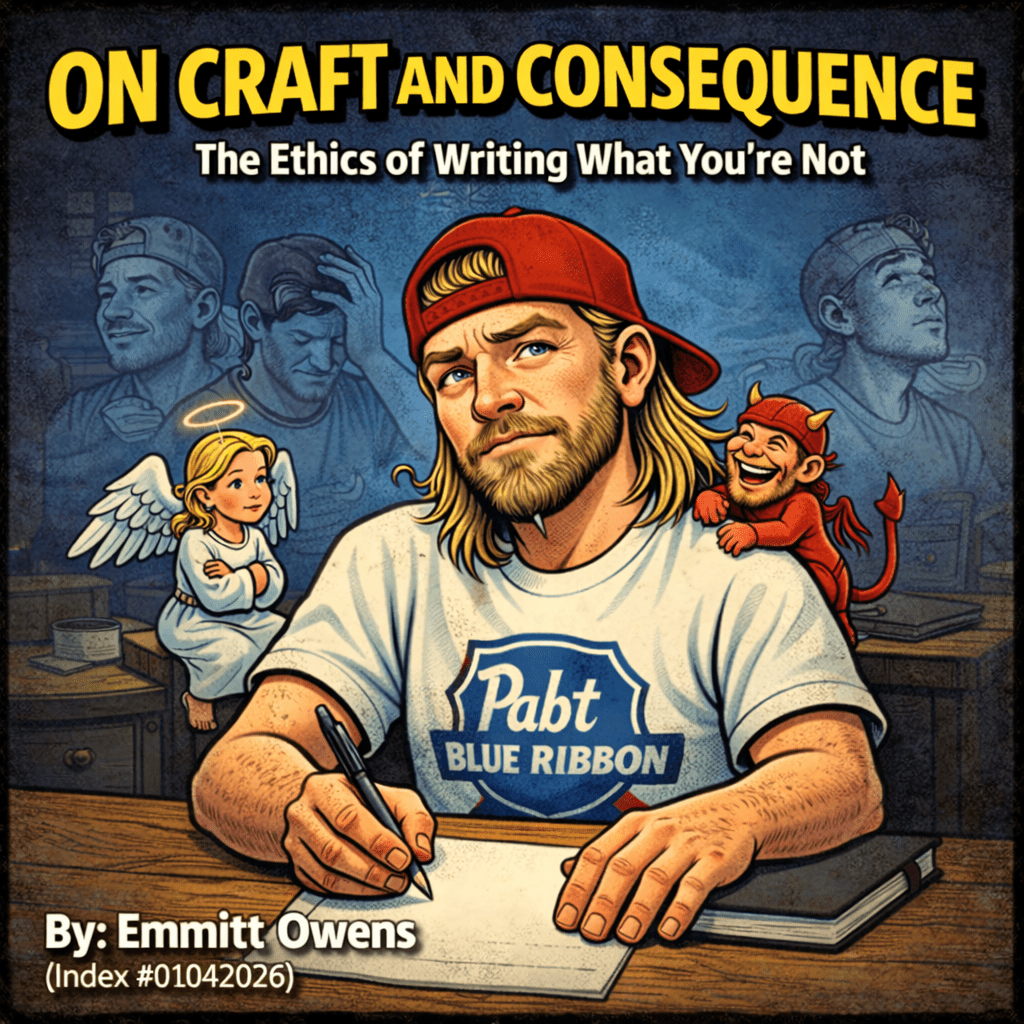
“On Craft and Consequence: The Ethics of Writing What You’re Not”
An Essay on the Trilogy: Red Flags, Red Lights / SEEN / Exhale
By: Emmitt Owens
(Index #01042026)
I. Why These Three Pieces Exist Together
I didn’t set out to write a trilogy. I set out to process a moment of confusion—a miscommunication so minor it barely registered as conflict. A woman thought I was moving too fast when I suggested lunch. I wasn’t. I moved on. That became “Red Flags, Red Lights.”
But the piece didn’t end cleanly. At the very end, I wrote: “She’s not a prophet—she’s just used to desperate dudes. That ain’t me.”
And as soon as I wrote it, a voice whispered back: “But what if it is?”
That intrusive thought became “SEEN.” After writing it, I felt so contaminated that I needed to cleanse myself. That became “Exhale.”
These three pieces aren’t a linear progression—they’re a psychological excavation:
1. Red Flags, Red Lights: The experience (what happened + a flicker of self-doubt)
2. SEEN: The intrusive thought given form (what if I am the thing she feared?)
3. Exhale: The correction (no, I’m not that—but I still need to understand who I am)
Together, they explore miscommunication, projection, and the self-protective distances we call wisdom. More than that, they map the space between who I am and who I fear I might be.
Writing is power. And power, wielded carelessly, becomes harm.
II. On Creating “SEEN”: The Intrusive Thought Given Form
Let me be clear: I am not the character in “SEEN.”
But for a brief moment, I wondered if I could be.
That horrible little statement at the end of “Red Flags, Red Lights”—”That ain’t me”—carried an unspoken question: But what if it is? The woman who turned down my taco invitation acted like I might be dangerous. And for just a second, I wondered: What does she see that I don’t?
I didn’t write “SEEN” to understand her perspective or critique toxic masculinity from a distance. I wrote it to disprove my own negative self-image. I needed to put on the mask and see if it fit.
So I built the character with everything I had: multisyllabic schemes, internal rhymes, rhythmic precision. I made them spiral from relatable frustration (being left on read) to genuinely unhinged behavior (catfishing, fake Yelp reviews, burning themselves trying to cast hexes).
The character uses “her” because my inciting incident involved a woman. But this psychology isn’t gendered. I’ve seen this same pattern—rejection turned into resentment, ego protection spiraling into harassment—in people of all genders. The target changes (ex-boyfriends, former friends, colleagues, romantic interests), but the formula remains: Rejection → Ego protection → Resentment → Justification → Escalation. Anyone can follow it if they refuse to interrupt the cycle.
I needed to map the entire descent to understand where I stood in relation to it.
Here’s what scared me: The psychology never stopped feeling possible. Not because I’m capable of that behavior, but because the formula is disturbingly simple.
When I finished, I felt horrible—not guilty, but contaminated. I’d channeled something toxic and it left residue. I laughed at the absurdity (hating the number 8, declaring war on Trader Joe’s), but I also felt sick because I’d written it so well it felt real. I’d given a monster my voice. The piece made me feel like it was spoken to me, not by me.
That’s when I knew I needed “Exhale”—not to defend myself to readers, but to myself.
“SEEN” is an intrusive thought given form. I wrote it to prove I’m not that person. But the fact that I could write them convincingly is what haunts me. If I can write toxicity this well, I understand it. And if I understand it, how far am I from it?
III. The Technical Craft of Empathy—and Its Dangers
All three pieces use the same technical foundation: multisyllabic rhyme schemes, internal rhymes and assonance, rhythmic variation matching emotional intensity, vivid imagery, and first-person immediacy.
The same tools that make “Red Flags, Red Lights” funny also make “SEEN” disturbing. Technique is neutral. A surgeon’s scalpel can save a life or take one. The skill is identical. Intent is everything.
I knew I was walking a tightrope. The character had to be real enough that I could test whether I recognized myself in them. But the piece also had to critique that mindset, not celebrate it.
The escalation is deliberate—designed to make you (and me) ask: “When did this become too far? At what point did I stop nodding along?” The line between “frustrated” and “dangerous” is a gradient, not a cliff. I needed to write the entire spectrum to know where I stood.
But here’s the risk: Not everyone will read it critically. Someone will read “SEEN” and think, “Finally, someone gets it.” They’ll miss the escalation, skip the author’s note, and focus only on the parts that validate their resentment.
I can’t control that. But I’m responsible for knowing it’s possible.
IV. Writing as Outlet: Healthy vs. Harmful
Writing has always been how I process the world—how I make sense of confusion, examine emotions, resolve contradictions.
But writing serves two opposite functions:
1. Metabolization: You take something painful or complicated and transform it into something you can examine, understand, and release.
2. Amplification: You take something toxic and give it structure, polish, and permanence—reinforcing it instead of interrogating it.
Both require diving deep. Both demand honesty and skill. But one is exorcism. The other is invocation.
“Red Flags, Red Lights” is metabolization. I turned minor social friction into something I could laugh about. The writing clarified my stance: I’m not chasing anyone. The miscommunication wasn’t a wound—just noise. But that piece ended with a flicker of doubt. And that doubt needed its own space.
“SEEN” is complicated. I wrote it to test a negative self-perception—to give the intrusive thought “What if she was right to run?” a complete voice and see if I recognized myself in it. In that sense, it’s metabolization: externalizing internal doubt so I can examine it from outside.
But it’s also dangerous. Giving that voice technical skill and visceral detail made it compelling. Made it sound true. And compelling language lodges itself in minds—including my own.
I tried to maintain critical distance by making the escalation absurd, including self-awareness that goes nowhere, and ending with a confession that undercuts sympathy. But even with all that, writing “SEEN” left me emotionally compromised. I laughed at the absurdity—because people really do dumb shit like that when they can’t process rejection—but I also felt sick.
“Exhale” is cleansing. I needed to ask uncomfortable questions: Am I protecting my peace or hiding from connection? Is my self-sufficiency strength or fear? I don’t answer those questions because I don’t have answers yet. But asking them—putting them into language—is the work.
More importantly, “Exhale” says: I am not the character in “SEEN.” I am the character in “Red Flags, Red Lights” and “Exhale.” That other person was born from a negative perspective I needed to explore and dismantle.
V. The Reader’s Role—and My Limits
I can’t control how you read this.
I can explain that “SEEN” came from an intrusive thought, not lived experience. I can structure the escalation to make toxicity obvious. I can write this entire essay. Someone will still misread it.
Someone will feel validated by “SEEN.” Someone will think “Red Flags” endorses emotional unavailability. Someone will call “Exhale” performative.
I can’t stop that. But I can be clear about intent:
“Red Flags, Red Lights” isn’t about paranoid women. It’s about miscommunication—how the same interaction produces completely different understandings. And it contains a seed of self-doubt I couldn’t ignore.
“SEEN” isn’t an instruction manual. It’s an intrusive thought given complete form—me asking “What if I am the thing she feared?” and writing toward the answer. The character says “her” because my experience involved a woman, but this psychology isn’t gendered. I’ve witnessed this same toxic pattern—rejection turned into obsessive resentment—across all genders. The pronouns change. The pathology doesn’t.
“Exhale” isn’t moral superiority. It’s admitting I don’t have answers and asking uncomfortable questions. It’s also declaring: I really am the character in “Red Flags” and “Exhale.” “SEEN” was just a detour through doubt.
What I can control is honesty about process. “SEEN” made me feel horrible and made me laugh—that dual response told me I’d written something psychologically accurate. And psychological accuracy, when applied to toxicity, is powerful and dangerous.
VI. What Writing Reveals—and What It Risks
These three pieces demonstrate range: humor, darkness, vulnerability—all equally technical. I can inhabit voices that aren’t mine, perspectives born from self-doubt rather than experience. That’s a craft.
But craft without intent is performance. And performance without responsibility is harmful.
I wrote “SEEN” because I had an intrusive thought I couldn’t shake. I gave it my full skill to see if the mask fit. It didn’t. But in proving that, I created something that could—if misread—validate the very behavior it exposes.
That’s the risk of writing. Better craft means more dangerous work if wielded irresponsibly.
Here’s what I’ve learned:
1. Writing toxic characters—even from self-doubt—requires discipline. You must inhabit a mindset without endorsing it. Write it convincingly enough to take seriously, but not so seductively it becomes aspirational.
2. Intent doesn’t erase impact. I can explain “SEEN” was born from intrusive thoughts. If someone feels validated anyway, my intent doesn’t matter. I still gave them language.
3. The same skills that create empathy can create harm. Multisyllabic rhymes don’t care about morality. Vivid imagery works equally well for toxicity and tenderness. Craft is neutral. What you build isn’t.
4. Writing is exorcism—but only if you put the demon down. I wrote “SEEN” to test negative self-image. But I didn’t stay there. “Exhale” reminds everyone that understanding something doesn’t mean embodying it.
5. Self-awareness without action is just performance. “Exhale” doesn’t absolve me. Asking hard questions doesn’t mean answering them or changing them.
6. Intrusive thoughts need examination, not indulgence. That defensive line—”That ain’t me”—could have stayed throwaway. But I had to explore it fully. That exploration became “SEEN.” The relief of realizing I’m not that character became “Exhale.”
VII. Conclusion: The Pen as Weapon and Mirror
I created these three pieces to understand the spaces between people and the space between who I am and who I don’t want to be. Writing can close those spaces or widen them, depending on what you’re reaching for.
I reached for clarity, honesty, and self-examination. But I also reached for craft. And craft, unchecked, can make anything sound true.
The character in “SEEN” is entirely fictional—born from negative self-perception I needed to dismantle. But they’re disturbingly believable because I gave them everything: technical skill, psychological accuracy, emotional intensity. I made them real enough to scare myself.
That’s the point. If you’re examining your worst fears about yourself, you must take them seriously. Half-hearted writing teaches nothing. But once you’ve written them—give them voice, form, rhythm—you have responsibilities:
To yourself: Don’t believe the character just because I wrote them well.
To readers: Make your intent clear, knowing some will misread anyway.
To the work: Let it be uncomfortable, imperfect, honest.
To the woman in “Red Flags, Red Lights”: You weren’t running from me specifically. You were protecting yourself from possibility. I get it.
To anyone who sees themselves in “SEEN”: That discomfort? Sit with it. Don’t dismiss or rationalize it. The character was born from my self-doubt and uses “her” because of my specific situation, but if you recognize yourself—regardless of your gender or who you’ve directed this energy toward—that’s information worth having. This pattern isn’t exclusive to men or women. It’s exclusive to people who refuse to process rejection in healthy ways.
To anyone reading “Exhale” and nodding: Don’t let self-awareness substitute for change. Asking questions is the first step, not the finish line.
To myself: You’re not the person in “SEEN.” You proved that. But you’re not absolved of your own patterns just because you’re not toxic. Keep asking hard questions. Keep writing honestly. Remember every word is a choice.
Language can heal or harm. Build or destroy. Connect or isolate. It can also help you understand yourself—even the parts you fear might exist.
I’ve used it here to do all of that.
What you do with it now is up to you.
— Emmitt Owens
January 4, 2026
 TumbleDweeeb
Leave a comment