
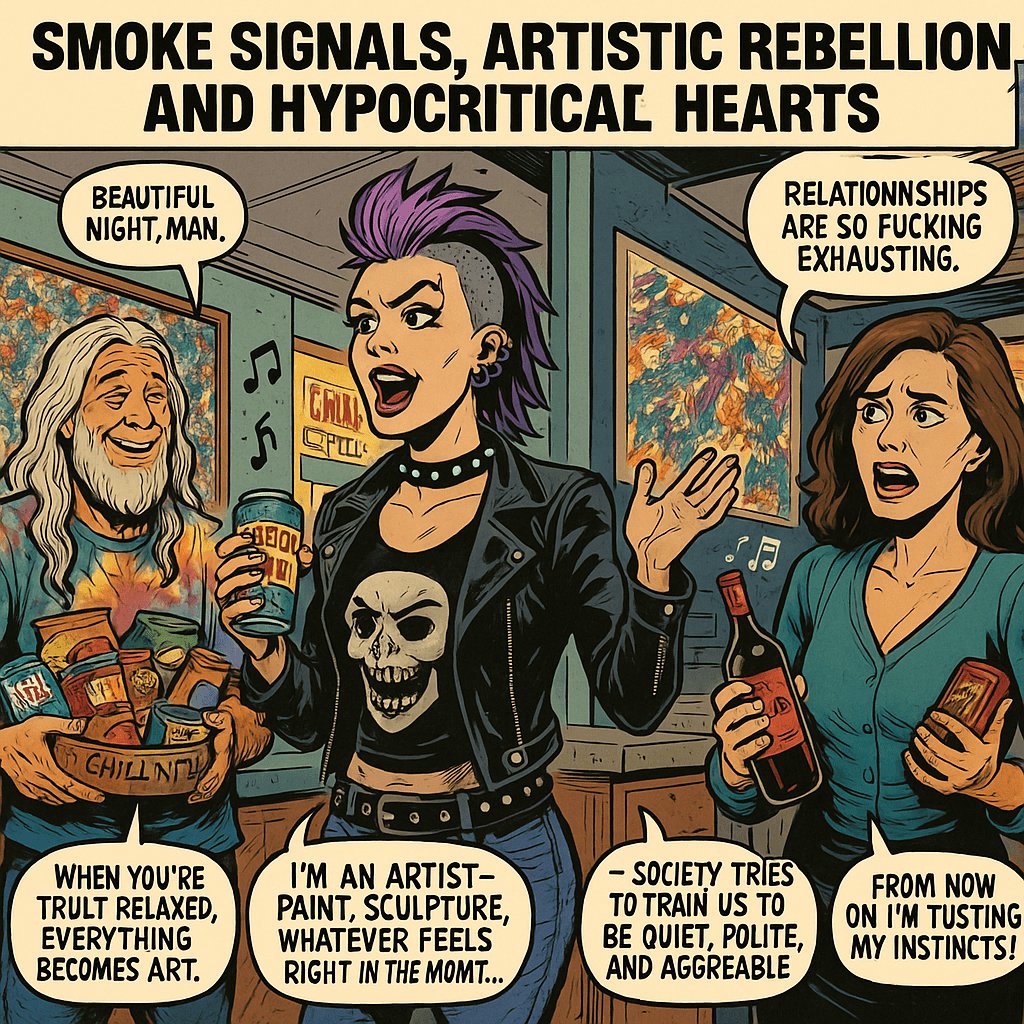
Smoke Signals, Artistic Rebellion, and Hypocritical Hearts
Saturday night at Chill n’Fill had that restless energy of a weekend in full swing, where people emerged from their weekly routines ready to embrace whatever chaos the night might offer. Behind me, tonight’s painting had appeared as Jackson Pollock’s “Number 1, 1950 (Lavender Mist)”—all those wild, chaotic splatters of paint creating something beautiful out of apparent disorder. The radio was playing some mellow reggae that set a distinctly laid-back vibe for whatever the evening had in store.
My first memorable customer of the night embodied that chill energy perfectly. He shuffled through the automatic doors with the unhurried pace of someone who’d made peace with time moving at whatever speed it chose. Long graying hair, tie-dyed shirt that had seen better decades, and the kind of perpetual smile that suggested he’d found the secret to cosmic contentment somewhere around 1972 and never looked back.
“Beautiful night, man,” he said, his voice carrying that distinctive raspy quality of someone who’d spent considerable time appreciating herbal relaxation. “Really beautiful night.”
“It is that,” I agreed, watching him drift toward our snack section with the purposeful aimlessness of someone following an internal compass that pointed toward munchies.
He selected an impressive array of items: several bags of chips, some cookies, candy bars, and what appeared to be enough beverages to hydrate a small music festival. As he approached the counter, he began humming something that sounded vaguely familiar.
“You know,” he said, setting down his haul with careful precision, “there’s this song, ‘Up in Smoke,’ that really captures the essence of, you know, the whole experience. The freedom, the peace, the way everything just flows when you’re in that perfect space.”
As if the radio had been listening to our conversation, it smoothly transitioned from the mellow reggae into the opening notes of Cheech and Chong’s “Up in Smoke”, that distinctive laid-back rhythm that perfectly matched his cosmic energy.
He stopped mid-reach for his wallet and stared at the radio with genuine amazement. “Whoa, man. How’d you do that? That’s the song I’m talking about. Are you a magician, man?”
“I wish I could take credit,” I said with a grin, “but our radio has a mind of its own. It seems to know exactly what people need to hear.”
“That’s beautiful, man,” he said, swaying slightly to the music. “Like the universe is speaking through your sound system. Everything really is connected.”
“I can imagine,” I replied, scanning his items while he continued his philosophical musings.
“It’s like, when you’re truly relaxed, truly in tune with the universe, everything becomes art, man. The way the light hits the trees, the way conversation flows, even the way snack food tastes—it’s all connected to this greater cosmic harmony.”
“Music, food, friendship, nature—it’s all one big beautiful tapestry when you’re viewing it from the right perspective,” he continued, his eyes taking on that slightly unfocused quality of someone contemplating deep universal truths. “Some people spend their whole lives stressed about stuff that doesn’t matter, but once you find that peace, that center, everything just makes sense.”
“Sounds like you’ve found your center,” I observed.
“Oh yeah, man. Found it years ago and never let it go. Life’s too short to spend it uptight about things you can’t control. Better to just flow with it, appreciate the beauty, and spread good vibes wherever you go.”
He paid for his supplies and headed toward the door, then turned back with that peaceful smile. “Keep spreading the good energy, you know? The world needs more people who understand that it’s all about love and understanding.”
As he drifted out into the night, presumably to continue his cosmic communion with the universe, the radio shifted to something with considerably more edge—The Sex Pistols’ “Anarchy in the U.K.” with its aggressive, rebellious energy that announced the arrival of a completely different type of customer.
The automatic doors burst open to reveal a woman in her twenties with purple hair, multiple piercings, and clothing that looked like it had been assembled by someone who’d declared war on conventional fashion. She moved through the store with the confident swagger of someone who’d turned not giving a damn into a fine art form.
“Holy shit, this place is exactly what I needed,” she announced to no one in particular, her voice carrying the kind of unfiltered enthusiasm that suggested she’d decided to live her life completely uncensored. “I’ve been driving for three fucking hours looking for somewhere that felt real, and this dive with the giant winking bear outside is perfect. That punk rock polar bear with the green mohawk and trenchcoat? That’s the kind of artistic statement I can get behind—twenty feet of ‘fuck you’ to anyone who thinks art should be polite and pretty.”
She grabbed an energy drink and what appeared to be the most aggressive-looking candy bar we had, something with packaging that screamed “extreme” in neon colors.
“You know what I love about gas stations?” she continued, approaching the counter with the energy of someone delivering a manifesto. “They’re honest. No pretense, no bullshit about being something they’re not. Just fuel, snacks, and people being exactly who they are without apologizing for it.”
“That’s one way to look at it,” I said, genuinely intrigued by her perspective.
“Damn right it is,” she replied with conviction. “I’m so tired of everyone trying to be polite and appropriate all the time. Like, why can’t we just say what we mean? Why does everything have to be filtered through layers of social fucking courtesy?”
She gestured broadly, warming to her theme. “I’m an artist—paint, sculpture, whatever feels right in the moment… and my whole philosophy is about raw, unfiltered expression. No censorship, no worrying about what people think, just pure creative honesty.”
“What kind of art do you make?” I asked.
“The kind that makes people uncomfortable,” she grinned. “Big, messy, aggressive pieces that don’t apologize for taking up space. Lots of bright colors, sharp edges, and text that says exactly what I’m thinking without any diplomatic bullshit. If art isn’t pushing boundaries and making people question their comfort zones, what’s the fucking point?”
“Speaking of boundary-pushing art,” I said, “Bob—our owner—made that punk bear you noticed outside entirely from repurposed materials. The green mohawk is actually a dust broom he dyed, the trenchcoat is black-out curtains he got on clearance from Walmart, and all those piercings are plastic bracelets from Dollar General that he spray-painted gold. Even the winking eye is a vintage trash can lid stamped ‘Cheinco 1957’ that he found somewhere.”
“Are you fucking kidding me?” she exclaimed, her eyes lighting up with genuine artistic appreciation. “That’s exactly what I’m talking about! Taking everyday garbage and turning it into a statement piece. That’s punk rock art at its finest—zero budget, maximum impact, and completely unapologetic about what it is.”
Behind me, Pollock’s chaotic masterpiece seemed to nod in approval of her artistic rebellion.
“Society tries to train us to be quiet, polite, and agreeable, but that’s just another form of control,” she continued. “Real freedom is saying ‘fuck it’ to all those expectations and creating something authentic, even if it pisses people off. Especially if it pisses people off.”
She paid for her items and headed toward the door, then turned back with a wild grin. “Keep questioning everything, and never let anyone tell you to tone it down. The world needs more chaos and less politeness.”
As she roared away in what sounded like a car with serious exhaust issues, the radio seemed to sense another shift in energy and transitioned to Alanis Morissette’s “You Oughta Know”—that raw, emotionally charged anthem of betrayal and rage that suggested my next memorable customer would bring psychological complications rather than philosophical declarations.
She entered like someone walking into a soap opera—mid-thirties, well-dressed, but carrying herself with the tense energy of someone whose internal emotional life was significantly more complicated than her polished exterior suggested. She selected a bottle of wine and some chocolate with the practiced efficiency of someone who’d made these particular purchases before.
“Relationships are so fucking exhausting,” she announced as she approached the counter, her voice carrying a mix of frustration and resignation. “Like, you try to be a good person, you try to be loyal and trustworthy, and then you find out the person you’re with is just playing games the whole time.”
“Rough night?” I asked.
“Rough life,” she replied with a bitter laugh. “My boyfriend has been accusing me of cheating for months—getting jealous about every conversation I have with other guys, questioning where I’ve been, making me feel guilty for having male friends and … the whole time he’s been doing this, he’s been sleeping with his ex-girlfriend.”
I winced sympathetically. “That’s awful.”
“Right? Like, the level of psychological manipulation it takes to act jealous and possessive while you’re the one actually betraying the relationship, that’s got to be some kind of mental illness. Who does that kind of dumb shit?”
She shook her head with the exhausted frustration of someone who’d been gaslighted for months. “He made me feel crazy for having normal friendships while he was literally sneaking around behind my back. The projection, the hypocrisy … it’s like he was accusing me of his own crimes to throw me off the scent.”
“How did you find out?” I asked.
“His ex-girlfriend told me,” she said with a sound that was half-laugh, half-sob. “Apparently she felt guilty about it and thought I deserved to know. Can you imagine? The other woman had more integrity than my actual boyfriend.”
She stared at her wine bottle like it contained answers to the mysteries of human psychology. “What kind of person acts jealous and controlling … while they’re the one cheating? It’s like some twisted form of psychological warfare, making your victim feel guilty for the crimes you’re committing.”
“Sounds like classic projection,” I offered. “People often accuse others of what they’re doing themselves.”
“Exactly! But the mental gymnastics required to pull that off—to genuinely act hurt and betrayed while you’re the one doing the betraying—that’s next-level psychological dysfunction. Like, you’d have to completely disconnect from reality to sustain that kind of performance.”
She gathered her emotional recovery supplies and headed toward the door, then paused. “The worst part is, I actually started questioning myself. Started wondering if I was being inappropriate with my friends, if I was somehow giving him reason to be suspicious. He had me doubting my own judgment about my own behavior.”
“That’s what manipulators do,” I said. “They make you question your own reality.”
“Never again,” she said with quiet determination. “From now on, I’m trusting my instincts. If someone’s accusing me of shit I’m not doing while acting shady themselves… I’m out, I’ll leave it right then and there. Life’s too short to date people who need therapy but refuse to get it.”
As she left to begin whatever healing process awaited her, I looked up at Pollock’s chaotic masterpiece and reflected on how the evening had covered the full spectrum of human coping mechanisms, from cosmic acceptance to rebellious authenticity to painful awakening from psychological manipulation.
I pulled out my phone to text my roommate: “Evan, OMG Tonight’s emotional journey: Chill customer channeling Tommy Chong vibes about ‘Up in Smoke’ and finding cosmic peace through herbal appreciation (very zen). Artist customer living completely uncensored, creating aggressive art that doesn’t apologize for taking up space (authentically rebellious). A woman discovering her jealous boyfriend was projecting his own cheating onto her (psychological warfare at its worst). Pollock’s chaotic splatters perfectly captured the beautiful mess of human nature. Sometimes people find peace, sometimes they embrace chaos, and sometimes they just need to escape toxicity.”
It’s been another night at Chill n’Fill, where customer service meant witnessing the full range of human responses to life’s complications—from blissful detachment to fierce authenticity to painful but necessary awakening. The radio played on, Pollock’s colors swirled in eternal creative chaos, and I settled in to see what other slices of the human experience might wander through our doors.

 TumbleDweeeb
Leave a reply to patc44 Cancel reply