
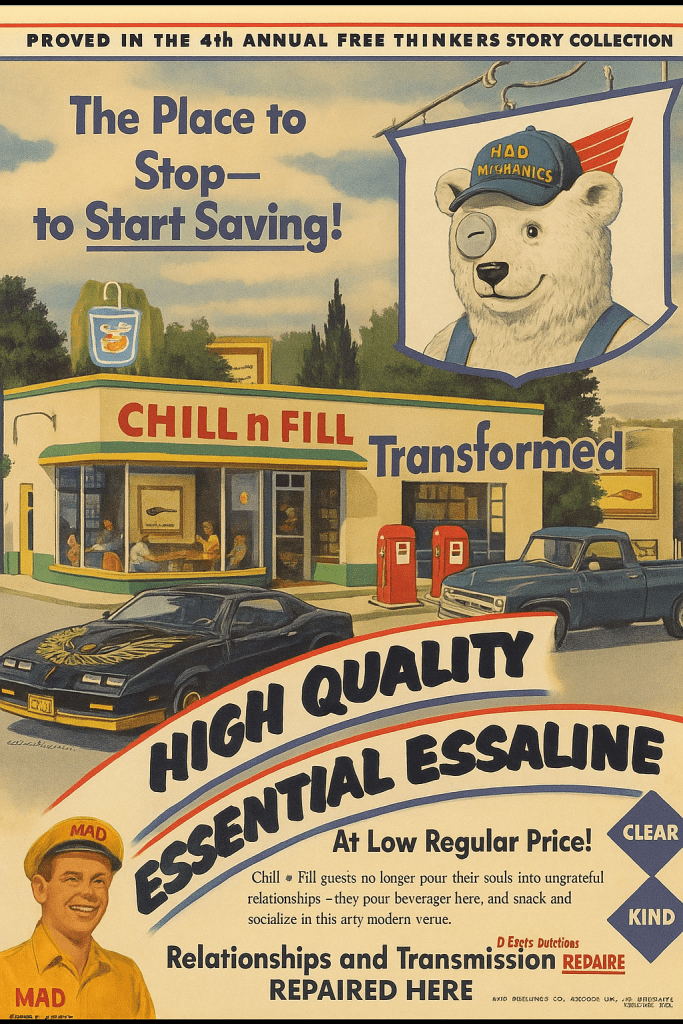
Mad Mechanics and Midnight Revelations
Saturday night at Chill n’Fill was buzzing with an unusual energy, the kind that comes when change is stirring in a small town. Behind me, tonight’s painting had appeared as René Magritte’s “The Treachery of Images” from 1929—that famous pipe with “This is not a pipe” written beneath it, perfectly capturing the theme of things not being what they appear to be.
Outside, Bob’s towering 20-foot polar bear stood dressed as a vintage mechanic, complete with grease-stained overalls made from old tarps, a tool belt fashioned from rope and actual wrenches, and a backwards baseball cap that read “Mad Mechanics” in Bob’s hand-painted lettering. The “Cheinco 1957” trash can lid that served as the bear’s winking eye seemed to gleam with automotive pride.
Through the window, I could see Bob himself head-banging enthusiastically to the music, his bald head and passionate intensity reminding me of a modern-day Matt Pinfield, the legendary MTV DJ and television host known for his encyclopedic music knowledge. The old Sentinel radio model IU-355P was playing Primer 55’s “Super Freak Love,” its ghostly mechanism apparently setting a rebellious, unapologetic mood for whatever stories the night would bring.
The first memorable customer of the night entered with the shell-shocked expression of someone whose entire understanding of friendship had just been turned upside down. She was a woman in her thirties, well-dressed but moving with the careful precision of someone who’d recently learned that solid ground could shift without warning.
As she browsed, the radio shifted to Def Leppard’s “Pour Some Sugar on Me,” the defiant anthem seeming to underscore her newfound determination to stop sweetening bitter situations for ungrateful people.
She selected a bottle of wine and some comfort food with the practiced efficiency of someone who’d had to process difficult truths before.
“You know what’s funny about loyalty?” she announced as she approached the counter, her voice carrying the bitter clarity of recent revelation. “I always thought it was this beautiful, pure thing. Turns out some people aren’t loyal to you—they’re just loyal to their need of you.”
“That sounds like it comes from personal experience,” I said carefully.
“Twenty years of friendship, down the drain,” she replied, setting her items on the counter with deliberate calm. “My best friend since college. I thought we had this unbreakable bond, you know? Through marriages, divorces, career changes, family drama—I was always there.”
She paused, staring at her wine bottle as if it held answers. “But then I started setting boundaries. Started saying no to things that weren’t good for me. Started prioritizing my own mental health over being her emotional dumping ground.”
“And that changed things?” I prompted.
“Like a switch flipped,” she said with a hollow laugh. “Suddenly I was ‘selfish’ and ‘not the same person.’ Suddenly twenty years of history meant nothing because I wasn’t meeting her needs anymore. That’s when I realized—she was never loyal to me as a person. She was loyal to what I provided for her.”
She paid for her items with the resigned grace of someone who’d learned a painful but necessary lesson. “I even took my car to that new place, Mad Mechanics, instead of her brother’s shop. Small gesture, but it felt like taking back a piece of my life. Callen, the owner, actually listened when I explained what was wrong instead of just assuming I didn’t know anything about cars.”
“Sometimes the end of something toxic is actually the beginning of something better,” I offered.
“Exactly. I’m learning to tell the difference between people who love me and people who love what I do for them. Mad Mechanics fixed my transmission and treated me with respect. My ‘best friend’ couldn’t even do that after two decades.”
The second customer burst through the doors with the frazzled energy of someone juggling too many responsibilities and not enough hours in the day. He was a man in his early forties, wearing work clothes that suggested he’d come straight from a job site, and carrying the weight of someone who felt responsible for fixing everything and everyone.
The radio switched to Twisted Sister’s “We’re Not Gonna Take It,” the rebellious cry perfectly matching his fed-up demeanor as he grabbed an energy drink, some aspirin, and what appeared to be dinner from our limited selection of microwaveable meals.
“You ever feel like you’re living in a house that’s on fire, but everyone keeps acting like everything’s normal?” he asked as he approached the counter, his voice tight with suppressed frustration.
“That’s… a very specific metaphor,” I replied.
“My family,” he explained, running a hand through his hair. “My wife’s drinking is getting worse, my teenage son is failing school and staying out all night, my daughter won’t eat anything and spends all day crying in her room. But whenever I try to address any of it, I’m the problem. I’m ‘overreacting’ or ‘being dramatic.’”
He set his items down with the careful control of someone who was barely holding it together. “I feel like I’m going crazy. Like I’m the only one who can see that our house is burning down while everyone else is just… rearranging furniture.”
“That sounds incredibly isolating,” I said.
“It is. And the worst part? I’m angry all the time now. Angry and anxious and exhausted. But when I express that, suddenly I’m the bad guy. Like having a normal human response to an insane situation makes me the villain.”
He opened his energy drink and took a long sip. “Even something as simple as getting my truck fixed became a whole thing. My wife wanted me to take it to her cousin’s shop, but that guy’s been jerking us around for months. So I went to Mad Mechanics instead… that new place across the street. Fixed it right the first time, fair price, no drama. But she acted like I’d betrayed the family by not supporting her cousin’s incompetence.”
“You can’t set yourself on fire to keep other people warm,” I said.
“Right? I keep telling myself that my anger is valid. That being distressed about watching your family fall apart is a normal reaction. But man, it’s hard to remember that when everyone’s telling you you’re the problem.”
The third customer entered with the purposeful stride of someone who’d recently made some major life changes and was still adjusting to the freedom that came with them. She was a woman in her late twenties, dressed in casual clothes that suggested she’d finally escaped from something that required a more formal uniform.
Whitesnake’s “Here I Go Again” began playing as she browsed, the song’s themes of independence and self-determination providing the perfect soundtrack for her newfound liberation as she selected a bottle of champagne and some fancy chocolates—clearly celebrating something.
“I quit my job today,” she announced with barely contained excitement as she approached the counter. “After five years of being told I was ‘difficult’ and ‘not a team player’ for pointing out that our company was screwing over clients.”
“Congratulations?” I said, unsure whether this was good news or not.
“Oh, it’s definitely congratulations,” she grinned. “I finally realized that what they called ‘being difficult’ was actually just having integrity. What they called ‘not being a team player’ was refusing to participate in unethical practices.”
She set her celebration supplies on the counter with the satisfaction of someone who’d made peace with a difficult decision. “For years, I thought maybe I was the problem. Maybe I was too rigid, too principled, too unwilling to ‘go with the flow.’ But you know what the real issue was?”
“What’s that?”
“I was a small and temporary instrument of something vast and infinite—my own conscience,” she said, paraphrasing something that had clearly resonated with her. “They needed me to abandon my principles to serve their profit margins. When I wouldn’t, suddenly I was the problem.”
She pulled out her keys, which had a new keychain from Mad Mechanics. “Even finding someone honest to fix my car became this whole revelation. I’d been going to the same shop for years because it was ‘convenient,’ even though they always found mysterious problems that cost a fortune. Finally tried Mad Mechanics, and Callen was completely transparent about what needed fixing and what could wait. It was like a metaphor for my whole life—I’d been accepting dishonesty as normal for so long that honesty felt revolutionary.”
“Sometimes it takes stepping away to see how toxic something was,” I observed.
“Exactly. Now I’m freelancing, setting my own standards, working with people who value integrity over compliance. It’s scary but so much better than slowly dying inside.”
The final customer of the evening entered with the cautious confidence of someone who was still learning to take up space in the world. She was a woman in her mid-twenties, carrying herself with the careful posture of someone who’d spent years making herself smaller and was now practicing being her full size.
As she moved through the store, Bon Jovi’s “Livin’ on a Prayer” filled the air, its message of holding on and taking control resonating with her journey as she selected items deliberately—a nice bottle of wine, some gourmet snacks, fresh flowers from our small display—like someone who was learning to treat herself well.
“I’m having a dinner party,” she announced as she approached the counter, her voice carrying a note of wonder like this was a revolutionary act. “Just me, cooking for people I actually like, in my own apartment, without worrying about whether everyone’s having the perfect time.”
“That sounds lovely,” I said.
“It is. For the first time in my life, I’m not frantically trying to anticipate everyone’s needs or manage their emotions or make sure nobody feels left out or uncomfortable.” She smiled with the relief of someone who’d put down a heavy burden. “I used to exhaust myself trying to be everything to everyone. But I finally realized that most people weren’t loyal to me—they were loyal to how I made them feel about themselves.”
She arranged her purchases thoughtfully. “The moment I stopped being available for everyone else’s emotional needs 24/7, I found out who actually cared about me as a person versus who just needed me as their unpaid therapist.”
“That must have been eye-opening,” I said.
“Painful but necessary. Like finally admitting that the body—my body, my life, my energy—was just a small and temporary instrument of something vaster and infinite, instead of existing solely to serve other people’s comfort.” She paused, then laughed. “Sorry, I’ve been reading a lot of philosophy lately.”
“No need to apologize. Sounds like you’re in a good place.”
“I am. Even something as simple as getting my car serviced became part of the journey. I used to go to whatever shop my friends recommended, even when they treated me poorly, because I didn’t want to seem ungrateful. Finally went to Mad Mechanics because I was tired of being condescended to. Callen explained everything clearly, respected my questions, charged fairly. It was such a small thing, but it felt like validation that I deserved to be treated well.”
She gathered her dinner party supplies with the satisfaction of someone who’d learned to value herself. “Tonight’s guests are people who see me as a full human being, not just a supporting character in their stories. It’s amazing how much energy you have for genuine relationships when you stop pouring it into bottomless pits of neediness.”
As the evening wound down, I reflected on how each customer’s story had somehow connected to Mad Mechanics, this new business that seemed to represent something more than just car repair—it was a symbol of finding authentic service in a world full of people who wanted to take advantage of your trust.
I pulled out my phone to text my roommate: “Evan, tonight was all about people discovering the difference between authentic loyalty and conditional need. Four customers, four stories of learning to recognize when someone values you versus when they just value what you provide. Also, Mad Mechanics seems to be winning hearts and minds by treating people with basic human decency—revolutionary concept, apparently. Magritte’s pipe painting perfect backdrop for all the ‘this is not what it appears to be’ revelations. Sometimes the most radical act is simply refusing to accept dysfunction as normal.”
Another night at Chill n’Fill, where customer service meant witnessing people’s journeys from confusion to clarity, from people-pleasing to self-respect, from accepting toxic normal to demanding healthy authentic. The Sentinel radio played on, Magritte’s pipe continued its eternal commentary on the difference between appearance and reality, and I settled in to see what other truths might walk through our doors.
 TumbleDweeeb
Leave a comment