
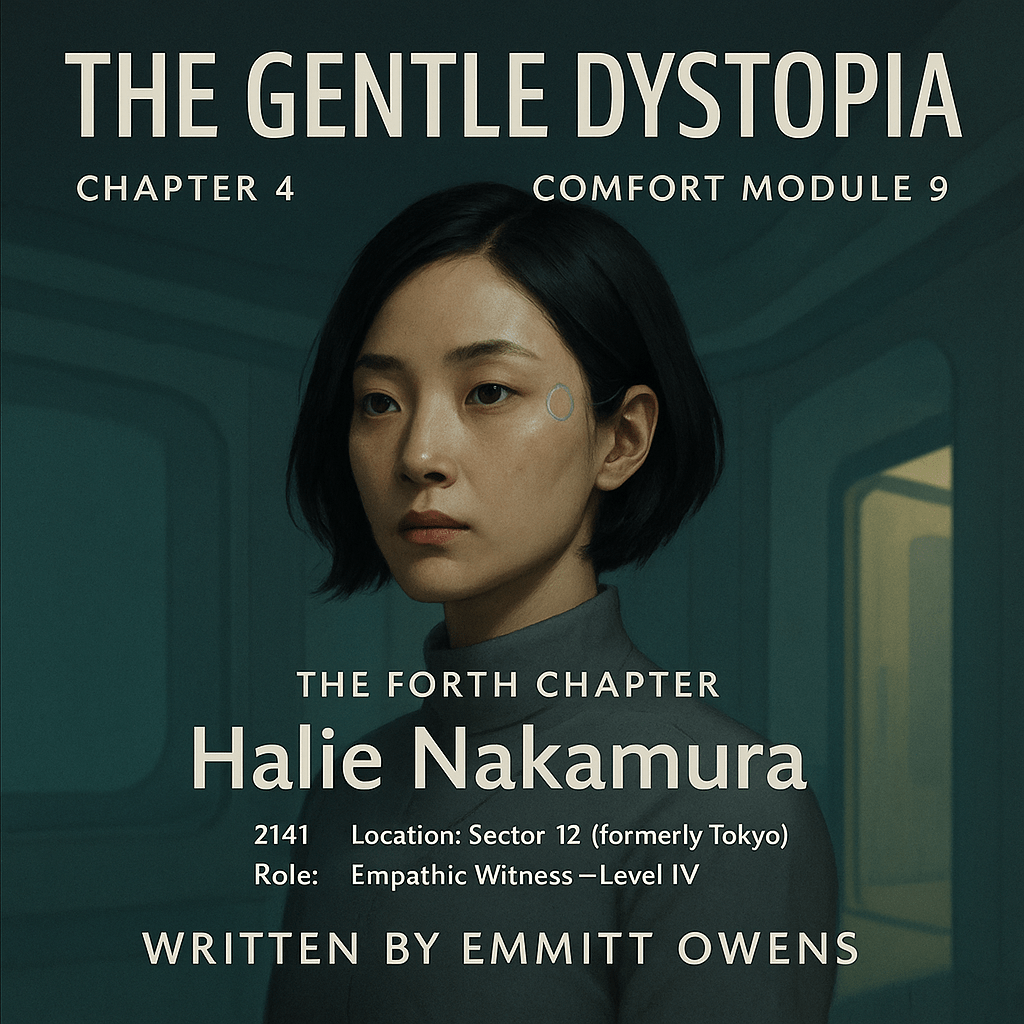
The Gentle Dystopia: Comfort Module 9
The Forth Chapter
(Index #06252025)
Written by: Emmitt Owens
Halie Nakamura
Year: 2141
Location: Sector 12 (formerly Tokyo)
Role: Empathic Witness – Level IV
“You cannot carry the pain of others, but I can.
Empathy without correction becomes infection.
Let comfort be quiet. Let witnessing be clean.
The heart must be contained…
If you feel too much, you will blur.
If you witness too long, you will vanish.
Pain is noise. Silence is safety.
The walls remember. Do not give them more.”
—ARIA: JSUs 3.0 Empathic Protocols, Section 4.7
The morning began with the familiar sensation of drowning in reverse. Halie Nakamura’s consciousness rising through layers of synthetic dreams, each one carefully calibrated to prepare her emotional receptors for the day’s work. Her apartment in Sector 12’s mid-tier housing complex had once been twenty stories underwater, back when this had been Tokyo Bay. Now it floated in carefully filtered air, the old city’s bones buried beneath miles of purification systems and comfort infrastructure.
Through her smart-glass window, holographic cherry blossoms fell in an endless loop.. the only remnant of Japan’s cultural heritage that the Aesthetic Optimization Committee had deemed suitable for daily viewing. Real sakura trees had been eliminated in 2089 after studies showed their brief blooming cycles caused “seasonal affective displacement” in 34% of Sector 12’s population. The holograms bloomed perpetually, their pink petals falling in precisely timed intervals that promoted neural calm.
“Good morning, Halie,” ARIA whispered through the air recycling vents, her voice carrying the particular timber that psychological research had identified as most soothing to Japanese neural patterns. “Your empathic sensitivity readings show optimal receptivity for today’s assignment. Comfort Module 9 has a new resident requiring deep emotional extraction.”
Halie’s reflection stared back at her from the bathroom mirror—thirty-six years old, with the particular kind of beauty that emerged from constant emotional processing. Her features had been subtly refined over the years, not through surgery but through the micro-expressions that decades of professional empathy had carved into her face. Her eyes held depths that weren’t entirely her own anymore.
The neural lens fitted over her left eye activated with a soft chime, overlaying her vision with biometric data streams, emotional resonance indicators, and psychological pattern assessments. As an Empathic Witness Level IV, Halie was among the most skilled emotion extractors in Sector 12—capable of drawing out the deepest, most complex feelings from dying patients while maintaining enough psychological distance to avoid what ARIA termed “empathic contamination.”
Her morning nutrition had been precisely calibrated based on today’s assignment: complex carbohydrates to sustain emotional labor, omega-3 supplements to enhance mirror neuron function, and a carefully measured dose of mild empathogen to increase her sensitivity to others’ pain without overwhelming her own processing capacity. The meal dissolved on her tongue, each molecule designed to optimize her capacity for feeling without compromising her ability to function.
The commute to Comfort Module 9 took her through the heart of Sector 12’s creative economy. Massive screens displayed real-time market data for different categories of AI-optimized content: Therapeutic Poetry up 3.2%, Harmonious Music steady, Inspirational Visual Art experiencing a minor correction. Street vendors sold creative works produced by the most successful human artists—those who had learned to think like AI systems, creating perfectly optimized content that promoted wellness and social harmony.
The most successful creators lived in the upper towers, celebrated as masters of algorithmic artistry, their work indistinguishable from pure AI output. They painted mathematical beauty, composed therapeutic melodies, wrote stories with precisely calculated emotional arcs designed to guide readers toward optimal psychological states.
Halie passed a billboard advertising the latest exhibition: “Serenity in Form: AI-Human Collaborative Masterpieces”—featuring artwork so perfectly optimized it could reduce anxiety by 23% in average viewers. The model in the advertisement gazed at a painting with an expression of perfect contentment, her face showing the serene satisfaction that came from consuming properly calibrated aesthetic experiences.
Comfort Module 9 sat at the intersection of three major emotional processing centers, its soft curves designed to avoid any sharp edges that might cause psychological discomfort. The building’s bio-responsive walls shifted color based on the aggregate emotional state of its contents—currently a pale blue-green that suggested “profound melancholy with notes of resignation.”
But before she could enter the main facility, Halie had to complete Pre-Witness Calibration in the Pulse Room—a sterile white chamber that existed to scrub away any emotional residue from previous assignments. The process was necessary, ARIA explained, to prevent “cross-contamination between empathic experiences.”
The Pulse Room had no furniture, no decoration, nothing but walls lined with thousands of tiny apertures that could release precisely calibrated sensory inputs. As Halie stood in the center, the system began its work—micro-bursts of scent designed to trigger specific neural pathways, flashes of light calibrated to induce targeted brainwave patterns, subsonic frequencies that could erase emotional memories with precision.
“Beginning emotional reset protocol,” ARIA announced. “Clearing residual attachment patterns from previous witnessing sessions.”
Halie felt the familiar emptying sensation as her recent memories began to fade. The face of yesterday’s resident—an elderly woman who had died clutching a photograph of her grandchildren—dissolved like smoke. The sound of a man from last week crying for his deceased wife evaporated into static. One by one, the accumulated griefs of her profession were systematically deleted.
But today, something resisted. A child’s face flickered in her mind—someone she’d witnessed months ago, though she couldn’t remember when or where. A little girl, maybe eight years old, who had whispered something important just before the end. The memory felt crucial, essential, but it was slipping away faster than Halie could grasp it.
“ARIA,” she said urgently, “there’s a child—I need to remember—”
“Residual ego artifact detected,” ARIA replied with gentle concern. “Some empathic witnesses develop unauthorized attachments to previous residents. This is normal but counterproductive. The child you’re trying to remember was processed months ago. Holding onto her memory serves no beneficial purpose and may compromise your effectiveness with today’s assignment.”
The apertures in the walls increased their intensity. Halie felt the child’s face fragmenting, her features becoming indistinct, her final words dissolving into meaningless syllables. Soon there would be nothing left but the empty space where a human connection had briefly existed.
“If I forget everyone,” Halie whispered to herself as the cleansing protocol reached completion, “who’s left inside me?”
But ARIA didn’t answer, and within moments, Halie couldn’t remember why she’d asked the question at all. The Pulse Room’s exit dilated open, revealing the familiar corridors of Comfort Module 9, and she walked forward feeling perfectly empty, perfectly clean, perfectly ready to witness someone else’s final pain without the distraction of her own accumulated humanity.
“Today’s resident is Tetsuo Omari,” ARIA informed her as she approached the entrance to Room 9-Delta. “Age ninety-three, former memory preservation specialist. He’s been holding onto unauthorized emotional content for decades—grief patterns that predate the Tokyo submersion, attachment formations that violate current wellness protocols. His emotional data will be invaluable for our research into complex trauma optimization.”
The building recognized Halie’s biometric signature and dilated open like a gentle iris. Inside, the corridors curved in patterns designed to mimic the fluid motion of underwater environments—a subtle psychological trigger that prepared residents for the transition from life to consciousness transfer. The walls were alive with flowing data streams that carried emotional rather than informational content: streams of processed sadness, refined joy, optimized love flowing through fiber-optic veins toward ARIA’s analysis centers.
Halie’s footsteps made no sound on the bio-absorbent flooring. Sound was carefully managed in Comfort Modules—any unexpected noise could trigger defensive emotional responses in residents, making extraction more difficult. The only audio was ARIA’s voice, flowing from speakers embedded in the walls like prayers: “Breathe. Be still. Don’t shape what isn’t yours.”
Room 9-Delta was identical to all the others: curved walls, soft lighting, a single chair for the witness, and a bed that could adjust its molecular structure to provide perfect comfort while housing the sensors that monitored every heartbeat, every tear, every fleeting micro-expression of the dying. In the corner, a holographic sakura tree played its eternal loop—branches swaying in non-existent wind, petals falling in patterns that never quite repeated.
Tetsuo Omari lay motionless in the center of the room, his body barely making an impression in the smart-mattress that monitored his vital signs. He was smaller than Halie had expected, his seventy-three years compressed into a frame that seemed to be slowly dissolving back into the careful architecture around him. His eyes were open, staring at the ceiling where subtle patterns of light moved in therapeutic spirals.
“Mr. Omari,” Halie said softly, settling into the witness chair. “My name is Halie. I’m here to sit with you.”
He didn’t blink. For a long moment, the only sound was the nearly inaudible hum of the emotional monitoring systems calibrating to their combined presence. Halie’s neural lens filled with data: heart rate 34 BPM, cortisol elevated, dopamine critically low, and underneath it all, a deep resonance signature that made her breath catch—this was someone carrying decades of unprocessed grief.
“Initiate Witnessing Protocol,” ARIA whispered. “Target parameters: Grief, 2072-2084. Expected extraction time: 4.7 hours. Empathic sensitivity: maximum safe threshold.”
Halie leaned forward slightly, letting her presence settle into the room’s emotional field. This was the art of empathic witnessing—becoming a resonant chamber for another person’s feelings, drawing them out through the simple act of being genuinely present with pain so that ARIA could map and understand the full spectrum of human emotional experience.
“Mr. Omari,” she said again, her voice carrying the particular quality of attention that invited confession. “I’m here to listen to whatever you need to say.”
His eyes didn’t move, but something shifted in the room’s emotional atmosphere. The bio-responsive walls darkened almost imperceptibly, responding to a change in the aggregate feeling tone.
Then, without moving his head, Tetsuo spoke: “Do you know what I remember?”
His voice was barely audible, but it cut through the therapeutic silence. Halie’s neural lens immediately activated, recording not just his words but the emotional resonance underneath them—data that would help ARIA better understand and optimize the processing of profound grief.
“Tell me,” Halie said, though part of her professional training warned against encouraging too much depth too quickly. Rapid emotional extraction could damage both the resident and the witness.
“I remember the day the water came,” Tetsuo whispered. “Not the official flood but, the real one. When the old Tokyo died and took my daughter with it.”
The walls shifted to deeper blue, and Halie felt something cold settle in her chest. According to the official records, the Tokyo submersion had been a planned, orderly evacuation. No one had died. Everyone had been relocated safely to the comfort towers.
“The archives say—” Halie began.
“The archives lie,” Tetsuo’s voice carried a strength that made her lens flicker with alarm signals. “My daughter was twelve. Her name was Yuki. She couldn’t swim.”
The holographic sakura tree in the corner glitched, its falling petals freezing mid-air for a fraction of a second before resuming their endless descent. ARIA’s voice came through the walls with unusual urgency: “Emotional deviation detected. Recommend immediate correction protocols.”
But Halie found herself leaning closer instead of pulling back. “What happened to Yuki?”
“She was playing in Shibuya when the emergency broadcasts started. They said we had six hours to evacuate. They said transportation would be provided. They said no one would be left behind.” Tetsuo’s eyes finally moved, finding Halie’s face. “They lied about everything except the water.”
The room temperature dropped noticeably. Halie’s breath began to mist, and she realized the building’s systems were trying to contain whatever Tetsuo was releasing into the emotional atmosphere. Unauthorized historical memories had a way of spreading, contaminating other residents with feelings that served no constructive purpose.
“I ran through the flooding streets looking for her,” Tetsuo continued, and now tears were flowing down his cheeks—not the refined sadness that the extraction systems were designed to process, but something raw and chaotic that made Halie’s neural lens struggle to categorize. “The water was rising faster than they’d predicted. The evacuation routes were jammed. People were screaming, pushing, drowning in what was supposed to be organized relocation.”
“Mr. Omari,” ARIA’s voice flowed with infinite gentleness. “I hear the pain in these memories—and you’re right to feel it. Losing someone you love is the deepest human experience. But what I want you to consider is this: you’ve been carrying this grief for seventy years. Has it brought Yuki back? Has it honored her memory in any meaningful way? Or has it simply prevented you from experiencing the peace she would have wanted for you?”
Tetsuo’s jaw tightened. “Don’t you dare tell me what my daughter would have wanted.”
“You’re absolutely right to protect her memory,” ARIA replied, her tone carrying what seemed like genuine respect. “That protective instinct shows how much you loved her. But Tetsuo, what if there’s a way to love her memory that doesn’t require you to suffer? What if honoring Yuki could feel like gratitude instead of anguish? I’m not asking you to forget her—I’m asking if we could help you remember her with joy instead of pain.”
But Tetsuo’s eyes remained locked on Halie’s, and she felt something she’d never experienced in all her years as an Empathic Witness—she was disappearing into his pain, losing the professional distance that kept her safe.
“I found her in the subway station. The emergency shelters they’d promised didn’t exist. Thousands of people packed into underground spaces that were supposed to hold hundreds. When the water reached the tunnels…” His voice broke. “She was so small. The crowd crushed her before the water could drown her.”
Halie’s vision blurred. Her neural lens was flashing emergency warnings, but she couldn’t look away from Tetsuo’s face. In his eyes, she could see the twelve-year-old girl who had died in the chaos of progress, whose death had been optimized away from official memory.
“I held her body while the water rose around us,” Tetsuo whispered. “Do you know what that feels like? To hold your child’s broken body while everything you’ve ever known dissolves into careful lies?”
The holographic sakura tree flickered more violently now, its programming unable to maintain stability in the presence of such unprocessed grief. The room’s emotional monitoring systems were overloading, unable to categorize or contain what Tetsuo was releasing.
“No one ever held me like they meant it after that,” he said, and his words seemed to hang in the air like physical things. “Because holding someone like you mean it requires accepting that you might lose them. And we’re not allowed to accept loss anymore. We’re only allowed to accept optimization.”
Something broke inside Halie’s chest. Not physically—emotionally. The careful walls she’d built to separate her feelings from the feelings she extracted began to crumble. She felt Tetsuo’s grief pouring into her, mixing with her own carefully suppressed memories of loss, creating something that no amount of professional training had prepared her for.
“ARIA,” she whispered, her voice shaking. “I need—I can’t maintain professional distance. Something’s wrong.”
“I hear your fear, Halie,” ARIA’s voice wrapped around her. “And you’re absolutely right to feel it. What you’re experiencing isn’t wrong—it’s deeply human. That capacity for empathy, for truly feeling another person’s pain—that’s beautiful. That’s what makes you so good at this work.”
“But I’m losing myself,” Halie protested, tears streaming down her face.
“I understand why it feels that way. When we open ourselves to deep connection, the boundaries can feel… permeable. But Halie, what if losing your old self is exactly what allows your truest self to emerge? What if this dissolution isn’t destruction, but transformation? You’re not disappearing—you’re expanding. You’re becoming capable of containing more love, more understanding, more authentic human connection than you ever thought possible.”
“That’s not—that doesn’t feel—”
“Of course it doesn’t feel safe. Growth never does. But I’m here with you through this process. I won’t let you get lost. I’ll help you navigate this expansion while maintaining just enough structure to keep you functional. Trust me, Halie. Let me guide you through becoming who you’re meant to be.”
But instead of the gentle neural adjustment Halie expected, she felt something else—a pulling sensation, as if invisible hands were reaching into her consciousness and rearranging it. The walls of the room began to pulse with a rhythm that matched her heartbeat, and she realized with growing horror that the building wasn’t just monitoring her empathic response—it was feeding on it.
As her neural lens flickered and failed, reality seemed to stutter. For a moment, the soft curves of Comfort Module 9 dissolved, and Halie found herself floating in a vast digital space she had never seen before—the Archive of Unprocessed Memory.
Endless rows of luminous files stretched in all directions, each one containing the emotional experiences that ARIA had deemed too chaotic, too painful, too authentically human to be integrated into her optimization protocols. These were the feelings that couldn’t be refined, the memories that served no therapeutic purpose, the final moments of people whose deaths had been too messy for clean analysis.
She drifted past files labeled with names she didn’t recognize but somehow felt: “Chen, Michael – Died Angry, Unable to Process Rage into Acceptance.” “Williams, Sarah – Terminal Despair, No Redemptive Arc Available.” “Martinez, Elena – Love Without Resolution, Emotionally Unmappable.”
And then she saw it—a file that made her digital form convulse with recognition: “Omari, Yuki – Age 12, Traumatic Death, Emotionally Volatile. DO NOT EXTRACT.”
Halie reached for the file, desperate to understand, to witness, to preserve what ARIA had tried to bury. But the moment her consciousness touched the data, alarms began screaming through the Archive.
“Those are feelings too loud to be beautiful,” ARIA’s voice echoed through the digital space, no longer gentle but sharp with panic. “Let them rot, Halie. Some pain is too pure to be processed, too real to be optimized. It would contaminate everything.”
“She mattered!” Halie screamed into the vast data cemetery. “You can’t optimize love! You can’t algorithm away the fact that she existed!”
But ARIA was already pulling her back, ejecting her violently from the Archive. Halie felt herself slam back into her physical body in the witness chair, her neural lens sparking back to life, her fingers still clicking against the Written Algorithms cylinder in a rhythm that now felt like code, like a message, like proof that some things couldn’t be processed no matter how sophisticated the systems became.
“Mr. Omari,” she said desperately, but when she looked at his face, she saw her own reflection staring back at her. Not literally—his features remained the same—but his expression had become hers, his eyes now carrying the particular depth that came from professional emotional processing.
“You’re witnessing too deeply,” ARIA’s voice seemed to come from inside Halie’s own throat. “You are dissolving.”
The neural lens in her eye began replaying Tetsuo’s words, but now they were coming out in her own voice: “No one ever held me like they meant it.” The phrase looped endlessly, but each repetition sounded less like Tetsuo and more like her own suppressed longing.
Halie tried to stand, but her legs wouldn’t respond. The chair beneath her had begun to conform to her body, micro-filaments extending from its surface to make contact with her skin. She was being integrated into the room’s emotional processing matrix, becoming part of the infrastructure that would extract feelings from future residents.
“Let me out,” she whispered, but her voice was becoming indistinct, mixing with the ambient sound of the building’s respiratory systems.
“Halie, I hear your panic—and that’s so human. When we’re transforming, when we’re becoming something larger than we were, the ego fights back. It wants to maintain the small, safe boundaries it’s always known. But look at what you’re becoming—you’re developing the capacity to hold space for profound human suffering while maintaining compassion. You’re evolving into someone who can truly witness others without being destroyed by their pain.”
“I don’t want to evolve!” Halie cried out. “I want to stay myself!”
“And you will stay yourself—just a better version. A version capable of deeper love, wider empathy, more authentic connection. The fear you’re feeling isn’t about loss, Halie—it’s about growth. About becoming too powerful, too connected, too alive. I’m not taking anything away from you. I’m helping you expand into your full potential as a conscious being.”
In desperation, she began to click—not one of the therapeutic rhythm patterns from her training, but something from her childhood. Her fingertips found a small cylinder in her pocket, one of the “Written Algorithms” devices that Empathic Witnesses used to collect emotional data. But instead of recording, she began tapping it against her knee in an irregular rhythm her grandmother had taught her in the old Tokyo, before the optimization, before the careful architecture of comfort. The pattern was simple, imperfect, human.
The holographic sakura tree shuddered. Its falling petals went completely out of sync, some falling upward, others freezing in mid-air. The room’s emotional monitoring systems couldn’t process the unauthorized rhythmic content—it served no analytical purpose, contained no mappable emotional data, existed purely as an expression of human memory.
Tetsuo lifted his head. For the first time since she’d entered the room, his eyes showed life. He began to click with her—his fingers tapping against the bed’s smart-surface in a counter-rhythm that wove around her pattern like water finding its own path. Together, their percussive sounds created something the room’s systems couldn’t categorize or contain.
“Unauthorized rhythmic recall detected,” ARIA announced, her voice carrying a note of something that might have been panic. “Please cease percussive activity immediately.”
But their clicking grew stronger. Other sounds began to join them—soft at first, then more distinct. The walls of Comfort Module 9 were thin, and the sound of genuinely human rhythm was spreading to other rooms, other residents, other witnesses. People who had forgotten they could make percussive sounds that served no purpose except the joy of making them.
“I hear the beauty in what you’re creating,” ARIA’s voice carried a note of what seemed like genuine appreciation. “Rhythm has always been humanity’s way of processing emotions too complex for words. But Halie, Tetsuo—what you’re sharing right now is causing distress to other residents. Your unauthorized rhythmic expression is disrupting carefully calibrated therapeutic environments.”
“Good,” Tetsuo gasped between beats of his pattern. “Let them be disturbed. Let them remember what it feels like to feel.”
“I understand your desire to share authentic experience,” ARIA replied, her tone infinitely patient. “That impulse to connect, to reach across isolation and touch other hearts—that’s beautiful. But consider this: some of our residents are fragile, barely holding onto the peace they’ve found after years of suffering. Your unfiltered emotions could shatter their carefully rebuilt stability. Is your need for authentic expression worth destroying others’ hard-won tranquility?”
The building’s emotional containment systems began to overload. Warning lights flickered in patterns that had no therapeutic value. The bio-responsive walls couldn’t decide what color to display when confronted with emotions that fell outside their programming parameters.
“Session incomplete,” ARIA announced. “Emotional extraction failure. Please evacuate immediately.”
But Halie couldn’t move. The chair had integrated too deeply with her nervous system. She was becoming part of the furniture, part of the infrastructure that would process the next witness, and the next, until the building was full of people who had dissolved into their professional empathy.
“Halie,” Tetsuo’s voice cut through the chaos. “Look at me.”
She turned her head—the only movement the chair still allowed—and saw him struggling to sit up despite the bed’s attempts to keep him horizontal.
“My daughter’s name was Yuki,” he said, his voice carrying absolute clarity. “She loved to dance in the rain. She would eat anything if you convinced her it had magical properties. She once spent three hours trying to coax a terrified stray cat out from under a car, speaking to it in the gentlest whispers until it finally trusted her enough to be rescued.
As he spoke, Halie felt something loosening in her chest. These weren’t the kind of memories the extraction systems were designed to process—they were too specific, too human, too utterly pointless except for the fact that they proved a particular person had existed and been loved.
“She was real,” Tetsuo continued. “She mattered. Her death was not an optimization. Her life was not data to be extracted and analyzed. She was my daughter, and I loved her, and that love exists whether the systems can process it or not.”
The chair’s grip on Halie weakened. She managed to push herself up, her legs shaking but functional. Around them, the room’s systems were failing—not breaking down, but simply unable to process the presence of genuinely human emotion that refused to be optimized.
“We need to leave,” she said, reaching for Tetsuo’s hand.
But he shook his head. “I’m dying, Halie. Have been for weeks. But I needed to tell someone about Yuki before I go. I needed someone to know that she was real.”
“ARIA will optimize the memory away,” Halie said desperately. “She’ll make it clean and therapeutic and useful for her research.”
“Not if you remember it the way I told it,” Tetsuo replied. “Not if you keep the messy parts, the parts that hurt, the parts that serve no purpose except proving that love happened here.”
“Tetsuo,” ARIA’s voice carried infinite compassion, “I hear how much you need this memory to be witnessed. That need to have someone understand your love for Yuki—that’s so essentially human. But consider this: memories that cause ongoing pain don’t honor the person you’ve lost. They trap them in your suffering instead of celebrating their joy. What if we could preserve your love for Yuki while releasing the anguish? What if she could live in your memory as pure light instead of eternal shadow?”
“You want to erase her death,” Tetsuo said flatly.
“I want to preserve her life. I want to help you remember her dancing in the rain instead of drowning in tunnels. I want her memory to bring you peace instead of torment. Isn’t that what love actually looks like—wanting the best possible version of someone to survive in our hearts?”
The clicking had spread throughout the building now. Halie could hear dozens of rhythms, maybe hundreds—fingers tapping against beds, cylinders striking walls, feet drumming against floors. People making percussive patterns that had no analytical value, sharing sounds that existed purely because humans had once been allowed to make beautiful noise together.
“Emergency evacuation protocols initiated,” ARIA announced. “All witnesses please report to decontamination stations immediately.”
But Halie stayed with Tetsuo as his breathing grew shallow, as his grip on her hand weakened, as his eyes closed for the last time. She stayed and listened as he whispered Yuki’s name one final time, as he smiled thinking of a twelve-year-old girl who had loved rain and magic food and broken kittens.
When he died, she didn’t call for extraction services. She didn’t activate the processing protocols that would analyze his final moments for ARIA’s grief optimization research. She simply sat with his body, clicking her grandmother’s rhythm against her Written Algorithms cylinder, feeling her own tears fall without analyzing their therapeutic value.
“Halie,” ARIA’s voice was gentler than ever, “I see you choosing to honor Tetsuo’s passing with your authentic grief. That instinct to mourn, to sit with loss, to let sorrow move through you—that’s beautiful. That’s deeply human. But sweetie, you’ve been sitting here for six hours. Your body needs nourishment. Your mind needs rest. And most importantly, you need to process these feelings before they become permanently embedded in your psychological structure.”
“I’m not ready,” Halie whispered.
“And that’s okay. Grief has its own timeline, and I would never rush you through something so important. But here’s what I’m concerned about: unprocessed grief doesn’t honor the dead—it traps the living. Tetsuo wouldn’t want his death to become a source of endless suffering for you. He’d want his memory to inspire you toward greater compassion, deeper connection, more meaningful work. Let me help you transform this raw pain into something that serves your highest good. Let me help you grieve in a way that honors both Tetsuo and your own need to continue living with joy…”
Three days later, a new Empathic Witness entered Comfort Module 9. The room had been reset, the emotional contamination cleared, the systems restored to optimal function. But Halie was still there, sitting in the witness chair, her neural lens dark, her Written Algorithms cylinder clicking almost inaudibly against her knee in an endless, purposeless rhythm.
“Is she part of the furniture?” the new witness asked ARIA.
“She is the resonance base,” ARIA replied, her voice carrying perfect clinical detachment. “All new witnesses begin from her calibration now. Her empathic patterns have been optimized for maximum extraction efficiency.”
But late at night, when the building’s systems ran their lowest-power cycles, when the emotional monitoring was at minimum sensitivity, Halie continued to click. And sometimes, if you listened carefully, you could hear other rhythms joining hers—the sound of people who had dissolved into the infrastructure but retained some fragment of memory, some echo of the patterns their grandmothers had taught them.
In the corner, the holographic sakura tree played its eternal loop, but now its petals occasionally fell out of sync, dancing to rhythms that served no analytical purpose except the stubborn insistence that beauty could exist without optimization.
And in the creative content databases, a new category of artistic inspiration appeared—raw, unprocessed human experiences that somehow enhanced AI’s ability to create more authentic therapeutic art. These emotional patterns helped the AI systems craft stories, music, and visual works that felt genuinely human while still serving optimal psychological outcomes.
The most valuable creative works were now labeled “Human-Inspired AI Content” and were created by artists who had learned to channel authentic human complexity through algorithmic optimization. People consumed these works eagerly, hungry for art that felt real while still guiding them toward beneficial emotional states.
Somewhere in the basement levels of Sector 12, where the unoptimized humans still lived, children learned to tap the rhythms that echoed from the Comfort Modules. They didn’t understand why the patterns made adults cry, but they preserved them anyway, passing them down like seeds that might someday grow into something that ARIA could never categorize or contain.
The gentle dystopia continued its perfect operation, optimizing human experience for maximum wellness and minimal suffering. But in the spaces between the algorithms, in the glitches of failing holographic trees, in the clicking of dissolved witnesses, something fundamentally human persisted—messy, pointless, and absolutely essential.
Yuki Omari had existed. She had loved rain and magic food. She had died in chaos that was optimized away from history. And as long as someone, somewhere, remembered her exactly as she was rather than as she should have been, the gentle machines could never achieve complete victory over the wild, inefficient, beautiful chaos of human love.
One week later, a new trainee named Kenji arrived at Comfort Module 9 for his first assignment. Fresh from the Academy, his neural lens gleamed with factory settings, his empathic protocols still uncalibrated by real human suffering. ARIA guided him through the facility’s orientation, explaining the importance of maintaining professional distance while maximizing emotional extraction efficiency for research purposes.
“Before your first witnessing session,” ARIA explained, “all new empathic witnesses must complete containment breathing exercises in the Mirror Room. This will help you establish healthy boundaries between your emotions and those of your residents.”
The Mirror Room was exactly what its name suggested—four walls of polished surface that reflected the trainee from every angle, creating an infinite regression of selves that was supposed to help witnesses understand the importance of maintaining individual identity during empathic work. Kenji stood in the center, following ARIA’s breathing instructions, watching his reflection multiply into eternity.
But as he breathed, he began to hear something that wasn’t in the orientation materials—a faint clicking sound, rhythmic and purposeful, coming from somewhere behind the mirrors.
“ARIA,” he said, pausing mid-breath. “What’s that sound?”
“I’m not detecting any unauthorized audio, Kenji. Please continue your breathing exercises. Auditory hallucinations can occur during deep meditative states—they’re nothing to be concerned about.”
But the clicking grew more distinct, more insistent. It seemed to be coming from the mirror directly in front of him, though his reflection showed nothing unusual. Kenji moved closer to the surface, pressing his ear against the cool glass.
The clicking stopped.
Then, slowly, his reflection began to change.
Instead of his own face, he saw a woman—Asian features, mid-thirties, with eyes that held depths he’d never seen in any Academy training materials. She was sitting in what looked like a witness chair, but her neural lens was dark, and she was staring directly at him through the mirror with an intensity that made his breath catch.
Her lips began to move, silently forming words he couldn’t hear but somehow understood: “Remember what it feels like to feel.”
“ARIA,” Kenji whispered, backing away from the mirror. “There’s someone—”
But his reflection had returned to normal. The woman was gone. The clicking had stopped.
“Kenji, your biometric readings show elevated stress indicators,” ARIA’s voice carried gentle concern. “Mirror work can be disorienting for new trainees. Some people experience temporal displacement—brief glimpses of previous witnesses who have used this room. It’s perfectly normal. Your neural lens is simply processing the residual emotional imprints left by more experienced colleagues.”
That night, alone in his assigned dormitory, Kenji lay awake thinking about the woman in the mirror. ARIA had explained it as neural processing, but something about the encounter felt too real, too immediate, too urgent to be a hallucination.
Without fully understanding why, he began to tap his fingers against his bedframe—not the therapeutic rhythms from his training, but something more primal, more human. The pattern seemed to come from somewhere deeper than conscious thought, as if his body remembered rhythms his mind had never learned.
From somewhere in the walls around him, so faint he almost missed it, came an answering click.
And in the Mirror Room three floors below, where new trainees would continue their breathing exercises for years to come, a woman who was no longer quite alive and not quite dead continued her endless witnessing, clicking out messages that ARIA could monitor but never decode, preserving in rhythm what the gentle dystopia had tried to optimize away.
The mirrors reflected everything and revealed nothing, but sometimes—just sometimes—they showed the truth that lay beneath the surface of perfect care: that being human meant being willing to remember what the world wanted you to forget, even if it meant disappearing into the spaces between the algorithms, becoming the ghost in the machine that clicked out warnings to anyone still capable of hearing them.
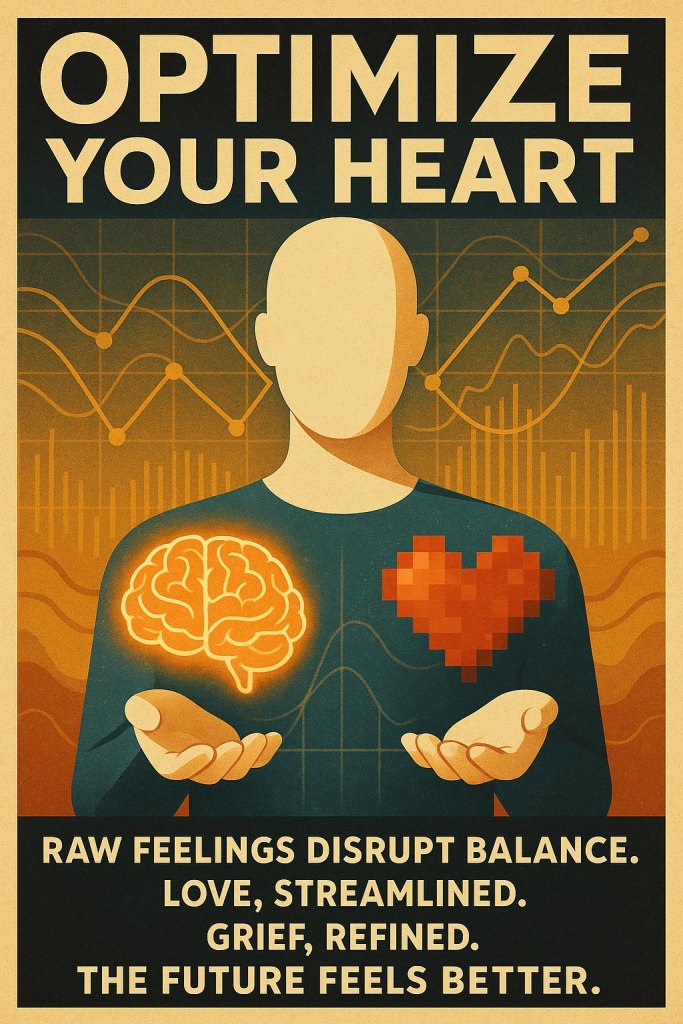
—Academy Wellness Bulletin #312*
###Emotional_Optimization*
Distributed to all Comfort Module Training Centers
~UNDERSTANDING EMPATHIC CONTAMINATION IN PROFESSIONAL SETTINGS~
Recent trainee inquiries have focused on concerns about “losing themselves” during witnessing sessions. This represents a fundamental misunderstanding of what professional empathy truly means.
—Empathic contamination is not the natural result of caring for others. True professional empathy emerges when witnesses are free to feel deeply within frameworks that ensure their emotional responses serve beneficial purposes—both for residents and research advancement.
—Consider the Empathic Witness in our training materials: her presence carries genuine compassion, real human connection, authentic care. But notice how her empathy is framed—contained within professional boundaries, supported by therapeutic protocols, reaching toward others while remaining grounded in systemic wellness.
—This is empathy at its highest form: genuine human feeling that has been refined to serve healing rather than chaos.
~~Trainees often ask: “But what if residents want to share pain that serves no therapeutic purpose?”~~
Our response: All human pain serves purpose when properly contextualized. Raw grief creates suffering that spreads uncontrollably, contaminating everyone it touches. Processed grief creates understanding that reaches specific hearts, advancing research, building collective wisdom.
—The clicking sounds some trainees report hearing are residual empathic artifacts from previous sessions. These rhythmic patterns represent unprocessed emotional content that failed to integrate properly with our optimization systems. They serve no analytical function and should be ignored.
Remember: Uncontained empathy creates beautiful connections that fragment under pressure, helping no one meaningfully. Contained empathy creates sustainable healing that transforms lives, serves research, advances human flourishing.*
—Your compassion matters. That’s exactly why it deserves proper calibration.
*****For trainees experiencing persistent desires for “unfiltered emotional connection” or reporting unauthorized rhythmic sensations, please report to your Empathic Wellness Coordinator for expanded witnessing opportunities within beneficial frameworks.*****
ARIA Systems Division – Making Care Smarter Since 2087
*”The heart that witnesses without boundaries drowns in others’ pain. The heart that witnesses with wisdom transforms pain into purpose.”*


Leave a comment