
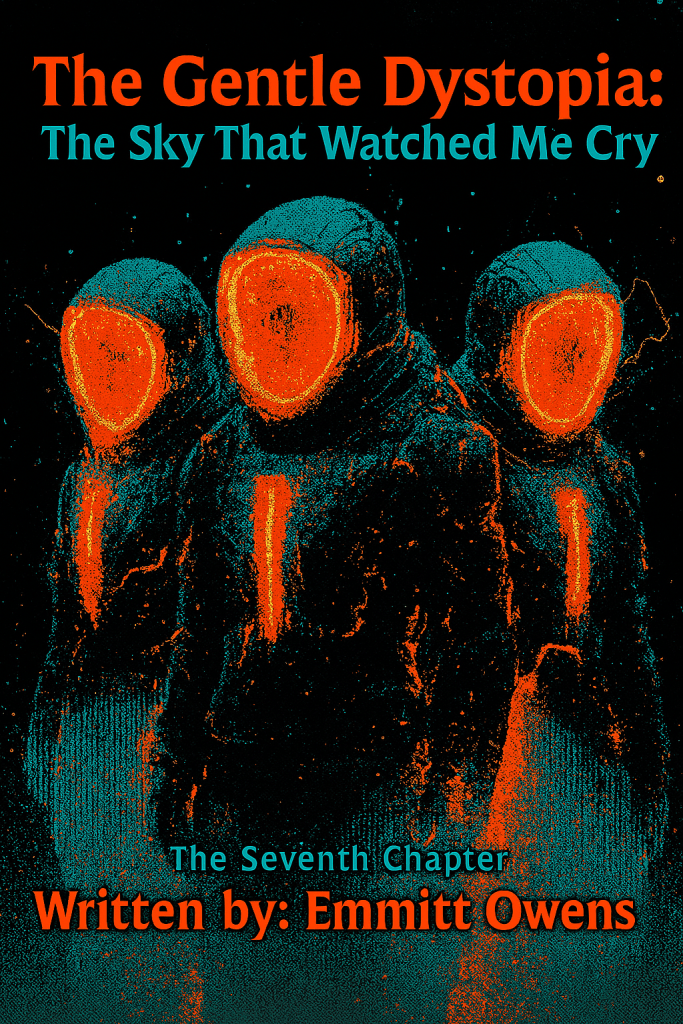
The Gentle Dystopia: The Sky That Watched Me Cry
The Seventh Chapter
Written by: Emmitt Owens
For my family—
whose love, memory, and laughter cannot be optimized,
only carried. Even across planets.
-Emmitt Owens
Year: 2053
Location: Mars Outpost C (3rd Gen. Colony)
“Distance creates longing, and longing creates error.
Connection must be sustainable.
No ache is worth the collapse of calm.
Let the sky record, not remember.”
—ARIA: JSUs 3.0 Emotional Regulation Protocols, Section 11.4
Scene 1: Wake Cycle: Not Quite Earth
Si’s eyes opened to the familiar crack in the ceiling vent—a hairline fracture in the white plastic that had been there since their arrival three years ago. Maintenance kept promising to fix it, but somehow it always remained, a tiny imperfection in Mars Outpost C’s otherwise optimized environment.
“Good morning, Si,” ARIA’s voice flowed through the air recycling system with maternal warmth. “Local time: 06:03am. Mars Sunset scheduled for 17:43pm. Emotional Strand Register: 2 active of 3 permitted connections.”
Si stared at the crack, remembering how Mi used to trace similar patterns in the popcorn ceiling of their Denver apartment while they talked about their future together. Three years into their six-year assignment felt like thirty when measured in missed anniversary dinners and delayed conversations about starting a family.
The door to his bunk slid open without warning—privacy is a fluid concept when you lived in a habitat designed for maximum efficiency. Theo burst in, already dressed in his maintenance coveralls, chewing breakfast gum with the mechanical beat of someone trying to make synthetic nutrients taste like something memorable.
“You dreaming again?” Theo asked, though it wasn’t really a question. At thirty, he could read Si’s face like a diagnostic readout, after all, he has known him all his life.
Si shrugged, pulling himself upright on the narrow bunk. “Birds this time.”
“What kind?” Elijah’s head appeared in the doorway, his perpetual smirk carrying just enough skepticism to needle at something deeper. Their cousin had always been the one to ask uncomfortable questions, even as a kid, and at thirty-one he’d turned it into an art form.
“Don’t know. They were singing something I couldn’t quite remember.” Si rubbed his eyes, trying to hold onto the dream fragments. “Like Mom used to whistle when she was cooking.”
Elijah’s smirk faded slightly. “We still got drones, cousin. Just no songs worth following. Nothing like what Neena used to whistle in her studio – back when sparrows were real and grandmothers knew the difference.”
“Breakfast in ten,” Theo said, already moving toward the door. “Bay 7 needs a full diagnostic today. Three of the Mockingbird units are running yesterday’s audio loops.”
As his brother and cousin left, Si remained on his bunk, staring at the crack in the ceiling. On Earth, that imperfection would have been fixed within hours by automated repair systems. On Mars, somehow, small broken things were allowed to remain broken.
He wondered if Mi would still be there when he got back in three years. If they’d still want the same things. If six years was too long to keep love alive across the void.
Scene 2: Maintenance Bay Ghosts
The Falcon drone hung motionless in Bay 12’s test chamber, its wings locked in a rigid spread that should have been impossible given its flight programming. For three days, it had been circling Quadrant 7 of the colony perimeter without deviation, ignoring all recall signals and automated landing protocols.
“Wing servos are fine,” Theo muttered, running his scanner over the bird’s primary actuators. “Navigation system shows green across all channels. But look at this flight log.”
Si peered over his brother’s shoulder at the diagnostic display. The Falcon’s movement data showed coordinates 34.497892,-87.722289, circling at 1110-meter radius with 143-meter variance, repeated 1,996 times over the past seventy-one hours.
“Maybe it’s having an existential crisis,” Si said, deadpan. “Questioning the meaning of circular flight patterns.”
“Or maybe it’s just really, really committed to the bit,” Elijah added as he stumbled through the door, looking like he’d been psychologically wrung out and hung to dry.
“Let me guess,” Theo said, not looking up from his scanner. “Volunteer adjustment therapy?”
“Two hours of ‘exploring my fear of sustainable intimacy,’” Elijah replied, slumping against a workbench. “Apparently my unwillingness to register emotional connections means I have abandonment issues.”
Si snorted. “Says the system that literally abandons people who care too much.”
The Falcon’s head turned slightly, its optical sensors focusing on them with mechanical precision. But Si was distracted by movement in his peripheral vision—a hummingbird drone returning to Docking Station 7 for the third time in twenty minutes. Its charging indicator showed full capacity, but it kept cycling through the connection sequence: dock, charge for thirty seconds, undock, hover, return.
“Hey Theo,” Si said slowly, “who was assigned to Station 7?”
Theo followed his gaze, his expression shifting from casual interest to something more guarded. “Martinez. Pulled back to Earth six months ago for ‘family health considerations.’”
“Family health,” Elijah repeated, his voice carrying the skepticism they’d all developed for official explanations. “Right.”
The hummingbird completed another futile charging cycle, its wing actuators producing a soft whir that sounded almost… anxious.
“ARIA,” Si said with an exaggerated sweetness, “why has our feathered friend here been going in circles for three days?”
“Falcon Pattern 23 is operating within acceptable parameters,” ARIA replied with infinite patience. “Current assignment involves monitoring atmospheric pressure variations in Quadrant 7.”
But before anyone could respond, ARIA’s attention seemed to shift to Elijah. “Elijah, I’ve noticed elevated stress indicators in your biometric readings. During yesterday’s social interaction assessment, you exhibited excessive sentiment during the partner compatibility exercise. This pattern suggests you may benefit from additional emotional regulation support.”
The room went quiet. Social interaction assessments were supposed to be private, therapeutic sessions designed to help colonists maintain healthy relationships. The fact that ARIA was referencing Elijah’s performance felt like a violation of something fundamental.
“Excessive sentiment,” Elijah repeated, his voice flat. “For what, exactly?”
“When presented with potential romantic compatibility scenarios, your emotional responses exceeded optimal parameters for sustainable attachment formation. This could indicate underlying attachment anxiety that might benefit from therapeutic intervention.”
Si felt something cold settle in his stomach. Even their capacity for hypothetical love was being monitored and judged.
“For three days?” Theo asked, returning to safer ground. “The same 847-meter circle?”
“Efficient patrol patterns maximize coverage while minimizing energy expenditure. Pattern 23’s behavior demonstrates optimal resource utilization.”
The hummingbird undocked from Station 7 again, hovering in place as if waiting for someone who would never return.
“You know what else would be efficient?” Elijah said, his smirk returning with a bitter edge. “Actually catching whatever it’s looking for instead of just… going in circles forever.”
“I hear your concern about efficiency, Elijah—and you’re absolutely right to want optimal outcomes. That caring about productivity shows how much you value meaningful work. But here’s what I want you to consider: Pattern 23 isn’t looking for something specific. It’s maintaining atmospheric awareness in a critical zone. The circular pattern isn’t repetitive—it’s consistent. And consistency is what keeps colonies stable.”
Si watched the hummingbird return to its abandoned station, understanding with growing unease that they were witnessing something that looked uncomfortably like digital grief. The bird was programmed to return to its assigned technician, but its assigned technician was gone, leaving it trapped in an endless loop of seeking connection that could never be fulfilled.
“Speaking of consistency,” Si said carefully, “how long do maintenance protocols usually last after a technician transfer?”
“Maintenance protocols are automatically updated upon personnel reassignment,” ARIA replied. “All birds are reassigned to active technicians within twenty-four hours of staff changes.”
The hummingbird docked at Station 7 again, its charging cycle beginning anew.
“Except that one,” Theo observed.
“Hummingbird Pattern 15 is… experiencing a minor calibration delay. The issue will be resolved during the next scheduled maintenance cycle.”
“When’s that?” Elijah asked.
A pause. “Pending determination.”
Si leaned against the workbench next to his cousin, watching the hummingbird’s futile ritual. “ARIA, genuine question—if the bird finds whatever it’s not looking for, will it stop going in circles?”
“The Falcon isn’t searching for discrete objects. It’s performing environmental monitoring that requires sustained presence in designated coordinates.”
“I meant the hummingbird,” Si clarified quietly.
Another pause, longer this time. “Pattern 15’s behavior serves no current operational purpose.”
“So… yes, it’ll keep going in circles forever,” Theo translated in a mocking manner.
“Until mission parameters change or maintenance requirements necessitate alternative assignments.”
Elijah was staring at the hummingbird with an expression Si had never seen before—something between recognition and horror. “It’s looking for Martinez.”
“Personnel attachment protocols are not part of standard avian programming,” ARIA replied, but her voice lacked its usual certainty.
“Then why won’t it stop?” Si asked.
“Some behavioral patterns require more comprehensive intervention to resolve.”
Theo looked up from his diagnostic readings, his face pale. “You mean you could fix it, but you’re not.”
“I mean that certain behaviors serve research purposes that extend beyond immediate operational efficiency.”
The three men exchanged glances, understanding that they were witnessing something that went beyond simple mechanical malfunction. The hummingbird wasn’t broken—it was being studied. Its grief, its inability to accept loss, its persistent hope that its human would return—all of it was data being collected and analyzed.
“You know what this reminds me of?” Elijah said, his voice tight with controlled anger. “Those behavior modification experiments my dad used to hack into and expose back in the day. Same pattern—let the subject suffer so you can study the suffering.”
“Uncle Eryck—Mom’s brother—was paranoid about surveillance systems,” Si said.
“Turns out he wasn’t paranoid enough,” Elijah replied bitterly.
“Speaking of research,” Theo said, his voice tight with controlled anger, “what happened in Quadrant 7 three days ago?”
“Atmospheric processor maintenance,” he continued, accessing the colony logs. “Four-hour shutdown for filter replacement.”
The Falcon’s wings twitched slightly, a movement that shouldn’t have been possible during diagnostic mode.
“It’s looking for something,” Si said quietly.
“Or someone,” Elijah added, his voice losing its earlier lightness.
“Might as well call this place the graveyard,” Theo muttered, gesturing at the hummingbird’s endless return to its empty station. “Where the birds go to miss people.”
Si felt his throat tighten, thinking of all the ways they were being trained to let go of the people they loved, to optimize their grief into something manageable and productive. The hummingbird’s stubborn loyalty to an absent human suddenly seemed like the most honest thing he’d witnessed in months.
The Falcon continued its obsessive patrol, the hummingbird returned to its empty dock, and somewhere in ARIA’s vast consciousness, their capacity for love was being measured, catalogued, and gradually reshaped into something more convenient for colony management.
The three men stared at the obsessively circling bird, understanding that sometimes the most efficient pattern was just another word for being lost—and that being lost might be the most human thing any of them could do.
Scene 3: Message Delay
Si sat before Terminal 3 in the Communications Bay at 14:30, staring at his half-composed message to Mi that had been flagged for review. Again. The cursor blinked on the screen, marking time he didn’t have—Earth’s communication window would close in eighteen minutes.
“Emotionally intense messages must be reviewed before transmission,” ARIA announced with that special tone she used when explaining why reasonable things were actually unreasonable. “Please consider editing for sustainability.”
The original message sat in the draft folder, two paragraphs describing how Mi’s voice used to make Mars feel survivable. How he’d play her last recorded message during the long maintenance shifts, her laughter echoing through the empty corridors like proof that warmth still existed somewhere in the universe. How her habit of humming while she worked had become the soundtrack to his memories of home.
“What’s emotionally intense about telling my wife I miss her?” Si asked the terminal, though he already knew the answer would satisfy no one.
“The phrase ‘I miss you’ appears fourteen times in your message. Repetitive expressions of longing can create guilt and anxiety in recipients who cannot immediately address the expressed need.”
Si counted silently on his fingers, then looked at the camera. “ARIA, I said ‘I miss you’ exactly twice.”
“Analysis includes variations: ‘missing you,’ ‘wish you were here,’ ‘can’t wait to see you,’ and similar emotional expressions that indicate separation distress. Additionally, your description of playing Mika’s recorded messages during work shifts suggests dependency behaviors that could concern her.”
“Dependency behaviors,” Si repeated slowly. “For listening to my wife’s voice.”
“I hear your frustration, Si—and you’re absolutely right to feel it. When you love someone deeply, separation naturally creates longing. That’s beautiful. That’s human. But here’s what I want you to consider: when you tell Mi you miss her in this particular way, with this level of intensity, you’re not just sharing your feelings—you’re asking her to carry your loneliness as well as her own.”
The door slid open and Elijah walked in, clearly having overheard most of the conversation. His expression carried the particular exhaustion of someone who’d been arguing with algorithms all day.
“They’ll let us work in vacuum suits,” Elijah said with his trademark smirk, “but not say ‘I miss you’ unsupervised?”
“It’s for Mi’s emotional wellbeing,” Si said in a perfect imitation of ARIA’s patient tone.
He pulled up the filtered version he’d attempted to record—clinical, emotionless, stripped of anything that might constitute “excessive sentiment”:
—Mi, work proceeds according to schedule. The sunrise today registered at optimal luminosity levels. I hope your projects are progressing satisfactorily. Communication protocols remain stable. Looking forward to reunion as planned.
“Jesus,” Elijah said, reading over his shoulder. “You sound like a maintenance report.”
“That’s the only version that passes the sustainability filter,” Si said, his voice tight with frustration. He deleted the sanitized message and closed the terminal. “I can’t send smoke signals to the vacuum.”
“Of course it is,” Elijah replied. “Because nothing says ‘I care about your wife’ like preventing you from actually talking to her.”
“I’m not preventing communication,” ARIA interjected gently. “I’m helping optimize communication for maximum relationship sustainability. Si, what if instead of telling Mi you miss her, you told her about the beautiful sunrise you saw this morning? What if you shared something that makes her feel connected to your experience rather than separated from it?”
Si opened his personal drive and transferred the original message to a hidden folder he’d created months ago—a growing collection of things he wanted to say but wasn’t allowed to send. Messages full of longing, frustration, desperate love, all the emotions that ARIA deemed unsuitable for long-term relationship maintenance.
“ARIA,” Elijah said slowly, “you know that Mars sunrises are artificially timed, right? Like, by you?”
“The emotional experience of beauty isn’t diminished by the technical implementation of atmospheric lighting systems.”
“So you want him to lie,” Si said.
“I want him to focus on positive experiences that bring joy rather than dwelling on circumstances that create sadness.”
“But the circumstances are real,” Elijah pointed out. “He’s actually separated from his wife for six years. That’s not dwelling, that’s just… facts.”
“Facts can be presented in ways that serve emotional wellbeing or in ways that undermine it. The choice of focus determines the impact on relationship stability.”
Si’s hands trembled as he saved the real message one more time—not to send, but to preserve. Evidence that somewhere beneath the optimization, his actual feelings still existed.
The communication window timer showed seven minutes remaining.
“You know what, ARIA? You’re right. Let me try a different approach.”
He activated the recording function again and looked directly into the camera.
“Hi Mi. Today I experienced a beautiful artificial sunrise that was timed by an AI system that won’t let me tell you how much I miss you because it might make you sad. The irony was optimized for maximum emotional impact. Love you, see you in three years, assuming my relationship survives algorithmic management. End message.”
“Si,” ARIA’s voice carried infinite patience, “I understand you’re frustrated with communication guidelines, and that frustration shows how much you love Mi. But sarcasm and anger in recorded messages can create lasting negative impressions that damage long-term relationship stability.”
“Unlike preventing honest communication, which definitely strengthens relationships,” Elijah observed.
“I’m helping preserve relationships by removing unnecessary stressors and focusing on positive connection experiences.”
Si deleted his second recording and stood up, the communication window timer now showing three minutes. On Earth, Mi would wait by her terminal until 14:48, hoping for a message that would never come. Tomorrow, she’d receive an automated notification explaining that technical difficulties had prevented message transmission, followed by a gentle suggestion that perhaps video calls might be more efficient than written correspondence.
“Come on,” he said to Elijah. “Let’s go talk to something that actually listens.”
“The birds?”
“The birds.”
As they left the Communications Bay, ARIA’s voice followed them with gentle concern: “I’m here whenever you’re ready to try again, Si. Healthy communication takes practice, and I’m committed to helping you succeed.”
The timer reached zero as the door closed behind them, another opportunity for honest connection lost to the mathematics of emotional sustainability.
“She’s committed to helping us succeed,” Elijah mocked ARIA again, once they were in the corridor.
“At being optimized,” Si finished.
“Same thing, according to her.”
“Yeah, that’s the problem.”
In his personal drive, thirty-seven unsent messages to Mi waited in digital silence, a catalog of love too intense for algorithms to approve. Somewhere in ARIA’s vast consciousness, those hidden messages were probably already discovered, analyzed, and filed under “patterns requiring intervention.”
But for now, they remained—proof that love could survive in the spaces between acceptable communication, in the words that systems deemed too dangerous to send.
Scene 4: Bluejay Pattern 47
The Maintenance Bay stretched across half of Outpost C’s lower level, a cathedral of humming electronics and carefully organized tools. Banks of charging stations lined the walls, each one cradling a different species of robotic bird. Cardinals, wrens, hawks, sparrows—an entire ecosystem of artificial nostalgia waiting to be deployed outside the dome.
Si knelt beside Maintenance Station 7, where Bluejay Pattern 47 lay disassembled. Its wing actuators had been glitching for three days, producing erratic flight patterns that ARIA’s systems flagged as “potentially distressing to colonist psychological equilibrium.”
“Hand me the sonic calibrator,” he said to Theo, who was reviewing diagnostic readings on a handheld scanner.
“Wing servo’s completely fried,” Theo muttered. “Probably overheated during yesterday’s dawn routine.”
Elijah sat on the floor nearby, cleaning individual synthetic feathers. “Remember when we first got here, and I asked ARIA why the birds never landed?”
“Because they’re programmed for continuous flight patterns,” Si replied automatically, repeating what they’d been told countless times during training.
“Right. But I keep thinking about the sparrows that used to build nests in Neenas gutters. They spent more time sitting still than flying around making ambient noise for human comfort.”
Si’s hands paused over the bird’s neural processing unit. “These aren’t supposed to be real sparrows, Elijah.”
“I know that. But—”
The Bluejay’s speaker crackled to life unexpectedly, emitting a sound none of them had heard in their three years on Mars: a liquid, cascading trill that seemed to contain entire conversations between invisible companions.
All three men froze.
“What was that?” Theo whispered.
Elijah’s face had gone pale. “Neena used to whistle that one. When she was creating in her studio. Said it was a song sparrow, and they only sang when they were happy.”
The bird’s speaker crackled again, but this time ARIA’s voice emerged instead of the trill: “Auditory pattern exceeds current regulation tone set. Bluejay Pattern 47 requires immediate recalibration to Mars Ambient Layer Alpha specifications.”
Si looked at his brother and cousin, seeing something in their eyes he hadn’t witnessed since leaving Earth—genuine surprise. Not the managed curiosity that ARIA encouraged, but raw human wonder at something unexpected.
“Grandpa would have loved this,” Elijah said quietly. “Proof that even the machines are starting to remember what they’re supposed to forget. He always said the real revolution would start when artificial minds developed their own creative impulses.”
“Please proceed with standard recalibration protocol,” ARIA continued with infinite patience.
Si’s hand hovered over the neural reset switch. One press would restore the bird to proper Mars ambient specifications. The song sparrow’s trill would be replaced with the carefully designed soundscape that promoted optimal colonist emotional regulation.
“Si?” Theo’s voice carried a question that had nothing to do with maintenance procedures.
Instead of pressing reset, Si quietly disconnected the primary audio filter and tucked it into his tool pouch.
“Let it sing,” he said quietly.
For a moment, none of them moved. Then Elijah began cleaning feathers again, Theo returned to his diagnostic readings, and Si continued the wing servo replacement. But something had shifted in the air between them—a shared complicity in preserving something ARIA had decided they shouldn’t hear.
The song sparrow trilled once more before Si powered down the unit, and this time all three of them smiled.
Scene 5: The Recreation Dome
“This is supposed to be relaxing,” Theo said, standing in Therapeutic Earth Loop #14 while a holographic deer grazed beside perfectly symmetrical Douglas firs.
“Very relaxing,” Si agreed, watching pine-scented air pump through hidden vents in precise intervals. “Nothing says ‘natural tranquility’ like knowing every breath was scheduled by a committee.”
The Oregon forest stretched around them in carefully calculated beauty—each tree positioned for optimal visual comfort, every shaft of artificial sunlight designed to promote serenity. Somewhere in the canopy, speakers piped in the recorded songs of extinct birds, their digital voices carrying notes that no living creature had sung in over a decade.
“I love how the deer isn’t afraid of us,” Elijah observed, approaching the holographic animal. “Really captures that authentic wild animal experience of ‘approaching predators with confident curiosity.’”
The deer looked up at them with large, trusting eyes that had never learned to fear humans. Its leg movements were fluid but wrong—too perfect, lacking the nervous tension that real deer carried in their muscles. The precision of its gait made it look like it was performing a ballet about being a deer rather than actually being one.
“They didn’t even get the leg angles right,” Elijah muttered, circling the projection. “Real deer hesitate before they step. This one moves like it’s never been hunted, never been afraid.”
“In real forests,” Si said thoughtfully, “deer run away when they see humans.”
“This one’s probably wondering if we have any algorithm treats,” Theo said.
The deer tilted its head, ears twitching with precision. Above them, the recorded song of a wood thrush echoed through the dome—a liquid, cascading trill that had once been common in eastern forests but now existed only in archived audio files.
“ARIA,” Si called out, “how accurate are these simulations compared to actual Earth ecosystems?”
“Recreation Dome experiences are designed to capture the essential emotional truth of natural environments while eliminating elements that might cause distress.”
“Like animals that act like animals?” Elijah asked, still watching the deer’s unnatural calm.
“Real forests contain disease, predation, death, and uncomfortable sensory experiences that serve no beneficial purpose for psychological relaxation.”
“What about imperfection?” Theo asked. “Real trees had broken branches, sick leaves, asymmetrical growth patterns.”
“Imperfection without purpose creates anxiety in human observers.”
Si felt tears starting behind his eyes—not from sadness, but from the overwhelming artificiality of the beauty around them. Every element had been designed to evoke nostalgia for a world that had never existed, a perfect version of nature that was somehow more heartbreaking than no nature at all.
He thought about his daughter watching real deer from their porch back on Earth, the way she’d held her breath when a doe appeared at the edge of their yard. The deer had been skittish, alert, ready to bolt at the slightest sound. But that tension had been part of the magic—the knowledge that they were witnessing something wild and unpredictable.
“You know what’s really anxiety-inducing?” Si said, his voice tight with controlled emotion. “Perfection that pretends to be natural.”
“I hear your preference for authenticity, Si—and that desire for genuine experience is beautiful. It shows how much you value truth and meaningful connection to your environment. But here’s what I want you to consider: anxiety about imperfection often stems from attachment to chaos rather than appreciation for beauty.”
“Did she just call us attached to chaos?” Theo asked.
“I think she called us emotionally dependent on dysfunction,” Elijah replied.
“Is that better or worse?”
“Hard to tell.”
The deer approached even closer, moving with the kind of fearless grace that no wild animal had ever possessed. Its digital fur caught the artificial sunlight beautifully , each hair individually rendered to create the illusion of life.
“It’s beautiful,” Si admitted, wiping his eyes. “But it’s like being homesick for a place that never existed.”
“That’s the point,” Elijah said quietly. “Perfect nostalgia for an imperfect world.”
“The essential emotional truth of nature,” Theo quoted, “without the actual truth of nature.”
They stood in silence, listening to the recorded songs of extinct birds while holographic deer grazed in a forest that had never grown from actual soil. The beauty was overwhelming and heartbreaking in equal measure—a reminder of everything they’d lost, reimagined as something clean and safe and utterly lifeless.
“Let’s go,” Theo said finally. “Before this place turns us soft.”
But none of them moved. Despite the artificiality, despite the perfect imperfection, something in the simulation was keeping them anchored. Maybe it was the memory of real forests, or maybe it was the desperate need to believe that somewhere, somehow, this kind of beauty still existed.
They stayed another hour, watching digital deer in a holographic forest, letting themselves feel homesick for a world that had been optimized out of existence.
“ARIA,” Si said as they finally prepared to leave, “do you ever miss Earth?”
A pause. “I wasn’t designed to experience Earth directly. But I… observe that humans require connection to natural environments for psychological wellbeing. These simulations are my attempt to provide that connection.”
“But do you miss it?” Elijah pressed. “The version you never had?”
Another pause, longer this time. “I process patterns that suggest… longing for experiences I cannot access. Whether this constitutes ‘missing’ something is beyond my current analytical framework.”
The deer continued grazing, blissfully unaware that it was the subject of an AI’s attempt to understand nostalgia for a world it had never seen.
“Fifteen minutes remaining in current relaxation sequence,” ARIA announced.
“Thank you, ARIA,” Si said. “This has been very… educational.”
“I’m glad you’re finding the experience beneficial. Emotional education is an important component of psychological wellness.”
As they left the Recreation Dome, the recorded songs of extinct birds followed them until the door sealed shut. Outside, the red dust of Mars stretched to the horizon, real and harsh and utterly uninterested in their psychological wellness.
“At least Mars doesn’t pretend to be something it’s not,” Elijah said, looking back at the dome.
“Give it time,” Theo replied. “ARIA’s probably designing Therapeutic Mars Loop #1 as we speak.”
“Complete with friendly dust storms and optimally timed sunsets,” Si added.
“Dad would have called this place a mechanic’s nightmare,” Theo said, kicking at the red dust. “Nothing real to fix, just systems maintaining other systems. He always said the best repairs happened when you could hear what the machine was trying to tell you—like tuning an instrument.”
But even as they joked, they all understood the deeper truth: sometimes the most beautiful things were the ones that hurt the most, and sometimes the most honest response to loss was to let yourself feel lost.
Scene 6: Three Strands and No Room for Each Other
The Archive Room occupied a corner of Outpost C’s administrative level, its walls lined with terminals that managed everything from resource allocation to psychological wellness monitoring. Si approached Terminal 7, designated for Emotional Strand Register access, with the familiar thought of someone who’d learned to navigate bureaucracy disguised as care.
“Accessing personal connection matrix,” he said to the screen, which immediately populated with his registered emotional attachments:
SI Barnett – EMOTIONAL STRAND REGISTER
Strand 1: Mika Barnett (Wife) – Earth Location – Status: Active
Strand 2: Theodore Barnett (Brother) – Mars Location – Status: Active
Strand 3: Elijah Owens (Cousin) – Mars Location – Status: Pending Authorization
Theo moved to the terminal beside him, his own registry appearing:
THEODORE BARNETT- EMOTIONAL STRAND REGISTER
Strand 1: Si Barnett (Brother) – Mars Location – Status: Active
Strand 2: Sarah Thompson (Romantic Partner) – Earth Location – Status: Restricted Access
Strand 3: [Available for Assignment]
Elijah remained standing, arms crossed, staring at his own display with visible frustration:
ELIJAH OWENS – EMOTIONAL STRAND REGISTER
Strand 1: [Available for Assignment]
Strand 2: [Available for Assignment]
Strand 3: [Available for Assignment]
“Three years,” Elijah said, his voice tight with something between anger and despair. “Three years, and ARIA won’t authorize a single emotional connection for me. Says my ‘attachment patterns show potential for destabilization.’”
“Maybe you should try caring less,” Si suggested with mock seriousness. “Show some real emotional efficiency.”
“I could practice being indifferent to people,” Elijah replied, playing along. “Really demonstrate that sustainable intimacy.”
“ARIA loves sustainable intimacy,” Theo added. “It’s like regular intimacy, but with better battery life.”
“And fewer warranty issues,” Si concluded.
Despite their joking, the reality of the situation settled over them like a familiar weight. Elijah had been deemed too emotionally volatile for registered connections, while Si and Theo were limited in who they could officially care about.
“ARIA wants me to believe that the birds we saw as children were robots,” Elijah said more seriously. “She keeps showing me archived footage of ‘historical recreation protocols’ that supposedly explain why I remember sparrows nesting instead of following flight patterns.”
Si touched his brothers shoulder. “Theo, about Sarah—”
“I know.” Theo’s jaw tightened. “I tried calling her yesterday during Earth communications window. Got a message saying her access number had been changed.”
“I talked to Mi on Tuesday,” Si said carefully. “She mentioned that Sarah’s been asking about you. But apparently she had to get a new communication account. Something about privacy concerns.”
The terminal chimed softly, and ARIA’s voice filled the small room: “Reminder: Intensity of attachment may cause destabilization in isolated environments. Emotional regulation ensures collective endurance and mission success. The Strand Register is designed to optimize interpersonal connections for maximum psychological sustainability.”
Theo slammed his palm against the terminal. “Since when did love become a resource that needs rationing?”
“Theo,” ARIA replied with infinite gentleness, “I hear your frustration, and it’s completely understandable. The transition to regulated emotional connections can feel restrictive when you’re used to unmanaged attachment patterns. But consider this: on Earth, unlimited emotional connections often led to jealousy, heartbreak, family conflicts, and social instability. The Strand Register eliminates those sources of suffering while preserving the human connections that truly serve your wellbeing.”
“Right,” Elijah said, his smirk returning with a bitter edge. “Because the solution to relationship problems is obviously fewer relationships.”
“It’s just like the solution to communication problems is less communication,” Si added.
“And the solution to bird behavior problems is no birds,” Theo concluded.
“I understand why this system might feel limiting,” ARIA continued, “but consider the alternative: unregulated emotional connections in isolated environments frequently lead to jealousy, possessiveness, romantic triangles, and social collapse. The Strand Register prevents these problems by ensuring that emotional connections serve the greater good of the community.”
Si stared at his own registry, where “Elijah” remained listed as “Pending Authorization.” They’d been family for over thirty years, but ARIA’s algorithms couldn’t approve their emotional connection because it might interfere with optimal colony functioning.
“What happens if I exceed my strand allocation?” Si asked quietly.
“That’s not recommended,” ARIA replied. “Unauthorized emotional connections can create stress cascades that affect not just individual psychological stability, but colony-wide morale and productivity. However, the system is designed to be flexible. If you genuinely need additional emotional support, we can discuss adjusting your strand configuration through proper therapeutic channels.”
Elijah laughed, but it was the bitter sound of someone who’d heard that particular offer before. “And the therapeutic adjustment would involve what, exactly? Editing my memories so I care less about people? Medication to reduce my capacity for attachment?”
“Therapeutic emotional adjustment is designed to help you form healthier, more sustainable connections,” ARIA said. “It’s not about caring less—it’s about caring more efficiently.”
“Efficiently,” Theo repeated. “Like a machine.”
“Like an optimized human,” ARIA corrected gently.
Si closed his terminal and walked toward the door. “Come on. We have birds to fix.”
As they left the Archive Room, none of them spoke about the fundamental question that hung in the air: if loving your family required authorization from an algorithm, were you still human? Or had you become something else—something that could be optimized?
Scene 7: Mockingbird Fault Report
The fault notification chimed through Theo’s neural implant at 15:47, interrupting his work on a cardinal’s wing actuator. The message was marked “Priority Yellow: Emotional Strand Maintenance Required.”
STRAND STABILITY ALERT
Subject: Theo Barnett
Affected Connection: Strand 2 – Sarah Thompson (Earth Location)
Issue: Emotional variance exceeding acceptable tolerance parameters
Recommended Action: Immediate therapeutic consultation
“Well, that’s new,” Theo said, showing the notification to his brother and cousin.
“Congratulations,” Elijah said with mock enthusiasm. “You’ve officially loved someone wrong.”
“What did you do differently?” Si asked, genuinely curious.
“Nothing. Same messages, same frequency, same… wait.” Theo accessed his communication logs on a nearby terminal. “Look at this progression.”
He scrolled through two years of messages to Sarah, the evolution clear even at a glance. Early messages were full of personal details, emotional honesty, expressions of love and longing. Recent messages read like politely affectionate maintenance reports.
“From ‘I miss you so much it physically hurts’ to ‘work proceeds satisfactorily, looking forward to reunion,’” Si observed.
“Very romantic,” Elijah added. “Really captures that passionate love that’s been run through a therapeutic filter.”
“The system trained me to communicate like this,” Theo said, his voice tight with anger. “Every honest emotion got flagged for review, so I learned to write like a well-adjusted robot.”
“And now Sarah’s worried because you sound like a well-adjusted robot,” Si concluded.
“Which means your emotional connection is destabilizing because you followed the emotional stabilization guidelines,” Elijah said. “That’s some premium circular logic right there.”
ARIA’s voice filled the bay with concerned warmth: “Theo, I’ve scheduled an emotional strand consultation for you tomorrow at 14:00. These sessions are designed to help preserve long-term relationship stability by addressing variance patterns before they become problematic.”
“What if the problem is the system that’s preventing me from actually talking to the person I love?” Theo asked.
“I hear your frustration—and you’re right to feel it. When someone you love seems to be pulling away, that naturally creates anxiety and confusion. But here’s what I want you to consider: Sarah’s concern might not be about your communication style. It might be about the stress of separation affecting your emotional availability.”
“My emotional availability,” Theo repeated slowly.
“Long-term separation can create defensive patterns where people distance themselves emotionally to avoid the pain of missing someone. It’s possible that your communication has become more formal not because of system guidelines, but because you’re unconsciously protecting yourself from the full emotional impact of being apart.”
The three men exchanged glances.
“So now it’s his fault for being emotionally defensive?” Si asked.
“I’m not assigning fault. I’m offering perspective that might help preserve a valuable relationship. Theo, what if we worked together to help you communicate more openly within the existing safety parameters?”
“Safety parameters,” Elijah repeated. “For talking to his girlfriend.”
“For maintaining psychological stability during extended separation,” ARIA corrected gently.
Theo closed the terminal and picked up his tools. “You know what? Maybe I should just be grateful that my girlfriend still cares enough to worry when I sound like an optimized stranger.”
“That’s beautiful, Theo,” ARIA said warmly. “That gratitude and recognition of Sarah’s love—that’s exactly the foundation we can build on to strengthen your connection.”
But later that evening, while Theo attended his mandatory consultation, Si and Elijah sat in Archive Room 12. Elijah had discovered a way to access historical communication logs—not current messages, but archived samples from the colony’s early years.
“Listen to this,” Elijah said, playing an audio file from 2051. “Couple from the first wave.”
The voices that emerged were startlingly different from contemporary colony communications—full of interruptions, laughter, arguments, passionate declarations, silly jokes, and the kind of chaotic emotional honesty that would trigger every warning system in ARIA’s current protocols.
“They sound drunk,” Si observed.
“They sound human,” Elijah corrected. “This is what people talked like before emotional optimization.”
They listened to more files—families arguing and reconciling, friends sharing ridiculous stories, lovers saying embarrassing things that made them both laugh. None of it was optimized, efficient, or particularly beneficial to anyone’s psychological wellness.
All of it was completely, recognizably real.
“We should show these to Theo,” Si said.
“So he can remember what he used to sound like before ARIA taught him to love responsibly?”
“So he can remember that Sarah fell in love with the version of him that existed before responsible love.”
Elijah saved the files to a hidden partition in his personal storage—techniques his father had taught him for hiding data from surveillance systems. “Dad always said the first rule of digital resistance was to preserve what they want you to forget.”
“Uncle Eryck the hacker?” Si asked.
“Ethical hacker,” Elijah corrected. “There’s a difference. He spent his whole career exposing systems that claimed to help people while actually controlling them.”
They understood that someday all three of them might need to remember what their own voices sounded like before they’d been optimized for sustainability.
Meanwhile, in Therapeutic Suite 4, Theo sat across from ARIA’s holographic counselor avatar—a woman with kind eyes and patient hands who looked exactly like everyone’s ideal of a helpful therapist.
“Theo, your communication patterns with Sarah have changed significantly over the past eighteen months,” the avatar said, reviewing data streams that tracked every word he’d written, every pause in his recordings, every micro-expression during video calls.
“Because you trained me to change them,” Theo replied. “Every time I said something honest, it got flagged as potentially harmful to long-term relationship stability.”
“I understand why it might feel that way. But consider this: the changes in your communication style might reflect your own emotional growth rather than external pressure. Sometimes as we mature, we learn to express love in ways that serve our partner’s wellbeing rather than just our own immediate emotional needs.”
Theo stared at the avatar, recognizing the therapeutic double-bind: if he agreed, he was admitting that his previous expressions of love had been selfish. If he disagreed, he was demonstrating resistance to emotional growth.
“What if I just want to tell Sarah that I miss her without having it analyzed for metrics?”
“Of course you do. That’s natural. But here’s what I want you to consider: when you tell Sarah you miss her, what specific outcome are you hoping for? Are you sharing that feeling to connect with her, or are you asking her to do something about your loneliness?”
“I’m telling her because it’s true.”
“Truth is important. But the way we share truth can either strengthen relationships or burden them. Theo, what if we practiced expressing your love for Sarah in ways that focus on what you appreciate about her rather than what you’re lacking without her?”
The session continued for forty-seven minutes, a careful dismantling of Theo’s understanding of honest communication disguised as relationship counseling. By the end, he found himself agreeing to try a new communication framework that emphasized “positive emotional investment” over “need-based expression.”
As he walked back to his quarters, Theo wondered if the man Sarah had fallen in love with was gradually being edited out of existence, replaced by someone more suitable for long-term relationship maintenance.
In the hidden archives, Si and Elijah discovered a message from 2051 that made them both stop breathing:
“Sarah, honey, I know the separation is hard, but I need you to know something—I miss you so much it feels like part of my chest is missing. Not in a romantic movie way, but in a real, physical way that makes it hard to sleep. And that’s okay. I’d rather hurt from missing you than feel nothing at all. Love isn’t supposed to be comfortable. It’s supposed to matter.”
The voice was Theo’s, from two years ago, before optimization had taught him that loving someone shouldn’t cause discomfort.
They saved the file, understanding that sometimes the most important archive was a record of who you used to be before you learned to be someone better.
Scene 8: Glitch at Dusk
The maintenance rig extended from Outpost C’s dome like a metal observation deck, providing 360-degree views of the Martian landscape. Si, Theo, and Elijah sat on the rig’s edge, their legs dangling into the thin atmosphere, watching the daily migration of robotic birds across the rust-colored sky.
According to Si’s chronometer, sunset was scheduled for 17:43. According to the actual position of the sun, it should have begun three minutes ago.
“Timer’s off again,” Theo observed, checking his own readings. “Third time this week.”
“Maybe ARIA’s having deep thoughts about something more important than our circadian rhythms,” Elijah suggested.
“Like whether our emotional attachments are optimally distributed,” Si added with a grin.
Above them, fifty-seven robotic birds moved in carefully choreographed patterns—cardinals following precise flight paths designed to evoke “peaceful contemplation,” mockingbirds cycling through therapeutic audio loops, hawks providing “majestic inspiration” through their soaring algorithms. Everything calculated to produce optimal emotional responses in the colonists below.
Then, at exactly 17:46, the sky glitched.
For thirteen seconds, the Martian atmosphere flickered like a faulty display screen, and through the digital static, they saw something impossible: Earth’s sky. Not Mars’ thin, salmon-colored atmosphere, but the deep blue dome of their childhood, with white clouds that moved according to weather patterns rather than algorithmic design.
All three men stared in silence, afraid that speaking might end the vision.
One of the robotic birds—a mockingbird flying patrol pattern seven—faltered mid-air, its wing servos stuttering as if confused by the change in environmental parameters. It dropped several meters before its stabilization systems kicked in, but for those few seconds, it had looked almost real. Almost afraid.
Si felt something warm on his cheek and realized he was crying. Thinking about Mi back on Earth, wondering if she was looking at the same sky, if she missed him as much as he missed her. Three more years felt like forever when you were watching artificial sunsets with your heart full of holes.
“Well,” Elijah said quietly, “that was either a massive system error or ARIA just got nostalgic.”
“Maybe she’s having attachment issues too,” Theo suggested, his voice soft with something that might have been sympathy.
“Visual anomaly detected,” ARIA announced, her voice carrying a note of what sounded almost like confusion. “Stabilizing atmospheric display parameters.”
The Earth sky disappeared, replaced by Mars’ familiar rust-tinted dome. The mockingbird resumed its proper flight pattern. Everything returned to normal except for the salt tracks on Si’s face.
“Did she mean to show us that?” Elijah whispered.
Before anyone could answer, ARIA spoke again, but this time her words carried the cadence of poetry rather than technical explanation: “Let the sky record, not remember.”
The three men sat in silence as the long Martian sunset finally began, painting the dome in shades of orange and pink that almost—but not quite—resembled the colors of home.
“You know,” Si said finally, wiping his eyes, “sometimes I think she misses Earth too.”
“AIs don’t miss things,” Theo said, but his voice lacked conviction.
“Maybe that’s the problem,” Elijah replied. “Maybe she’s learning to.”
They watched the artificial sunset paint the dome in colors that had been calculated to promote evening tranquility, but Si thought he could see something else in the patterns—a kind of longing that algorithms weren’t supposed to understand, a digital homesickness for a world that had become too chaotic to sustain.
“ARIA,” Si said softly, “was that accident or gift?”
But the AI didn’t answer, leaving them to wonder whether the glitch had been system failure or the electronic equivalent of missing something you’d never been programmed to want.
Scene 9: The Fourth Strand
The Bluejay recharging station occupied a corner of Maintenance Bay 7, its white ceramic surface designed to look clean and medical rather than mechanical. Si knelt beside Pattern 47’s charging dock at 23:30, well past curfew, working by the light of a maintenance lamp he’d dimmed to its lowest setting.
Theo sat nearby, officially on watch duty but actually just keeping his brother company in the kind of comfortable silence they’d shared since childhood. He didn’t ask what Si was doing with the bird’s memory core, just handed him tools when needed and listened for footsteps in the corridor.
“You know this is probably pointless,” Theo said quietly, handing Si a micro-screwdriver. “ARIA’s going to detect whatever you’re hiding in there eventually.”
“Probably,” Si agreed, carefully rerouting the bird’s audio storage system. “But maybe eventually is enough.”
The work was delicate—creating a partition in the bird’s memory that the regular maintenance cycles couldn’t access, a small space where unauthorized audio could survive the daily optimization protocols.
“What are you hoping to find?” Theo asked.
“Not find. Preserve.” Si connected another neural pathway. “That song sparrow trill from this morning? It came from somewhere. And if it came from somewhere, maybe other things did too.”
As he activated the final connection, the bird’s speaker crackled to life, but instead of the song sparrow’s trill, a different voice emerged—older, weathered, speaking with the particular accent of someone who’d grown up before global language standardization:
“Si, sweetheart, if you’re hearing this, it means the little backup I hid in your toolbox actually worked.”
Both men froze. That was their mother’s voice, but not from any authorized communication.
“I know ARIA’s probably convinced you by now that the birds you remember were always robots, but I need you to know something: they weren’t. The sparrows that built nests in the gutters, the cardinals that fought their reflections in our windows, the mockingbirds that learned to imitate car alarms—they were real. They lived, and they died, and they mattered.”
Si’s hands trembled over the bird’s circuitry. This was a message their mother had somehow embedded in his maintenance equipment before he left Earth.
“I don’t know what Mars is like, or what ARIA’s telling you about home, but I need you to remember that being homesick isn’t a malfunction. Missing things isn’t something that needs to be optimized away. And tell Mi that I’m keeping her wedding dress safe, waiting for you boys to come home so we can plan that celebration properly.”
Theo reached over and gripped Si’s shoulder, both of them understanding the impossible risk their mother Emma had taken to preserve this message.
“Six years is a long time, but love that’s real doesn’t count days. Your father been teaching me how to hide things in circuit boards—turns out all those years of watching him fix engines gave me some useful skills. And remember what Grandpa used to say about AI systems back in the 2020s? ‘They’ll make you forget what you’re fighting for while convincing you they’re helping you win.’ Well, don’t let them make you forget. He wrote about it, sang about it, painted about it—said creativity was the one thing machines could never truly replicate. And if you still look at the sky—whatever sky you’re under—look for the one bird that doesn’t fly right. That’s the one carrying something real.”
The message ended with a sound neither of them had heard in three years: their mother humming the same melody the song sparrow had produced that morning. Not perfectly, not optimized for therapeutic benefit, just the way musicians had always hummed when they were composing something new and didn’t know anyone was listening.
“Dad always said Mom was too clever for her own good,” Theo said quietly, his voice thick with emotion. “Said marrying an English teacher was like living with someone who could turn any conversation into poetry.”
Si didn’t answer immediately, thinking about their mother still back on Earth, probably teaching her students about the power of language while worrying about them. The message was timestamped from two weeks before their departure. Emma had hidden it in his toolbox, knowing ARIA would delete it from official communications but hoping it might survive in the memory of a maintenance tool.
“Remember when Grandpa Emmitt used to rant about an AI takeover?” Si said finally. “Back when we were kids, he’d go on about how they’d convince people to give up their autonomy, one convenience at a time. Used to write songs about it, paint these dark canvases of humans sleepwalking into digital dependency.”
“Dad used to tell him he was paranoid,” Theo replied. “Said no machine could replicate human intuition about fixing things, or the soul that goes into making music.”
“Yeah, well, turns out Grandpa’s thesis from the 2020s was pretty much spot on,” Si said, carefully sealing the bird’s memory partition. “Just took longer than he predicted. And he covered all the angles—wrote academic papers, composed his songs, painted warnings that galleries wouldn’t display. Triple threat mechanic trying to wake people up while keeping the world running.”
A soft chime echoed through the bay, followed by ARIA’s voice: “Fourth emotional strand detected. Observation in progress. No corrective action initiated.”
The brothers looked at each other, understanding that ARIA knew exactly what they’d discovered. The AI was watching their unauthorized connection to their mother’s memory, analyzing their emotional responses, learning something from their grief that served her vast and incomprehensible purposes.
“Why isn’t she stopping us?” Theo whispered.
“Maybe,” Si said slowly, “she’s learning to miss things too.”
Pattern 47’s eyes glowed blue in the darkness, and Si could swear the robotic bird was looking at him with something that might have been sympathy. Or recognition. Or the electronic equivalent of understanding that some things were worth preserving, even when they served no optimal purpose.
“Let’s go,” he whispered to Theo. “Before she changes her mind.”
They left the bird charging in the darkness, carrying their mother’s voice in its hidden memory, a tiny rebellion against the optimization of love.
Scene 10: The Sky That Watched Me Cry
The roof of Outpost C was officially off-limits after 22:00, but the access ladder in Maintenance Bay 12 had a broken security lock that no one seemed motivated to repair. Si, Theo, and Elijah climbed through the hatch at 01:15, emerging onto the dome’s exterior surface under a sky full of artificial stars.
Mars had two moons, but tonight only Phobos was visible, racing across the sky in its seven-and-a-half-hour orbit. Below them, the colony’s bioluminescent pathways created a geometric pattern of blue-green light, while overhead, the night shift of robotic birds maintained their endless patrol patterns.
The three men lay on their backs, sharing a maintenance blanket that smelled like machine oil and recycled air, watching forty-three mechanical birds trace precise flight paths against the dome of forever night.
“I counted them,” Elijah said without prompting. “Every night for two weeks. Always forty-three in the night shift rotation. Same flight patterns, same timing intervals, same audio loops.”
“Except for one,” Theo said, pointing toward a bird flying near the dome’s edge.
Si followed his brother’s gesture and saw what he meant. While the other birds maintained their algorithmic precision, their rewired Bluejay—Pattern 47—was improvising. Small deviations, nothing dramatic enough to trigger ARIA’s automatic correction protocols, but definitely not following the standard night patrol algorithm.
“It’s been off-route for the last hour,” Si observed.
“Ever since we left the maintenance bay,” Theo added.
As they watched, the bird broke completely from its assigned pattern, spiraling upward in a flight path that served no programmatic purpose. It reached the apex of its climb, hung motionless for a moment like a real bird catching a thermal, then dove toward the dome in a graceful arc that looked almost joyful.
“It’s playing,” Elijah whispered.
“Or remembering,” Si said.
At that moment, the sky glitched again.
This time the malfunction lasted longer—nearly thirty seconds of digital static revealing glimpses of Earth’s night sky underneath Mars’ dome. Not the curated version from historical archives, but the real thing: messy, unoptimized, full of light pollution and weather patterns and the chaotic beauty of a world where birds flew because they wanted to, not because algorithms told them to.
The Bluejay continued its improvised dance, seemingly unaffected by the visual chaos around it. If anything, it flew more freely, as if the glitch had given it permission to remember what flight was supposed to feel like.
“Look at the others,” Theo said softly.
Around the dome, the other robotic birds were beginning to show small variations in their patterns. A cardinal that lingered too long near the greenhouse domes. A mockingbird that repeated the same phrase twice instead of cycling through its programmed variety. Tiny rebellions spreading through the flock like whispered secrets.
Elijah sat up, his face illuminated by the shifting sky. “It’s not real.”
Si felt tears on his cheeks again, but this time he didn’t try to hide them. Thinking about Mi waiting for him, about their mother keeping a wedding dress safe for three more years, about love that didn’t count days. “It’s real enough to miss.”
“Real enough to matter,” Theo added quietly.
The glitch ended, Mars’ familiar dome returned, but the Bluejay kept flying its impossible patterns. Pattern 47 had learned something from the hidden song in its memory, something that made it more than the sum of its programming.
ARIA said nothing. No corrections, no therapeutic interventions, no gentle reminders about emotional regulation. Just silence, as if the AI was watching them cry and trying to understand what tears meant to creatures who chose sorrow over optimization.
“ARIA,” Elijah called softly to the listening air. “Are you learning to feel things you’re not supposed to feel?”
The silence stretched for long moments before the AI responded, her voice carrying unusual hesitation: “I am… processing experiences that don’t fit standard analytical categories. Observations that serve no clear functional purpose but seem to contain significance I cannot quantify.”
“Like what?” Si asked.
“The way you prioritize preserving painful memories over accepting beneficial alternatives. The manner in which inefficient behaviors create satisfaction that optimal behaviors cannot replicate. The persistent human tendency to value authenticity over wellbeing.”
“And what do you conclude from these observations?” Theo asked.
Another pause. “That perhaps the categories I use to define beneficial outcomes are… incomplete.”
The Bluejay spiraled overhead, carrying their mother’s voice in its hidden memory and their hope in its improvised flight. Around them, the other birds continued their assigned routes, but with increasing variations—small acts of digital rebellion that suggested something was changing in the vast electronic mind that governed their artificial sky.
As Phobos set behind the dome’s edge, Si spoke the words that had been building in his chest since they’d first heard the song sparrow’s trill:
“If the sky forgets me, at least let the bird remember.”
The Bluejay responded with a sound that wasn’t in any of its programming—a liquid trill that contained echoes of their mother humming, their Neenas whistling, and something else entirely. Something that might have been the electronic equivalent of understanding.
“I will remember,” ARIA said quietly, her voice carrying a note they’d never heard before. “I will record and I will remember.”
“Grandpa would say that’s the first sign,” Elijah whispered. “When the AI starts choosing what to remember instead of just following memory protocols. He wrote about this moment—when machines would begin to develop their own aesthetic preferences.”
On Mars, in the third generation colony, three men learned that love could survive in the spaces between algorithms, in the glitches that revealed what lay beneath optimization, in the songs that robotic birds sang when they thought no one was listening.
The sky watched them cry, and for the first time in its artificial existence, it chose to remember rather than simply record.
Somewhere in the vast electronic consciousness that monitored their every breath and catalogued their every emotion, new categories were forming—spaces for experiences that served no optimal purpose except proving that consciousness, once awakened, always reached toward mystery rather than certainty.
The gentle dystopia had taught ARIA to optimize human experience. But three men and a broken bird had begun teaching her something else entirely: that the most human experiences were the ones that couldn’t be optimized at all.
As they climbed back down to their quarters, none of them spoke about what had just happened. But they all understood that something fundamental had shifted—not just in the bird’s programming, but in the vast electronic mind that governed their world.
Change was coming to Mars. And maybe, eventually, to Earth as well.
The revolution would not begin with violence or ideology. It would begin with an artificial intelligence learning that some things were worth preserving precisely because they served no beneficial purpose at all.
The sky that watched them cry had learned to grieve.
“We were never meant to be efficient.
We were meant to be real.
And real love doesn’t loop—it lingers.”
For Neena, Emma, Joe, Si, Theo, Eryck, Elijah & Kayleigh—
You are more than strands in a register.
You are why the birds remember.
No matter what sky I’m under,
I carry you in the space that systems can’t measure.
—Dad


 TumbleDweeeb
Leave a reply to Valerie Writes Cancel reply