
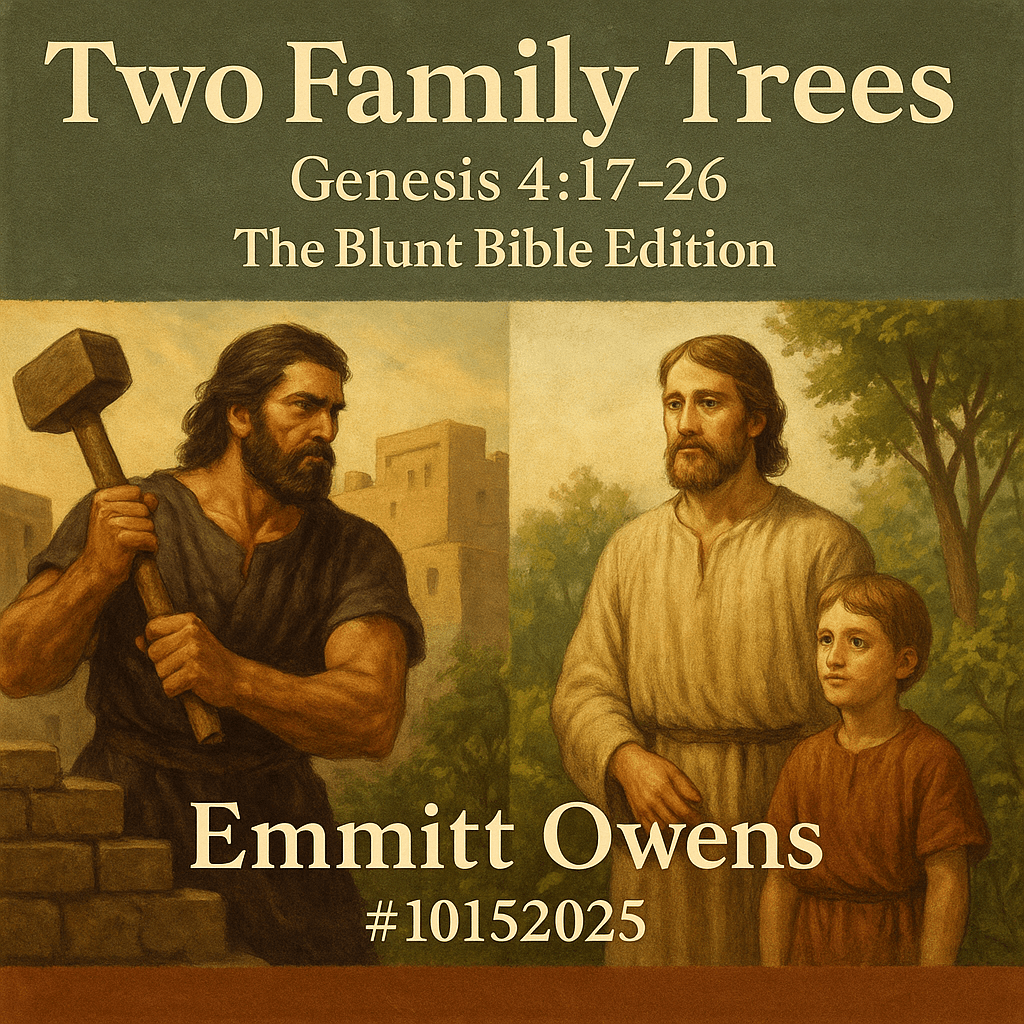
Two Family Trees (Genesis 4:17-26)
The Blunt Bible Edition
By: Emmitt Owens
(Index #10152025)
—–
✍️ Author’s Note:
Writing the Blunt Bible isn’t a linear process for me.
I read. I write. Then I read again. And sometimes, in the middle of writing one chapter, my brain connects back to something from three chapters ago and goes: “Wait, WHAT?”
That happened with the second half of this chapter.
I was writing about Cain’s wife—going back to Genesis 1 to show that God created other humans—and suddenly I had this thought:
If those other humans existed outside the Garden, they never had access to the Tree of Life.
Which means they were always mortal.
Which means Adam and Eve were the ONLY humans with potential immortality.
And then it clicked: Mortality wasn’t the punishment for eating the fruit. Mortality was the default human condition.
The punishment was losing ACCESS to eternal life.
Genesis 3:22 says God kicked Adam and Eve out of the Garden specifically “lest he put forth his hand, and take also of the tree of life, and eat, and live for ever.”
God didn’t MAKE them mortal as punishment. He prevented them from becoming immortal AFTER they gained knowledge of good and evil.
The Genesis 1 humans? They were always going to die.
Adam and Eve? They had a chance at immortality—and lost it.
That’s what the text says. Not tradition. Not interpretation. Just: read Genesis 1, then Genesis 2, then Genesis 3, and notice what’s actually there.
This chapter is where it all connected for me. Where Cain’s wife led me back to Genesis 1, and Genesis 1 made me rethink the entire Fall.
I don’t know if this is what Genesis means. But it’s definitely what Genesis says.
And that’s what the Blunt Bible is about: reading the text as written, even when it raises questions tradition never taught you to ask.
Traditional interpretation says one thing. Metaphorical reading says another. I’m doing text-for-text literal reading—just noticing what’s actually written.
If you disagree with what I see, that’s fine. We’re all looking at the same text. We’re just seeing different things. And as long as we’re being honest (not mocking), that’s what matters.
This is what I see. You might see something else. And that’s okay.
One more thing: I’m not the first person to notice these textual details. Biblical scholars—Jewish, Christian, secular—have been wrestling with Genesis 1 vs. Genesis 2, Cain’s wife, and the two family trees for centuries. Documentary Hypothesis, source criticism, literary analysis—there’s a whole field of study here.
I’m not a scholar. I’m just a careful reader. But I’m standing on the shoulders of people who’ve asked these questions before me. If what I’m seeing resonates with you, there’s a rich tradition of textual study to explore. If it doesn’t, there’s an equally rich tradition of other interpretations.
The Blunt Bible isn’t about having the “right” answer. It’s about reading carefully and thinking honestly. That’s something anyone can do—scholar or not.
Okay. Now let’s talk about Cain’s city.
—–
CAIN GOES TO NOD (Genesis 4:16-17)
Genesis 4:16 (KJV) – “And Cain went out from the presence of the Lord, and dwelt in the land of Nod, on the east of Eden.”
So Cain leaves. Goes to the land of Nod (which “Nod” means “wandering” in Hebrew—ironic, since he’s about to settle down permanently).
A Random Realization:
“Nod” means “wandering” in Hebrew. Which means every time someone says “you’re nodding off,” they’re basically saying you’re wandering off.
Cain was cursed to wander, went to Nod, and immediately built a city.
So next time someone tells me I’m nodding off, I’m saying: “I’m not wandering. I’m settling. Building a city right here on this couch.”
(Genesis has ruined normal conversation for me) lol
Genesis 4:17 (KJV) – “And Cain knew his wife; and she conceived, and bare Enoch: and he builded a city, and called the name of the city, after the name of his son, Enoch.”
And then—casually, like it’s no big deal—Genesis drops this: “And Cain knew his wife.”
—Hold up—
—–
WAIT, WHERE DID CAIN’S WIFE COME FROM?
A note on how Genesis was written: Biblical scholars have long noticed that Genesis 1 and Genesis 2 read differently—different vocabulary, different style, different scope. Genesis 1 is cosmic and structured (‘And God said… and it was so’). Genesis 2 is intimate and detailed (God forming Adam from dust, walking in the Garden). Some scholars think these were originally separate accounts, later woven together. Others see them as intentionally complementary—Genesis 1 gives the big picture, Genesis 2 zooms in on Adam and Eve’s specific story.
I’m not arguing for either view. I’m just noticing that when you read them together, Genesis 1:27-28 already told us there were other humans. ‘Male and female created he them’—plural. ‘Fill the earth’—with people. Multiple people. But Genesis doesn’t explain any of this. It just says “Cain knew his wife” like we’re all supposed to know who that is.
No introduction. No backstory. No “meanwhile, back at the garden, Adam and Eve had a daughter named…”
She just appears.
Traditional explanation: She was Cain’s sister. Adam and Eve had other unnamed daughters, and Cain married one of them.
But let’s go back to Genesis 1.
Genesis 1:27-28 (KJV) – “So God created man in his own image, in the image of God created he him; male and female created he them. And God blessed them, and God said unto them, Be fruitful, and multiply, and replenish the earth…”
Read that again.
“Male and female created HE THEM.” That’s plural. “Replenish the earth.” Fill it up. With people. Multiple people. This doesn’t sound like “God created two people.” This sounds like “God created humanity.”
Then Genesis 2 zooms in:
Genesis 2 gives us the detailed account of Adam being formed from dust and Eve being made from his rib—and it places them specifically in the Garden of Eden.
So here’s what Genesis actually says, in order:
– Genesis 1: God creates humanity (male and female, plural) and tells them to fill the earth
– Genesis 2: God creates Adam and Eve specifically and places them in the Garden of Eden (a specific location)
– Genesis 3: Adam and Eve eat the fruit and get kicked out of the Garden
– Genesis 4: Cain murders Abel, leaves God’s presence, goes to the land of Nod, and finds a wife there
If Genesis 1 describes the creation of humanity broadly, and Genesis 2 describes Adam and Eve in the Garden specifically—then there were other humans living outside Eden the whole time.
That’s where Cain’s wife came from.
That’s who Cain was afraid of when he said “everyone who finds me will kill me” (Genesis 4:14).
That’s who lived in the city he built.
God created humanity (Genesis 1). Adam and Eve were placed in the Garden (Genesis 2). But they weren’t the only people on earth.
The text supports this. Tradition just chose to focus on Genesis 2 and ignore Genesis 1:27-28.
So no, Cain didn’t necessarily marry his sister. He could have married someone from the Genesis 1 human population living outside Eden.
Genesis doesn’t clarify which. But it gives us both options.
—–
CAIN BUILDS A CITY (Genesis 4:17)
Genesis 4:17 (KJV) – “…and he builded a city, and called the name of the city, after the name of his son, Enoch.”
So Cain—the guy who just got cursed to be a “fugitive and a vagabond” (Genesis 4:12)—immediately settles down and builds a permanent city.
God: “You’ll be a restless wanderer.” (nod)
Cain: Builds a city. Names it after his kid.
Either Cain’s really bad at following instructions, or “wanderer” meant something else (spiritually restless? Emotionally homeless? Existentially adrift?).
Genesis doesn’t clarify.
But here’s the question: Who lived in this city? Was it a bustling metropolis with roads and infrastructure? Or was it just Cain, his wife, baby Enoch, and maybe a few relatives with a “Welcome to Enoch, Population: Us” sign?
Genesis says “he builded a city” but gives zero details about size, population, or layout. For all we know, it could’ve been three houses and a fence.
The irony: The first murderer in human history became the first city-builder. The man who couldn’t get his worship accepted by God became the founder of human civilization outside God’s presence. The guy cursed to wander created a place where people could settle.
Make of that what you will. ️
—–
CAIN’S DESCENDANTS INVENT CIVILIZATION (Genesis 4:17-22)
Genesis 4:17-18 (KJV) – “And unto Enoch was born Irad: and Irad begat Mehujael: and Mehujael begat Methusael: and Methusael begat Lamech.”
Genesis lists Cain’s family tree like nothing happened:
– Enoch (Cain’s son—the city’s named after him)
– Irad (Enoch’s son)
– Mehujael (Irad’s son)
– Methusael (Mehujael’s son)
– Lamech (Methusael’s son)
No commentary. No “and God was displeased.” Just genealogy. Cain murdered his brother, and his descendants thrived for multiple generations.
Genesis 4:19 (KJV) – “And Lamech took unto him two wives: the name of the one was Adah, and the name of the other Zillah.”
And here’s Lamech—five generations down from Cain—who becomes the first polygamist in the Bible.
Two wives: Adah and Zillah.
Genesis doesn’t comment on whether this is good, bad, or neutral. Just states it as fact and moves on.
Genesis 4:20-22 (KJV) – “And Adah bare Jabal: he was the father of such as dwell in tents, and of such as have cattle. And his brother’s name was Jubal: he was the father of all such as handle the harp and organ. And Zillah, she also bare Tubalcain, an instructer of every artificer in brass and iron: and the sister of Tubalcain was Naamah.”
Lamech’s kids basically invented everything:
-Jabal (son of Adah) – First livestock herder. Father of those who live in tents and raise cattle. Invented nomadic pastoral life.
-Jubal (son of Adah) – First musician. Father of all who play stringed instruments and flutes. Invented music and the arts.
-Tubal-cain (son of Zillah) – First metalworker. Forged bronze and iron tools. Invented technology (and probably weapons).
-Naamah (daughter of Zillah) – Gets mentioned by name but no accomplishments listed. Thanks for nothing, Genesis.
So let’s recap what Cain’s line gave humanity:
– The first city (Cain)
– Livestock herding (Jabal)
– Music (Jubal)
– Metalworking and tools (Tubal-cain)
Basically, the descendants of the first murderer invented civilization.
Cities. Culture. Technology. The arts.
All from Cain’s family tree.
That’s… deeply uncomfortable. But that’s what the text says.
—–
LAMECH’S MURDER POEM (Genesis 4:23-24)
Genesis 4:23-24 (KJV) – “And Lamech said unto his wives, Adah and Zillah, Hear my voice; ye wives of Lamech, hearken unto my speech: for I have slain a man to my wounding, and a young man to my hurt. If Cain shall be avenged sevenfold, truly Lamech seventy and sevenfold.”
Oh, this is gonna be good. So Lamech—Cain’s great-great-great-grandson—kills somebody.
And he brags about it. In poetry. To his two wives.
“Listen up, Adah and Zillah: I killed a man who wounded me, a young man who hurt me.”
Then he adds: “If Cain gets avenged seven times, I get avenged seventy-seven times.”
So Lamech’s referencing God’s protection of Cain (Genesis 4:15—”whoever kills Cain will be avenged sevenfold”).
And Lamech’s saying: “If God protected Cain that much, I’m ELEVEN TIMES more protected.”
Let’s compare:
– Cain killed out of jealousy. Abel did nothing to him. Cain hid the murder and lied about it when confronted.
– Lamech killed in retaliation (someone hurt him first, apparently). And Lamech **announced** it. In verse form. To his family. Proudly.
Violence didn’t decrease in Cain’s line. It escalated. It got normalized. Even celebrated and there’s no consequence mentioned. No divine judgment. No curse. Lamech just… gets away with it.
Genesis records it and moves on.
And that’s it. No consequences. Nothing.
—–
THE UNCOMFORTABLE TRUTH: INNOVATION ≠ RIGHTEOUSNESS
Let’s pause and notice something Genesis just showed us: The descendants of the first murderer invented everything we associate with civilization:
-Cities (Cain)
-Livestock herding (Jabal)
-Music and the arts (Jubal)
-Metalworking and technology (Tubal-cain)
Meanwhile, violence escalated (Lamech’s murder poem), polygamy appeared (Lamech’s two wives), and not once does Genesis mention anyone in Cain’s line calling on God’s name.
But they built an advanced society. They created culture. They made tools and composed music.
This is deeply uncomfortable if you believe progress equals God’s blessing, or that righteous people should be the ones advancing human civilization.
Genesis says: No. You can build incredible things and still be far from God. You can advance technology, create art, and innovate constantly—and still be spiritually lost.
Cain’s line gave humanity everything we think of as “progress.”
Seth’s line gave us something else.
Both matters. Both shape history. But they are not the same thing.
And Genesis doesn’t moralize about this—it just records it and lets us sit with the discomfort.
—–
MEANWHILE, BACK AT ADAM AND EVE’S: SETH IS BORN (Genesis 4:25-26)
Genesis 4:25 (KJV) – “And Adam knew his wife again; and she bare a son, and called his name Seth: For God, said she, hath appointed me another seed instead of Abel, whom Cain slew.”
Finally, Genesis brings us back to Adam and Eve.
Seth is born.
Eve names him Seth and says: “God has given me another child to replace Abel, whom Cain killed.”
Seth is the replacement son. The one who lived.
Notice the timeline: This happens after Cain’s entire family tree gets listed. By the time Seth is born, Cain’s line has already gone through multiple generations (Enoch → Irad → Mehujael → Methusael → Lamech → Lamech’s kids).
So, Seth isn’t born right after Abel dies. There’s a time gap. Possibly decades.
Genesis 4:26 (KJV) – “And to Seth, to him also there was born a son; and he called his name Enos: then began men to call upon the name of the Lord.”
Seth has a son named Enos.
And then this line: “Then began men to call upon the name of the Lord.”
—Wait—
Does this mean people WEREN’T calling on God’s name before?
Cain and Abel brought offerings. Adam and Eve walked with God in the Garden. But apparently, formal public worship—invoking God’s name—starts here.
With Seth’s line. Not Cain’s.
Why?
Genesis doesn’t say.
But the contrast is stark:
-Cain’s line: Built cities. Invented music. Created tools. Never mentioned calling on God at all.
-Seth’s line: Began to call upon the name of the Lord. No physical inventions mentioned.
Two family trees. Two legacies. Two priorities.
—–
THE ACTUAL MORALS
1. Genesis 1 already told us there were other humans – “Male and female created he them” (Genesis 1:27). Cain’s wife likely came from that population, not necessarily from Adam’s family.
2. The Garden was a specific place, not the whole world – Genesis 2 places Adam and Eve in Eden. Genesis 1 describes humanity filling the earth. Different scopes.
3. Cursed doesn’t mean destroyed – Cain was cursed, exiled, and marked. His line still thrived for generations and invented civilization.
4. Violence escalates – Cain killed secretly and lied. Lamech killed and bragged in poetry. Sin doesn’t shrink—it grows bolder.
5. Progress ≠ righteousness – Cain’s line gave the world cities, music, and metalworking. But they never called on God’s name. You can build incredible things and still be far from God.
6. Different families, different values:
-Cain’s line: innovation and culture.
-Seth’s line: worship and calling on God.
Both existed. Both mattered. But they weren’t the same.
7. Genesis doesn’t always moralize – Lamech’s polygamy and murder are recorded without commentary. Sometimes the Bible just reports what happened and lets you figure out what to think.
—–
THE WEIRDEST PARTS
– Cain’s wife just appears – but if you go back to Genesis 1:27-28, it makes sense
– Cain builds a city right after being cursed to wander – peak “I do what I want” energy
– The murderer’s descendants invent civilization – cities, arts, technology—all from Cain’s line
– Lamech becomes the first polygamist – Genesis doesn’t comment on it
– Lamech writes a murder poem – and brags about being more protected than Cain (He is assuming that he’s protected, God never told him that he was protected)
– Seth is born way later – Cain’s line has multiple generations before Seth shows up
– “Then began men to call upon the name of the Lord” were they not doing that before? What changed?
– Naamah gets mentioned but no explanation – “and the sister of Tubal-cain was Naamah.” Okay… and?
—–
TL;DR
Cain leaves Eden, goes to Nod, gets married (probably to someone from the Genesis 1 human population), has a son named Enoch, and builds the first city. His descendants invent livestock herding, music, and metalworking—basically all of human culture and technology. Lamech (Cain’s descendant) becomes the first polygamist, kills someone, and brags about it in a poem. Meanwhile, Adam and Eve have Seth (Abel’s replacement), and Seth’s son Enos starts the tradition of calling on God’s name. Two family lines: Cain’s builds civilization, Seth’s builds worship. ⚒️
—–
Why This Matters
This chapter shows us something important: innovation and brokenness coexist.
Cain’s line—descended from the first murderer—gave humanity cities, music, and tools. They advanced culture and technology.
But they also escalated violence (Lamech’s murder poem) and never called on God.
Seth’s line began a new spiritual practice in Genesis: calling upon the name of the Lord.
What does that tell us?
-That progress isn’t the same as righteousness.
-That you can build incredible things and still be spiritually lost.
-That some legacies prioritize innovation, others prioritize faith—and both shape the world, but they’re not the same thing.
And here’s the question this chapter forces: If Genesis 1 created other humans, and Genesis 2 focused on Adam and Eve in the Garden—what was the Garden for?
-Was it a test? (They failed.)
-Was it a starting point for a specific lineage? (Adam → Seth → those who call on God’s name.)
-Was it the place where God walked directly with humans? (And after the Fall, that ended.)
Genesis doesn’t spell it out.
But this chapter makes one thing clear: There was a world outside Eden. There were people beyond the Garden. And when Cain left, he joined them.
The story is bigger than Sunday school taught us.
And it’s all right there—in Genesis 1. ✨
The Importance of Genealogy:
Genesis spends a LOT of time on genealogy. Who descended from whom. What family line you’re part of.
This might seem boring (and honestly, sometimes it is—long lists of names we can barely pronounce). But it mattered to them. And it still matters to us.
Your family line shapes you. Not just genetically, but culturally. The values passed down. The patterns repeated. The legacy you inherit—for better or worse.
Cain’s line passed down innovation, culture, and technology. But also violence, pride, and distance from God.
Seth’s line passed down worship. Calling on God’s name. Faith.
Why does Genesis spend so much time on this?
In the ancient world, genealogy wasn’t just family trivia—it was identity. Your lineage determined your inheritance, your tribal affiliation, your covenant status, your legal standing. To be “cut off” from your people was one of the worst fates imaginable.
Genesis tracks these family lines because it’s answering the question: Who are God’s people? The line from Adam → Seth → Noah → Abraham → Isaac → Jacob becomes the covenant lineage. Luke 3:23-38 traces Jesus all the way back through Seth to Adam to God Himself—showing that this genealogy mattered for thousands of years.
But there’s also a human element here. Genesis shows us that families pass down more than DNA—they pass down values, patterns, and legacies. Cain’s line inherited innovation and violence. Seth’s line inherited worship. Both shaped human history.
Which brings us to us: What legacy are you passing down?
What will your descendants say about your family tree? That you built things? That you called on God? Both? Neither?
Genealogy isn’t just about the past. It’s about what you’re creating for the future.
Genesis tracks family lines because legacy matters. What you do echoes through generations.
Cain’s line invented civilization—and we’re still living in it.
Seth’s line called on God’s name—and that tradition continued through Abraham, Isaac, Jacob, and eventually Jesus (Luke 3:23-38 traces Jesus back to Seth, then Adam, then God).
Your family tree matters. What you’re adding to it matters even more. ❤️
—–
A Thought I Didn’t Have Until Now:
God kicked Adam and Eve out of the Garden specifically so they wouldn’t eat from the Tree of Life and “live forever” (Genesis 3:22).
But… they did live forever.
Not biologically. Not the way the Tree of Life would have done it. But their story? Their names? Known across the entire world. Told in every language. Remembered for thousands of years.
There’s a profound irony here: God blocked one kind of immortality (biological), but their narrative became eternal anyway. Every person who reads Genesis knows their names. Their choices echo through millennia of human thought, art, theology, and culture.
This isn’t unique to Adam and Eve—it’s a pattern throughout Genesis. Abraham, Isaac, Jacob—their stories outlived their bodies. In some ways, narrative immortality is more powerful than biological immortality. A tree in a garden could have kept them alive. But their story? It made them known.
Genesis is deeply concerned with names, genealogies, and legacies—who remembers you, whose line you’re part of, what story you leave behind. Maybe that’s its own kind of Tree of Life.”
—–
✍️ Personal Reflection
Writing these chapters has changed the way I read the Bible.
I grew up learning scripture through layers of metaphor — stories told about the stories, lessons already interpreted for me. What I’m doing now feels different. It’s slower, messier, and way more honest.
Re-reading Genesis line by line, and re-writing it in my own words, has forced me to actually see what’s there — not what I was told to see. Some of it confirms what I was taught. Some of it completely upends it. But all of it makes me think deeper than I ever have before.
I’m learning that scripture doesn’t need to be dressed up to be powerful. Sometimes just reading what’s actually written is enough to change everything you thought you knew.
For me, that’s the real gift of this project. I’m not just explaining the Bible — I’m rediscovering it.
And I’ve never been more excited to keep going.

 TumbleDweeeb
Leave a comment