
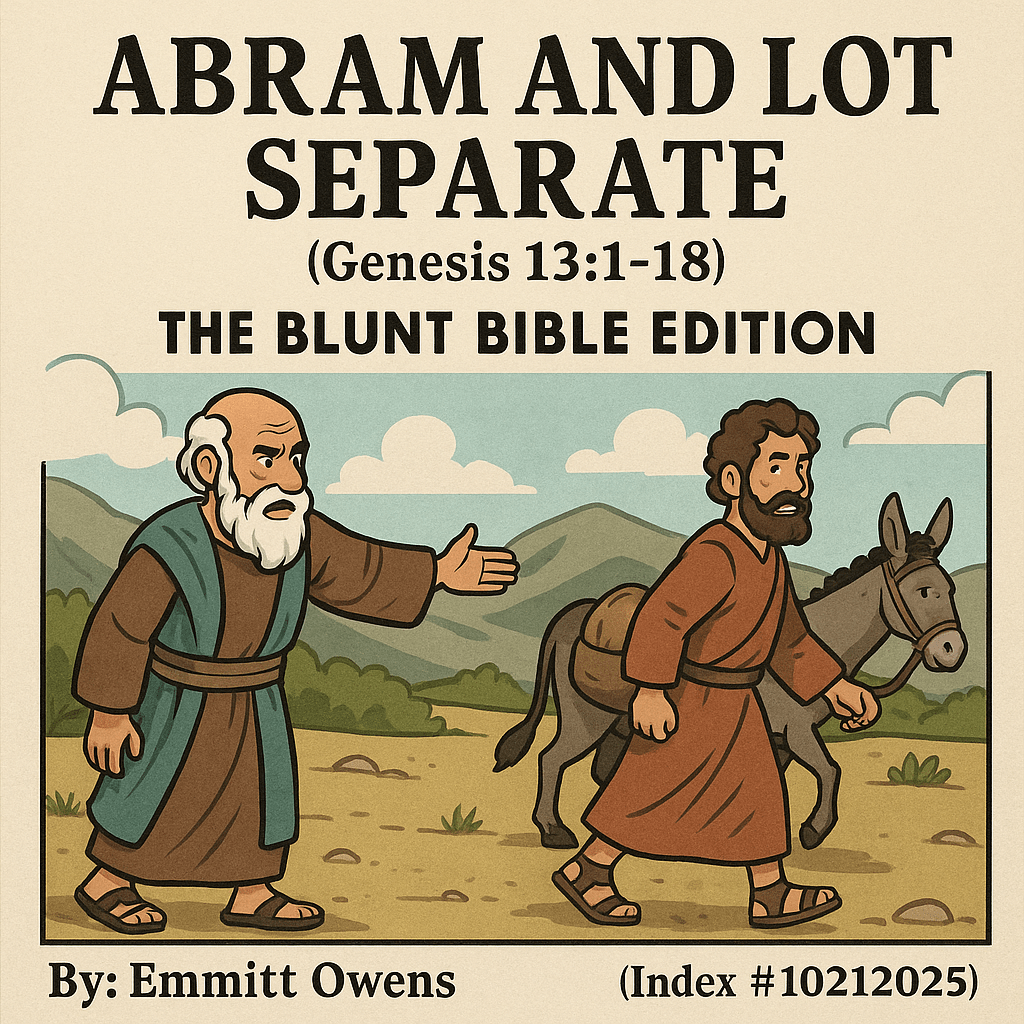
ABRAM AND LOT SEPARATE (Genesis 13:1-18)
The Blunt Bible Edition
By: Emmitt Owens
(Index #10212025)
Lot chooses by sight. Abram trusts a sentence from God.
—–
✍️ Author’s Note:
I’ve always let everyone have first choice of anything.
All my life.
You pick where we eat. You choose the movie. You take the better seat. You get the promotion. You decide.
I’ll take whatever’s left.
It’s not that I’m noble. It’s not that I’m some saint of generosity.
I just learned early: my needs come last. My preferences don’t matter as much. If I make myself small enough, maybe there will be less conflict. Less disappointment. Less risk of being told “no, not you.”
So I step back. I let others choose first.
Every. Single. Time.
And I tell myself it’s fine. I tell myself it’s generosity. I tell myself God will provide.
But sometimes—late at night, when I’m honest—I wonder: Was it faith? Or was it fear?
Was I trusting God? Or was I just erasing myself to keep the peace?
This is the story of Abram and Lot separating. Abram—the elder, the one with God’s promise—offers Lot first choice of the land. Lot takes the best without hesitation. Abram gets the leftovers.
And God shows up after Lot leaves and says: “Actually, all of this is yours.”
I don’t know if that’s happened for me yet.
But I know what it feels like to always let everyone else choose first.
Let’s talk about Genesis 13.
—–
PART 1: RETURNING FROM EGYPT (Genesis 13:1-4)
Abram Comes Back—Rich but Disgraced
Genesis 13:1-2 (KJV) – “And Abram went up out of Egypt, he, and his wife, and all that he had, and Lot with him, into the south. And Abram was very rich in cattle, in silver, and in gold.”
The Return:
Abram leaves Egypt.
Not triumphantly. Not victoriously.
He was kicked out (Genesis 12:20).
Pharaoh discovered Abram’s lie, confronted him—”What have you done to me?”—and deported him.
This is not a hero’s return. This is a walk of shame.
With luggage.
Lots of luggage.
But Abram leaves wealthy:
– Cattle
– Silver
– Gold
– Servants (including Hagar—whose story will matter later)
– All the gifts Pharaoh gave him before discovering the deception
Blessed on paper, disgraced in practice.
Abram profited from his lie. Got rich from putting his wife in Pharaoh’s harem. Kept everything even after being exposed.
This is not a clean victory.
This is walking away from a dumpster fire with your pockets full.
“Well, I lied, nearly lost my wife, got exposed by a pagan king, and was deported… but hey, free camels.”
Not exactly the testimony you want to share at Sunday service.
And Lot was there for all of it.
Lot saw Abram lie. Saw him profit. Saw him get kicked out—and keep the loot.
Lot learned: deception can be profitable.
(Remember that. It’s going to matter when Lot makes his own terrible decisions later.)
—–
Genesis 13:3-4 (KJV) – “And he went on his journeys from the south even to Bethel, unto the place where his tent had been at the beginning, between Bethel and Ai; Unto the place of the altar, which he had made there at the first: and there Abram called on the name of the Lord.”
Abram returns to Bethel.
This is significant.
Bethel = “House of God”
This is where Abram built an altar BEFORE going to Egypt (Genesis 12:8).
Before the famine. Before the fear. Before the lie. Before Pharaoh yelled at him.
Abram is retracing his steps.
Going back to where he was before he messed up.
Back to the altar. Back to worship. Back to calling on the name of the Lord.
This is repentance without the word “repentance.”
Abram doesn’t explicitly confess his sin. Genesis doesn’t record a tearful apology tour.
No “I’m sorry for lying about my wife, profiting from deception, and getting us kicked out of Egypt.”
Just: he goes back to the altar.
He returns to the place where he worshiped before fear took over and made him do something spectacularly stupid.
Sometimes repentance looks like returning to where you were before you lost your way.
Retracing your steps.
Going back to the last place you knew you were following God, and starting over from there.
Abram’s basically doing a spiritual U-turn.
“Okay, Egypt was a disaster. Let’s pretend that didn’t happen and start from Bethel again.”
(Spoiler: God’s cool with that.)
—–
PART 2: THE CONFLICT (Genesis 13:5-7)
Too Much Wealth, Not Enough Land
Genesis 13:5-6 (KJV) – “And Lot also, which went with Abram, had flocks, and herds, and tents. And the land was not able to bear them, that they might dwell together: for their substance was great, so that they could not dwell together.”
The Problem:
Both Abram and Lot are now wealthy.
Lots of livestock. Lots of herds. Lots of tents. Lots of people.
And the land can’t support both of them.
The “we’re too successful” problem.
This is what rich people call a “good problem to have.”
But it’s still a problem.
Not enough resources for everyone.
This is the setup for every family conflict ever:
– Not enough inheritance for all the siblings
– Not enough attention from parents
– Not enough space in the house
– Not enough prime grazing land for both mega-ranches
When there’s not enough, people fight.
Even—especially—when there’s technically plenty.
Because it’s never really about the resources.
It’s about pride. Territory. Who gets the better deal.
A tale as old as time.
—–
Genesis 13:7 (KJV) – “And there was a strife between the herdmen of Abram’s cattle and the herdmen of Lot’s cattle: and the Canaanite and the Perizzite dwelled then in the land.”
The herdsmen start fighting.
Not Abram and Lot directly. Their employees.
Fighting over:
– Water rights
– Grazing land
– Space for the flocks
– Whose cattle get to drink first
– Petty territorial nonsense
Classic middle management conflict.
The bosses are fine. The workers are throwing hands.
And here’s the kicker:
“The Canaanite and the Perizzite dwelled then in the land.”
Translation: They’re fighting in front of the neighbors.
The people who actually LIVE in the Promised Land—the ones who were here first—are watching Abram’s family drama unfold like it’s reality TV.
Maximum awkwardness.
God promised to bless Abram so that all nations would be blessed through him (Genesis 12:3).
But right now? The nations are watching Abram’s family tear itself apart over cattle and water rights.
Not exactly a great witness.
“Come see how God’s people handle conflict! (Spoiler: just like everyone else, but with more livestock.)”
When God’s people fight publicly, it damages the witness.
This is true in Genesis 13. It’s true today.
Nothing says “we’re different because of God” like a very public family meltdown over resources.
The Canaanites are eating popcorn watching this unfold.
“What looks prosperous isn’t always what’s blessed.”
—–
PART 3: ABRAM’S SOLUTION (Genesis 13:8-9)
“You Choose First”
Genesis 13:8 (KJV) – “And Abram said unto Lot, Let there be no strife, I pray thee, between me and thee, and between my herdmen and thy herdmen; for we be brethren.”
Abram steps in.
“Let there be no strife between us. We’re family.”
Abram prioritizes peace over possessions.
He could have pulled rank:
– “I’m the elder. I decide.”
– “God gave ME the promise, not you.”
– “I brought you along. You’re here because of me.”
He doesn’t.
Instead, he says: “We’re brethren. Let’s not fight.”
—–
Genesis 13:9 (KJV) – “Is not the whole land before thee? separate thyself, I pray thee, from me: if thou wilt take the left hand, then I will go to the right; or if thou depart to the right hand, then I will go to the left.”
Abram’s Solution:
“The land is big. Let’s separate. You choose first. Whatever you pick, I’ll take what’s left.”
Let that sit.
Abram is:
– The elder (seniority = authority in ancient culture)
– The one with God’s promise (literally chosen by God)
– The one who brought Lot along (Lot’s here because of Abram)
– The one with all the leverage
And he offers Lot first choice.
This is radical generosity.
Or is it?
Because here’s the other way to read this:
This is conflict avoidance.
Abram doesn’t want to fight. He just got back from Egypt where he made a mess of everything. He’s probably tired. His reputation is shaky. His herdsmen and Lot’s herdsmen are brawling in front of the Canaanites.
So he gives Lot whatever he wants to make it stop.
“Just pick. I don’t care. Whatever ends this drama.”
Is that faith? Or is that fear?
Is Abram trusting God will provide no matter what Lot picks?
Or is Abram just exhausted from conflict and willing to give away prime real estate to avoid another confrontation?
Is this generosity? Or is this “I’ll do anything to not have this conversation”?
Genesis doesn’t say.
But the text leaves room for both interpretations.
Maybe it’s faith. Maybe it’s fatigue. Maybe it’s both.
In real life, motives tangle. God can honor the faithful part while healing the fearful part.
Welcome to the complexity of human motivation.
But I know the feeling.
The “just take it, I don’t want to fight” feeling.
The “you choose, I’ll be fine with whatever’s left” instinct.
Is it trust in God? Or is it just easier than standing up for yourself?
That’s the question Abram doesn’t answer.
And neither do I.
—–
What “You Choose First” Actually Feels Like: All My Life
Before we get to Lot’s choice, I need to tell you what this moment feels like when it’s not just one decision.
When it’s a lifetime pattern.
I’ve always let everyone have first choice of anything.
All my life.
You pick where we eat. You choose the movie. You take the better seat. You get the opportunity. You go first.
I’ll take whatever’s left.
I learned early: my needs come last.
If I make myself small enough, maybe there will be less conflict. Less disappointment. Less risk of being rejected.
So I step back. Every. Single. Time.
And I tell myself it’s generosity. Humility. Faith.
But late at night, I wonder: Was it faith? Or was it fear?
Was I trusting God? Or just erasing myself because I didn’t think I deserved first choice?
—–
Here’s the part that stings:
Rarely does someone say “No, YOU choose first this time.”
They just take. Like Lot.
Without asking if I’m okay with the leftovers. Without noticing I always step back.
And I’m left in the hill country, telling myself God will provide.
But what if God wanted me to choose first sometimes?
—–
But here’s the thing: being chosen second never bothered me.
In dating, in jobs, in opportunities—if I was chosen first, that’s a blessing.
If someone else was chosen before me, that’s a blessing too.
I’ve never taken it personally when I wasn’t chosen.
Not because I’m naive. Not because I’m pretending rejection doesn’t exist.
But because I believe there are always blessings in everything and reasons why it happens in that manner.
Not because I’m settling. Not because I’m telling myself the leftovers are fine.
But because I trust that God’s in control of the order.
Lot picked first. Abram got second choice.
And God showed up for Abram anyway.
The order didn’t matter. The Provider did.
When someone chooses someone else over me—whether it’s a relationship, a job, an opportunity—I don’t see it as rejection.
I see it as redirection.
Maybe that person wasn’t supposed to be mine. Maybe that job would have destroyed me. Maybe that opportunity would have led me toward my own Sodom.
Maybe being chosen second is protection I don’t see yet.
So no, being second never bothered me.
Because I trust God’s ordering the choices.
And wherever I land—first, second, last—He’s there.
—–
But here’s what I’ve learned:
It works out.
Almost every time I choose last, it works out positively.
I don’t know if it’s faith driving me to step back. I don’t know if it’s fear making me small.
But I do know this: whatever I’m supposed to have comes eventually.
Even if it takes longer. Even if I have to wait.
It comes.
And if it never comes? I’ve learned to see that as confirmation: it was never supposed to be mine.
Not every well-watered plain is meant for me. Some of them are near Sodom.
Choosing last has protected me from more disasters than I probably realize.
So maybe it’s not faith. Maybe it’s not fear.
Maybe it’s the learned wisdom of someone who’s watched God show up after everyone else has taken their pick.
And He does. Almost every time.
“Proximity becomes presence; presence becomes participation.”
—–
PART 4: LOT’S CHOICE (Genesis 13:10-13)
Lot Takes What Looks Best Without Hesitation
Genesis 13:10 (KJV) – “And Lot lifted up his eyes, and beheld all the plain of Jordan, that it was well watered every where, before the Lord destroyed Sodom and Gomorrah, even as the garden of the Lord, like the land of Egypt, as thou comest unto Zoar.”
Lot surveys the options.
He looks around and sees:
– The plain of Jordan
– Well-watered everywhere
– Like the garden of Eden (Genesis literally says this)
– Like Egypt (where they just came from, where everything was lush and prosperous—and where they got kicked out, but Lot’s apparently not dwelling on that part)
It looked GOOD.
Fertile. Prosperous. Beautiful. Abundant.
The Instagram-worthy land.
The kind of place you take a photo of and caption “Blessed ✨ #GodIsGood #Abundance”
Meanwhile, the hill country Abram’s getting? Rocky. Less water. Less impressive.
Not exactly postcard material.
Lot chose based on appearance.
Not on God’s direction. Not on wisdom. Not on “where should I go?”
Not even on “hey, maybe I should ask Uncle Abram if he’s sure about this.”
Just: “That looks good. I’ll take that.”
Zero hesitation. Zero discernment. All vibes.
Lot picked the place that looked best on paper.
Turns out, the fine print was a nightmare.
—–
Genesis 13:11-12 (KJV) – “Then Lot chose him all the plain of Jordan; and Lot journeyed east: and they separated themselves the one from the other. Abram dwelled in the land of Canaan, and Lot dwelled in the cities of the plain, and pitched his tent toward Sodom.”
Lot’s Decision:
“I’ll take the plain of Jordan.”
No hesitation. No “Are you sure, Uncle Abram?” No “Let me pray about it.”
Abram offers first choice. Lot takes it. Done.
Fastest land deal in Genesis.
“Cool, I’ll take the good stuff. Thanks!”
And off he goes.
And where does Lot go?
He “pitched his tent toward Sodom.”
Toward.
Not IN Sodom yet. But moving in that direction.
Like someone who says “I’m not going to the casino, I’m just staying at the hotel next door.”
Sure, Lot. Sure.
Genesis 13:12 says he “dwelled in the cities of the plain” and “pitched his tent toward Sodom.”
By Genesis 14, he’s living IN Sodom.
By Genesis 19, he’s sitting at the city gate (a position of authority/influence in Sodom).
This is the slow slide.
Step 1: “I’ll just pitch my tent *near* the sketchy city.”
Step 2: “Okay, I’m living in the sketchy city, but I’m not *like* them.”
Step 3: “I’m a respected leader in the sketchy city and my daughters are engaged to locals.”
Step 4: Angels show up to destroy the sketchy city and you barely escape with your life.
We do this all the time:
“I’ll just take this job at the ethically questionable company—I won’t adopt their values.”
(Three years later: you’re defending their practices in meetings.)
“I’ll just date this person who doesn’t share my faith—I won’t compromise my convictions.”
(Six months later: you’re skipping church to keep the peace.)
“I’ll just stay in this friend group that gossips constantly—I won’t participate.”
(A year later: you’re the one sharing the stories.)
“I’ll just move closer to the nightlife—I won’t get pulled into that scene.”
(Two years later: your calendar revolves around it.)
Lot didn’t wake up one day fully compromised.
He took small steps toward Sodom. Each one seemed fine. Each one felt manageable.
Pitched his tent toward it. Moved closer. Settled in. Gained influence. Defended the city when judgment came.
Proximity becomes presence. Presence becomes participation. Participation becomes identity.
You don’t realize you’re sitting at the gate of Sodom until angels show up to destroy it.
Lot didn’t just pick the good land. He picked proximity to wickedness.
And it cost him everything.
But hey, the land looked nice.
—–
Genesis 13:13 (KJV) – “But the men of Sodom were wicked and sinners before the Lord exceedingly.”
Genesis pauses to note:
The land Lot picked? Beautiful. Prosperous. Well-watered. Garden-of-Eden-level gorgeous.
The people living there? Wicked and sinners before the Lord exceedingly.
Not just “sinners.” Not just “wicked.”
Exceedingly wicked and sinners.
Genesis is really emphasizing this point.
Like: “In case you missed it, Sodom is BAD. Really bad. Excessively bad.”
Lot chose based on what looked good.
-He ignored (or didn’t care about, or didn’t think it mattered) what was actually happening there.
-He picked a beautiful neighborhood with terrible neighbors.**
The curb appeal was 10/10.
The community values were 0/10.
What looks prosperous isn’t always what’s blessed.
The well-watered plain was full of wickedness.
The hill country Abram got? That’s where God’s promise would unfold.
Appearance vs. Reality.
Lot picked appearance. It was shiny. Impressive. Fertile.
Abram got reality. It looked like leftovers. But it was the place where God would actually show up and say “All of this is yours.”
Lot got the Instagram post.
Abram got the promise.
Guess which one mattered more in the long run.
“Faith leaves footprints; worship leaves altars.”
—–
PART 5: GOD REAFFIRMS THE PROMISE TO ABRAM (Genesis 13:14-18)
After Lot Leaves, God Shows Up
Genesis 13:14-15 (KJV) – “And the Lord said unto Abram, after that Lot was separated from him, Lift up now thine eyes, and look from the place where thou art northward, and southward, and eastward, and westward: For all the land which thou seest, to thee will I give it, and to thy seed for ever.”
Timing is everything.
God doesn’t show up to reaffirm the promise until AFTER Lot leaves.
-After Abram gives away what looked like the better land.
-After Lot takes first choice and walks away with the well-watered plain.
-After Abram is left standing in the rocky hill country with the “leftovers.”
THEN God shows up.
Classic divine timing.
Where was God during the negotiation? Silent.
Where was God when Lot was surveying the options? Nowhere.
Where was God when Lot picked the best land and walked away? MIA.
But the moment Lot is gone and Abram’s stuck with the hill country?
God appears.
And says:
“Lift up your eyes. Look north, south, east, west. ALL of this is yours. Not just the hill country. Not just the leftovers. Not just the part Lot didn’t want. All of it. Forever. For you and your descendants.”
Abram gave away the plain of Jordan.
God gave him the entire land.
Including, presumably, the plain Lot just took. (Awkward.)
Lot picked what looked best in the moment.
Abram got what God promised for eternity.
That’s the difference between sight and faith.
Lot chose based on what he could see with his eyes: “That looks fertile and prosperous.”
Abram trusted what God said—even when it didn’t look as good, even when it seemed like he got the worse deal.
And God showed up after the choice was made to say: “You didn’t lose anything. I’m giving you everything.”
That’s how God works.
-He doesn’t always show up before the hard decision.
-He shows up after you’ve already chosen to trust Him.
And then He says: “Good. Now let me show you what I’ve been holding for you this whole time.”
—–
Genesis 13:16 (KJV) – “And I will make thy seed as the dust of the earth: so that if a man can number the dust of the earth, then shall thy seed also be numbered.”
God doubles down on the promise:
“Your descendants will be like the dust of the earth. Countless. Innumerable. Try to count dust. You can’t. That’s how many kids you’re going to have.”
Abram still has zero children.
Sarai is still barren.
Abram is 75+ years old at this point.
But God says: “Your offspring will be like dust. Uncountable.”
Math status: still not mathing.
God’s doing that thing again where He promises something physically impossible and expects Abram to just nod and say “Sounds good.”
And Abram does.
Because at this point, what else is he going to do? Argue with God about biology?
“Actually, Lord, Sarai and I have been trying for decades and—”
God: “Dust. Like dust. Got it? Good.”
But the promise is real.
Even when the math doesn’t work.
—–
Genesis 13:17-18 (KJV) – “Arise, walk through the land in the length of it and in the breadth of it; for I will give it unto thee. Then Abram removed his tent, and came and dwelt in the plain of Mamre, which is in Hebron, and built there an altar unto the Lord.”
God tells Abram: “Walk through the land. Length and breadth. It’s yours.”
Not Lot’s. Not the Canaanites’. Yours.
Even though you don’t own a single square foot of it yet.
Even though you just gave away what looked like the best part.
Walk through it. Claim it spiritually before you own it physically.
Abram’s Response: He moves to Hebron.
And builds another altar.
The altar pattern continues.
Every major moment in Abram’s journey: he builds an altar.
Shechem (Genesis 12:7). Bethel (Genesis 12:8). Back to Bethel after Egypt (Genesis 13:4). Now Hebron (Genesis 13:18).
Altars = worship = remembering who’s in control.
Not me. Not my choices. Not my strategy.
God.
—–
The Morals
1. Conflict in community is inevitable, but fighting in public damages the witness – Abram and Lot’s herdsmen fought while the Canaanites watched
2. Peace is worth pursuing, even at personal cost – Abram prioritized relationship over possessions
3. Choosing based on appearance is dangerous – Lot picked what looked good; it was near Sodom
4. “What looks prosperous isn’t always what’s blessed” – Well-watered plain = wicked city
5. Generosity doesn’t cost you when God is your provider – Abram gave away the “better” land; God gave him everything
6. God reaffirms His promises after acts of faith – After Abram gives Lot first choice, God shows up
7. Letting others choose first can be faith—or fear – Abram’s choice was generous, but was it also conflict avoidance?
8. Walking through the promise before you own it is an act of faith – Abram claimed the land spiritually before possessing it physically
9. Altars mark moments of remembering God’s faithfulness – Every crisis, every transition: Abram builds an altar
10. The difference between sight and faith: Lot chose what he could see; Abram trusted what God said
11. Proximity to wickedness is a slow slide – Lot “pitched his tent toward Sodom,” then lived in Sodom, then nearly died there
12. Sometimes God waits to show up until after you’ve let go – The promise came after Lot left with the “better” land
—–
The Weirdest Parts
– Abram returns from Egypt richer but disgraced – Blessed materially, compromised morally
– Lot learned from Abram’s lie – Saw deception profit, will repeat the pattern later
– Abram goes back to Bethel – Retracing steps, returning to the altar (repentance without the word)
– The land can’t support both Abram and Lot – Success creates new problems
– Abram offers first choice to Lot – The elder giving the younger authority to decide
– Lot picks without hesitation – No “Are you sure?” Just takes the best immediately
– “Pitched his tent toward Sodom” – The beginning of a slow slide into disaster
– God shows up AFTER Lot leaves – Timing matters
– God gives Abram ALL the land – Not just the leftovers, everything
– Abram still has zero children – Promise of countless descendants, current descendants: none
– “Walk through the land” – Claim it before you own it (faith move)
– Another altar at Hebron – The altar-building pattern continues
—–
Why This Still Matters Today
Choosing Based on Appearance vs. Trusting God’s Direction
Lot looked at the land and picked what looked best.
Fertile. Prosperous. Well-watered. Beautiful.
He didn’t ask: “Is this where God wants me?” He just saw what looked good and took it.
We do this all the time:
– The job that pays more but costs your soul
– The relationship that looks good on paper but feels wrong in your gut
– The opportunity that seems perfect but leads toward compromise
What looks prosperous isn’t always what’s blessed.
Lot got the well-watered plain. And Sodom. And disaster.
Abram got the hill country. And God’s promise. And everything.
The question isn’t “What looks best?” It’s “Where is God leading?”
—–
The Danger of Proximity to Wickedness
Lot didn’t move into Sodom immediately.
He “pitched his tent toward Sodom.”
Genesis 13:12 – moving toward it.
Genesis 14 – living in it.
Genesis 19 – sitting at the gate (position of authority).
It’s a slow slide.
You don’t wake up one day fully compromised. You take small steps toward wickedness, and before you know it, you’re sitting at the gate of Sodom, defending the city’s honor while angels come to destroy it.
Proximity matters.
Who you’re near. What you’re moving toward. The direction you’re drifting.
Lot’s choice of land determined his proximity to wickedness.
And it almost cost him everything.
—–
Generosity Doesn’t Cost You When God Is Your Provider
Abram gave away what looked like the better land.
Lot took first choice and walked away with the plain of Jordan.
And then God showed up and said: “Actually, all of this is yours.”
Abram’s generosity didn’t cost him anything.
Because God was his provider, not the land.
When you trust God, giving doesn’t deplete you. It positions you for blessing.
Abram gave Lot first choice.
God gave Abram everything.
That’s how it works when you trust the Provider more than the provision.
—–
The Pattern of Always Letting Others Choose First
For me, this story isn’t just about one generous moment.
It’s about a lifetime pattern of always stepping back.
Always letting others choose first.
Always taking the leftovers.
And telling myself it’s faith.
But is it?
Was Abram trusting God? Yes.
Was he also avoiding conflict? Maybe.
Am I trusting God when I let everyone else choose first?
Or am I just afraid of being seen as selfish?
Afraid of asking for what I want and being told “no”?
Afraid of taking up space?
I don’t have the answer yet.
But I know this: God showed up for Abram after he let Lot choose first.
I’m still waiting for that moment in my story.
Still standing in the hill country, watching everyone else take the well-watered plains.
Still telling myself: “God will provide.”
And maybe He will.
Or maybe He’s waiting for me to stop erasing myself and actually ask for what I need.
I don’t know.
But I know what Genesis 13 feels like when it’s not just one decision.
When it’s a lifetime of “you choose first.”
And I know what it feels like to wonder: Was I faithful like Abram? Or was I just afraid to be seen?
—–
God Shows Up After You Let Go
The timing in Genesis 13 is critical.
God doesn’t reaffirm the promise before Abram offers Lot first choice.
He shows up after Lot leaves.
After Abram lets go.
After the “better” land is gone.
Then God says: “All of this is yours.”
Sometimes God waits until after you’ve let go to show you what He’s been holding for you.
Not because He’s cruel.
Because He’s teaching you: Your provision comes from Me, not from what you’re clinging to.
Abram had to let go of the well-watered plain to receive the promise of the entire land.
What are you holding onto that God’s asking you to release?
Maybe it’s not about losing something.
Maybe it’s about making space for God to give you everything.
—–
TL;DR
Abram returns from Egypt wealthy but disgraced. Both he and Lot have so much livestock that the land can’t support them. Their herdsmen start fighting. Abram offers Lot first choice of land to keep the peace. Lot picks what looks best—the well-watered plain near Sodom. Abram gets the leftovers—the hill country of Canaan.
After Lot leaves, God shows up and tells Abram: “Actually, ALL of this land is yours. Forever. Walk through it. Your descendants will be countless.”
Abram moves to Hebron and builds another altar.
The Lesson:
Lot chose based on what looked good. Abram trusted what God said. Lot got the prosperous-looking land near wickedness. Abram got the promise of everything. Generosity doesn’t cost you when God is your provider. But the question remains: When you always let others choose first, is it faith or fear? ✨
—–
Final Reflection
Genesis 13 is about separation, generosity, and trust.
Abram lets Lot choose first. Lot takes the best. Abram gets what’s left.
And God shows up and says: “You didn’t lose anything. I’m giving you everything.”
That’s the promise.
And here’s what I’ve realized: I’ve spent my whole life letting everyone else choose first.
And here’s what I’ve learned: God shows up.
Not always immediately. Not always obviously.
But almost every time I’ve stepped back and let someone else take first choice, what I got—even if it came later, even if it looked smaller—**worked out better**.
Not always what I wanted. But what I needed.
I don’t know if that’s faith or fear driving me to choose last.
But I do know: it works.
And when it doesn’t come—when I don’t get what I thought I wanted—I’ve learned to see that as grace too.
Maybe that was my Sodom. Maybe God protected me by giving it to someone else.
But here’s the tension I can’t resolve: Maybe God has been faithful even when I was operating out of fear.
Maybe He’s been showing up all along—every time I chose last and somehow ended up with exactly what I needed.
But maybe the lesson isn’t “keep choosing last.”
Maybe the lesson is: “Learn when to choose first.”
Because here’s the question I can’t shake: What if God’s been providing in spite of my pattern, not because of it?
What if there are well-watered plains He’s wanted to give me, but I keep stepping back before He can?
What if I’ve been so busy making myself small that I never walked through the land God was offering?
Abram let Lot choose first. God gave Abram everything.
But Abram didn’t make that choice out of fear. He made it out of faith and strategic peace-keeping.
I’ve been making it out of both. And I don’t know how to untangle them.
So maybe the real question isn’t: “Has God been faithful?” (Yes. He has. The evidence is undeniable.)
The real question is: “Am I still supposed to keep choosing last?”
Or is God waiting for me to learn that sometimes—not always, but sometimes—I’m allowed to choose first?
That taking up space isn’t selfish.
That asking for what I want isn’t greedy.
That saying “Actually, I’d like the well-watered plain this time” doesn’t mean I lack faith.
Maybe faith isn’t always stepping back.
Maybe sometimes faith is stepping forward.
But here’s what I’m learning: First or second doesn’t matter as much as I thought.
Lot got first choice. Abram got second.
Lot ended up fleeing Sodom. Abram ended up with the promise.
The order wasn’t the issue. The Provider was.
I’ve spent my life being chosen second—in dating, in jobs, in opportunities.
And every time, I’ve seen it as a blessing. Not a consolation prize. A blessing.
Not because I’m pretending rejection doesn’t hurt.
But because I believe there are always blessings in everything and reasons why it happens in that manner.
If God wanted me chosen first, I would have been.
And if He had someone else go first, that was protection, preparation, or providence I didn’t see yet.
I’ve never taken it personally when I wasn’t chosen.
Not because I lack self-worth.
But because I trust that God’s ordering matters more than human preference.
So maybe the lesson isn’t “choose first” or “choose last.”
Maybe the lesson is: Trust that God’s ordering the choices, and wherever you land—first, second, last—He’s there.
That doesn’t mean I shouldn’t ever choose first.
Maybe there are moments when I’m supposed to step forward.
But it does mean: whether I’m first or second, chosen or passed over, it’s all part of the plan.
Lot thought first choice meant winning.
Abram knew God’s choice was what mattered.
And maybe I’ve been living that all along without naming it.
I don’t have the answer yet.
Abram built altars. He kept worshiping. He kept trusting.
And God was faithful.
But Abram also offered Lot first choice from a place of strength, not erasure.
He had God’s promise. He knew who he was. He wasn’t disappearing to keep the peace.
He was making space for peace while trusting God with the outcome.
There’s a difference.
And I’m still learning what that difference looks like for me.
So here’s where I land:
-Walk.
-Build altars.
-Trust.
But also: don’t be afraid to choose first sometimes.
God’s not looking for you to erase yourself.
He’s looking for you to trust Him—whether you’re in the hill country or the well-watered plain.
Whether you chose last or chose first.
Whether you got the leftovers or asked for the best.
The promise doesn’t depend on your strategy.
It depends on His faithfulness.
And maybe—just maybe—part of growing in faith is learning that you’re allowed to take up space.
That your needs matter.
That choosing first doesn’t make you selfish.
It just makes you human.
And God’s big enough to handle that.
That’s Genesis 13.
That’s faith—messy, tangled, uncertain.
That’s the only way forward. ✨
 TumbleDweeeb
Leave a comment