
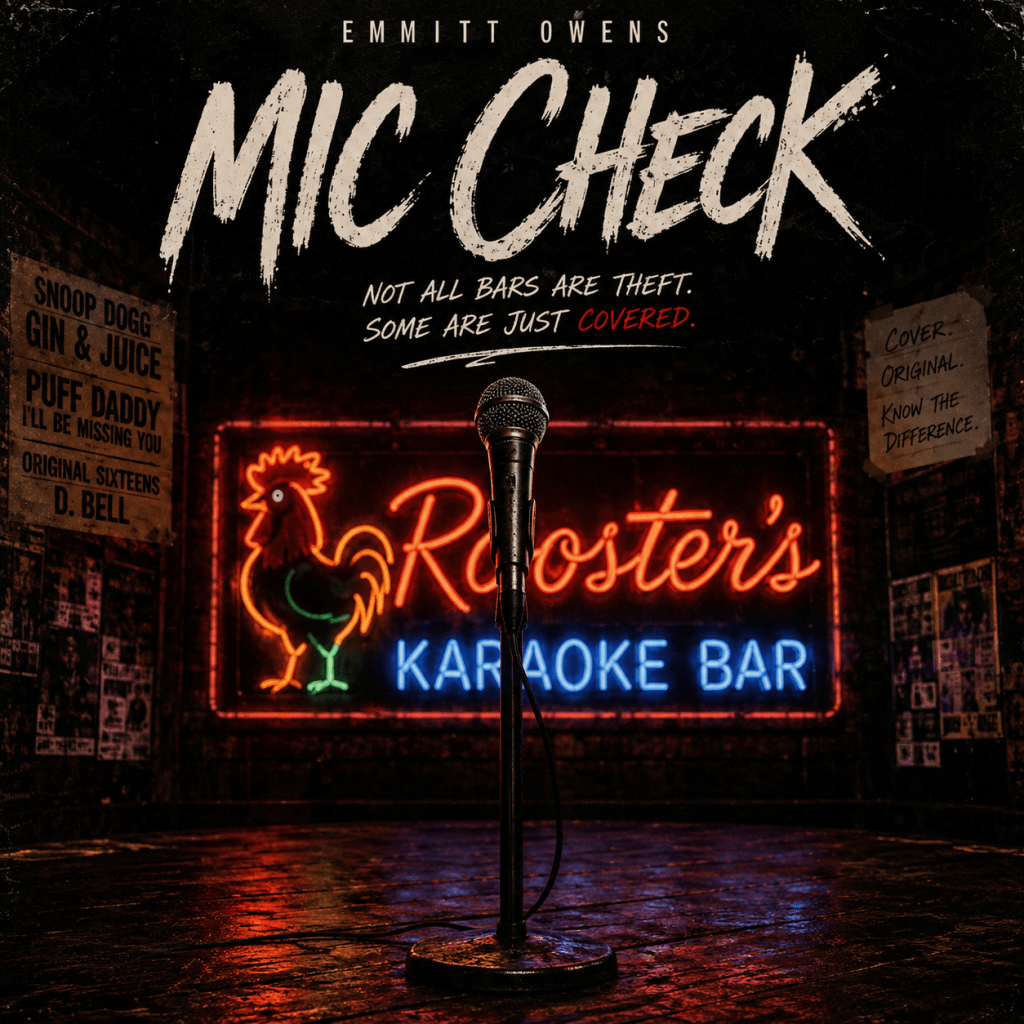
Mic Check
By: Emmitt Owens
(Index #12092020)
Deshawn Bell had a system.
Every Thursday night, he’d walk the six blocks from his mama’s apartment to Rooster’s, the karaoke bar on Fenwick and 9th that let him in even though he’d only just turned nineteen, because the owner, Miss Odell, liked that he tipped the bartender in quarters he’d saved all week and never once asked for a real drink. He’d sign up under the name “D. Bell,” sit in the back booth with his hood up, and wait for his number to get called.
Most nights he did two kinds of sets, and in his head they were nothing alike.
The first kind was pure crowd-pleaser karaoke — the songs everybody in the bar already knew word for word, the ones that got grandmothers and college kids on their feet at the same time. He’d pull up Snoop Dogg’s “Gin and Juice” and ride that laid-back G-funk bounce exactly the way it was written, note for note, letting the whole room shout the hook back at him. Some nights he’d close with a Puff Daddy record, one of those big, shiny, horn-heavy anthems built for a room full of people throwing their hands up, and he’d let Diddy’s own ad-libs do half the work while he handled the rest. That was karaoke. That was the format. You picked a song somebody else already wrote, already recorded, already owned, and you performed it — credited, obvious, no different than singing “Happy Birthday.”
The second kind was his. Original sixteens he wrote himself, over instrumentals nobody else wanted, because that was the only equipment he had. No studio, no producer, just a laptop mic and Thursday nights. He’d slide those in between the crowd songs, unannounced, like a secret he was testing out loud.
His best friend Marcus was the one who talked him into recording all of it.
“You’re better than open mic at Rooster’s, D. You know that, right?” Marcus had his phone propped against a beer bottle on the booth table, angled at the stage. “I been filming you for a month. People need to see this.”
“Nobody wants to watch phone footage of a karaoke bar,” Deshawn said, but he was already tightening his hood, already halfway to the stage.
Marcus posted everything — the Snoop covers, the Puff Daddy covers, and, mixed in without much distinction, the sixteens Deshawn had actually written himself. By Sunday the compilation had eleven thousand views. By the following Thursday, people were showing up to Rooster’s specifically to see “the karaoke kid.”
Deshawn liked that, in the private, guilty way you like something you never let yourself want out loud. For nineteen years he’d been the quiet one, the one who did his homework at the kitchen table while his mama worked doubles. Now people were coming to a bar on a Thursday to watch him.
He never once thought about the fact that some of what he was performing was somebody else’s song entirely, and some of it was his — and that most people watching a nine-minute video on their phone weren’t going to slow down long enough to tell the two apart.
Rell Osei had been rapping in this neighborhood since before Deshawn could tie his shoes.
Everybody on Fenwick knew Rell — the almost-deal in Atlanta back in 2009, the hard drive full of unreleased tracks, the after-school circle he still ran out of the rec center on Delancey where half the young rappers in a six-block radius had learned to find the pocket in a beat. Deshawn had sat in that circle himself, twice, back in seventh grade.
Rell wasn’t a karaoke guy. Never had been. In his mind rap was something you built from nothing — you wrote it, you owned it, you defended it. The idea of standing on a stage performing someone else’s already-famous song, on purpose, for fun, was just foreign to him, the same way another man might not understand darts, or trivia night. He knew karaoke bars existed. He’d never once thought about what actually happened inside one.
So when somebody sent him a link — “yo isn’t this your flow???” — and he watched forty seconds of a kid rapping in a cadence that felt exactly, uncomfortably close to his own delivery, something in his chest went hot and cold at once. He didn’t stop at that one clip. He kept scrolling through Marcus’s whole page, and because nothing on the page was labeled — no “cover” tag, no distinction between a Snoop Dogg record and one of Deshawn’s own sixteens — Rell watched a Gin and Juice performance right next to an original verse and processed both of them the exact same way: this kid is up there performing stuff that isn’t his.
To Rell, that wasn’t two different things. That was one long pattern.
He posted that night. A screenshot of one of Deshawn’s original bars next to a screenshot of Rell’s own from two years back, no caption except three exclamation points and a magnifying glass. It didn’t need a caption. Everybody who followed Rell knew exactly what it meant.
By morning, half of Fenwick knew a name: the karaoke kid was biting Rell Osei.
What happened over the next two weeks was worse than Deshawn expected, and it happened in a direction he hadn’t seen coming.
It wasn’t just his original bars people were dragging into the argument anymore. Somebody — Deshawn never found out who — had gone back through Marcus’s entire page and started stitching together a new compilation: Deshawn doing “Gin and Juice.” Deshawn doing the Puff Daddy record. Deshawn doing his own verse. All three cut together with a caption that read “dude really don’t have ONE original bone in his body,” like performing a credited karaoke cover of a Snoop Dogg song a hundred people in the room recognized instantly was somehow the same crime as a disputed sixteen bars.
“That’s not even — that’s karaoke,” Deshawn said out loud, alone in his room, to nobody, staring at the comments stacking under the clip. “That’s the whole point of it being karaoke. Everybody knows that’s a Snoop song. I’m not claiming I wrote ‘Gin and Juice.’”
But the comment section didn’t care about the difference, and worse, Rell — when someone tagged him and asked directly, “wait some of this is just him doing karaoke covers right? that’s not biting that’s just karaoke” — didn’t correct it. He just replied, three words: “I don’t know all that. All I know is what I heard.”
That was the sentence that did the real damage. Not because it was cruel. Because it came from Rell, and Rell’s word carried weight in this neighborhood the way a verdict does. He wasn’t lying, exactly — he genuinely didn’t know karaoke culture well enough to draw the line himself, didn’t know that performing a cover was a completely different, completely accepted thing from claiming someone’s original bars. His not-knowing read, to everyone watching, like confirmation.
The consequences showed up fast after that.
First it was Marcus texting him, apologetic, that the block party organizer on Ashwell had quietly pulled Deshawn’s name off the Saturday lineup — “didn’t wanna deal with the drama,” was the message Marcus relayed. Then it was Rooster’s itself, where Miss Odell still let him in but where two other regular karaoke rappers started signing up for the same night slots as him just to talk over him at the bar, loud enough to be heard, calling him “the biter” like it was a nickname that had already been voted on and finalized. Then it was the rec center cipher on Delancey — the one Rell ran — where a kid Deshawn didn’t even know told him, not unkindly, just matter-of-fact, that some of the older guys had said don’t bring him around for a while.
Three different venues. Two different crews. All of it built on the same unexamined assumption: that a kid who did karaoke covers of famous songs must not have anything of his own, and that whatever he did have, he must have taken.
“It’s karaoke,” Deshawn kept saying, to Marcus, to his mama, to the empty room. “That’s the entire format. You’re supposed to do somebody else’s song. Nobody accuses a wedding singer of biting Whitney Houston. I didn’t do anything wrong just standing up there and doing Snoop the way Snoop wrote it.”
He believed that all the way down, and he was right about it. But being right didn’t get his name back on the Ashwell lineup, and it didn’t stop two grown men from talking over him at Rooster’s on a Thursday night like he wasn’t even standing there.
His mama found him on the fire escape again, a week and a half in, phone face-down beside him.
“You still not sleeping right,” she said. Not a question.
He told her everything — the compilation, the comment that lumped Snoop Dogg in with his own bars like they were the same offense, Rell’s three words that had somehow made it official, the block party, the guys at Rooster’s, the message from the rec center.
“I didn’t do anything,” he said. “Not with the covers. That’s just — that’s what karaoke IS. You think people were mad at me when I did Puff Daddy? Everybody in that room was singing along. Nobody thought I was claiming I wrote that. It’s when somebody decided to pretend they didn’t understand the difference that it turned into this.”
His mama was quiet a moment, turning her mug in her hands.
“You’re right,” she finally said. “About the covers. Ain’t no argument there — a man doing karaoke ain’t stealing nothing, and anybody with sense knows that. But you know what’s got you up at midnight on this fire escape? It ain’t really the covers. It’s that Rell said ‘I don’t know’ instead of finding out. That’s what let it spread.”
“So what am I supposed to do? Explain karaoke to a man who’s never done karaoke?”
“Sounds like exactly what you’re supposed to do,” she said. “Man can’t correct a thing he never understood in the first place. Somebody’s gotta walk him through it before he can walk it back.”
He went to the rec center on a Saturday he wasn’t invited to, notebook in hand, heart going the whole six blocks.
Rell was mid-circle when Deshawn walked in, six kids on folding chairs looking up at the interruption. Rell’s face didn’t do much — not friendly, not hostile, just watchful.
“Got a minute?” Deshawn said. “Not for the circle. Just you.”
They stepped into the hallway by the water fountain that had been broken since Deshawn was in seventh grade.
“I need you to actually watch the videos,” Deshawn said, before Rell could say anything. “Not the compilation somebody cut together to make a point. The actual Thursdays, start to finish, the way they happened. Because there’s two different things in there and you reacted to them like they’re one thing.”
“I know what I heard,” Rell said, arms crossed.
“I’m not talking about the bars that sound like you. I’m talking about Snoop. I’m talking about Puff Daddy. That’s karaoke, Rell. That’s not me claiming anything. That’s the entire point — you get up, you do somebody’s song exactly like they wrote it, on purpose, out loud, in front of a room that already knows every word. Ain’t a rapper alive who’d call that biting. You said ‘I don’t know all that’ to somebody who asked you straight up, and that one sentence got me pulled off a lineup and talked over in a bar I’ve been going to since before all this.”
Something shifted in Rell’s face — not collapse, just recalculation, the look of a man running back through his own certainty and finding a gap in it he hadn’t checked.
“I don’t do karaoke,” Rell admitted, slower now. “Never been to one of them nights. Didn’t think about it being — I just saw a kid rapping stuff that wasn’t his, over and over, and it all looked the same to me.”
“It’s not the same. The Snoop is a cover. The Puff Daddy is a cover. Those two, you got no case, and you know it now that I’m standing here explaining it. The other stuff — the sixteens I actually wrote — that’s a real conversation, and I’ll have it with you all day, because I did sit in your circle, and maybe some of what you taught me is still living somewhere in how I write. I’m not running from that. But you let one uncertain conversation turn into three venues treating me like a thief, and two of those three things weren’t even in question.”
Rell didn’t apologize right there in the hallway. But he didn’t argue either, and for Rell, Deshawn would learn, that silence was as close to “you’re right” as he tended to get in the moment.
“Come back Thursday,” Rell said instead. “To Rooster’s. I’ll be there.”
He was. So was half of Fenwick, word having spread that something was about to happen, the way it always did.
Deshawn did his set the way he always had — a Snoop record first, the room singing along on the hook, then one of his own sixteens, the one about his father’s Buick backfiring on Tremont Street, no attempt to prove or disprove anything, just the song as it was.
When he stepped off stage, Rell took the mic himself, which he never did at Rooster’s, karaoke not being his format at all.
“Most of y’all know I said some things about this young man that spread further than I meant them to,” Rell said, no notes, just talking. “Turns out I didn’t understand what I was looking at. Half of what got called biting was karaoke — a Snoop song, a Puff Daddy song, covers, exactly what karaoke is supposed to be, and there ain’t a person in this room who thought for one second he wrote ‘Gin and Juice.’ That part’s on me. I said ‘I don’t know’ when I should’ve found out before I let it cost him bookings.”
He paused, glanced at Deshawn.
“The rest of it — his own bars sounding close to mine — that’s a realer conversation, and him and me are still having it, slower, the right way. But that’s a different conversation than the one that got him blacklisted off three stages in two weeks. Man didn’t do nothing wrong doing karaoke. That part I got wrong, plain and simple.”
It wasn’t a full pardon. It wasn’t supposed to be. The question of Deshawn’s own cadence — how much of it was inheritance and how much was theft, if any — stayed open, unresolved, the kind of thing that maybe never gets a clean answer, the way his mama had said: both things can be true at once, a kid picking things up from people he admired without stealing anything, and a teacher noticing the resemblance without being wrong to notice it.
But the block party organizer texted Deshawn that same week asking if he wanted back on the Ashwell lineup. The two guys at Rooster’s stopped talking over him. The rec center door stayed open.
Marcus still filmed every Thursday, but he started doing something new — a little caption under each clip now, “cover” or “original”, nothing fancy, just enough so nobody watching on their phone would ever again have to guess which was which.
Deshawn kept doing both. Kept doing Snoop when the room wanted to sing along, kept doing Puff Daddy when the horns hit right, kept writing his own sixteens in the gaps between, some nights wondering himself where the line was between what Rell had taught him and what he’d built on his own — and deciding, most nights, that the wondering itself was probably the most honest place to stand.
Months later, the week Deshawn dropped the first song he ever actually recorded in a real studio — the one about the Buick — he found a comment sitting under it. No magnifying glass this time. Just five words, from Rell:
“that’s your voice now, kid. You sound like your peers.”
Deshawn read it twice, then went back and watched one more time the old clip of himself doing “Gin and Juice” under the disco ball at Rooster’s, nineteen years old, hood up, doing exactly what karaoke was always supposed to be — somebody else’s song, sung out loud, on purpose, owed to no one.


Leave a comment