
Now hEar This
Buzzard News’ monthly spotlight on the sounds you need to know.
Now hEAr This is Buzzard News’ answer to the traditional music-discovery column: a monthly look at independent artists, unusual sounds and music worth hearing.
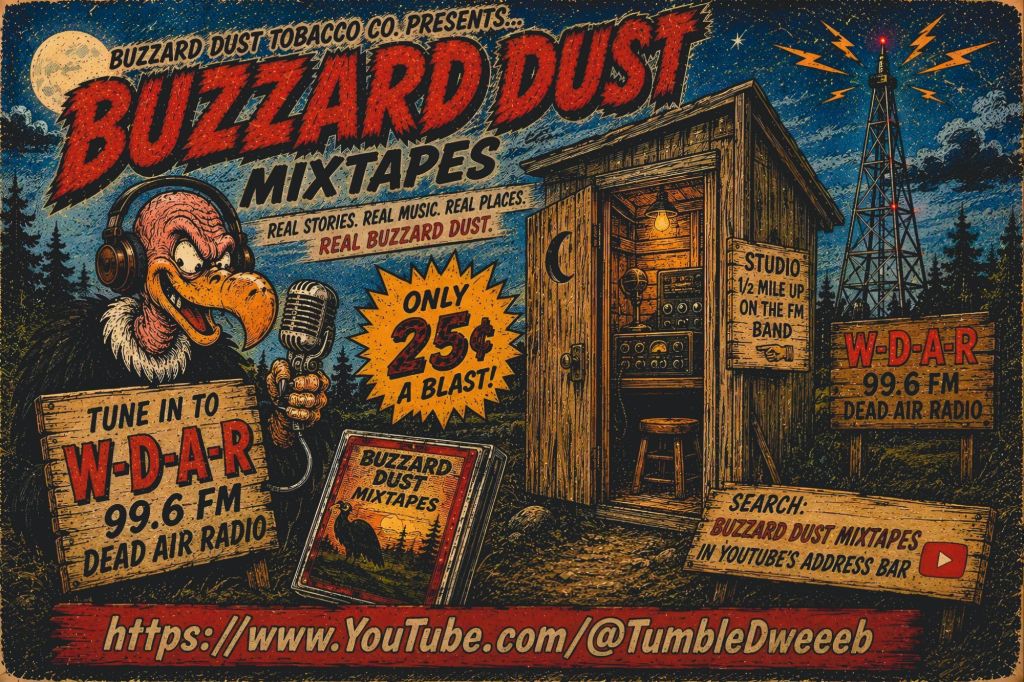
Buzzard Dust Mixtapes
Sounds like: Appalachian folk, bluegrass, old-time mountain music, gospel, country, Americana, and Southern storytelling filtered through fictional radio broadcasts and novelty music — with the distant echo of the project’s original hip-hop period still audible underneath.
Interview:
Describe your approach to music and how you would explain your sound to others.
I don’t really think of Buzzard Dust as a genre project. I think of it as a musical world. The music can move from an old-time mountain ballad to bluegrass, gospel, country, comedy, spoken word or a fictional radio transmission without necessarily feeling as though the project has lost its identity.
That range comes from how long I’ve been at this. I started writing in high school, back in 1994 or 1995, just because I had stories and ideas that needed somewhere to go. I began making music in 1999, which gave the writing a voice. Those early recordings were rooted in hip-hop, but the impulse behind them was always broader than one genre.
Over time, my ear pulled toward Appalachian folk, bluegrass, gospel, old-time mountain music, country and Americana. Those traditions connected more naturally with the kinds of stories and atmosphere I wanted to create, and that’s the sound Buzzard Dust lives in today — though the hip-hop DNA is still in there if you listen for it.
So the identity isn’t the genre. It’s the world surrounding the music.
How did you come up with the name of your project?
The name came relatively late — around 2011, well over a decade into writing and making music.
I was reading the Foxfire books, particularly their accounts of traditional Appalachian remedies and practices, and came across an old remedy that mentioned “buzzard dust.” The phrase caught me immediately. It sounded old and rural, but strange enough to suggest a whole world of its own. I remembered it, and eventually realized it could name the project I was already building.
The “mixtapes” half came naturally from the music itself — at the time it was primarily hip-hop, and the mixtape was the familiar form for independent rap, a way to collect experiments and ideas without forcing them into a traditional album. I ended up recording six ten-minute albums under that mindset, treating each one as a quick, loose experiment rather than a big statement.
The name survived even after the sound changed around 2013, and I think that’s important. Buzzard Dust has never been about one period of my life — the name connects the early hip-hop recordings with everything that came after, carrying the project’s whole history with it.
What are some artists and albums that have informed your creative direction?
My influences are probably more scattered than most people’s because I’ve never really stayed in one musical neighborhood.
I was lucky enough to have two very different musical introductions growing up. One set of grandparents introduced me to 1950s rock and roll and rockabilly, while the other introduced me to Hank Williams Sr. and Doc Watson. So I was hearing both sides of American music early on — the electricity and attitude of early rock and roll on one side, and the older Appalachian and country traditions on the other.
From there, my taste kept moving. Around twelve years old, I discovered heavy metal. Guns N’ Roses will probably always be my favorite band, and Metallica was a huge part of that period for me, particularly everything from Kill ‘Em All through The Black Album. Then grunge and alternative music came along — Nirvana, Stone Temple Pilots and a lot of the other music that defined that period of my life. Beck’s Mellow Gold is another album that made an impression on me.
Hip-hop hit me around sixteen, and that stayed with me. By the time I began making music, rap had become a significant part of the musical vocabulary I was carrying around. That eventually became the foundation of the early Buzzard Dust period.
But looking back, I don’t think those influences are as disconnected as they might appear on paper.
Hank Williams, Guns N’ Roses, Metallica, Nirvana, Doc Watson, Beck and hip-hop are obviously very different kinds of music, but they all have something that interests me: personality. They sound like somebody. They have an attitude, a voice, a world behind them.
That’s probably what I’ve always been looking for.
As I’ve gotten older, I’ve found myself returning more and more to the older music I heard from my grandparents. Appalachian string bands, bluegrass, early country, gospel, blues and old-time recordings have become increasingly important to the modern Buzzard Dust sound. There’s something about those recordings that I find difficult to reproduce artificially because they carry so much sense of place.
You can hear the room. You can hear the instruments. You can hear the people.
I don’t necessarily try to sound like any one artist. I’m more interested in absorbing the feeling of those traditions and seeing what comes out the other side.
The influences are scattered, but the thread connecting them is probably storytelling and character. That’s the part that has stayed with me the longest.
What’s the most exciting thing happening in music right now?
The fact that almost anybody can make something is exciting to me.
When I started making music, there were a lot more barriers between having an idea and actually turning that idea into a recording. You needed equipment, knowledge, a few dollars, computer knowledge or older studio equipment and often somebody willing to take you seriously.
That’s changed dramatically.
Now somebody sitting in their bedroom can make something completely strange and put it in front of people all over the world. Some of it will be terrible, some of it will be brilliant, and a whole lot of it will be something nobody has a name for yet.
I like that.
I’m also fascinated by what technology is doing to the creative process. Artificial intelligence, digital production and all these new tools are changing what one person can accomplish. There are legitimate questions surrounding all of it, but creatively, we’re living through a very unusual period.
For somebody like me, that’s liberating.
I don’t have to decide whether a song belongs on a country record, a comedy record, a rap record or a radio broadcast before I make it. I can follow the idea and figure out what it is afterward.
That’s probably why Buzzard Dust has gotten as strange as it has.
Where do you see the music world heading in the next five years?
I think we’re going to see the walls between genres become even less important.
People are going to have access to more tools, more sounds and more ways of making music than ever before. Artificial intelligence is going to become part of that whether people like it or not, and I suspect we’re still very early in understanding what that means.
But I don’t think technology is going to eliminate people’s desire for something genuine.
If anything, I think the opposite might happen.
The more music becomes easy to generate, the more people may start looking for things that have a sense of history behind them. Old instruments. Regional voices. Imperfect recordings. Music that sounds like it belongs to a particular place.
That’s part of what keeps pulling me toward Appalachian music and old-time recordings. There’s something there that technology can’t manufacture simply by copying the surface of it. The music carries the lives of the people who passed it down.
I think the future is going to be a strange combination of extremely advanced technology and a renewed appreciation for very old things.
And honestly, that’s a pretty good place for Buzzard Dust to exist.
How is music helping you during these uncertain times?
Music gives me somewhere to put everything.
I’ve always had more ideas than I know what to do with. Some of them become songs. Some become stories. Some become characters. Some become radio commercials. Some become an entire fictional radio station that probably shouldn’t be broadcasting.
That’s what Buzzard Dust has become for me — a place where all those things can exist together.
So when I look at Buzzard Dust now, I don’t really see a collection of albums. I see a long trail — the kid writing in high school, the guy making music in the late ’90s, the hip-hop years, the shift toward Appalachian music, and everything I’m still inventing. Music gives all of those versions of me somewhere to meet.
Maybe that’s why I’m not interested in making it fit neatly into anything. It’s been growing too long for that. I just want to keep following it and see where it goes.
Links
Emmitt Owens
EmmittOwens.com
Buzzard Dust Mixtapes — YouTube
Search Buzzard Dust Mixtapes on YouTube
Buzzard Dust Mixtapes — https://youtube.com/@tumbledweeeb?si=zziEKlttV1iQIA5a
Buzzard Dust Mixtapes — Instagram
Instagram
Buzzard Dust Mixtapes — Facebook
Facebook
Read More
Behind the Project: Why Buzzard Dust Mixtapes Became What It Was Always Meant to Be
A history of the project, from its early hip-hop recordings through its return as an Appalachian-rooted musical universe. Read the story on EmmittOwens.com
Buzzard Dust Mixtapes: One Man’s Mission to Build America’s Largest Independent Appalachian Mixtape Network
An overview of the larger vision behind the regional mixtape project. Read the feature
No, Buzzard Dust Mixtapes Isn’t Rap—And That’s Exactly the Point
A look at the musical transformation from the original 2011–2013 hip-hop period to the project’s modern roots-oriented sound. Read the article
NOTES: The “Now Hear This” format has become a familiar way for music publications to introduce listeners to artists they may not have encountered before. Buzzard News takes its own approach to that tradition with “Now hEar This.”
About the column: Now hEAr This is an independent Buzzard News feature and is not affiliated with or published by SPIN Magazine.


Leave a comment