
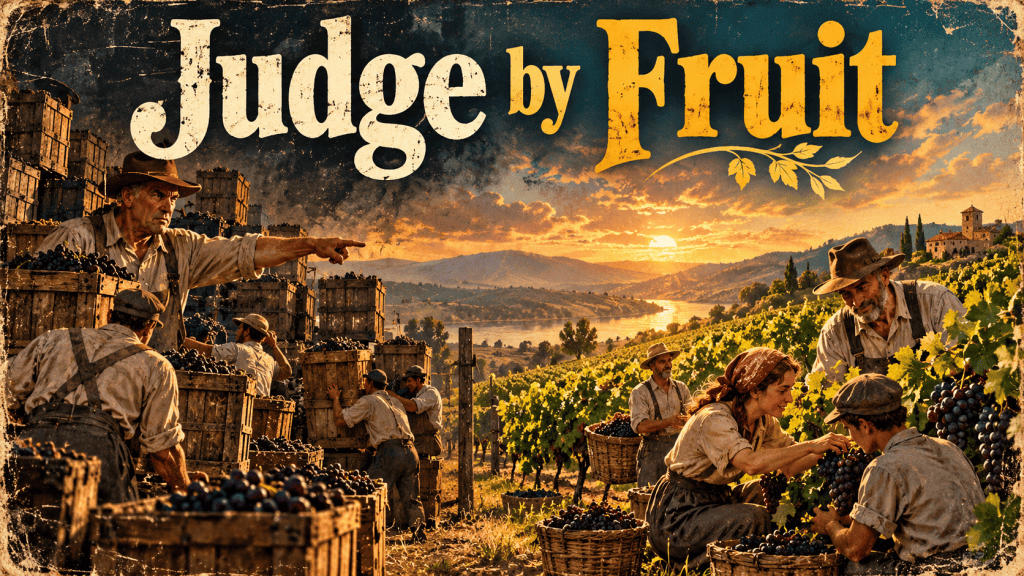
Judge by Fruit
Oct 13, 2026 · Emmitt Owens • (index #10132026)
Baskets Full or Baskets Few
God will not ask how many baskets you filled. He will not ask whether your numbers were high or low, whether you were the fastest, or whether anyone was impressed. Those things matter to the world, and the world is quick to measure us by them.
We live in a culture that weighs people by their output. We call a worker “productive,” a company “fruitful,” a year “successful,” and we mean the same thing every time: it produced more. It is easy to carry that same scale into church, into our homes, and even into how we see ourselves before God.
But Jesus gave us a different scale. He told us to judge by fruit, and the fruit He meant cannot be counted, weighed or sold.
A Parable of Two Vineyards
There were two men who owned vineyards on the same hill, and on Sunday they sat in the same pew. The preacher closed his Bible and said, “Judge by fruit. Love. Humility. Peace. Faithfulness. By their fruits you shall know them.” Both men nodded. Both carried the sermon home.
The first man, Frank, went out to his vineyard Monday and called his workers together. “The preacher is right,” he said. “From now on I judge by fruit. Every basket will be counted. Whoever fills the fewest is a dead branch.” By the end of the week, two workers had left, one had wept among the rows, and the baskets were up a little. Frank called it a good harvest.
The second man, Martin, walked his rows that same Monday, and he looked at his workers differently. He noticed Darlene, who filled fewer baskets than anyone because she kept stopping to show the new hands how to cut without bruising the grapes. He noticed Tom, who filled the most, but trampled the young vines to get there and never thanked the ones who carried his load. For the first time, Martin wondered which of them was really bearing fruit.
When the next season came, Frank’s vineyard was full of strangers, for no one stayed long. Martin’s was full of workers who returned year after year, who helped one another, and who trusted him enough to tell him the truth. Same sermon, same word, two different harvests. Frank judged by fruitfulness. Martin judged by fruit.
What Jesus Meant by Fruit
In the Sermon on the Mount, Jesus warned His followers about false prophets who come in sheep’s clothing. How would they tell the true from the false? “Wherefore by their fruits ye shall know them” (Matthew 7:20). A good tree cannot bring forth evil fruit, He said, and a corrupt tree cannot bring forth good.
Jesus was not talking about how much a person could get done. False prophets can be very busy. They can draw crowds, build ministries, and stay productive for years. What they cannot fake forever is the character that grows from a heart rooted in God.
In John 15, Jesus explains where that fruit comes from: “I am the vine, ye are the branches: He that abideth in me, and I in him, the same bringeth forth much fruit: for without me ye can do nothing.” A branch does not strain to produce grapes. It bears fruit because it stays connected to the vine.
Paul names that fruit plainly in Galatians 5:22-23: “the fruit of the Spirit is love, joy, peace, longsuffering, gentleness, goodness, faith, meekness, temperance.” Notice that Paul calls it fruit, singular, as one harvest with many flavors. Not one item on that list can be counted on a production report.
This essay focuses on four of those flavors: love, humility, peace and faithfulness. Love is the root Paul names first. Peace and faithfulness are on his list directly. Humility is the meekness he names, the posture Jesus modeled when He washed His disciples’ feet. Together they are the four that daily life tests most, and the four a world chasing numbers is most likely to trample.
Fruit, Not Fruitfulness
Here is where many of us go wrong. We hear “judge by fruit” and we think of results. The person with the most to show looks like the most fruitful. The one who fills twenty baskets looks more fruitful than the one who fills twelve.
But a person can be enormously productive and spiritually barren. Someone in charge can raise the numbers every season while crushing the people beneath him. Anyone can outpace everyone around them and never once show kindness to the person beside them. By the world’s measure, that is a good harvest. By heaven’s measure, it may be all leaves.
The opposite is also true. The quiet soul who never has the biggest numbers, but stops to help the one who is struggling, may be bearing more fruit than anyone around her. Her harvest does not show up on any tally. It shows up in the lives she touches.
This does not mean work is unimportant. Scripture tells us to work heartily, as unto the Lord (Colossians 3:23). Diligence is good. But diligence is not the fruit. It is, at best, a place where the fruit can be seen. God is not measuring what we produce. He is looking at who we are becoming while we produce it.
When the Word Gets Twisted
Some people get this confused, and not always by accident. They call themselves Christian, hang a verse on the wall, and preach “be fruitful” to everyone under them. But what they mean is more output, longer hours, and mass quantities of whatever sells. They borrow God’s language to serve the bottom line.
This is one of the oldest confusions there is. “Be fruitful and multiply” (Genesis 1:28) becomes a slogan for getting more done. Someone who slows down to help another is told he is not being fruitful. Someone tired and falling behind is made to feel unfaithful. The words sound holy, but the harvest is worldly.
Jesus warned about this directly: “Ye cannot serve God and mammon” (Matthew 6:24). A man can fill his storehouses to the rafters and still be the rich fool of Luke 12, who built bigger barns and forgot his soul. Calling production “fruit” does not make it so. The test is not how much is gained, but how people are treated along the way.
Let us call it what it is. Measuring people by their labor and output is not a Christian practice, no matter who does it or what verse is hung on the wall. It is materialism, the service of mammon dressed in church clothes. A man may call himself Christian, but if his only harvest is product, Jesus’ own test tells us to look closer. We are not the judge of any man’s soul. But we are told to know the tree by its fruit, and a practice that tramples love, humility, peace and faithfulness bears no fruit of the Spirit at all.
Anyone who truly understands the sermon will still care about good work. But he will measure himself first by love, humility, peace and faithfulness, and he will never use Scripture as a whip.
The Sweeter Fruit
Love. Paul says that without love, all our gifts and accomplishments amount to nothing (1 Corinthians 13:2-3). Love is the first fruit and the root of the rest. It shows in how we treat people who can do nothing for us: the stranger, the newcomer, the one everyone else ignores.
Humility. Jesus, though He was God, “made himself of no reputation, and took upon him the form of a servant” (Philippians 2:7). Humility is not thinking less of yourself. It is thinking of yourself less. It gives credit away, admits mistakes, and does not need to be the biggest name in the room.
Peace. “Blessed are the peacemakers: for they shall be called the children of God” (Matthew 5:9). Some people bring fire into every room they enter. Others bring calm. A person bearing this fruit lowers the temperature, heals divisions, and leaves others steadier than they found them.
Faithfulness. “Well done, thou good and faithful servant” (Matthew 25:21). Notice that the master did not say “good and productive servant.” Faithfulness is keeping your word when no one is checking, showing up for people when it costs you, and staying true to God in small things as well as large.
None of these can be faked for long. They take a season to grow, but in time they always show.
Bearing Fruit in a World That Counts Baskets
Most of us are not Frank or Martin. We are Darlene, living in a world that counts our baskets and rarely asks about our hearts. What does fruit look like there?
- Stay kind when the pressure rises. No measure of success excuses cruelty. Help the one who is struggling anyway. Thank the person no one thanks.
- Work well, but not for the numbers. “Whatsoever ye do, do it heartily, as to the Lord, and not unto men” (Colossians 3:23). Your effort is an offering, not a scorecard.
- Keep your peace. Do not let a world that worships production rob you of the calm Christ gives. Your worth was settled at the cross, not by any tally.
- Stay faithful in small things. Keep your word. Live honestly. Do right when no one is watching, because Someone always is.
- Do not let the numbers define you. A few baskets on a hard day does not make you a dead branch. A branch is judged by the vine it clings to.
You may never change how the world keeps score. But your fruit may be the only sermon some people ever hear.
Check Your Own Branches
The same chapter that tells us to know a tree by its fruit also warns us to take the beam out of our own eye before reaching for the speck in our brother’s (Matthew 7:5). Judging by fruit is not a license to condemn others. It is first a mirror.
So before we weigh anyone else, we can ask ourselves: Did I love today, or did I only perform? Was I humble, or did I need the credit? Did I bring peace into the room, or fire? Was I faithful in the small things no one saw?
One day the work will end. The baskets will be emptied, the tallies forgotten, the titles handed to someone else. Many or few, the count will fade. What remains is the harvest of the heart: the love we gave, the pride we laid down, the peace we made, and the faithfulness we kept.
Jesus said He chose us to “bring forth fruit, and that your fruit should remain” (John 15:16). That is the fruit that lasts. That is the sweeter fruit. And that is how we are to judge.
So here is the challenge for this week: let someone see your fruit before they see your numbers. Each morning, ask God to make you more like Martin than Frank, and more like Darlene than Tom.
A short prayer: Lord, You are the vine and I am the branch. Keep me close to You, so that what grows in me is love, humility, peace and faithfulness. When the world counts my output, help me remember that You are looking at my heart. Let my fruit remain. Amen.
Judge by fruit: love, humility, peace and faithfulness.


Leave a Reply