
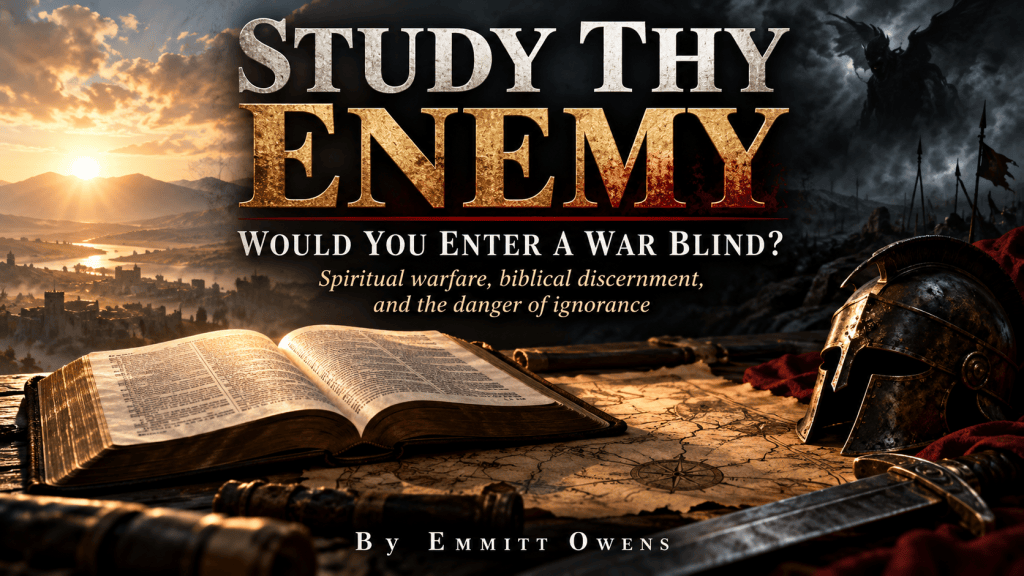
Study Thy Enemy: Would You Enter a War Blind?
Spiritual warfare, biblical discernment, and the danger of ignorance
By Emmitt Owens
Every serious commander understands a fundamental principle: know your enemy.
No competent general sends troops into battle without studying the opposition. He surveys the terrain, identifies the weapons in play, examines the enemy’s tactics, and locates his own weak points. He wants to understand the fight before his soldiers ever take the field.
No one calls that a lack of courage. We call it preparation.
Why, then, do so many Christians approach spiritual warfare unprepared? We speak readily of resisting evil, overcoming temptation, and standing firm in the faith. Yet few of us have carefully examined what the Bible actually says about the adversary it warns us against — his methods, his limits, and the defenses Scripture provides.
The apostle Paul gave the church a direct warning:
“Lest Satan should get an advantage of us: for we are not ignorant of his devices.” — 2 Corinthians 2:11, KJV
Paul ties awareness of Satan’s devices to protection from his advantage. In context, Paul writes these words while urging the Corinthian church to forgive and restore a member who had been disciplined (2:5–11). He warns that Satan could gain an advantage if excessive sorrow, continued punishment, or a refusal to forgive left that person overwhelmed and the church divided.
Knowing the adversary’s devices, then, begins close to home. It means recognizing how harsh or unwise responses to sin can wound a person and divide a church. Ignorance of that leaves us exposed.
This is not a call to become preoccupied with Satan. It is a call to take Scripture seriously. If the Bible warns us about an adversary, we should study those warnings ourselves rather than relying on tradition, popular culture, or secondhand opinion.
A soldier who understands the battlefield recognizes threats sooner. A Christian grounded in biblical discernment recognizes deception sooner.
Faith does not require us to close our eyes. It requires us to learn how to see.
1. The Intelligence Report: What Scripture Says About Satan
Before examining the enemy’s methods, we must examine the Bible’s own descriptions of him.
Begin with Job. In Job 1:6–12, the sons of God come to present themselves before the Lord, and Satan comes among them. When the Lord asks where he has come from, Satan answers:
“From going to and fro in the earth, and from walking up and down in it.” — Job 1:7, KJV
Satan describes himself as roaming the earth. He then challenges Job’s integrity, and the Lord permits him to test Job — within limits the Lord Himself sets (Job 1:12; 2:6). Whatever else we conclude, the adversary is not presented as a figure detached from human affairs.
Notice, too, what Job does not know. He suffers without ever seeing the exchange in the heavenly court. The reader is shown a conflict that Job himself never fully understands. Sometimes Scripture lets us see the larger battle precisely because the person in the story cannot.
Now consider 1 Peter 5:8:
“Be sober, be vigilant; because your adversary the devil, as a roaring lion, walketh about, seeking whom he may devour.” — KJV
Peter does not tell believers to panic. He tells them to be sober and vigilant. The image of a prowling lion conveys danger, predatory intent, and the need for alertness. In the very next verse he gives the response: “Whom resist stedfast in the faith” (1 Peter 5:9).
Here the military analogy proves useful. A wise commander never assumes the enemy has withdrawn simply because the field is quiet. Biblical vigilance likewise recognizes that temptation and deception rarely announce their arrival.
The question is not whether we should look for a devil behind every inconvenience. The question is whether we understand the warnings we have already been given.
2. His Methods: Testing, Deception, and Accusation
A sound study of any adversary examines not only who he is but how he operates. Scripture offers several distinct pictures.
The adversary who tests
In Luke 22:31, Jesus tells Peter:
“Simon, Simon, behold, Satan hath desired to have you, that he may sift you as wheat.” — KJV
Jesus then says He has prayed that Peter’s faith would not fail, and charges him: “when thou art converted, strengthen thy brethren” (Luke 22:32). That same night, Peter denies knowing Jesus three times.
Sifting is an image of severe testing. Peter’s story shows how quickly human confidence can collapse under pressure. We may believe we are stronger than we are. We may mistake enthusiasm for endurance. Spiritual preparation is not merely knowing the right words; it is the humility to recognize our own weaknesses.
The adversary who deceives
In Genesis 3, the serpent approaches Eve with a question that casts doubt on what God has said: “Yea, hath God said…?” (Genesis 3:1). The conversation draws her attention toward suspicion, desire, and a rival interpretation of God’s command. Genesis itself does not name the serpent as Satan; that identification is made later, in Revelation 12:9 (see also 20:2), which calls him “that old serpent, called the Devil, and Satan.”
The account presents deception not as a blunt denial but as a distortion of understanding. Not every lie looks like a lie. Sometimes the danger is a half-truth, a misleading emphasis, or a question designed to make us distrust what we have never carefully examined.
The temptation of Jesus in Matthew 4:1–11 shows the same pattern — and the answer to it. The devil even quotes Scripture, lifting Psalm 91:11–12 out of its purpose (Matthew 4:6). Jesus answers each temptation with Scripture rightly understood: “It is written” (Matthew 4:4, 7, 10).
This is why discernment matters. A person who believes everything is not thereby faithful. A person who rejects everything is not thereby wise. Discernment requires examination.
The adversary who accuses
Revelation 12:10 calls Satan “the accuser of our brethren,” who “accused them before our God day and night.” Zechariah 3:1–2 shows Satan standing at the right hand of Joshua the high priest to oppose him — the Hebrew word satan itself means “adversary” or “accuser” — and the Lord rebukes him.
Accusation, however, must not be confused with conviction. Scripture also calls us to repentance, correction, and honest confession of wrongdoing. Not every uncomfortable realization comes from the devil.
An accusation may expose a genuine failure. It may also be used to discourage, condemn, or block restoration. The Christian must learn to tell honest correction from destructive condemnation — and that requires more than emotion. It requires discernment.
3. The Unseen Realm: What Scripture Does and Does Not Claim
The Bible repeatedly points to a reality beyond what human eyes can see. Job 1 opens a window into the heavenly court. Ephesians 6:12 describes a struggle “not against flesh and blood.” Daniel 10 links spiritual conflict — including the opposition of “the prince of the kingdom of Persia” — to earthly events. Revelation uses vivid imagery to portray the forces of evil set against the purposes of God.
These passages invite serious study. They also demand care about what we claim.
Some of these texts, especially in Daniel and Revelation, use symbolic and apocalyptic imagery, and Christians differ on how particular passages relate to one another. Identifying the serpent of Genesis with Satan, for example, comes from reading Genesis alongside Revelation 12:9. The questions below try to separate what passages state outright from conclusions drawn by connecting them.
- Does Scripture portray Satan as active on the earth? Yes. Job 1:7 records him describing his roaming, and 1 Peter 5:8 portrays him prowling and seeking someone to devour.
- Does Scripture call Satan an accuser of God’s people? Yes. Revelation 12:10 says so explicitly.
- Does Scripture present Satan as the ruler of hell? No. None of these passages establish that.
The distinction matters because popular imagery often pictures Satan enthroned in hell, reigning over the damned as sovereign of an independent kingdom. The image is familiar, but familiarity does not make it biblical.
Job 26:6 declares that Sheol (rendered “hell” in the KJV) is naked before God, and Proverbs 15:11 says that Sheol and Abaddon (“hell and destruction”) lie open before the Lord. These verses stress God’s knowledge of, and authority over, the realm of the dead. They give no hint that Satan governs it.
Scripture does give Satan titles of influence: “the prince of this world” (John 12:31) and “the god of this world” (2 Corinthians 4:4). These passages describe his influence in the present age; they do not establish him as the ruler of hell. In John 12:31, Jesus also announces the judgment of this world’s ruler.
Revelation 20:10, likewise, shows the devil cast into the lake of fire and brimstone. It is a scene of judgment on Satan, not his coronation. Jesus similarly speaks of “everlasting fire, prepared for the devil and his angels” (Matthew 25:41) — a place of punishment for Satan, not a throne.
This leads to a necessary correction. Satan is a real adversary in Scripture, but he is never presented as God’s equal. The biblical story is not a contest between two evenly matched powers with an uncertain outcome.
God remains sovereign. The adversary operates within limits, and the final judgment belongs to God.
4. Recognizing the Enemy at Work: Discernment Without Participation
Studying what Scripture says about the adversary is the foundation. But a soldier who knows the enemy only from manuals may still fail to recognize him in the field. Many sincere believers do not recognize occult influence, not for lack of faith, but because no one has shown them what it looks like.
Scripture itself models this kind of awareness. When Paul arrived in Athens, he observed the city’s objects of worship. He found an altar inscribed “TO THE UNKNOWN GOD” (Acts 17:23). When he spoke to the Athenians, he also quoted their own poets (17:28). His approach illustrates how familiarity with an audience’s beliefs and language can help someone address those beliefs thoughtfully without adopting them.
In Philippi, Paul met a girl possessed with “a spirit of divination” who brought her masters much gain by soothsaying (Acts 16:16). Her words even sounded supportive: she cried out that these men were servants of the most high God. Yet Paul discerned the spirit behind the words and commanded it to leave her (16:18). Not everything that sounds spiritual comes from God. As Paul warned elsewhere, “Satan himself is transformed into an angel of light” (2 Corinthians 11:14), and John urges believers to “try the spirits whether they are of God” (1 John 4:1).
In contemporary life, practices Scripture warns against may be presented as entertainment, curiosity, or self-help: horoscopes, tarot readings, spirit boards sold as games, or mediums promising contact with loved ones. A believer who has never considered these things may treat them as harmless. Discernment begins with recognizing them for what they are.
There is, however, a line Scripture draws clearly:
“For all that do these things are an abomination unto the LORD.” — Deuteronomy 18:12, KJV
The preceding verses (18:10–11) name divination, enchantment, witchcraft, consulting familiar spirits, and necromancy. The command is not “do not know these exist.” It is “there shall not be found among you” anyone who practices them. Understanding a belief is not the same as participating in it.
A word of care is needed here. Scripture does not mention horoscopes or tarot cards by name. Applying Deuteronomy 18 to modern practices is an interpretation of its principle, though one many Christians share.
Nor does it follow that everyone who has encountered such material has experienced supernatural influence, or that every troubling circumstance is evidence of Satan’s activity. Discernment avoids both errors: dismissing these practices as harmless, and seeing a demon behind everything.
Solomon offers a sober warning. He set his heart “to know wisdom, and to know madness and folly,” and concluded that “this also is vexation of spirit” (Ecclesiastes 1:17). Few men in Scripture understood the world more broadly.
God had previously warned Israel against intermarriage with the surrounding nations, explaining that such unions could turn the people’s hearts toward other gods (Deuteronomy 7:3–4). First Kings 11:2 recalls that warning, yet Solomon “clave unto these in love.” In his old age his heart “was not perfect with the LORD his God” (11:4), and he built high places for Chemosh and Molech (11:7).
The text does not blame Solomon’s learning for his fall. It places the emphasis on his divided heart, his disobedience, and his worship of other gods. His wisdom did not excuse his disobedience or protect him from its consequences. The narrative emphasizes the importance of remaining faithful to God, even when one possesses extraordinary knowledge.
That is the lesson: learn to recognize what Scripture warns against, but do not participate in practices God forbids simply to discover how they work.
Recognizing the enemy is wisdom. Experimenting with his tools is not. Paul expressed the balance plainly: “I would have you wise unto that which is good, and simple concerning evil” (Romans 16:19). Learn enough to recognize deception, and let Scripture remain the standard by which you judge it.
5. Know His Devices, but Do Not Become Obsessed With Him
Studying evil without the right perspective carries its own danger. A person can grow so fascinated with the adversary that the adversary moves to the center of his spiritual life. That is not the purpose of biblical discernment.
We have already seen the context of 2 Corinthians 2:11. Paul’s concern was a grieving member who might be “swallowed up with overmuch sorrow” (2:7), and his remedy was forgiveness, not speculation about demonic activity. A verse can be quoted accurately and still be used to support a point it was never making.
The same principle governs our study of spiritual warfare:
- If we study Satan but neglect the teachings of Jesus, we have lost our direction.
- If we study temptation but neglect repentance, we have missed the objective.
- If we study deception but refuse to examine our own assumptions, we have missed discernment’s most practical application.
The goal is not to know evil better than we know goodness. The goal is to recognize evil without being deceived by it — not to give the adversary our attention, but to remain faithful to God.
6. Put On the Armor: Preparation Is Part of Faith
In Ephesians 6:10–18, Paul instructs believers to “put on the whole armour of God, that ye may be able to stand against the wiles of the devil” (6:11).
He then names each piece (6:14–17):
- The loins girt about with truth
- The breastplate of righteousness
- The feet shod with the preparation of the gospel of peace
- The shield of faith
- The helmet of salvation
- The sword of the Spirit, which is the word of God
These are not defenses we manufacture through willpower alone. Paul begins by telling believers to “be strong in the Lord, and in the power of his might” (Ephesians 6:10). The armor is grounded in God’s provision, and believers are called to take it up and stand firm.
Notice what this equipment is made of: truth, righteousness, peace, faith, salvation, and the word of God. Paul does not tell believers to master the weapons of darkness. He tells them to be firmly grounded in the things of God.
Paul does not tell believers to stay unaware and hope for the best. He tells them to take up the armor, to stand, and to pray “always with all prayer and supplication in the Spirit” (6:18).
Consider what each piece means in practice:
- Truth requires us to examine claims rather than accept whatever sounds persuasive.
- Righteousness requires us to examine our own conduct, not merely condemn the conduct of others.
- Peace reminds us that this struggle is no excuse for needless hostility toward people.
- Faith is the shield we raise when circumstances shake our confidence.
- Salvation anchors our hope in God’s work, not in our own ability to overcome every difficulty.
- The word of God is the standard by which we test every spiritual claim.
This is not passive faith. It is disciplined faith — a faith that studies, tests, remembers, prays, and acts.
7. The Enemy Is Not the Person Standing in Front of You
Here the military analogy needs one more distinction. In a human war, the enemy may be a visible opposing army. In the Christian understanding of spiritual warfare, Ephesians 6:12 states plainly: “we wrestle not against flesh and blood, but against principalities, against powers, against the rulers of the darkness of this world, against spiritual wickedness in high places.”
That means we must be careful about naming other people as the enemy. Someone who disagrees with us is not automatically serving Satan. Someone who challenges our reading of Scripture is not automatically an agent of evil. Someone who exposes our mistakes may in fact be helping us see what we need to correct.
This matters especially when we speak of judgment. In Matthew 7:1–5, Jesus warns against hypocritical judgment. He does not tell His hearers to abandon moral discernment. He tells them to remove the beam from their own eye first, and then they will see clearly to remove the mote from their brother’s eye (7:5).
The difference is essential:
- Discernment asks: Is this true? Is this right? What does Scripture say?
- Pride asks: How can I prove that I am right and the other person is wrong?
Discernment weighs the evidence. Pride has already reached its verdict.
If we are serious about studying the adversary’s methods, we must be equally serious about our own capacity for self-deception. People can rationalize selfishness, excuse cruelty, distort facts, and condemn others while overlooking their own faults. As Jeremiah 17:9 warns, “The heart is deceitful above all things.”
That is why the Christian life requires humility alongside vigilance. We cannot claim to recognize deception in others while refusing to consider it in ourselves. Discernment is not meant to make us suspicious of everyone. It is meant to make us wiser about what we believe, how we live, and how we treat other people.
Warfare is also only one of Scripture’s pictures of the Christian life. The Bible speaks just as readily of shepherding, reconciliation, endurance, and growth in grace. Christian preparedness is not merely recognizing threats. It is loving others faithfully, for “love worketh no ill to his neighbour: therefore love is the fulfilling of the law” (Romans 13:10).
8. Search the Scriptures, Not Just the Traditions
Many people form their picture of Satan from art, folklore, films, sermons, and religious idiom long before they read the relevant passages themselves. Some of those traditions contain interpretations worth weighing. Others blend biblical imagery with ideas developed over centuries. John Milton’s Paradise Lost and Dante’s Inferno, for example, have helped shape popular Western images of Satan and hell alongside biblical traditions.
The problem comes when we stop distinguishing between what the text says and what later generations imagined or inferred. To understand the adversary, we must return to the source:
- Genesis 3
- Deuteronomy 18:9–14
- 1 Kings 11:1–8
- Job 1–2
- Zechariah 3:1–2
- Matthew 4:1–11
- Luke 22:31–32
- Acts 16:16–18; 17:16–34; 19:18–20
- 2 Corinthians 2:5–11
- Ephesians 6:10–18
- 1 Peter 5:8–9
- Revelation 12 and 20
Then ask honest questions of each passage:
- What does the passage actually say?
- Who is speaking, and to whom?
- What is happening in the surrounding narrative?
- What conclusion does the text support?
- What conclusion am I adding that the text does not establish?
These questions are not signs of weak faith. They are the foundation of responsible Bible study.
The Bereans set the example. Acts 17:11 commends them because “they received the word with all readiness of mind, and searched the scriptures daily, whether those things were so.” They did not treat examination as the enemy of faith. They made it part of their response to the message.
We should be willing to examine even what we have believed for years. If a belief is sound, careful study will deepen it. If it is mistaken, careful study gives us the chance to correct it. Truth loses nothing by being investigated.
Conclusion: Know What You Stand Against, and What You Stand Upon
Would you enter a war without studying your enemy? Would you ignore intelligence about the battlefield, dismiss warnings about your weak points, and refuse to learn the tactics being used against you?
Then why approach spiritual warfare without studying the warnings Scripture provides?
But remember the greater truth: God, not Satan, is at the center of the story, and the adversary is not His equal. The purpose of studying spiritual warfare is not to be consumed by darkness, but to recognize deception, resist temptation, and remain faithful to the truth.
Study the adversary’s methods. Study the Scriptures that describe him. Study the armor God provides. And study your own heart, because a person who never examines himself may mistake his own assumptions for divine wisdom.
Know what you stand against. Know what you stand upon. And never confuse faith with ignorance.
“Be sober, be vigilant.” — 1 Peter 5:8, KJV
✍️
Author’s Note:
I hold my own writing to the standard this essay describes. Before publishing, I seek to verify each Scripture reference in its proper context and examine my conclusions for theological consistency. I am especially careful with statements that could be taken out of context or lead readers toward a misunderstanding of Scripture.
That said, careful study and checking can reduce error; they do not make any author infallible. I encourage you to do what the Bereans did (Acts 17:11): examine the Scriptures for yourself, test my reasoning, and hold this essay to the same standard you would apply to any other teacher.
My goal is not to ask you to take my word for it, but to encourage you to seek the truth faithfully through God’s Word.


Leave a Reply