
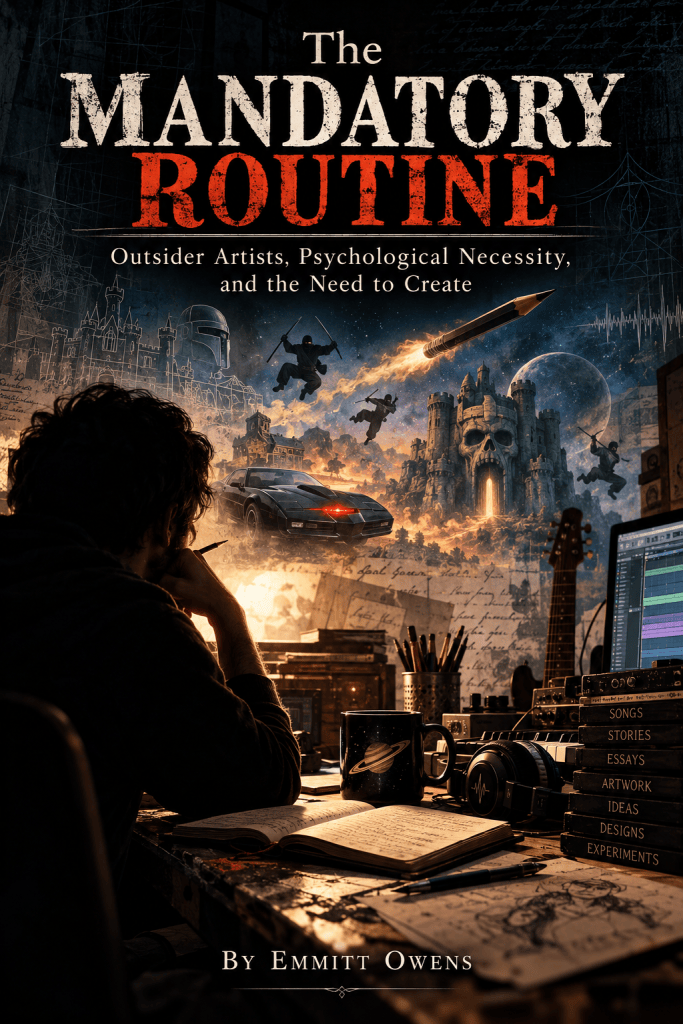
The Mandatory Routine
Outsider Artists, Psychological Necessity, and the Need to Create
By Emmitt Owens
There is a question society rarely asks artists correctly.
Instead of asking why someone creates, we ask what they intend to do with the work. Will they publish it? Sell it? Build an audience, turn it into a business, perhaps even make a living from it? We have grown so accustomed to measuring creative work by its value to the marketplace that we forget to ask whether it serves a purpose for the person making it.
For some, creation is a career. For others, it is a hobby or a pleasant way to spend an afternoon. But there is another kind of creator who operates by a different set of rules.
The outsider artist may spend years making music that never reaches the radio, writing stories that never find a publisher, or filling notebooks no one else will ever read. They often work without formal training, institutional approval, or any reasonable expectation of reward. Their projects can seem disconnected, moving from one subject to the next by a logic that is difficult to explain.
Yet the work continues—not because success is around the corner, not because a market is waiting, and not because the creator believes every new project will be good. It continues because the need to create exists independently of the reward.
For some people, creation is not a career choice. It is a mandatory psychological routine: a way of processing experience, organizing thought, exploring identity, and giving tangible form to the invisible activity of the mind. They are not always trying to become something. Sometimes they are simply trying to remain themselves.
Before I Knew What an Artist Was
I did not become a creator when I learned to record music, write an essay, or publish something online. I was creating long before I knew there was a word for it.
As a child with ADHD, my imagination was already busy constructing worlds the people around me could not see.
I might sit in a classroom with a pencil in my hand, and to the teacher I probably looked like a distracted kid fidgeting with a writing utensil. But in my head, that pencil was not a pencil. It was a missile, and Castle Grayskull was about to take a direct hit.
Some days, ninjas were dropping out of the air vents, and I was the only one in the room who knew we were under attack. Other days, I was behind the wheel of KITT, the talking car from Knight Rider, speaking into my Casio watch as if the machine beside me were answering back.
My hands were doing one thing. My imagination was doing something else entirely.
I understand how an adult might have seen a child who could not sit still, would not pay attention, or kept disrupting the class. On the surface, I was a kid moving his hands when he was supposed to be listening. From the inside, an entire world was unfolding.
I sometimes wonder how many of my childhood disruptions were really failed attempts to give an inner experience an outward form. I had no stage, no studio, and no permission to turn the classroom into the world I was imagining. I had a pencil, a desk, and a mind with little interest in keeping the adventure confined to my head. The adults saw the disruption. I was living the story.
I was not merely holding a pencil. I was using whatever was available to give my imagination something to work with. The objects were real; what they represented was limited only by what I could imagine. I had no recording studio, no publishing platform, no computer capable of building fictional worlds. I had whatever happened to be within reach, and the ability to turn ordinary things into something else.
Looking back, I see a clear line between that child and the adult who now makes music, writes essays, develops characters, and explores ideas across many mediums. The tools changed. The output grew more sophisticated. But the impulse to create was already there.
As an adult, I have also wondered whether I might be on the autism spectrum. I have no diagnosis, and I would not claim that a vivid childhood imagination or a preference for silence proves anything. But it is a question I have considered while trying to understand how I experience the world, how I process my thoughts, and why creating has so often felt more natural than explaining myself in conversation.
What I do know is this: I had ADHD as a child, imagination was my constant companion, and I have spent a lifetime producing things, often without needing an audience to justify the effort.
I cannot tell you exactly what every part of that experience means psychologically. I can tell you what it felt like to live it.
My mind was always making something. It never really stopped.
The Mind Needs Somewhere to Put Things
I have spent my entire life creating things: songs, stories, essays, characters, fictional worlds, and strange experiments that often seem to have nothing to do with one another. I have moved freely between mediums, subjects, and creative identities, following my thoughts wherever they lead.
Someone looking at that output might assume I am chasing a career, seeking recognition, or searching for the one thing I am good enough to make a living at. That misses something fundamental. I need somewhere to put my thoughts.
It may be the simplest explanation for a lifetime of creation, and the one that makes the most sense to me. My work serves a purpose regardless of whether anyone listens, reads, watches, understands, or approves. It lets me take something that exists only inside my head and move it into the world, where I can examine it, reshape it, challenge it, or simply set it down.
In my own experience, creating works something like a psychologist’s office: a private place to process what is on my mind before deciding whether any of it needs to be shared with another person. I supply the room, and the medium becomes the conversation.
A song can hold an emotion I have not yet learned to explain. An essay can organize an argument I have been turning over for weeks. A fictional character can explore a possibility without requiring me to live it. A strange experiment can answer a question that might seem trivial or inexplicable to anyone else.
Not every thought needs to become a finished product, and not every idea needs an audience. Sometimes the act of making something is enough.
There is real relief in giving an idea a physical form. Once it exists outside of you, it becomes something you can observe rather than something you must carry. You can study it, work on it, decide whether it holds up—even disagree with what you made yesterday because today’s thinking has taken you somewhere new.
Creation becomes a conversation with yourself, except that this conversation leaves evidence behind. For a mind that is constantly producing material, having somewhere to put it is invaluable.
The Silence Is Intentional
I am a high-output creator, but I am not a particularly talkative person.
To an observer, that may look like a contradiction. How can someone produce so much and say so little in ordinary conversation? The answer is that producing and speaking are not the same thing.
My mind has plenty to say; it always has. I have simply learned to be careful about where I say it, to whom, and how much of myself I am willing to put on display. My silence is not indifference, nor an absence of thought, curiosity, or emotion. If anything, the sheer amount happening inside my head is often why I feel little need to add noise to the world outside it.
I know people. Wherever human beings gather, judgment is possible. People interpret what they hear through their own experiences, assumptions, insecurities, and expectations. They can misread an explanation, assign a motive that was never there, or turn a passing remark into a permanent verdict on the person who made it.
Some people listen to understand. Some listen to evaluate. And some decide what they think of you before you have finished speaking. I am not interested in granting everyone unrestricted access to my inner life simply because we share a room.
So I stay quiet—not because I have nothing to contribute, but because I understand that expression has consequences. I get to decide which parts of myself are open to public interpretation. I do not owe every acquaintance an account of how my mind works, and I do not have to defend every thought simply because someone has formed an opinion about it.
For me, silence can be a form of self-preservation. Being unable to speak is different from choosing not to, just as having nothing to say is different from deciding that not everyone needs to hear it.
Protecting my peace sometimes means allowing people to know less about me than they might like. Not every thought must be shared, not every interest justified, and not every unusual idea must survive a public debate before I am permitted to explore it. I can be present without being entirely exposed, and that distinction matters to me.
Creation as a Private Conversation
Creation offers another option.
I can write an essay without watching someone’s expression change as they decide whether they agree. I can make a song without stopping to explain what I meant. I can explore a complicated subject, entertain an unusual idea, or build an entire fictional world without needing immediate approval from anyone around me.
The work gives my thoughts somewhere to exist without exposing me to every reaction they might provoke in conversation. An idea that is hard to explain aloud can be explored for hours on the page. A feeling can become a melody, a question an essay, an observation about human behavior a character.
Most of all, I can work at my own pace. There is no pressure to respond instantly, no obligation to find the perfect words in the moment, and no requirement that someone else understand before I can continue.
That freedom matters. Conversation is spontaneous: you speak, someone responds, and suddenly you are navigating a situation with a life of its own. A simple observation becomes an argument. An innocent question is taken as a challenge. An explanation is heard as an excuse.
Creative work gives me greater control over that process. I can revise a sentence before anyone reads it, reconsider an argument before I publish it, leave a project unfinished while I think, or return to an old idea years later and see it differently. The space between thought and expression becomes mine to manage.
This does not mean every conversation is dangerous or that everyone is waiting to pass judgment. It means I recognize the emotional cost some interactions carry, and I have found a way of expressing myself that lets me manage that cost.
My work may eventually become public, but it always begins in private. I choose the medium and the words. I decide when the work is finished and when it is ready to leave my hands. Once it enters the world, people may interpret it however they wish—but by then I have already accomplished what mattered most. I have given the thought a place to go.
There is a strange contradiction in being a private person who makes public work. I may say almost nothing in a room full of people, then publish an essay that reveals more about my thinking than a month of ordinary conversation would. The difference is time and choice. I decide what to reveal, organize my thoughts before presenting them, and let the work speak without standing beside it to defend every sentence in real time.
Perhaps I do not object to being understood so much as to losing control of the process by which I am understood.
Where the Ideas Come From
People have asked me where my ideas come from: how I arrived at a particular song or metaphor, or how one thought led to something that seems completely unrelated to where I started.
For most of my life, I have not had a satisfying answer. I sit down and write. I follow a thought wherever it leads, and whatever emerges is the result. Sometimes I have a destination in mind. Other times, I discover where I was going only after I arrive.
I have always appreciated a remark attributed to Hank Williams in accounts of his life. Asked where his songs came from, he reportedly said he did not know, suggesting that perhaps God had written them. It is one of the most satisfying answers I have encountered—not because it settles where creativity originates, but because it honors the mystery.
A creator can often explain the techniques behind a piece of work without being able to explain why a particular idea arrived, why two unrelated thoughts suddenly connected, or why a line took on a meaning that was never consciously planned.
I can tell you how I recorded a song or how I built an essay. I can describe the tools, the revisions, and the decisions that shaped the finished work. But explaining the process does not explain the origin of the idea.
There are moments when writing feels less like following a plan and more like following a trail. I begin with something, keep moving, and discover what it becomes along the way.
Perhaps the mind has been making connections beneath conscious awareness. Perhaps memory, experience, imagination, and association are working together in ways I cannot fully observe. My faith shapes how I think about that mystery, too. I do not pretend to know exactly where every idea begins.
I only know that I have spent a lifetime sitting down to create without always knowing what will emerge. Perhaps that is why I have never been especially good at answering the question.
Sometimes I do not know where the idea came from. I only know that it arrived, and I followed it.
The Difference Between a Career and a Compulsion
A career has objectives, deadlines, customers, and financial incentives. It generally requires some alignment between what a person produces and what the market wants.
Creative necessity works differently. Someone who creates because it serves an internal purpose may keep working long after the financial incentive disappears. They keep writing after a book fails to find readers, keep making music after a release draws little attention, and start the next project even when the last one returned nothing measurable. They continue because the activity itself provides something no outcome can.
This is one reason outsider artists are so difficult to evaluate by conventional standards. Their output may follow no recognizable career path. They move between mediums, ignore trends, abandon projects, revisit old ideas, and produce work that looks commercially impractical. From the outside, it can look like a lack of direction. From the inside, it is often a natural progression from one thought to the next.
The outsider artist is not necessarily building a brand; they may simply be following their curiosity. They are not always searching for a market; they may be searching for a way to express what has held their attention. They are not necessarily trying to become famous; they may be trying to understand what they think.
And they do not need every project to succeed for the larger process to remain worthwhile. When creation serves a psychological function, the finished product is only part of the story. The act of making it matters, too.
There is also a difference between creating and producing. Production is concerned with the finished object: the song completed, the book published, the project delivered. Creation begins earlier, in the curiosity that makes someone want to explore an idea at all. Some of my most meaningful creative experiences may never result in anything worth publishing. They still matter, because the exploration itself had value.
Not every experiment needs to become a product, and not every unfinished project is a failure. Sometimes the discovery is the finished work, even when there is nothing tangible to show for it.
Perhaps some people create because they want the world to see what they have made. Others create because they need somewhere to put what the world cannot see.
The Archive of an Inner Life
Consider what happens when someone creates for decades. The songs accumulate. The essays pile up. The notebooks fill. The experiments become a collection of attempts, discoveries, failures, and unexpected turns.
Some projects are polished and complete; others are abandoned halfway through. Some make perfect sense to their creator while remaining a mystery to everyone else. Taken individually, these works may seem insignificant. Taken together, they become something more: an archive of an inner life.
Each piece captures a moment when the mind encountered something worth exploring—a question, a fascination, an emotion, an attempt to make sense of the world. The archive does not have to be a collection of masterpieces to be meaningful. It is a record of a person thinking.
Looking back across years of work reveals patterns that were invisible while it was being made. Interests appear and fade. Certain questions return in new forms. Old assumptions are overturned. Ideas that once seemed unrelated begin to connect. The creator changes, but the archive preserves traces of who they were along the way.
This is one of the overlooked benefits of creating without making every project answer to commercial success: the work remains available to its maker as a record of the process itself. I can look at something I made years ago and remember what occupied my mind at the time. I can trace how an idea developed, how a question shifted, or how one interest led somewhere I never expected.
The work does not need to earn money to offer that perspective, or attract thousands of people to justify its existence. It performed its function the moment it was made.
Perhaps that is why a high-output creator can keep producing long after conventional measures of success would suggest giving up. The archive is not merely an inventory of products waiting for buyers. It is evidence of a life spent exploring one’s own mind.
The world sees a pile of unfinished projects. The outsider artist sees a lifetime of thoughts that refused to remain only thoughts.
When Judgment Becomes Part of the Calculation
Sharing work publicly carries a different risk than speaking in a room. A conversation fades; a published essay or a released song stays. Once it leaves my hands, I surrender control over how it will be read. People bring their own histories to it. They may grasp what I meant, misread it, admire it, criticize it, or dismiss it without a second thought.
That permanence changes the calculation. A careless remark in conversation can be corrected a minute later. A misunderstood piece of work circulates without me, carrying an interpretation I never intended to people I will never meet. Knowing that, I sometimes hesitate before releasing something—not because I doubt the work, but because it will be judged apart from the context that produced it.
The possibility of judgment can also shape the work itself, if I let it. It is tempting to sand down an odd idea, explain away an unusual choice, or abandon a project because I can already hear how it might be received. That is the real cost of anticipating criticism: not the criticism itself, but the things that never get made because of it.
So I try to keep two decisions separate. While I am creating, the work answers only to me. Whether to share it is a later question. Sometimes the answer is yes, and the chance of reaching someone outweighs the risk of being misread. Sometimes the answer is no, and the work stays in the archive, having already done its job.
I cannot control what others make of what I share. I can control whether the fear of their reaction is allowed into the room while I am working. Keeping it out is how I protect both the work and my well-being.
Creation Doesn’t Replace Every Conversation
An important distinction belongs here. Creative work can be a meaningful outlet for thought and emotion, but it cannot replace every form of human connection. Some experiences call for another person’s perspective, understanding, companionship, or practical help. Sometimes we need to speak directly to someone who cares about us.
Using creativity as a psychological outlet does not mean living entirely inside one’s own head. It means having another way to process what happens there.
Writing can clarify a thought before it is discussed. Music can give shape to an emotion that has not yet found words. Fiction can explore difficult questions without turning them immediately into personal declarations. And sometimes, having made something, a person understands themselves well enough to explain it to someone else. Other times, the creation is sufficient for the purpose it served.
Nor should we assume that every song is a cry for help, every essay an attempt to settle a score, or every project a coded message to someone. Sometimes a song is simply a song. Sometimes an essay is an effort to understand an idea. Sometimes a fictional world is just an enjoyable place to explore what might be.
The point is not that creation cures every difficulty. It is that creation offers a space to think, experiment, express, and reflect without turning every inner experience into a social event. For some of us, that space is essential.
The Conversation I Had to Have
A mandatory routine does not affect only the person who keeps it. It affects everyone who shares a life with them.
Before my wife and I were married, I sat her down and told her about it. Not as a charming quirk or a passing hobby, but as something she needed to understand before she agreed to build a life with me. I told her that creating is not something I do when I have spare time. It is something I do the way other people breathe, and it does not always ask permission before it takes over.
I needed to tell her because it had already cost me. In previous relationships, the routine got in the way. There were stretches when I disappeared into a walk-in closet for days at a time, writing and recording, emerging only long enough to eat, sleep, and go back in. To me, those days felt productive, even necessary. To the person on the other side of the door, they felt like absence.
The complaints were remarkably consistent. Every partner I had, in one way or another, said the same thing: I was there, but I was not present. The closet had my attention. They had what was left over.
I do not say that to blame them. Their frustration was fair. They were asking for something reasonable, and I was often unable to give it, because the thoughts that needed somewhere to go did not care whether it was a convenient time.
That history taught me something I could not learn on my own: a need can be real and still require boundaries. Being honest about who I am is not the same as expecting someone else to absorb every consequence of it.
So I told her the truth before we married. I told her about the closet, the lost days, and the pattern that had followed me from one relationship to the next. I wanted her to know what she was choosing, not discover it later and feel misled.
She married me knowing. That does not mean the routine gets a free pass. It means the conversation started honestly, and that it is one we keep having.
The Firestarter Incident
I have never seriously chased fame. It was never the point. But I would be lying if I said I never flirted with the idea.
There was one stretch when I started calling myself a firestarter. In my mind, the meaning was obvious: I was lighting a spark, building a little momentum, letting people believe that something big might be on the way. It was a metaphor for buzz, for the kind of anticipation that makes someone lean in and wonder whether fame is about to arrive.
My coworkers did not hear it that way.
To them, a firestarter was exactly what it sounded like. Somewhere between my mouth and their ears, a creative metaphor turned into a confession. I had meant that I was about to make some noise. They heard that I was about to strike a match and watch something burn.
For the record, I am not an arsonist. I have never set anything on fire except, briefly and only in my own imagination, the expectations of a few listeners.
Looking back, the episode is funny. It is also a near-perfect illustration of everything I have described in this essay. I offered a thought with layers, and the people around me took the one definition they already had and ran with it. No malice, no real harm, just a room full of literal interpretations of a figurative idea.
It is a small story, but it explains a great deal about why I keep so much of my thinking off the table in ordinary conversation, and why I would rather put it into a song or an essay, where a metaphor has room to be a metaphor.
What If Nobody Ever Discovers It?
Here is a question worth asking. If an artist creates for thirty years without commercial success, yet creating remains central to their life, did they fail as an artist? Or did society misunderstand what they were doing in the first place?
We tend to measure artistic success by visibility: sales, streams, followers, awards, publications, invitations. These measures have their place, especially for artists who want to make a living from their work. But they do not tell the whole story.
They cannot count the thoughts clarified while writing an essay. They cannot measure the satisfaction of finishing a song, the curiosity behind an experiment, or the value of a private outlet for exploring an idea. They cannot tell us what the artist would have done with all those thoughts had the outlet never existed.
An undiscovered work can still have been meaningful to the person who made it. An unsuccessful project can still have taught its creator something. A song with ten listeners can serve the same personal purpose it would have served with ten thousand.
Recognition is a reward, but it is not proof that the creation mattered. The artist’s relationship with the work began before any audience arrived—and sometimes the audience never arrives at all. The work can still have been worth making.
Perhaps that is the hardest thing for a commercially minded society to accept: not everything people do is an attempt to win something from someone else. Some activities are valuable for what they give the person doing them. Creation can be one of them.
The Routine Continues
I have been creating all my life. The mediums have changed, the technology has changed, and the subjects have changed, but the underlying need has remained remarkably constant. There has always been something else to make.
I do not have to speak constantly to prove my mind is active. I do not have to share every thought to prove I care about the world. And I do not have to turn my creative life into a commercial career for the work to have served its purpose.
My mind produces things that interest me—questions to explore, ideas to test, thoughts that need somewhere to go. So I give them somewhere to go. Sometimes they become songs or essays. Sometimes they become stories, characters, experiments, or projects that may never be finished.
The world hears the song. It does not necessarily see the thoughts that needed somewhere to go.
The world reads the essay. It does not necessarily know that writing it was how I worked through the question in the first place.
And the world sees the finished work and asks what comes next. I already know: another thought, another question, another idea that needs a place to live.
I sometimes think about that kid in the classroom with a pencil, fighting imaginary ninjas and launching imaginary missiles at imaginary castles. The adults around him could see the pencil, the fidgeting, the interruption. They could not see the entire world unfolding in his imagination.
Decades later, the tools are different. I have words, recording equipment, computers, and a place to publish my thoughts. But the process is familiar. I still take what exists inside my head and give it a form that can exist outside it.
Maybe that is what I have been doing all along—not simply trying to become an artist, but finding ways to give expression to a mind that has always been creating.
Maybe the work will find an audience. Maybe it will earn something. Maybe some of it will be forgotten, misunderstood, or never discovered at all. Those possibilities no longer decide whether the work was worth making.
That is also why I do not linger. I am a high-output creator, and I always have been, long before I ever posted a single piece of work online. I do not spend weeks polishing something until it gleams. My process is simple: complete the mission, then start the next one.
At any given moment, I might have ten ideas competing for attention. I finish the first. If it does not fully satisfy me, I do not reopen it and sand it down indefinitely; I move on to the second, carrying whatever the first one taught me. Then the third. Then the fourth. The loop continues.
To some people, that might look like impatience or a lack of discipline. To me, it is simply how the work stays alive. The satisfaction I am looking for is rarely found in perfecting one thing. It is found in the next attempt, and the one after that.
I create because my mind produces things that need somewhere to go. I have done it all my life, and I suspect I will keep doing it for as long as I have thoughts worth exploring.
The child with the pencil never really disappeared. He just acquired better tools.
And the conversation continues.


Leave a Reply