
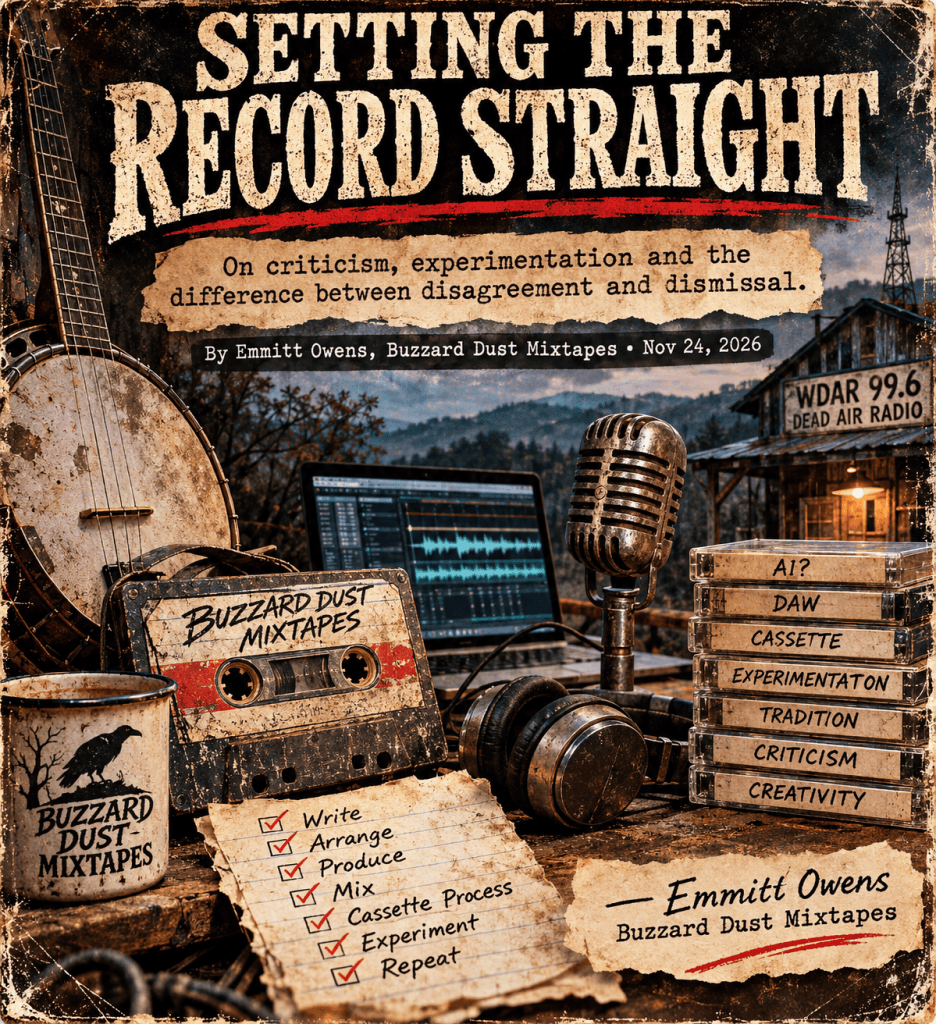
Setting the Record Straight: My Issue Isn’t With The Holler Hounds — It’s With Matty Thomas.
On criticism, experimentation and the difference between disagreement and dismissal. By Emmitt Owens, Buzzard Dust Mixtapes · Nov 24, 2026
This isn’t a Buzzard Dust Mixtapes skit or a publicity stunt, and it isn’t aimed at The Holler Hounds as a band. It’s a response to a dismissive comment made by Matty “Reverend Banjo” Thomas, and to the bigger question it raises about artistic independence, experimentation, and who gets to decide what qualifies as legitimate music.
I’m writing it because I’d rather say my piece once, clearly, than keep trading jabs in comment threads.
How it started
On The Banjo Forum, someone asked whether my Buzzard Dust Mixtapes rendition of the traditional song “Skip to My Lou” was AI-generated. Matty Thomas answered with two words: “AI slop.”
I wasn’t hiding how the track was made. I’d been talking openly about the process: the DAW work, the cassette recorders, the arrangement and the vintage sound I was going for. It’s my own interpretation of an old song, with Appalachian instrumentation and a deliberate lo-fi character. It’s found an audience, drawing approximately 2,000 views in just a few days.
There’s also an interesting contrast in the work being discussed. My recording was a deliberately produced studio arrangement, while the comparison being offered was a live phone video recording of a Doc Watson cover. Neither format is inherently superior, and no view count establishes artistic merit. But dismissing someone’s production while overlooking the creative decisions behind it seems a rather selective way to evaluate music.
I’ll own my part. I fired back with a crack about his singing. It got a few laughs, but it didn’t move the conversation anywhere useful, and I’d rather make my point properly here.
To be fair, “Is this AI?” is a reasonable question. It’s being asked in nearly every music community right now, and listeners have a right to know what they’re hearing. But a question invites an answer and a conversation. A two-word verdict, delivered after the answer was already on the table, ends the conversation before it starts. That’s the part that stuck with me.
The real question: who gets to experiment?
I have no problem with anyone disliking my music. Music is subjective, and criticism comes with putting work out in public. But “I don’t care for this” is an opinion. “AI slop” is a dismissal. It says the work isn’t worth discussing, and it says that about the person who made it, too.
Appalachian, folk, bluegrass and roots music have always grown by people borrowing, adapting and trying new things. The banjo itself has roots in African musical traditions before becoming an integral part of Appalachian music. That tradition of mixing is alive and well today. Take gothic punk bluegrass. You heard me right, folks. Picture Marilyn Manson walking into Bill Monroe’s recording studio and announcing they’ve got an album to make. Somewhere between a haunted house, a punk show and a Saturday night at the Opry, a new genre is born. And honestly? I love that it exists. That’s what living traditions do.
So I’d ask for one thing: consistency. If experimentation is welcome when it comes with dark imagery and punk attitude, it should be welcome when it comes with cassette decks, DAWs or new technology. You don’t have to like AI tools, use them or call the results art. But nobody gets to appoint themselves gatekeeper of everyone else’s creativity.
Here’s the irony. The things people usually blame on AI, like lyrics that drift without a clear story or a final chorus that spells out the song’s meaning, show up all the time in music made entirely by hand. I’ve heard plenty of it lately. “Sounds like AI” isn’t a critique of how something was made. It’s a shortcut that skips the harder work of saying what actually isn’t working.
Every new tool was “cheating” once
The argument over AI feels brand new, but the shape of it is old. Roots music has fought this fight with nearly every new tool that came along, and the tools usually won.
In 1927, Victor Records producer Ralph Peer brought a recording team to Bristol, Tennessee, and set up a temporary studio in a hat company building. Over two weeks, they recorded 76 performances by 19 acts, including the Carter Family and Jimmie Rodgers. They didn’t invent country music, but those recordings carried regional music that had lived on porches and in churches into a much larger commercial world. Some saw a tradition being preserved. Others saw it being packaged and sold. Both were a little right.
Bill Monroe didn’t inherit bluegrass. He built it over time, blending old-time fiddle music with blues and gospel, and the classic sound took shape around 1945–46, when Earl Scruggs joined his band. Earl Scruggs’ three-finger roll sounded so new that people couldn’t believe it was a banjo. Today both are treated as the definition of tradition.
In 1965, Bob Dylan plugged in an electric guitar at the Newport Folk Festival, and some of the crowd booed, though accounts differ on how much was about the music and how much was about the poor sound and the short set. Folk purists called it a betrayal. Within a few years, folk rock was everywhere. Multitrack tape, drum machines, digital recording and Auto-Tune each got the same welcome. Each was called the death of real music. Each ended up as just another tool, used well by some and badly by others.
That’s the pattern. The tool is never the whole story. What matters is what the person holding it does with it.
Who I am
I’m Emmitt Owens, an independent songwriter, producer and multimedia creator from Russellville, Alabama. I’ve been making music, writing and creating photo imagery since 1999, working across different genres, mediums, production styles and creative identities for more than 26 years.
I’ve never been particularly interested in staying inside one musical lane. Over the years, my work has moved through hip-hop, boom bap, Southern rap, experimental music, Appalachian folk, bluegrass, country and industrial metal. I’ve worked under several creative identities, including Plizaya Productions, Plizaya Playa, Razão, NdubN Glitch, Malcolm Hand and Moth Oslodg. Each represents a different direction I’ve explored.
I’ve also been around long enough to hear this argument before. When digital photography became accessible, editing images with software was called cheating. Rap wasn’t considered real music. Sampling was stealing, and making beats on a computer wasn’t playing an instrument. Every generation seems to develop a new definition of what constitutes legitimate creativity, usually based on the tools they grew up accepting. Today those once-controversial tools are commonplace. Now the tools have changed again, and I’m hearing the same arguments in new clothes.
Buzzard Dust Mixtapes is one of my most ambitious projects. What started as a musical exploration of hip-hop and rural Americana gradually evolved into a deeper exploration of Appalachian culture, eventually growing into an entire fictional universe complete with original songs, fictional performers, characters, stories, artwork, and its own radio station, WDAR 99.6 Dead Air Radio.
I write, produce, experiment, develop the concepts and build the world surrounding the music. It’s not just about making songs. It’s about creating something with its own identity and personality.
My production philosophy has always involved experimentation. I’ve spent years exploring different recording techniques, software, hardware and ways of combining old and new technology. I enjoy the limitations and imperfections of older recording equipment just as much as the possibilities offered by modern production tools.
I don’t consider myself a traditional musician working within traditional boundaries. I’m an independent creator who enjoys figuring out what happens when different ideas, technologies and musical influences collide. That’s been the common thread throughout my creative history, and it’s still what drives me today.
I also sell my music the old-fashioned way: on the honor system. If you want a song, you message me, pay what you think it’s worth (I suggest 25 cents), and I email it to you. No subscriptions, no middlemen. That’s not how someone chasing a quick payout runs things. It’s how someone who loves making things shares them.
How I make music
Most Buzzard Dust tracks start with a concept: a character, a story, or a moment on WDAR where the song belongs. From there, the work moves into my DAWs, where I shape the arrangement, edit, layer and mix.
Then I bring in the old gear. I run material through cassette decks and other vintage equipment so the hiss, wobble and saturation of tape become part of the sound. Pairing old recording gear with modern production tools is the heart of the Buzzard Dust sound: the past and the present end up on the same tape.
Some of it works and some of it doesn’t. I don’t pretend every track is a masterpiece. But a live phone video recording and a layered studio production are both legitimate ways to make music. The craft is bigger than the gear.
Where AI fits, and where it doesn’t
Since the question started all this, I’ll answer it plainly. Yes, I used AI to generate the musical performance for “Skip to My Lou.” But there’s an important distinction: I wrote my own rendition of the song, and I made the creative decisions that determined how that recording came together.
There’s a difference between being a musician and being a music producer. A performer performs. A producer develops the creative vision, decides how a recording should sound, directs the production and shapes the finished product. Those roles can overlap, but they aren’t interchangeable.
For this recording, I was the producer. I chose the musical direction, the instrumentation and the overall sound. I determined the arrangement and the vintage character I wanted. I took the AI-generated material into my DAWs, worked with it, experimented with it, and brought my cassette recording equipment into the process.
AI provided the performance. I provided the creative direction and production decisions that shaped the finished recording.
I’m not pretending I sat in a studio and personally played every instrument or sang every note. That’s not what happened, and I’ve never claimed otherwise. But suggesting that no human creativity or production work was involved, simply because AI generated the initial performance, is equally misleading.
I’m open about using these tools because I think honesty is the right standard. Let listeners know how something was made, and let them decide what they think.
There are legitimate concerns about AI in music. Artists deserve fair compensation. Nobody’s voice or work should be copied without permission. The flood of low-effort, mass-produced material creates real challenges for working musicians. Those concerns deserve serious discussion.
But labeling something “AI slop” doesn’t address any of them. It avoids the actual conversation about the music, the production and the creative decisions behind it.
What good criticism looks like
I’m not asking for praise. I’m asking for criticism worth having. Good criticism identifies something specific that a musician or listener can actually hear: the vocal sits too far back in the mix, the arrangement drags in the middle, the instrumentation feels unbalanced, the timing is off, or the lyrics don’t quite land. That’s criticism I can work with. It gives me something tangible to consider and, if I agree, might send me right back to my DAW to make adjustments. I don’t mind criticism, even when it stings. That’s part of creating and improving. But calling something “AI slop” tells me absolutely nothing about the music, the production, or what could be done better.
The old-timers who taught this music did that for each other. They’d tell you your timing was off or your tuning was sour, then show you how to fix it. That’s how the tradition got passed down. Nobody got better from being told their work was slop.
If Matty, or anyone else, wants to tell me specifically what doesn’t work in one of my tracks, I’m listening. I might even agree.
Where I stand
This disagreement is between me and one person. The rest of The Holler Hounds had nothing to do with it, and I wish them continued success.
I don’t need Matty’s approval or anyone else’s to keep creating. Disagreement doesn’t bother me. Condescension dressed up as musical authority does. If my music isn’t your thing, that’s fine. There’s plenty I don’t enjoy either, and I don’t go looking for it just to knock it down. That includes what I might consider human-generated slop and the occasional butchered cover recorded on a Samsung Galaxy and proudly presented as musical evidence.
I’ll keep making my music, and he can keep making his. And if you come across something of mine you don’t like, the song title already has the answer: skip to my Lou.
— Emmitt Owens, Buzzard Dust Mixtapes
✍🏼 Author’s Note: If you don’t like my rendition of “Skip to My Lou,” don’t worry. The title pretty much tells you what to do. Just skip to my Lou! And if you’re going to butcher a song on a Samsung Galaxy and call it music, at least give me a reason to listen before you tell me how music should be made. 🤣😂🤣


Leave a Reply