
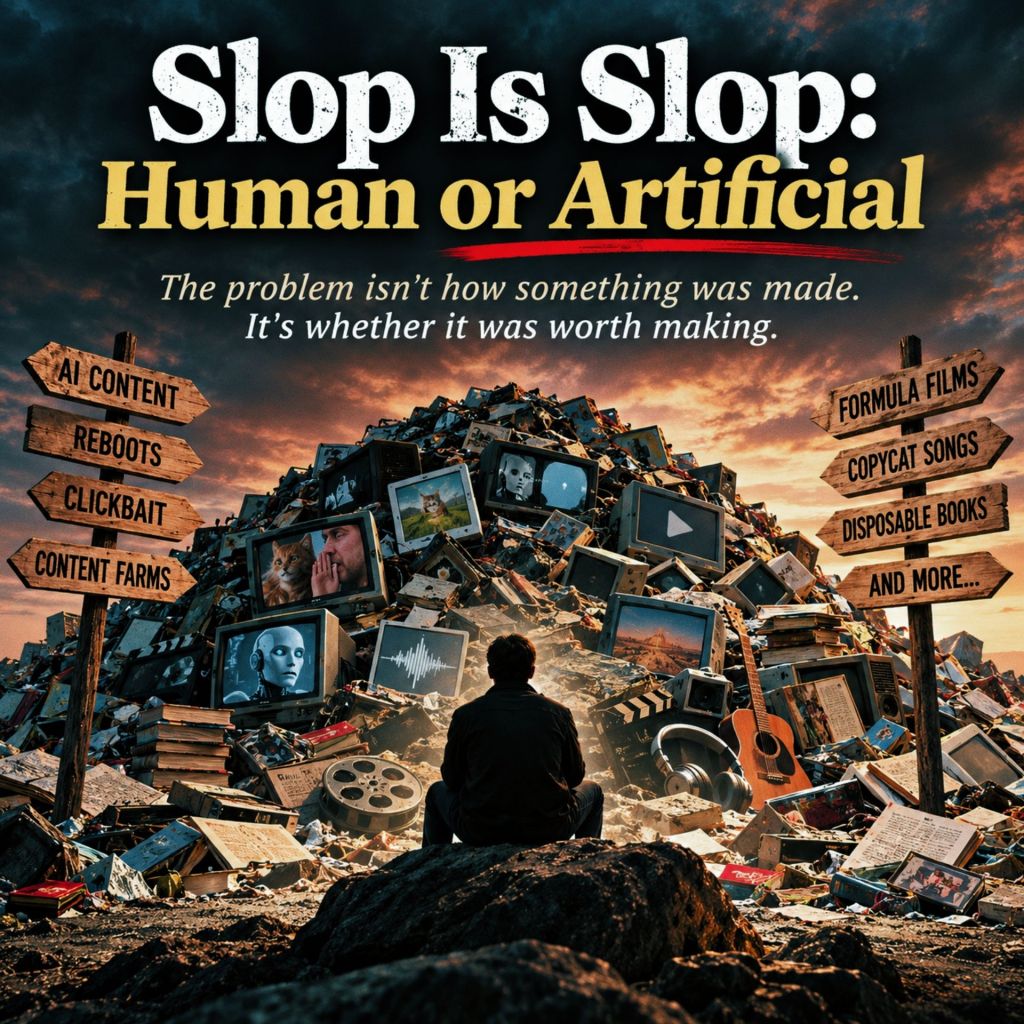
Slop Is Slop: Human or Artificial
Nov 27, 2026 · @Emmitt
The problem isn’t how something was made. It’s whether it was worth making.
We have found a new word for something as old as making things: slop.
The internet, we are told, is drowning in it. AI images, AI music, AI video, AI-written articles. The word gets flung like a bucket of paint at anything someone dislikes, distrusts, or believes shouldn’t exist. It has become less a description than a verdict, delivered before anyone has looked closely at the thing being judged.
Sometimes the verdict is deserved. Artificial intelligence is producing an extraordinary volume of garbage. Images are generated by the thousand to fill feeds. Songs are assembled without direction or intent. Fabricated stories circulate as news, and recycled ideas are dressed up as new ones. Much of it is engineered for a single purpose: to game an algorithm, harvest a click, and vanish into an endless digital landfill.
But the conversation rests on a false premise: that AI invented slop. It didn’t. We have been making it for generations. What is new is not the slop itself but our alarm about it, and that alarm deserves a closer look than it usually gets.
What We Mean by Slop
The word is far older than the internet. Over the centuries, slop has meant a muddy hole, soft mud, watery food, and the scraps fed to pigs, and from there anything of little value: cheap food, careless work, something thrown together without effort.
In 2025, Merriam-Webster made slop its word of the year. Its new definition describes low-quality digital content “produced usually in quantity by means of artificial intelligence.”
Look closely at that definition and you will see the whole debate inside it. The low quality and the quantity are the old meaning, the one that has applied to junk for centuries. The artificial intelligence is the new part, and it has been written into the word itself, as if the machine were what makes something slop. Even the dictionary hedges with “usually,” quietly admitting that slop does not need a machine.
So here is the definition this essay works from instead. Slop is work made without anything to say, produced to fill space, capture attention, or turn a profit, with no real concern for the person on the other end. The tool is not part of the definition. The emptiness is.
The Human Slop Factory
Long before anyone typed a prompt, entertainment was manufactured at industrial scale. Television was designed to keep people watching rather than to give them something worth watching. Magazines sold sensational headlines wrapped around empty stories. Bookstore racks filled with disposable paperbacks written to a template, and radio played songs that had been engineered in a boardroom before they were ever sung. Reality television went further, building whole seasons on staged conflict. An entire industry existed to produce just enough to keep the audience from changing the channel.
Hollywood has spent decades remaking, rebooting, and recycling, wringing one more dollar from stories already told. The music industry has turned out countless songs built to the same formula, recorded not because someone had something to say but because a market existed for one more.
Social media accelerated all of it. Content farms churned out articles no one needed, keyword-stuffed pages written to rank rather than to inform. Influencers learned that outrage travels further than insight. Advertisers learned to disguise ads as entertainment. Creators discovered that repetition and controversy reliably outperform originality, and many of them stopped trying to be original.
To be fair, people noticed. Human-made junk has been called out for as long as it has existed, just never with a single word. Critics called it schlock, dreck, kitsch, junk food for the mind. Audiences mocked formulaic boy bands, straight-to-video sequels, clickbait headlines, and the creators who uploaded the same video every week under a new thumbnail. Musicians with major-label budgets, world-class studios, and flawless mixes were panned for releasing polished, empty records, and everyone understood that the polish was not the point. Search engines spent years trying to bury the content farms. Whatever we called it at the time, it was slop.
But notice where the criticism landed. It landed on the work and on the people who made it. Nobody blamed the recording studio for a hollow album, the word processor for a content farm, or the camera for a bad reality show. The tool was never the villain.
Until a machine started doing it.
Slop Doesn’t Have a Species
Slop is not defined by the tool that made it. It is defined by what is missing: thought, intention, care, some reason for the thing to exist beyond the fact that it could be produced.
A writer can produce a thousand words that say nothing. A musician can record an entire album without a single original idea. A painter can create something technically dazzling with nothing to communicate. A studio can spend hundreds of millions of dollars on a film that feels like two hours of corporate committee meetings. A machine can do all of the same, and so far it often does.
What AI has changed is the economics. Production is now faster and cheaper than it has ever been. That cuts both ways. It lowers the barrier to entry, so people who never had access to a studio, an orchestra, or an illustrator can experiment, and ideas that might have stayed trapped in someone’s imagination can finally take shape. It also means more garbage, far more than any human industry could have produced on its own.
But volume is not value, and the ability to produce something says nothing about whether it deserves to exist. By all means, criticize the spam, the plagiarism, the deception, and the flood of content designed solely to capture attention. Just apply the same standard to everyone, whether the person responsible was holding a paintbrush or typing a prompt.
The Tool Is Not the Vision
One of the stranger assumptions in today’s creative debate is that using a powerful tool rules out creativity. We have had this argument before, almost word for word.
When photography arrived, Baudelaire dismissed it as the refuge of failed painters and warned that it would corrupt art. In 1982, the London branch of the British Musicians’ Union passed a motion to ban synthesizers and drum machines from sessions, fearing they would put real players out of work. Sampling was treated as theft before it was treated as an art form, and hip-hop producers spent years in court defending a technique that now runs through much of popular music. Auto-Tune, digital editing, and computer graphics each faced the same charge: that they made creativity easier, cheaper, and less authentic.
The critics were sometimes right about the consequences. Session musicians did lose work. Convenience did, at times, displace craft. But in every case the tool eventually became ordinary, and the question shifted from what was used to what was made. Nobody today asks whether a photograph is art because a camera was involved. We ask whether that particular photograph is any good.
That is because a tool has never guaranteed an idea. A camera doesn’t make someone a photographer. A guitar doesn’t make someone a musician. A word processor doesn’t make someone a writer. And artificial intelligence doesn’t make anyone creative, nor does it stop them from being so.
The distinction that matters is between someone who makes something simply because the software makes it possible and someone who arrives with an idea and a reason. The first person accepts whatever comes out. The second person rejects most of it, revises, combines, and keeps pushing until the result matches something they had in mind. That difference, between generating content and creating with intention, is visible in the work. It is the same difference that has always separated the snapshot from the photograph.
The Algorithm Doesn’t Care
Perhaps the real problem isn’t artificial intelligence at all, but the system we have built around entertainment. The internet rewards volume. Social platforms reward engagement. Recommendation systems reward whatever keeps people on the page a few seconds longer.
An algorithm doesn’t care whether a song has soul or whether an article says anything. It doesn’t know whether a video took six months or six seconds to make. It measures one thing: whether someone stopped scrolling.
That incentive predates AI by years. Platforms have been feeding us human-made slop for a long time, because it performs. Manufactured controversy performs. Recycled trends perform. Sensational nonsense performs. Creators who wanted to make careful, slow, unusual work learned that the system would not reward them for it, and many adapted. Now machines can compete in the same system, and we are shocked that they, too, can manufacture disposable content.
The machine simply learned the lesson we had already taught the internet: make more, make it faster, and never mind whether it means anything. If we want less slop, the tool is a strange place to start. The incentives are where the problem lives.
But Doesn’t Scale Change Everything?
The strongest objection to this argument deserves a real answer, not a footnote. It goes like this: human slop was always limited by human effort. Even the most cynical content farm needed people to type the words, and every bad sitcom needed actors, writers, and a crew. That friction kept the junk in proportion. AI removes the friction. When slop costs almost nothing and needs no person at all, it stops being a share of the culture and starts to become the medium the culture swims in.
That is a serious point, and it is partly right. Scale can change the nature of a problem, not just its size. A single counterfeit bill is a crime; a billion of them is a collapse of the currency. If a search for a recipe, a song, or a children’s book returns mostly machine-made filler, the cost falls on everyone looking for the real thing. The good work doesn’t disappear, but it becomes harder to find. For an independent artist trying to be discovered, that is not an abstract worry.
There is a second, quieter problem. Much of AI slop is not just low in quality but dishonest about where it came from. A fake band with invented members, a stock image passed off as a photograph of a real event, a book listed under a name that belongs to no one: these are not failures of taste. They are failures of honesty, and they deserve a harder response than a shrug.
But notice what these problems actually are. Discoverability is a problem of distribution and curation. Deception is a problem of disclosure and accountability. Neither is solved by sneering at anything a machine touched, and neither disappears if the junk is human-made. A platform flooded with human-written spam is no easier to search. A ghostwritten celebrity memoir is no more honest about its authorship. The answers to the scale problem are better filters, clear labeling, real penalties for fraud, and platforms that stop rewarding volume for its own sake. Those answers improve things whether the flood comes from a server farm or a sweatshop of underpaid writers.
So yes, scale matters. It is the best reason to take AI slop seriously. It is not a reason to judge a piece of work by its origin rather than by what it is.
The Flood Doesn’t Make Everything Worthless
The other concerns about AI are real too, and they are not the same as the slop question. Many of these systems were trained on the work of artists and writers who were never asked and never paid. That is a question of consent and fairness, and it would remain one even if every AI output were a masterpiece. People who make creative work for a living are watching clients replace them with software that learned from their portfolios. Their anger is not snobbery. It is a reasonable response to a real loss, and any honest defense of AI-assisted work has to sit alongside it rather than wave it away.
But those are arguments about how the tools were built and who profits from them. They are not arguments that everything made with the tools is worthless. Conflating the two lets us skip the harder work of actually looking.
And a flood doesn’t make everything in it worthless. Among the millions of mediocre photographs taken every day, some are worth looking at. Among the songs released each year, a handful are worth hearing more than once. Among the books published, some are worth reading. Among the things made with AI, some will be worth experiencing too, if we are willing to notice them.
The challenge isn’t identifying which technology produced something. It’s developing the discernment to tell disposable content from work of genuine value. That has always been the job of critics, editors, curators, and careful audiences, and it matters more now than it ever has. A reflex can sort by origin. Only attention can sort by quality.
The Contradictions of Slop
If slop is defined by emptiness rather than by tools, some uncomfortable conclusions follow.
The first is that polish proves nothing. An artist can book a world-class studio, hire the best session players, and pay for a flawless mix, and still release slop. The same goes for every medium. A film can have a nine-figure budget and nothing to say. A podcast can have perfect audio and an hour of filler. A glossy ad campaign, a bestselling ghostwritten memoir, a museum-quality print of a forgettable image: all of it can be professionally made and still empty. Production value is a measure of resources, not of meaning. We have simply been trained to mistake one for the other, because for most of history only professionals could afford to sound and look that good. AI has broken that link, and in doing so it has exposed how often the polish was hiding nothing.
The second contradiction is harder. I said earlier that slop is the absence of care. But care is not the whole story. A person can pour their heart into something that matters deeply to them and means nothing to anyone else. A song written for a private grief, a novel that only makes sense inside its author’s head, a painting full of symbols no viewer can read. To its maker, that work is the opposite of slop. To the public, it can be indistinguishable from it.
So is it slop? It depends on who it was for. A diary is not slop, because it was never meant to be read. But the moment a work is published, promoted, and pushed into other people’s feeds, it is asking for their time, and it will be judged by what it gives back. Sincerity does not rescue it. Work made only for the creator, then handed to the world, is likely to feel like slop to everyone except the creator.
The reverse is also true, and it is the part critics of slop rarely admit. Something made cynically, to a formula, purely for money, can still mean a great deal to the person receiving it. A by-the-numbers pop song can carry someone through a breakup. A predictable comfort show can be the thing that gets someone through a hard winter. The maker may have felt nothing, but the listener did.
This is the real contradiction at the heart of the word. Slop is not a fixed property of a thing. It lives in the gap between what a work offers and what its audience needs from it. The maker’s intention matters, but it does not settle the question. Neither does the audience’s reaction on its own. Slop is what happens when nothing crosses that gap, and that can happen with any tool, any budget, and any amount of sincerity.
Criticize the Slop, Not Just the Machine
I am not here to defend every AI-generated image, song, video, or article. Much of the internet is already disposable, and AI can produce disposable material at a rate nothing before it could match. What I want is a more honest conversation, one with a single standard instead of two.
If a person produces meaningless garbage, call it garbage. If a machine produces it, call it garbage. If a corporation spends millions on soulless entertainment, call it soulless, even if every frame was made by hand. And if someone creates something original, strange, funny, or moving with whatever tools are at hand, judge the result on its merits instead of dismissing it before looking.
That standard is harder than it sounds. It means admitting that some beloved human-made things were slop all along. It means giving a fair hearing to work we were prepared to hate. It means holding the people who use these tools responsible for what they publish, rather than blaming the software or excusing them because of it.
Technology has no moral compass and no taste. It cannot tell the meaningful from the meaningless the way a person can. But the people using it can, and they are accountable for the choice. Responsibility doesn’t vanish when a machine is involved. Neither does the possibility of creativity.
Slop Is Slop
Perhaps we are living in the age of slop. Perhaps we always have been. Every generation has produced mountains of disposable material alongside the work that truly mattered, and most of those mountains have been forgotten. We remember the few things worth remembering. We can simply build the mountains faster now.
That is no reason to celebrate the garbage. It is a reason to stop pretending garbage is new, and to aim our criticism where it can do some good: at the incentives that reward it, at the people who profit from deception, and at our own habit of judging work by its label rather than its substance.
Human or artificial, handmade or machine-assisted, slop is still slop. The real question was never whether a machine made it. It’s whether anyone had something worth making in the first place, and that is the question we should have been asking all along.


Leave a Reply