
Bob’s Great Hot Dog Roller Caper
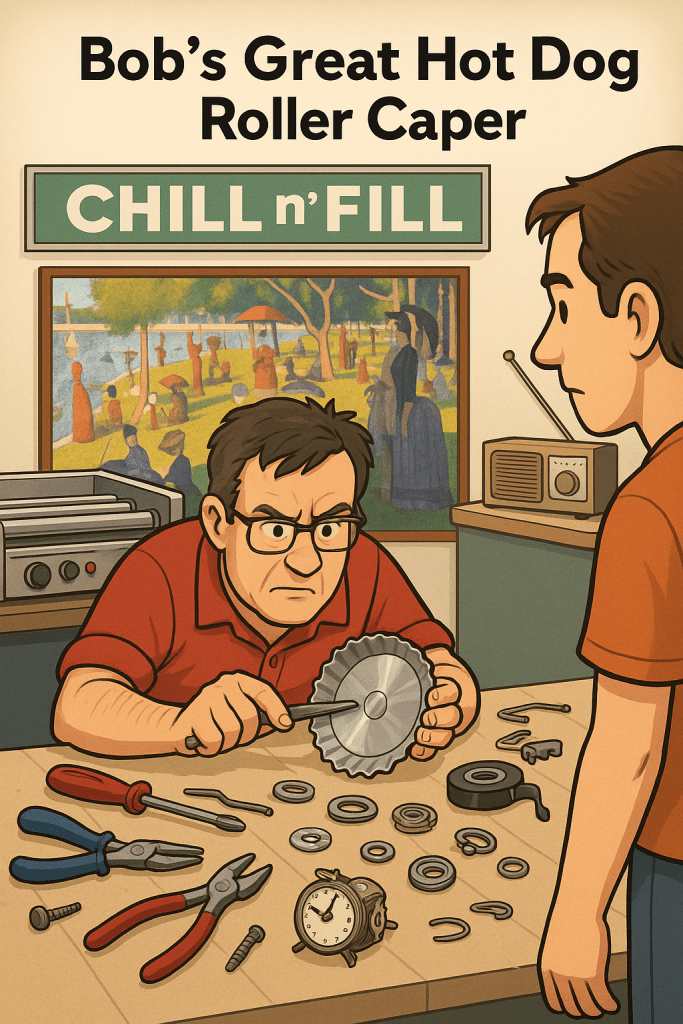
I arrived for my Tuesday shift at Chill n’Fill to find Bob crouched behind the counter like a surgeon preparing for the operation of a lifetime, surrounded by what appeared to be the dismantled remains of our hot dog roller. Tools I’d never seen before were spread across the floor in a pattern that suggested either careful organization or complete chaos—with Bob, it was always hard to tell which.
Behind me, tonight’s painting had manifested as Georges Seurat’s “A Sunday on La Grande Jatte,” all those tiny dots of color somehow perfectly capturing the meticulous, pointillistic nature of whatever engineering miracle Bob was attempting to perform. The radio was playing “The A-Team” theme song, which felt both ominous and oddly appropriate.
“Don’t panic,” Bob announced without looking up, his voice carrying the kind of forced calm that suggested I should definitely be panicking. “Everything is totally under control.”
“What happened to the hot dog roller?” I asked, surveying the mechanical carnage spread across our usually pristine floor.
“Minor setback,” Bob replied, holding up what looked like a small metal cog with several teeth missing. “The main drive wheel decided to retire without giving proper notice. But I’ve got this entirely handled. No need to call a repair service or spend money on replacement parts when we’ve got good old-fashioned American ingenuity.”
I stared at the broken mechanism, then at Bob’s face, which had that slightly manic gleam that appeared whenever he was about to transform ordinary objects into something they were never meant to be. “Bob, that component looks pretty specialized. Are you sure we can’t just order a replacement?”
“Order a replacement?” Bob scoffed, as if I’d suggested we abandon capitalism and return to a barter system. “Do you know how much they charge for these proprietary parts? Forty-three dollars. For a piece of metal smaller than a silver dollar. That’s highway robbery.”
“So what’s the plan?” I asked, though I was already dreading the answer.
His face brightened with the enthusiasm of someone who’d just discovered fire. “We’re going to make our own wheel. Right here, right now, using materials we have on hand. MacGyver style.”
“MacGyver never had to fix a hot dog roller,” I pointed out.
“MacGyver never had access to a convenience store’s worth of random supplies,” Bob countered. “Plus, I learned about metalworking from this old machinist at my brother-in-law’s shop. I’m practically an expert now.”
He reached into a bag I hadn’t noticed before and began pulling out items like a magician revealing his tricks: a stack of aluminum pie pans from the deli section, a roll of electrical tape, several different sizes of washers from the hardware display we kept by the automotive supplies, a metal coat hanger he’d apparently dismantled, and most mysteriously, what appeared to be the internal mechanism from a small alarm clock.
“First,” Bob announced, laying out his materials with the precision of a craftsman, “we need to create the basic wheel structure. The pie pans will provide the aluminum base.”
“Pie pans?” I repeated. “Bob, those are for food.”
“Not anymore they’re not,” he said cheerfully, using a pair of tin snips to cut precise triangular teeth around the edge of the largest pan. “See? Instant cog teeth. Just need to get the spacing right.”
I watched in fascination and horror as Bob carefully measured the circumference of the aluminum disc, divided it by the number of teeth the original part had, and began marking points with a Sharpie. His technique was surprisingly methodical—apparently that machinist had taught him something about ratios and tooth spacing.
“The trick,” Bob explained as he worked, “is maintaining the same diameter as the original component. Too big and it won’t mesh with the other wheels. Too small and it’ll slip. But if we layer multiple pans and reinforce with these washers…” He held up the various metal rings he’d collected.
As “The A-Team” theme reached its climactic crescendo, Bob began assembling his creation. He stacked three pans of slightly different sizes, using the washers as spacers and the coat hanger wire—which he’d straightened and reshaped—as internal reinforcement. The alarm clock mechanism, he explained, would provide the precise center hub needed to mount the wheel on the roller’s drive shaft.
“This is either brilliant or absolutely insane,” I said, watching him wrap strategic points with electrical tape for additional strength.
“Often the same thing,” Bob replied, testing the flexibility of his improvised component. “The key is understanding that every engineering problem is just a puzzle waiting for the right combination of available resources.”
Twenty minutes later, Bob had created what could generously be called a functional wheel and less generously be called a metallic sculpture that vaguely resembled one. It had the right number of teeth, approximately the correct diameter, and through some miracle of physics and determination, actually seemed structurally sound.
“Now comes the moment of truth,” Bob announced, approaching the disassembled roller like a bomb disposal expert approaching a suspicious package.
The reassembly process was surprisingly smooth—Bob clearly understood the machine’s mechanics better than I’d given him credit for. He carefully mounted his homemade component onto the drive shaft, aligned it with the other wheels, and began threading the roller bars back into position.
“Cross your fingers,” he said, reaching for the power switch.
The machine hummed to life. For a moment, nothing happened. Then, slowly, majestically, the rollers began to turn. Bob’s pie pan creation engaged with its metal counterparts, the teeth meshing smoothly, the whole assembly rotating with the dignified precision of a well-oiled machine.
“It works,” I said, genuinely impressed despite myself.
“Of course it works,” Bob replied, but I could hear the relief in his voice. “Though we should probably put some frankfurters on there to test it under load.”
I grabbed a package of hot dogs from the cooler and carefully placed them on the rotating rollers. They began their slow, hypnotic rotation, cooking evenly under the heat lamps. Bob’s improvised wheel continued its steady work, showing no signs of stress or slippage.
“Bob,” I said, watching our lunch meat carousel in action, “that’s actually pretty impressive.”
“That old machinist knew his stuff,” he grinned. “Plus thirty years of refusing to pay retail prices for things I can make myself. You’d be amazed what you can accomplish with determination and a total disregard for manufacturer warranties.”
As if celebrating Bob’s triumph, the radio switched to “We Are the Champions” by Queen, while Seurat’s pointillistic masterpiece seemed to sparkle with approval behind us—all those tiny dots of color representing the countless small innovations that add up to something greater.
“How long do you think it’ll last?” I asked.
“Could be a week, could be five years,” Bob shrugged. “But when it breaks, I’ll fix it again. That’s the beauty of understanding how things work—you’re never really stuck as long as you’ve got imagination and access to a hardware store.”
A customer walked in just as the first batch of links reached optimal rotation speed. She approached the roller, examined the perfectly rotating frankfurters, and selected two for lunch.
“Your hot dogs always look so perfectly cooked,” she commented as I rang up her purchase.
“We take pride in our equipment maintenance,” I replied, glancing at Bob, who was quietly cleaning up his metalworking debris with the satisfied expression of someone who’d just solved the unsolvable.
After she left, Bob stood back to admire his handiwork one more time. “You know what the best part is?” he asked.
“That it actually works?”
“That it cost me four dollars in materials instead of forty-three for the replacement part. That’s what I call a return on investment.”
As I watched the dogs continue their eternal rotation, powered by Bob’s magnificent contraption of pie pans, washers, and clockwork, I had to admit there was something deeply satisfying about fixing something with ingenuity instead of just throwing money at the problem.
“So what’s next on your engineering agenda?” I asked.
That familiar spark appeared in Bob’s eyes as he glanced toward our perpetually temperamental slush machine. “Well, since you asked…”
I pulled out my phone to text my roommate: “Bob turned pie pans and alarm clock parts into a functioning wheel to fix our hot dog roller. It actually works. Currently watching frankfurters rotate with the dignity they deserve while Bob eyes the slush machine like his next victim. Tonight’s painting was pointillist masterpiece and radio played The A-Team theme. Never underestimate the power of old machinist wisdom and creative stubbornness.”
Another night at Chill n’Fill, where broken equipment was just an opportunity for Bob to prove that with enough determination and utter disregard for conventional repair methods, any problem could be solved with whatever happened to be lying around. The hot dogs rolled on, blissfully unaware they were being rotated by a masterpiece of convenience store engineering.


Leave a comment