
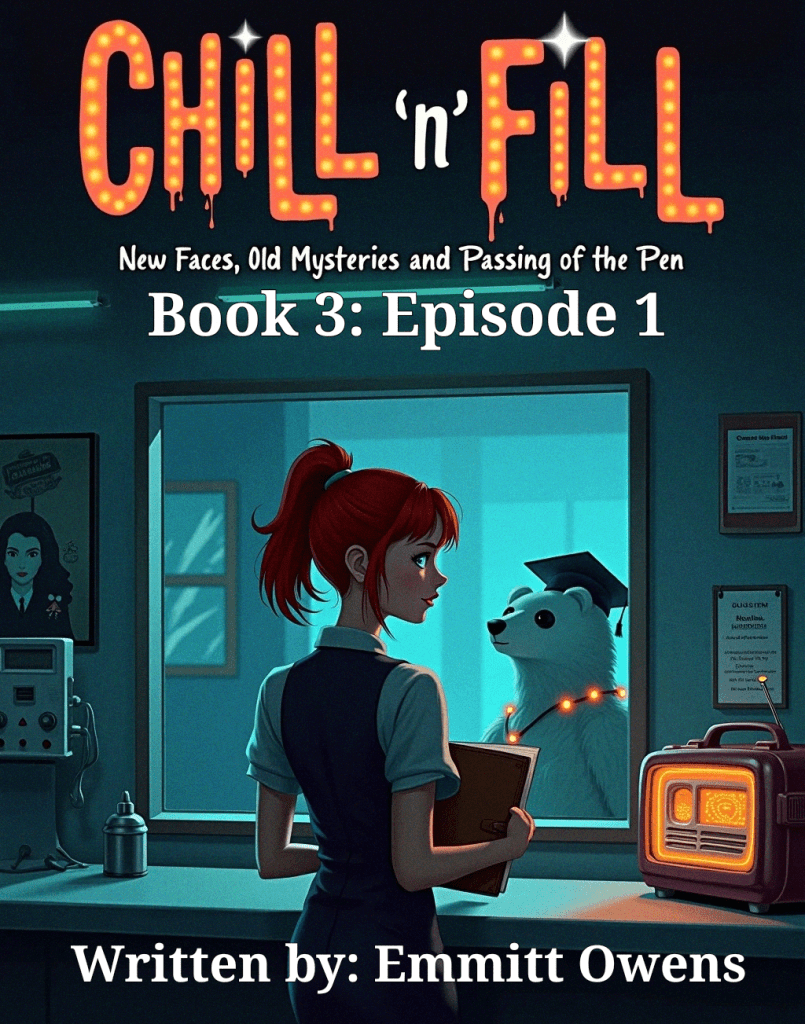
Chill’n’Fill
Book 3: Episode 1
New Faces, Old Mysteries, and the Passing of the Pen
Written By: Emmitt Owens
The announcement crackled through Chill n’Fill’s speakers with Bob’s characteristic blend of corporate formality and complete detachment from reality. I watched from behind the counter as the handful of evening customers paused their snack selections to listen, their faces displaying the now-familiar expression of people trying to process Bob’s latest proclamation.
“Attention valued Chill n’Fill family members and assorted witnesses,” Bob’s voice boomed over the PA sounding as if someone had clearly rehearsed this speech. “Management is pleased to introduce our new evening associate, Cindy Martin, who brings enthusiasm, punctuality, and most importantly, a verifiable work history that doesn’t include mysterious week-long disappearances involving alleged ‘swimming adventures’ with unnamed friends.”
I froze behind the register as a middle-aged woman near the energy drinks turned to stare at me with undisguised curiosity. Wait, what?
“Our previous evening associate, Karlee Thompson, has been reassigned to ‘customer status’ following her unexplained absence and subsequent return with what management determined to be ‘creatively insufficient justification for job abandonment.’ We wish her well in her future endeavors and remind all current staff that ‘I went swimming for six days’ is not considered adequate documentation for extended leave.”
The woman was now openly gawking as the full reality of Bob’s announcement hit me. He was firing me. Right now. Over the intercom. In front of customers.
“Karlee Thompson, please step away from the register so that Cindy Martin can assume her duties immediately. This transition is effective as of this announcement. Thank you for your… sporadic service.”
The announcement ended with Bob’s signature abrupt cutoff, leaving the store in mortified silence broken only by the soft hum of the refrigeration units and my own heart pounding in my ears. I stood there for a moment, processing the fact that I’d just been publicly fired via convenience store PA system.
“Um,” came a tentative voice from behind me. I turned to see a young woman about my age with shoulder-length red hair, bright blue eyes, and an expression of genuine sympathy mixed with professional awkwardness. She was wearing the standard Chill n’Fill polo shirt and holding what appeared to be new employee paperwork. “I’m really sorry about… that. I’m Cindy Martin.”
“Karlee Thompson,” I replied, my voice surprisingly steady as I began untying my work apron. “The mysteriously swimming, recently unemployed person you’re replacing.”
“This is incredibly awkward,” Cindy said, stepping closer to the register as I moved aside. “I had no idea Bob was going to do it like this. I thought you’d already been… you know… let go.”
I handed her the register keys, trying to maintain whatever dignity remained after being fired over an intercom. “Apparently Bob enjoys the theatrical approach to termination.”
Her directness, even in this mortifying situation, was oddly comforting. “It’s… complicated,” I admitted, gathering my things from behind the counter.
“The best adventures usually are,” she replied, taking her position at the register with professional efficiency while still managing to sound genuinely sympathetic.
I looked up at the painting hanging behind the register—a new addition since my return that was an unmistakable print of Edward Hopper’s “Nighthawks.” The lonely late-night diner scene, with its isolated figures bathed in fluorescent light, seemed almost too perfect for a convenience store setting. Bob claimed he’d bought it at a garage sale because “it matched the store’s aesthetic,” but like everything else at Chill n’Fill, it seemed to possess an unsettling tendency toward prophetic accuracy—depicting people finding connection in the most unlikely places during the loneliest hours.
The one-eyed polar bear outside had been dressed in a graduation cap and diploma today, adding to its growing collection of Bob’s modifications. The bear’s mechanical eye, fashioned from a garbage can lid stamped with “Cheinco 1957,” caught the light as it performed its robotic wink, while Christmas tree bulbs had been strung around its form, creating an oddly festive glow. Around its neck hung the usual small chalkboard, today reading: “STORIES FIND THEIR TELLERS, TRUTH FINDS ITS VOICE.” The faded “Marty’s Quikmart” sign behind it was barely visible now, like a ghost from the store’s mysterious past.
Before I could process my termination any further, I reached under the counter and pulled out a worn leather journal, its pages filled with mine & Jennifers handwriting from months of late-night shifts. Every strange customer, every bizarre Bob announcement, every inexplicable radio coincidence—it was all documented in careful detail.
“Here,” I said, placing the book in Cindy’s hands. “You’re the narrator now.”
She looked down at the journal, flipping through a few pages and reading snippets of my observations about the store’s peculiar ecosystem of characters and mysteries.
“What is this?” she asked, genuine curiosity in her voice.
“The real story of this place,” I replied, “from when it was still Marty’s Quikmart and Jennifer stood where you’re standing now, through the name change, and into my own version of it after she left. Every weird thing that happens here, every customer who walks through that door with a story to tell—it all gets written down. Bob thinks this place is just a convenience store, but it’s really more like… a collection of human experiences.”
Cindy held the journal carefully, as if understanding its significance. “And now it’s my job to document the weirdness?”
“Your job is to work the register,” I corrected with a small smile. “The documenting part… that’s everything. This place has a way of showing you things about people you never expected to see. Write it all down, Cindy. Every customer, every strange moment, every time the radio does something impossible. You’re the narrator now.”
The bell chimed, announcing the first customer of what would be Cindy’s inaugural shift as both cashier and chronicler. A man in his early thirties entered, moving with the careful deliberation of someone who was trying very hard to appear normal while processing something significant. He had the slightly hollow look of someone who hadn’t been sleeping well, but his clothes were clean and his hair was combed—the efforts of someone determined to maintain appearances despite internal turmoil.
“That’s my cue to leave,” I said, gathering the last of my things. “Good luck, Cindy. You’re going to need it.”
“Wait,” she called after me, “what if I don’t know what to write?”
“Trust me,” I replied, already heading for the door, “the stories will find you.”
The store’s radio—which had been playing generic background music—suddenly shifted to Gotye’s “Someone That I Used to Know” as if responding to the changing of the guard. I paused at the door to give Cindy one last piece of advice.
“See?” I said. “The radio always knows. Just listen, and write it down.”
And with that, I left Chill n’Fill as a customer rather than an employee, leaving Cindy Martin alone behind the register with a mysterious journal, a ghostly radio, and her first customer of the night already approaching the counter with a story that needed to be told.
Through the window, I could see her looking down at the journal, then up at the customer, then back at the journal. She opened it to a fresh page, picked up a pen, and began to write.
The narrator’s torch had been passed. Whatever stories unfolded in that fluorescent-lit confessional tonight would be hers to document, hers to preserve, hers to understand.
*From the journal of Cindy Martin, new evening associate and apparently, narrator:*
Okay, so I’m doing this. Karlee just walked out of here after handing me this journal and telling me I’m supposed to write down everything that happens. She seemed really serious about it, like this was some kind of sacred duty rather than just documenting weird convenience store interactions.
The first customer is approaching the counter now. He looks like he hasn’t slept well in days, but he’s clearly making an effort to appear put-together. Let me try to write this the way Karlee did in all these previous entries…
—
The man had spent nearly ten minutes wandering the store with purposeful aimlessness, picking up items and setting them down without really seeing them. A bag of chips examined and replaced. A candy bar considered and rejected. He moved like someone using the act of shopping as a meditation, a way to organize his thoughts before committing to whatever conversation he was working up to having.
Finally, he made his way to the coffee station and filled the largest cup available, adding cream and sugar with care, seeming like someone who was buying himself time. When he approached the counter, he set the coffee down and looked at me with the expression of someone who had just made a decision.
“Just the coffee tonight?” I asked.
“Actually,” he began, then paused, running his hand through his hair. “Can I ask you something? Do you believe in the healing power of solitude?”
Before I could answer, the store’s radio—suddenly shifted to Simon & Garfunkel’s “The Sound of Silence,” its contemplative melody filling the space with perfect appropriateness. I blinked in surprise at the timing.
“I’m starting to believe in a lot of things I didn’t before,” I replied, gesturing vaguely toward the speakers. “What’s going on?”
“I’ve been alone for three weeks now,” he said, his voice growing stronger. “Really alone, for the first time in five years. My girlfriend—ex-girlfriend—moved out after I found out she was cheating. Everyone keeps asking if I’m lonely, if I’m dating yet, if I need them to set me up with someone.”
He paid for his coffee but made no move to leave, as if he needed to finish his thought.
“But the thing is,” he continued, “I’m not lonely. I’m discovering who I am when I’m not trying to be half of something else. I wake up when my body wants to wake up. I eat what I want to eat. I’ve started painting again—something I gave up because she said it made the apartment smell weird.”
Paul Simon’s haunting vocals about people talking without speaking seemed to underscore his revelation about finding his authentic voice.
“Last weekend, I spent an entire Saturday working on a single canvas,” he said, his face lighting up with genuine excitement. “Lost track of time completely. When I finally looked up, it was dark outside, and I realized I hadn’t thought about the breakup or the cheating or my loneliness once. I was just… present. Creating something that was entirely mine.”
“That sounds liberating,” I observed.
“It is,” he nodded emphatically. “I’m remembering dreams I had before I became someone’s boyfriend. Goals that got shelved because they didn’t fit into our couple narrative. I’m reading books she thought were boring. I’m listening to music that speaks to my soul instead of what we could both tolerate.”
As the song continued, its message about the importance of genuine communication and authentic expression seemed to reflect his journey toward self-discovery.
“The silence isn’t empty,” he said, as if the lyrics had sparked a deeper realization. “It’s full of possibilities. Full of my own thoughts and dreams and aspirations. I’m not running from solitude anymore—I’m embracing it. Using it to rebuild myself from the ground up.”
He gathered his coffee, standing taller than when he’d entered.
“Everyone says I should be angry about what she did,” he concluded. “But I’m actually grateful. Her betrayal forced me into this solitude, and this solitude is teaching me who I really am. For the first time in years, I’m excited about my future—not our future, my future.”
He left with the stride of someone who had found strength in being alone, the bell chiming softly behind him as Simon & Garfunkel continued to play their ode to meaningful silence and authentic self-expression.
*Journal note: First customer just taught me that solitude and loneliness are completely different things. There’s something beautiful about someone who can turn betrayal into self-discovery, who can find strength in being alone rather than seeing it as something to escape from.*
*Also, this radio situation is definitely not normal. That song started playing at exactly the right moment. I need to ask Bob about this tomorrow.*
—
About forty-five minutes later, the bell chimed to announce the second customer of my shift. A woman in her late twenties entered with the glowing energy of someone carrying wonderful news. She moved through the store with unhurried joy, taking her time to browse before selecting a bottle of sparkling cider and an expensive box of chocolates. Her movements had the languid happiness of someone savoring a perfect moment.
She spent several minutes reading greeting cards, finally selecting one with a simple design, before making her way to the counter with her small celebration collection.
“Special occasion?” I asked, noting the thoughtful curation of her purchases.
“The best kind,” she replied with a radiant smile. “I just came from my wedding reception. Well, technically our wedding reception—my husband and I had it in his parents’ backyard with just close family and friends.”
As if summoned by her joy, the radio shifted from its background music to Ed Sheeran’s “Perfect,” the romantic ballad filling the store with its tender celebration of deep, abiding love.
“Congratulations!” I said, genuinely delighted. “These look like perfect reception treats.”
“Thank you,” she beamed, then her expression grew more thoughtful. “But honestly, I’m not just celebrating the wedding. I’m celebrating the fact that I almost talked myself out of marrying the most wonderful man in the world because I thought there was something wrong with our relationship.”
“What do you mean?” I asked, intrigued.
She arranged her items on the counter as she spoke, her hands moving with the unconscious grace of someone completely at peace.
“We’ve been best friends for eight years, dated for two,” she explained. “And everyone kept asking us when we knew we were ‘more than friends,’ like there was supposed to be some dramatic moment where everything changed. But the truth is, we built our love so slowly and naturally that there was never a single moment of realization.”
Ed Sheeran’s lyrics about finding love in ordinary moments seemed to perfectly complement her story of gradual, authentic connection.
“I kept waiting for that passionate, all-consuming feeling that movies talk about,” she continued. “The kind of love that’s supposed to feel like drowning and flying at the same time. And when I didn’t feel that, I worried we were just settling for comfort instead of true romance.”
“But that’s not what you concluded?” I asked.
“My grandmother set me straight,” she laughed, her eyes sparkling with the memory. “She told me that after sixty-two years of marriage, the butterflies are nice, but what matters is finding someone who feels like home. And that’s exactly what he is—home.”
She paid for her items, but lingered at the counter as if she wanted to share the full story.
“We don’t have dramatic fights followed by passionate reconciliations,” she said. “We just communicate. When something bothers one of us, we talk about it like adults and figure it out together. We don’t have this desperate need to be together every second—we just genuinely enjoy each other’s company. We laugh together every single day.”
The song’s message about dancing in the dark and loving someone exactly as they are seemed to capture the essence of her relationship—love that was both romantic and grounded in genuine friendship.
“The night he proposed,” she continued, her voice soft with remembered tenderness, “we were cooking dinner together like we do every Sunday. And he just said, ‘I love building a life with you. Want to make it official?’ No grand gesture, no elaborate plan. Just truth.”
“That sounds perfect to me,” I said.
“It was perfect,” she agreed. “Not because it was dramatic or traditionally romantic, but because it was authentically us. And our wedding was the same way—simple, genuine, surrounded by people who know and love us both. No pretense, no performance, just celebration of what we’ve built together.”
She gathered her celebration supplies, practically glowing with contentment.
“Purpose over pleasure,” she said, as if summarizing her philosophy. “We didn’t build our relationship on butterflies or passion that burns hot and fast. We built it on friendship, respect, shared values, and genuine affection. And you know what? That foundation is strong enough to support a lifetime of love.”
She left with the serene confidence of someone who had chosen wisely, the bell chiming softly behind her as Ed Sheeran’s tribute to lasting love continued to play.
*Journal note: Customer number two just gave me a master class in authentic love. There’s something revolutionary about choosing substance over drama, about recognizing that the best relationships might be the ones that feel easy rather than difficult. She’s right—why should love feel like work when it could feel like coming home?*
*The radio continues to be impossibly perfect with its timing. I’m starting to think Karlee was completely right about it having some kind of consciousness.*
—
Nearly an hour later, the bell chimed for the third time that evening. A man in his forties entered with the weary expression of someone who had been wrestling with uncomfortable truths. He moved through the store slowly, clearly in no hurry, stopping occasionally to read labels on products he had no intention of buying. Eventually, he selected a single bottle of beer and a bag of pretzels before approaching the counter.
“Long day?” I asked, noting the tension in his shoulders and the thoughtful way he set his items down.
“Long marriage,” he replied with a rueful smile. “Or rather, long process of understanding why it ended.”
As if responding to his words, the radio shifted to Fleetwood Mac’s “Go Your Own Way,” its raw honesty about the end of a relationship filling the store with bittersweet recognition.
“Divorce?” I asked gently.
“Finalized last week,” he nodded. “She had an affair, moved out six months ago, and everyone keeps telling me how sorry they are for what she did to me. And for months, I played that role—the wronged husband, the victim of her betrayal.”
He paid for his items but made no motion to leave, as if he needed to work through his thoughts out loud.
“But the thing is,” he continued, “the more honest I’ve become with myself, the more I realize that the affair was just the symptom, not the disease. Our marriage was already dead; we just hadn’t admitted it yet.”
Lindsey Buckingham’s vocals about the pain of growing apart seemed to underscore his realization about the complexity of relationship failure.
“What I mean is,” he said, his voice growing more confident, “we stopped having real conversations about our relationship years ago. Not just about feelings, but about everything—including whether we were still compatible in the most basic ways.”
“That must be hard to acknowledge,” I observed.
“It’s liberating, actually,” he said, surprising me. “Because it means our marriage didn’t fail because we were terrible people. It failed because we changed, grew apart, and were too afraid of difficult conversations to address it honestly.”
He opened his beer, taking a thoughtful sip before continuing.
“The truth is, we wanted different things, needed different things, but we kept pretending everything was fine because that felt easier than admitting we’d grown incompatible,” he explained. “She found what she needed with someone else instead of being honest with me about what wasn’t working. And I buried myself in work instead of facing the fact that we’d become strangers.”
The song’s message about the necessity of going separate ways when love has run its course seemed to reflect his hard-won understanding of their situation.
“So where does that leave you now?” I asked.
“Surprisingly, in a good place,” he said with a genuine smile. “We’re actually talking more honestly now than we have in years. Turns out when you stop pretending everything is perfect, you can have real conversations about what went wrong and why.”
He gathered his items, standing straighter as he spoke.
“I’m not saying the affair was right,” he clarified. “But I understand now why it felt like her only option when honest communication had broken down so completely. And maybe if we’d been brave enough to have difficult conversations earlier, we could have either fixed our problems or ended things with dignity before anyone got hurt.”
“That takes incredible maturity,” I said, genuinely impressed.
“It takes incredible exhaustion with being angry,” he replied with a laugh. “Blame is just as destructive as denial. The truth is more complex, but it’s also more useful for moving forward.”
As he headed toward the door, he paused and turned back.
“The strangest part,” he said, “is that I think we’re going to be okay. Both of us. Because for the first time in years, we’re being honest about who we are and what we need. Even if what we need isn’t each other.”
He left with the quiet dignity of someone who had found peace in complexity, the bell chiming softly behind him as Fleetwood Mac’s honest examination of love’s end continued to play.
*Journal note: Third customer of the night just demonstrated something profound about the difference between blame and understanding. There’s incredible strength in taking responsibility for your part in a relationship’s failure while still holding the other person accountable for their choices. He’s choosing truth over comfortable narratives, even when the truth is harder to live with.*
*This job is definitely more than just working a cash register. It’s like being a witness to people’s most honest moments, when they finally stop hiding from difficult truths. I can see why the other two cashiers felt compelled to document all of this.*
*The radio remains mysteriously perfect in its song selection. One song per customer, perfectly matched to their story. There’s definitely something supernatural happening here.*
*First night on the job and I already have three incredible stories about human resilience, authentic love, and the complexity of relationships. If this is what working here is like, I think I understand why this place needed a narrator.*
Outside, the one-eyed polar bear continued its robotic wink at passing cars, its graduation cap now completely askew in the evening breeze. The mechanical eye, fashioned from a garbage can lid stamped with “Cheinco 1957,” gleamed under the Christmas tree bulbs Bob had wrapped around its form, creating an oddly mystical glow in the darkness. The small chalkboard around its neck swayed gently, its message “STORIES FIND THEIR TELLERS, TRUTH FINDS ITS VOICE” catching the streetlight. The faded Marty’s Quikmart sign flickered once more, as if acknowledging the end of another night of revelations.
Just another evening at Chill n’Fill, where Edward Hopper’s lonely diner scene watched over late-night confessions, where a ghostly radio provided the perfect soundtrack to people’s most honest moments, and where a new narrator was learning that some stories choose their teller as much as their teller chooses them.
As I closed the journal and settled in for the rest of my shift, I couldn’t help but smile. Karlee was right—the stories really did find you. You just had to be ready to listen, ready to write, and ready to witness the beautiful complexity of human experience under fluorescent lights.
The torch had been passed, and I am honored to carry it.
 TumbleDweeeb
Leave a comment