
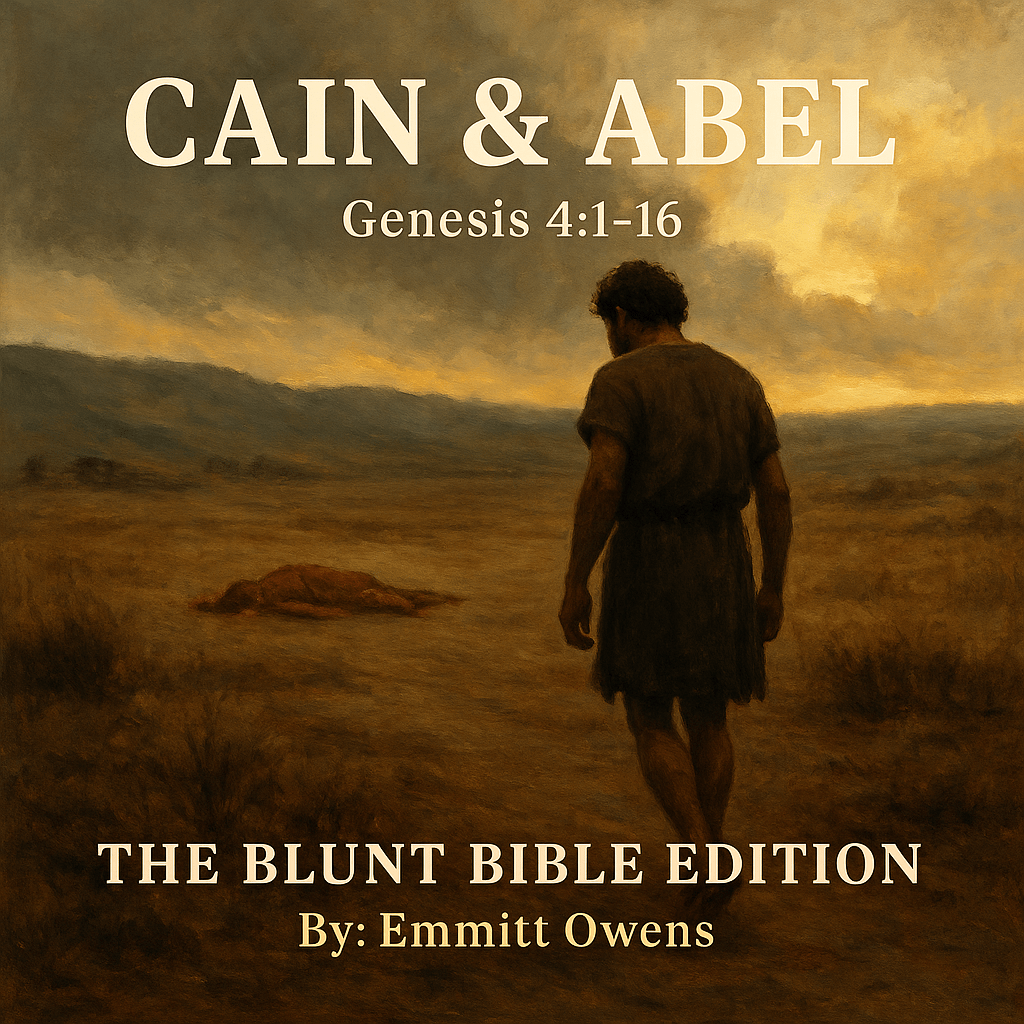
CAIN & ABEL (Genesis 4:1-16)
The Blunt Bible Edition
By: Emmitt Owens
(Index #10142025)
—–
✍️ Author’s Note:
I almost didn’t write this one.
My original plan was to skip the full story and just give you the morals and the “Why This Matters” section. Move on quickly. Because Genesis 4 doesn’t work with the Blunt Bible format I’ve built. There’s no quirky detail to soften the blow. No weird moment that makes the horror easier to digest.
Genesis 1-2 had light before the sun and a woman made from a rib—strange, yes, but ultimately hopeful. Genesis 3 had a talking serpent and the world’s first fashion emergency with leaf underwear—bizarre, sure, but Adam and Eve still built a life together afterward. They found purpose in the wilderness.
Genesis 4? There’s nothing to lighten this.
No punchlines in fratricide. No humor in jealousy-fueled violence. No clever angle on humanity’s first hate crime.
This is just dark. Horror. Hate. Brother murdering brother.
And here’s what made it harder: I’ve written horror stories. I’m comfortable with dark material. I know how to sit in the uncomfortable. But writing this—this was different.
Blood crying out from the ground. A brother leading another to a field with the intent to kill. The earth itself drinking blood and screaming for justice. Premeditated violence. A lie to God’s face. The first curse on a human being.
This is the goriest, most vivid & viscerally disturbing story I’ve ever written.
And it’s not fiction.
It’s not something I made up to explore human darkness or to shock readers.
It’s scripture. Word for word. Genesis 4:1-16.
I couldn’t skip it. Even though I wanted to. Even though it made me uncomfortable to write.
Because this story matters too much.
This is where jealousy, lies, and murder enter the human story. This is where we see what unchecked sin actually does when you don’t master it. And honestly? We’re still living in the aftermath of Genesis 4 every single day.
So I’m telling it.
Seriously. Directly. Without jokes. Without softening.
Because some stories are too important to skip—even when they’re too sad to make light of, and even when they’re too disturbing to write comfortably.
This is one of those stories.
—–
Remember how everything was “very good” two chapters ago? Paradise, purpose, no pain, no shame, eternal life on the table? Genesis 3 happened. They ate the fruit, got exiled, and now humanity is outside Eden dealing with the consequences. Genesis 3 introduced fear, shame, and blame. Genesis 4 introduces something worse: violence between brothers.
This is where we see:
– The Very First Baby ever Born
– The Very First Rejected Worship
– The Very First Act of Jealousy
– The Very First Sin Mentioned by Name
– The Very First Premeditated Violence
– The Very First Murder
– The Very First Lie (yes, the actual first DIRECT LIE in the Bible)
– The Very First Question Asked in Deflection
– The Very First Curse Upon a Born Human
– The Very First Exile from Family
– The Very First Divine Protection Mark
– The Very First Separation from God’s Presence
This isn’t symbolic. This isn’t metaphor.
This is brother killing brother.
Let’s walk through what happened.
—–
THE FIRST FAMILY
Genesis 4:1-2 (KJV) – “And Adam knew Eve his wife; and she conceived, and bare Cain, and said, I have gotten a man from the Lord. And she again bare his brother Abel. And Abel was a keeper of sheep, but Cain was a tiller of the ground.”
Adam and Eve have two sons:
– Cain – the firstborn, a farmer (works the soil—ironic, given that the ground is now cursed)
– Abel – the younger, a shepherd (keeps flocks)
Eve named Cain with hope: “I have gotten a man from the Lord.” The Very First Baby ever Born. Humanity’s fresh start outside Eden. Two brothers. Two different vocations. Everything seems normal. It won’t stay that way.
—–
THE OFFERINGS
Genesis 4:3-4 (KJV) – “And in process of time it came to pass, that Cain brought of the fruit of the ground an offering unto the Lord. And Abel, he also brought of the firstlings of his flock and of the fat thereof. And the Lord had respect unto Abel and to his offering:”
Time passes. Both brothers bring offerings to God:
– Cain brings “some of the fruits of the soil” – produce from his cursed farm
– Abel brings “fat portions from some of the firstborn of his flock” – the best of his animals
Notice what the text emphasizes: Abel brought the firstborn and the fat portions (the choicest parts). It doesn’t say Cain brought his best. Just “some of the fruit.”
Genesis 4:5 (KJV) – “But unto Cain and to his offering he had not respect. And Cain was very wroth, and his countenance fell.”
-God accepted Abel’s offering.
-God rejected Cain’s offering.
(The Very First Rejected Worship)
This is the first time in human history that someone brought worship to God and had it rejected. Why? The Bible doesn’t explicitly say. That silence has echoed for millennia. Was it the quality? The heart behind it? The type of sacrifice? The text leaves us wondering.
What we do know:
Cain was furious. His face fell.
(The Very First Act of Jealousy)
Not jealous of something Abel had. Jealous that Abel’s worship was accepted and his wasn’t.
—–
GOD’S WARNING
Genesis 4:6-7 (KJV) – “And the Lord said unto Cain, Why art thou wroth? and why is thy countenance fallen? If thou doest well, shalt thou not be accepted? and if thou doest not well, sin lieth at the door. And unto thee shall be his desire, and thou shalt rule over it.”
God confronts Cain—not with condemnation, but with questions:
“Why are you angry? Why is your face downcast?” Then comes one of the most important warnings in Genesis:
“If you do what is right, will you not be accepted? But if you do not do what is right, sin is crouching at your door; it desires to have you, but you must rule over it.” Pause on that image: Sin is crouching at the door. Like a predator. Waiting. Watching. Ready to pounce.
This is the first time the word “sin” appears in the entire Bible. Genesis 3 describes disobedience and consequences, but never uses the word “sin.” If we’re going word-for-word, scripture-only, non-traditional: this is (The Very First Sin Mentioned by Name.)
And it’s not described as a rule you break or a mistake you make. It’s described as something alive—crouching, desiring, hunting. God is giving Cain a way out. A warning. A choice. You can master this. Or it will master you.
—–
THE MURDER
Genesis 4:8 (KJV) – “And Cain talked with Abel his brother: and it came to pass, when they were in the field, that Cain rose up against Abel his brother, and slew him.”
Cain talked with Abel.
(The Very First Premeditated Violence)
This wasn’t a sudden outburst. This wasn’t a heat-of-the-moment crime of passion. Cain talked with Abel first. Then took him to the field—away from everyone, where no one could see. This was planned. Then, when they were alone—Cain attacked Abel and killed him.
(The Very First Murder)
The Bible doesn’t describe the method. Doesn’t describe the struggle. Doesn’t linger on the violence. It just states it plainly: Cain killed his brother. The first human death in history wasn’t old age. Wasn’t disease. Wasn’t an accident. It was murder. Brother killed brother over jealousy. Sin didn’t just crouch at the door. It pounced. And Cain let it.
—–
THE QUESTION
Genesis 4:9 (KJV) – “And the Lord said unto Cain, Where is Abel thy brother? And he said, I know not: Am I my brother’s keeper?”
God comes to Cain and asks a question He already knows the answer to: “Where is your brother Abel?”
God isn’t confused. He knows exactly where Abel is. He knows exactly what Cain did. But He’s giving Cain a chance—a chance to confess, to own what he’s done, to take responsibility. Instead, Cain says: “I don’t know. Am I my brother’s keeper?”
(The Very First Lie)
Yes, the serpent twisted truth in Genesis 3. But this? This is humanity’s first direct, deliberate lie to God’s face.
This is it. The first direct, deliberate lie in the Bible. Not the serpent’s half-truths in Genesis 3. Not Adam and Eve’s deflections. A straight-up lie. “I don’t know.”
(The Very First Question Asked in Deflection)
Followed by sarcasm: “Am I my brother’s keeper?” It’s not a genuine question. It’s a deflection. A rhetorical shield to avoid responsibility. The answer, by the way, is yes. Yes, you are your brother’s keeper. That’s exactly what you were supposed to be. And … you just killed him.
—–
THE CONSEQUENCE
Genesis 4:10-12 (KJV) – “And he said, What hast thou done? the voice of thy brother’s blood crieth unto me from the ground. And now art thou cursed from the earth, which hath opened her mouth to receive thy brother’s blood from thy hand; When thou tillest the ground, it shall not henceforth yield unto thee her strength; a fugitive and a vagabond shalt thou be in the earth.”
God’s response is devastating: “What have you done?” “Your brother’s blood cries out to me from the ground.” The earth itself testifies. The ground has drunk Abel’s blood, and it’s screaming for justice.
God’s judgment:
– The ground is cursed for Cain – It will no longer yield crops for him (Cain was a farmer—his livelihood just ended)
– Cain will be a restless wanderer – No home, no stability, no belonging
(The Very First Curse Upon a Born Human)
In Genesis 3, the ground was cursed for Adam’s sake. But here, Cain himself is cursed. This is the first time a born human being is directly cursed by God.
(The Very First Exile from Family)
The punishment fits the crime: Cain spilled his brother’s blood into the ground, so the ground will reject him forever. He wanted to be better than his brother. Now he has no brother. And no home.
—–
CAIN’S RESPONSE
Genesis 4:13-14 (KJV) – “And Cain said unto the Lord, My punishment is greater than I can bear. Behold, thou hast driven me out this day from the face of the earth; and from thy face shall I be hid; and I shall be a fugitive and a vagabond in the earth; and it shall come to pass, that every one that findeth me shall slay me.”
Cain’s response tells you everything: “My punishment is more than I can bear.” Not “I’m sorry.” Not “I shouldn’t have done it.” Not “Abel didn’t deserve this.”
Just: This is too hard for me.
Cain is terrified—terrified of being cut off from God, from the land, from his family. And terrified that someone will kill him the way he killed Abel.
(Interesting side note: Who is “everyone” that might find him? Adam, Eve, and Cain are the only people mentioned so far. The text doesn’t explain. Maybe future relatives? Other unnamed descendants? Genesis doesn’t say.)
—–
THE MARK
Genesis 4:15 (KJV) – “And the Lord said unto him, Therefore whosoever slayeth Cain, vengeance shall be taken on him sevenfold. And the Lord set a mark upon Cain, lest any finding him should kill him.”
God’s response is surprising: “Not so; anyone who kills Cain will suffer vengeance seven times over.” Then God put a mark on Cain so that no one who found him would kill him.
(The Very First Divine Protection Mark)
This is the “mark of Cain.” What was it? A physical mark? A sign? Divine protection radiating from him? The Bible doesn’t say. But here’s what matters: Even after committing the first murder, Cain is still protected by God.
Not because he earned it.
Not because he repented.
But because God doesn’t want the cycle of violence to continue. Justice, yes. Consequences, absolutely. But not endless vengeance. Not blood for blood spiraling forever.
—–
CAIN’S EXILE
Genesis 4:16 (KJV) – “And Cain went out from the presence of the Lord, and dwelt in the land of Nod, on the east of Eden.”
(The Very First Separation from God’s Presence)
Cain left the Lord’s presence. Adam and Eve were expelled from Eden. But Cain went out from God’s presence himself. This is different from exile. This is choosing to leave. He went to live in the land of Nod (which literally means “wandering”) east of Eden.
He’s cut off from God.
Cut off from his family.
Cut off from the land that once fed him.
He’s alive. But he’s lost.
—–
THE ACTUAL MORALS
1. Jealousy kills – Cain wasn’t angry because Abel wronged him. He was angry because Abel’s offering was accepted. That’s it.
2. Sin doesn’t stay small – It crouches. It waits. Then it pounces. Cain had a warning. He ignored it.
3. God gives warnings before judgment – “Sin is crouching at your door” wasn’t a threat. It was a heads-up. A chance to choose differently.
4. You can’t hide from God – Cain tried to lie, tried to deflect. God already knew everything.
5. The first lie leads to the first murder – Deception and violence are tied together from the start
6. Innocent blood cries out – Abel’s blood “speaks” from the ground. God hears victims even when no one else does.
7. Consequences are real, but so is mercy – Cain is exiled, cursed, cut off. But God still protects him from being killed.
8. Yes, you are your brother’s keeper – That sarcastic question? The answer is yes. Always yes.
—–
THE WEIRDEST PARTS
– Why did God reject Cain’s offering? Genesis never says explicitly
-Cains offering was rejected, but God never said it was the type of offering (plant vs. animal). Later in the Bible, grain offerings are perfectly acceptable (Leviticus 2). So what made Abel’s acceptable and Cain’s not? Genesis leaves us wondering.
-Traditional teachings say that Cain slayed Abel with a fieldstone. In Genesis 4, no weapon is described.
– “Sin is crouching at your door” – the first mention of sin, described as a living predator
– Cain asks “Am I my brother’s keeper?” with sarcasm—but the answer is literally yes
– Who was Cain afraid of? There are only three named people so far
– What was the mark of Cain? A brand? A glow? We have zero details
– God protects a murderer from being murdered – grace in the strangest place
– The land of “Nod” means “wandering” – Cain’s punishment becomes his address
– Abel never speaks in the entire story – completely silent until his blood cries out from the ground
– Later (Genesis 4:17), Cain builds the first city – the first murderer becomes the first city-builder
—–
TL;DR
Cain and Abel both bring offerings to God. God accepts Abel’s, rejects Cain’s. Cain gets jealous (first jealousy), lies to God (first lie), and murders his brother (first murder). God curses him to wander the earth, cut off from the ground and from God’s presence (first human exile from family). But even then, God puts a mark on Cain to protect him from being killed. This is what sin does when you don’t master it: it crouches, it strikes, it destroys. And it starts with jealousy. ⚠️喝
—–
Why This Matters
This isn’t just an ancient story about two brothers and a bad day in a field. This is the origin story of violence.
Cain had everything he needed to make the right choice:
– A relationship with God
– A clear warning about sin
– A chance to master his anger
– Time to reflect and choose differently
He chose violence anyway. That’s the horror of Genesis 4—not that Cain was some unrecognizable monster, but that he was human. Just like us. Jealous when someone else succeeds. Angry when things don’t go his way. Proud enough to lie to God’s face. Unwilling to take responsibility. And sin was crouching at his door—just like it crouches at ours. The question God asked Cain is the same question He’s asking us: “Will you master it, or will it master you?” Cain didn’t master it. And his brother’s blood cried out from the ground.
That’s why this story still matters. Not because it’s shocking. But because jealousy, lies, and violence didn’t die with Cain. They’re still crouching. Still waiting. Still whispering that someone else’s success diminishes yours, that hiding the truth is easier than facing it, that anger can be solved with destruction. Genesis 4 says: No. You can rule over this. But you have to choose to. Cain didn’t. Will you? ️
✍️ Personal Reflection
As I write these stories, I’m realizing something I didn’t expect — I’m learning the Bible all over again.
I was raised on traditional teaching, where every story came wrapped in metaphor and moral shortcuts. You learned the “lesson,” but not always the raw details of what actually happened.
Re-reading and re-writing these chapters directly from the text has forced me to slow down, look closer, and notice what was really there — not what I was told was there.
And that’s changed everything.
I’m seeing patterns, emotions, and truths I missed before. Some things I thought I knew turned out not to be there at all. Other things hit deeper than I ever imagined.
This process has given me a new light on Scripture — one that’s honest, unfiltered, and alive.
For the first time in my life, I’m not just studying the Bible.
I’m experiencing it.
And that has made me more excited to learn & write about it than I’ve ever been.


 TumbleDweeeb
Leave a reply to william sinclair manson (Billy.) Cancel reply