
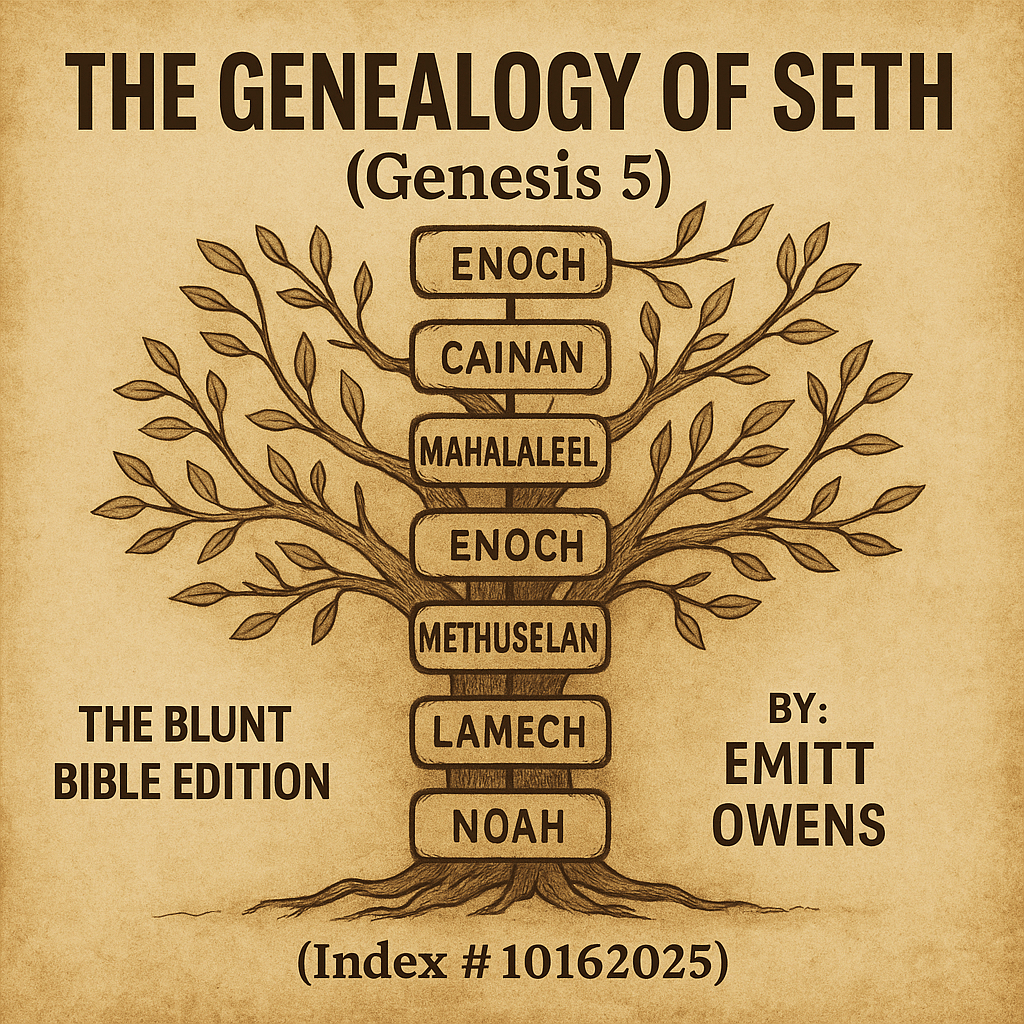
THE GENEALOGY OF SETH (Genesis 5)
The Blunt Bible Edition
By: Emmitt Owens
(Index #10162025)
—–
✍️ Author’s Note:
Genesis 5 is a genealogy chapter.
And I almost skipped it.
Because honestly? It’s a lot of names, ages, and “begats.”
“And [person] lived [number] years, and begat [next person], and [person] lived after he begat [next person] [more years], and he died.”
Repeat. For 32 verses.
It’s the kind of chapter you skim in Sunday school. The kind where the teacher says “we’ll skip this part” and jumps straight to Noah.
But I can’t skip it.
Because buried in this genealogy are some of the WEIRDEST details in all of Genesis:
– Everyone lived 900+ years (casually, like that’s normal)
– One guy didn’t die – God just… took him
– The oldest person ever recorded lived 969 years
– This connects Seth’s line (the “calling on God’s name” family from Genesis 4) directly to Noah
And here’s the thing: Nothing about genealogy has really changed.
We’re still doing this today. Ancestry.com, Family trees, and DNA tests. Tracing lineage back through generations.
Computers have made it easier—no more chasing paper trails through dusty records like people did years ago. But the purpose is the same: knowing where you came from. Understanding your ancestors. Tracking your legacy.
Genesis 5 is doing exactly what we’re still doing thousands of years later.
That’s why it shouldn’t be skipped. The importance of knowing your ancestors hasn’t changed.
A question this raises in Genesis 5: If you add up the ages in Genesis 5, from Adam’s creation to the flood is 1,656 years.
Here’s the math:
– Adam → Seth: 130 years
– Seth → Enos: 105 years
– Enos → Cainan: 90 years
– Cainan → Mahalaleel: 70 years
– Mahalaleel → Jared: 65 years
– Jared → Enoch: 162 years
– Enoch → Methuselah: 65 years
– Methuselah → Lamech: 187 years
– Lamech → Noah: 182 years
– Noah to flood: 600 years (Genesis 7:6)
Total: 1,656 years from creation to flood.
If you keep adding genealogies through the rest of the Bible, you get to roughly 6,000-10,000 years for the age of the earth.
Science says the earth is 4.5 billion years old and humans have been around for about 300,000 years.
How do we reconcile that?
Genesis doesn’t answer that question. It just lists the ages and moves on.
Some people read these genealogies literally. Some read them symbolically. Some think there are gaps (skipped generations). Some integrate science and say Genesis describes spiritual origins, not physical timelines.
I’m not here to settle that debate. I’m just here to tell you what Genesis says.
And Genesis says: Adam to Noah = ten generations, roughly 1,656 years.
So yeah. We’re doing Genesis 5.
Buckle up. It’s a family tree where everyone’s a senior citizen for centuries.
—–
THE FAMILY LINE: ADAM TO NOAH (Genesis 5:1-32)
Genesis 5:1-2 (KJV) – “This is the book of the generations of Adam. In the day that God created man, in the likeness of God made he him; Male and female created he them; and blessed them, and called their name Adam, in the day when they were created.”
So Genesis 5 starts by reminding us: God created humanity. Male and female. Called them Adam (which can mean “humanity” in Hebrew).
This is a callback to Genesis 1:27 – the “male and female created he them” moment we talked about in the last chapter.
Then Genesis gives us the family tree. And it’s LONG.
Here’s the lineup:
1. Adam → 2. Seth → 3. Enos → 4. Cainan → 5. Mahalaleel → 6. Jared → 7. Enoch → 8. Methuselah → 9. Lamech → 10. Noah
Ten generations from Adam to Noah.
And every single one of them lived HUNDREDS of years.
Let’s break it down.
—–
ADAM (Genesis 5:3-5)
Genesis 5:3-5 (KJV) – “And Adam lived an hundred and thirty years, and begat a son in his own likeness, after his image; and called his name Seth: And the days of Adam after he had begotten Seth were eight hundred years: and he begat sons and daughters: And all the days that Adam lived were nine hundred and thirty years: and he died.”
Adam lived 930 years.
Let that sink in.
– Had Seth at age 130
– Lived another 800 years after that
– Had “sons and daughters” (plural, unnamed)
– Died at 930
That’s almost a millennium.
Imagine living through 930 years of human history. Seeing your great-great-great-great-grandchildren. Watching civilization develop. Remembering what the Garden of Eden was like.
A Question Nobody Answers: How old was Adam when he was created?
Genesis doesn’t say.
But he was clearly created as a full-grown adult—not a baby or child. He could speak, work, name animals, and recognize Eve immediately.
So Adam was probably created at physical maturity (the equivalent of maybe 20-30 years old in appearance).
But his “age” starts counting from creation.
Another question: How old was Adam when he left the Garden?
Genesis doesn’t say.
Did they spend days in Eden? Years? Decades?
We know Adam was 130 years old when Seth was born (Genesis 5:3).
We know Cain and Abel were born before Seth.
But we don’t know how long Adam and Eve lived in the Garden before the Fall, or how soon after exile Cain was born.
Genesis just doesn’t give us those details.
So when Genesis 5:3 says “Adam lived an hundred and thirty years, and begat a son,” that’s counting from his creation—not from birth (since he wasn’t born), and not from leaving the Garden.
130 years total. Sometime in there: Garden, Fall, exile, Cain, Abel, Abel’s murder, then Seth.
The timeline’s fuzzy. Genesis doesn’t care to clarify.
And then dying.
Genesis just says: “and he died.”
That’s it. The first human. The guy made from dust. Gone.
—–
SETH (Genesis 5:6-8)
Genesis 5:6-8 (KJV) – “And Seth lived an hundred and five years, and begat Enos: And Seth lived after he begat Enos eight hundred and seven years, and begat sons and daughters: And all the days of Seth were nine hundred and twelve years: and he died.”
Seth lived 912 years.
Remember Seth? The “replacement” son after Abel was murdered (Genesis 4:25).
His line was the one that “began to call upon the name of the Lord” (Genesis 4:26).
Seth lived 912 years. Had kids at 105. Lived another 807 years after that.
Then died.
—–
ENOS (Genesis 5:9-11)
Genesis 5:9-11 (KJV) – “And Enos lived ninety years, and begat Cainan: And Enos lived after he begat Cainan eight hundred and fifteen years, and begat sons and daughters: And all the days of Enos were nine hundred and five years: and he died.”
Enos lived 905 years.
Had Cainan at 90. Lived another 815 years.
Died.
—–
CAINAN (Genesis 5:12-14)
Genesis 5:12-14 (KJV) – “And Cainan lived seventy years, and begat Mahalaleel: And Cainan lived after he begat Mahalaleel eight hundred and forty years, and begat sons and daughters: And all the days of Cainan were nine hundred and ten years: and he died.”
Cainan lived 910 years.
Pattern’s becoming clear, right?
Live for decades. Have a kid. Live for 800+ more years. Have more kids. Die.
—–
MAHALALEEL (Genesis 5:15-17)
Genesis 5:15-17 (KJV) – “And Mahalaleel lived sixty and five years, and begat Jared: And Mahalaleel lived after he begat Jared eight hundred and thirty years, and begat sons and daughters: And all the days of Mahalaleel were eight hundred ninety and five years: and he died.”
Mahalaleel lived 895 years.
Had Jared at 65. Lived another 830 years.
Died.
—–
JARED (Genesis 5:18-20)
Genesis 5:18-20 (KJV) – “And Jared lived an hundred sixty and two years, and he begat Enoch: And Jared lived after he begat Enoch eight hundred years, and begat sons and daughters: And all the days of Jared were nine hundred sixty and two years: and he died.”
Jared lived 962 years.
Almost hit 1,000. Didn’t quite make it.
Had Enoch at 162. Lived another 800 years.
Died.
But Enoch? Enoch’s different.
—–
ENOCH (Genesis 5:21-24) – THE GUY WHO DIDN’T DIE
Genesis 5:21-24 (KJV) – “And Enoch lived sixty and five years, and begat Methuselah: And Enoch walked with God after he begat Methuselah three hundred years, and begat sons and daughters: And all the days of Enoch were three hundred sixty and five years: And Enoch walked with God: and he was not; for God took him.”
—Hold up—
Enoch lived 365 years.
That’s SHORT compared to everyone else (who’s hitting 900+).
But here’s what’s different: “And Enoch walked with God: and he was not; for God took him.”
Enoch didn’t die.
Everyone else in this chapter: “and he died.”
Enoch? “He was not; for God took him.”
Where did he go?
Genesis doesn’t say.
Did God take him to heaven? To another place? Did he just… vanish?
The Bible doesn’t explain.
All we know:
– Enoch walked with God (close relationship)
– God took him
– He didn’t experience death
Enoch is one of only TWO people in the entire Bible who didn’t die. (The other is Elijah in 2 Kings 2:11, who went up in a whirlwind.)
Why Enoch? Genesis doesn’t say.
Just: he walked with God, and then he wasn’t there anymore.
Moving on.
—–
METHUSELAH (Genesis 5:25-27) – THE OLDEST HUMAN EVER
Genesis 5:25-27 (KJV) – “And Methuselah lived an hundred eighty and seven years, and begat Lamech: And Methuselah lived after he begat Lamech seven hundred eighty and two years, and begat sons and daughters: And all the days of Methuselah were nine hundred sixty and nine years: and he died.”
Methuselah lived 969 years.
The oldest person ever recorded in the Bible.
Just barely missed 1,000 years.
Had Lamech at 187. Lived another 782 years.
Then died.
Fun (terrifying?) fact: Methuselah’s name possibly means “when he dies, it shall come.”
And if you do the math (which people have), Methuselah died the same year the flood started.
Coincidence? Prophecy in a name? Genesis doesn’t comment.
But the timing is… interesting.
—–
LAMECH (Genesis 5:28-31)
Genesis 5:28-31 (KJV) – “And Lamech lived an hundred eighty and two years, and begat a son: And he called his name Noah, saying, This same shall comfort us concerning our work and toil of our hands, because of the ground which the Lord hath cursed. And Lamech lived after he begat Noah five hundred ninety and five years, and begat sons and daughters: And all the days of Lamech were seven hundred seventy and seven years: and he died.”
Lamech lived 777 years.
(Not the same Lamech from Cain’s line who wrote the murder poem. Different guy. Same name. This Lamech is from Seth’s line.)
Lamech had Noah at 182.
And when Noah was born, Lamech said something interesting:
“This same shall comfort us concerning our work and toil of our hands, because of the ground which the Lord hath cursed.”
Lamech is referencing the curse from Genesis 3 – when God cursed the ground after Adam and Eve ate the fruit.
Lamech’s hoping Noah will bring relief from that curse.
Spoiler: Noah brings a flood first. Comfort comes later. Maybe.
Lamech lived another 595 years after Noah was born.
Died at 777.
—–
NOAH (Genesis 5:32)
Genesis 5:32 (KJV) – “And Noah was five hundred years old: and Noah begat Shem, Ham, and Japheth.”
And here’s Noah.
At 500 years old, he has three sons: Shem, Ham, and Japheth.
Genesis 5 ends here.
Genesis 6 begins with God looking at humanity and deciding to start over.
But we’ll get to that.
—–
THE ACTUAL MORALS
1. Everyone lived absurdly long lives before the flood – 900+ years was normal. After the flood, lifespans drop dramatically. Why? Genesis doesn’t say.
2. This is Seth’s family line, not Cain’s – Remember: Cain’s line built civilization but never called on God. Seth’s line called on God’s name and led to Noah.
3. Enoch didn’t die – He “walked with God” and God took him. Where? Genesis doesn’t explain. It’s one of the Bible’s great mysteries. The disappearing man.
4. Methuselah lived longer than anyone – 969 years. And possibly died the year the flood started.
5. Genealogy matters – Genesis tracks family lines because legacy matters. Seth’s line leads to Noah, who leads to… well, everyone after the flood.
6. Everyone else died – Except Enoch, everyone in this chapter ends with “and he died.” Mortality is real, even if you live 900+ years.
7. The curse of the ground was still active – Lamech mentions it when Noah is born. The consequences of Genesis 3 were still affecting humanity generations later.
—–
THE WEIRDEST PARTS
– Everyone lived 900+ years – and Genesis treats this as totally normal
– Enoch didn’t die – “God took him” and Genesis gives zero details about where or how
– Methuselah lived 969 years – the oldest person ever, and his name possibly means “when he dies, it shall come” (the flood)
– The lifespans drop dramatically after the flood – Noah lives 950 years, but his descendants start living 400, then 200, then eventually normal lifespans. What changed?
– “And he died” – repeated over and over, like a drumbeat reminder of mortality
– Everyone had “sons and daughters” – but only specific sons are named (the ones continuing the line to Noah)
– Lamech’s prophecy about Noah – he hoped Noah would bring comfort from the cursed ground. Instead, Noah brought a flood. Comfort came… eventually?
– Adam’s age is unclear – We don’t know how old he was when created, how long he lived in the Garden, or when Cain was born
– The math makes the earth young – If you add up Genesis 5’s ages, creation to flood = 1,656 years. Keep adding through the rest of the Bible and you get roughly 6,000-10,000 years total. Science says 4.5 billion years and humans evolved over 300,000 years. Genesis doesn’t address this tension.
—–
樂 Could Enoch symbolize something?
Many Christians see Enoch as a picture of the rapture—the belief that believers will be “caught up” to meet Jesus without dying (1 Thessalonians 4:16-17).
The parallels are there:
-Enoch was taken without dying
-It happened because he walked closely with God
-It was sudden (“he was not”)
But Genesis doesn’t say that.
Genesis just says God took him. No explanation of where, how, or why.
-Is Enoch a foreshadowing of the rapture?
-A symbol of something?
-A unique event?
Genesis doesn’t tell us. Later theology fills in those blanks.
What we know for sure: Enoch walked with God. God took him. Death didn’t touch him.
Everything else is interpretation.
—–
TL;DR
Genesis 5 is Adam’s family tree from Adam to Noah. Everyone lived 900+ years. Enoch walked with God and didn’t die—God just took him. Methuselah lived the longest (969 years) and possibly died the year the flood started. Lamech had Noah and hoped he’d bring relief from the cursed ground. This is Seth’s family line—the “calling on God’s name” lineage—leading directly to Noah, who’s about to build a very big boat. ⛵
—–
Why This Matters
Genesis 5 might seem like a boring list of names and ages. But it’s doing something important:
It’s showing the passage of time between the Fall (Genesis 3) and the Flood (Genesis 6-9).**
Adam lived 930 years. His son Seth lived 912 years. By the time Noah was born, Adam’s direct descendants had been alive for over 1,000 years.
Think about that.
Adam—the guy who walked in the Garden, ate the fruit, got exiled—was still alive when Lamech (Noah’s father) was born.
Adam could have told Lamech about Eden. About what it was like before the curse. About the Tree of Life.
The memory of paradise was still within living reach.
And yet, by Genesis 6, humanity is so wicked that God decides to wipe it all out and start over.
That’s how fast things fell apart.
Even with people living 900+ years. Even with Enoch walking so closely with God that God took him. Even with the memory of Eden still alive.
Humanity still descended into violence and corruption.
Genesis 5 isn’t just a genealogy. It’s a timeline showing how quickly everything went wrong—and how long God waited before the flood.
And here’s the other thing:
-Seth’s line—the family that “began to call upon the name of the Lord”—is the line that survived.
-Cain’s line? The inventors of civilization, music, technology, metalworking?
Gone after the flood.
Seth’s line? Leads to Noah. And through Noah, to everyone alive today.
The family that called on God’s name is the family that continued.
Make of that what you will. ✨
And one more thing about Enoch: In a chapter where everyone dies (“and he died” is repeated like a drumbeat), Enoch is the exception.
“Enoch walked with God: and he was not; for God took him.”
What does it mean to “walk with God”?
Genesis doesn’t define it. But apparently, it means something significant enough that God took Enoch without him experiencing death.
Everyone else—no matter how long they lived—eventually died.
Enoch walked with God, and death didn’t get him.
That’s the hope buried in Genesis 5: Even in a world under the curse, even in a genealogy defined by death, one man walked so closely with God that death couldn’t touch him.
And that matters.
Because it means the curse isn’t absolute. Death isn’t the final word.
Walking with God changes the rules. ♂️✨
—–
✍️ Personal Reflection
I used to skim genealogies.
They felt like the boring parts of the Bible—just names and numbers to skip over on the way to the “real” stories.
But Genesis 5 changed that for me.
Because when you actually read it—word for word, slowly—you start noticing things.
-The repetition of “and he died.”
-The shocking exception of Enoch.
-The absurd lifespans that Genesis treats as normal.
-The fact that Adam was still alive when his great-great-great-great-great-great-grandson Lamech was born.
Genealogies aren’t boring. They’re timelines. They’re legacy trackers. They’re showing us how things unfolded.
And Genesis 5 specifically is showing us how long God waited.
How many generations passed between the Fall and the Flood.
How humanity had centuries—literal centuries—to turn things around.
And they didn’t.
That makes Noah’s story hit different.
This isn’t God being impulsive or cruel. This is God watching for over 1,000 years as humanity descended further and further into wickedness.
And finally saying: “Enough.”
Genesis 5 matters.
Even if it’s just names and ages.
Because those names and ages tell a story of patience, corruption, and one man who walked so closely with God that death couldn’t touch him.
That’s not boring.
That’s profound.


Leave a comment