
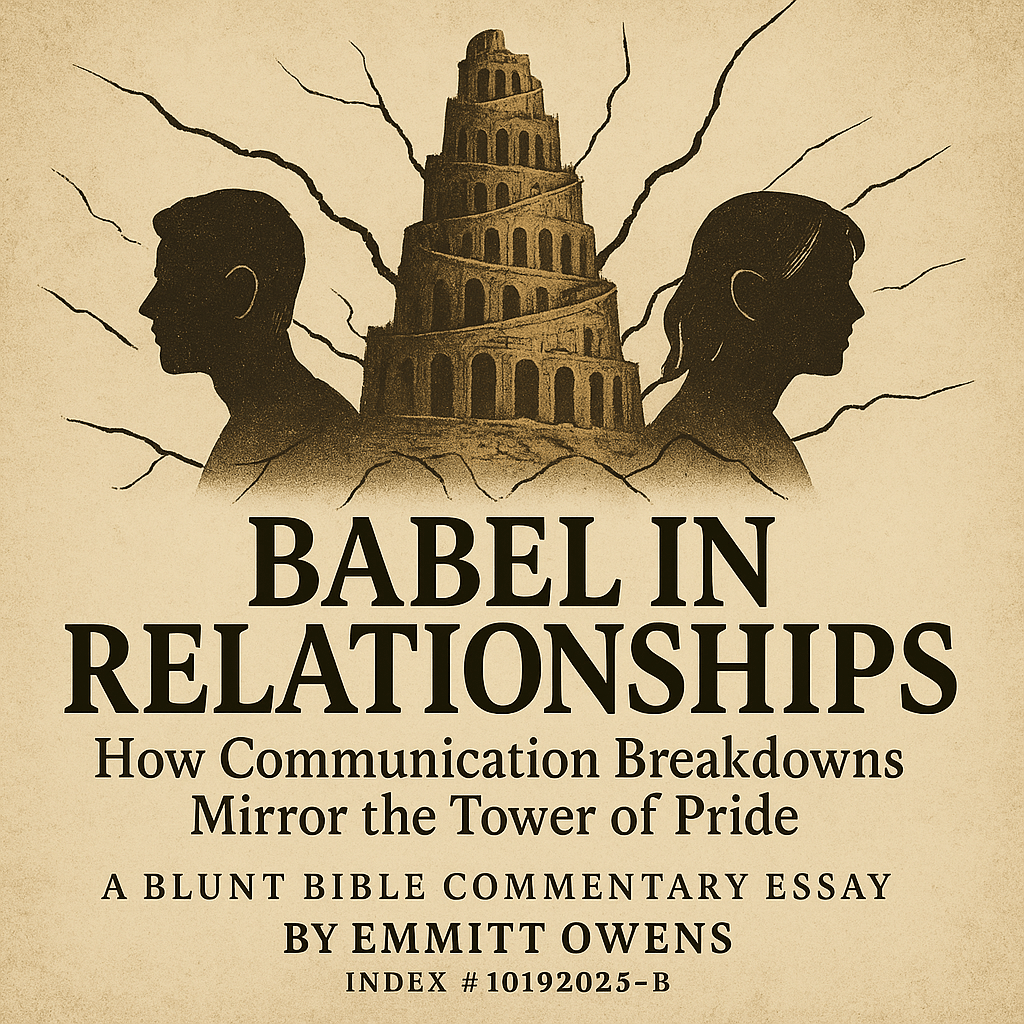
Babel in Relationships: How Communication Breakdowns Mirror the Tower of Pride
(A Blunt Bible Commentary Essay by Emmitt Owens)
(Index #10192025-B)
Written: October 19th 2025 Version Two
Author’s Note
The Tower of Babel isn’t just about architecture — it’s about communication.
And if you’ve ever tried to love someone and found yourself talking circles around the same fight, saying the same words with totally different meanings, then congratulations: you’ve been to Babel.
This isn’t ancient history.
It’s emotional archaeology.
Every relationship that falls apart because of miscommunication, misunderstanding, or manipulation is a modern ruin of the same kind — a collapsed tower where everyone swore they were building together.
I. The Original Story: The Blueprint for Miscommunication
In Genesis 11, humanity’s fresh start after the flood turns into humanity’s next disaster. Everyone speaks the same language — a perfect world for coordination and understanding. But instead of using that unity to honor God, they use it to elevate themselves.
They find a plain in Shinar, say, “Let’s build a city and a tower to heaven,” and start stacking bricks.
They’re not building a place to worship — they’re building a monument to themselves.
Their motivation is loud and clear:
“Let us make a name for ourselves.”
And right there, pride takes the blueprint out of God’s hands.
God’s response isn’t a thunderbolt — it’s confusion.
He scrambles their speech so they can’t understand one another.
They stop building, scatter across the world, and the place gets renamed Babel — “confusion.”
It’s one of the shortest stories in the Bible, but it explains more about human nature than most of psychology.
II. The Hidden Layer: When the Words Don’t Work Anymore
If you’ve ever been in a relationship where communication collapses, you already know what Babel felt like.
You’re using the same words you always did — “love,” “trust,” “sorry,” “fine” — but they don’t seem to mean the same thing anymore.
You’re building something together — a life, a future, a sense of safety — and then suddenly you’re not. The words don’t connect. The tone shifts. The meaning dissolves mid-sentence.
That’s Babel.
In Genesis, it happens instantly. In relationships, it happens slowly — through blame, pride, defensiveness, and unspoken resentment. The tower doesn’t fall in one moment; it erodes with every misunderstood phrase.
Babel isn’t ancient history. It’s every argument where one person says, “That’s not what I meant,” and the other says, “But that’s what I heard.”
III. The Modern Blueprint for Collapse
Humanity’s first tower was built on bricks and arrogance.
Ours are built on words and ego.
Let’s call out the pattern.
Pride: “Let us make a name for ourselves.”
When the goal becomes being right instead of being understood, you’re in Babel territory.
Control: “Lest we be scattered.”
Fear of loss creates manipulation. We cling tighter, speak louder, and call it love.
Disobedience: “God said spread out.”
We ignore wisdom, intuition, and truth because we want things our way.
Distortion:
“I’m fine” means “I’m furious.”
“We’re okay” means “I’m scared we’re not.”
“I love you” becomes “Don’t leave me.”
Language bends. Meaning breaks.
And suddenly, two people speaking the same language might as well be shouting into different universes.
IV. The Psychology of Babel: When Pride Becomes Static
At Babel, shared language was humanity’s power source — and pride short-circuited it.
The same happens in relationships: the better two people know each other, the more dangerous pride becomes.
We learn each other’s weaknesses, not just to comfort but to win arguments.
We use what should connect us to divide us.
That’s not love — that’s construction-site sabotage.
God saw that humanity’s unity without humility would destroy them.
So, he confused their language.
He didn’t do it to humiliate them — He did it to protect them.
When pride becomes the architect, confusion is mercy.
Sometimes, losing the ability to communicate is God’s way of saying,
“Stop building towers with the wrong materials.”
V. When Words Stop Working
The people at Babel weren’t silenced — they were still talking.
They just couldn’t understand each other anymore.
That’s what happens when:
Apologies lack accountability.
Promises lack follow-through.
“I love you” lacks proof.
The sound remains, but the meaning vanishes.
Words without honesty are just noise.
And no tower — no relationship — stands long on noise.
This is where Babel moves from ancient myth to daily reality.
Every time our language loses truth, the tower starts cracking.
Every time we speak carelessly, defensively, manipulatively — we add one more weak brick to a doomed structure.
VI. Emotional Babel: How We Confuse Ourselves
Babel isn’t just between people — it’s inside us, too.
We say, “I’m fine,” when we’re exhausted.
We say, “I don’t care,” when we care deeply.
We say, “It’s okay,” when we’re bleeding inside.
We confuse ourselves until even our own hearts can’t translate the truth.
That’s the real danger: when the confusion becomes internal.
When our inner voice stops matching our outer words.
When language becomes armor instead of bridge.
At that point, Babel isn’t a place — it’s a condition.
A disconnection between truth and tongue.
VII. The Mercy Hidden in Confusion
Most people see God’s act at Babel as punishment.
But read it again — it’s prevention.
He saw where pride-led unity was heading and stopped it before it got worse.
Sometimes confusion saves us.
When communication collapses, it forces reflection:
“Maybe we weren’t building together — maybe we were just building next to each other.”
That realization hurts — but it’s also the moment truth sneaks back in.
Confusion can end a tower built on arrogance.
And that’s grace disguised as chaos.
VIII. The Reversal: Pentecost and the Healing of Language
The Bible doesn’t leave Babel unresolved.
Centuries later, in Acts 2, something extraordinary happens.
People from every nation gather in Jerusalem — different languages, different backgrounds — and when the Spirit comes, they all understand each other.
That’s the anti-Babel moment.
Different tongues, same truth.
Unity not through pride, but through grace.
It’s the same cure modern relationships need:
Humility instead of ego.
Listening instead of defensiveness.
Honesty instead of performance.
At Pentecost, God didn’t erase diversity — He redeemed it.
He showed that understanding doesn’t come from everyone speaking the same, but from everyone hearing the same truth.
That’s the difference between Babel and belonging.
IX. What We Build When We Speak Truthfully
Every conversation is a construction site.
Every sentence is a brick.
And every lie, deflection, or half-truth weakens the foundation.
But when language is used honestly — to reveal, to connect, to heal — it becomes sacred again.
We stop trying to build to heaven on our own.
We let grace come down to meet us where we are.
“We built up. God came down.”
That’s not just theology — that’s therapy.
X. The Blunt Moral
Pride still leads to collapse.
Whether it’s a city or a marriage, ego is still the wrecking ball.
You can’t build your way to heaven.
We still try — with good deeds, charm, status, money, followers — but salvation doesn’t work by construction. It works by descent.
Communication is holy.
When words align with truth, they create life. When they don’t, they destroy it.
Confusion isn’t always a curse.
Sometimes it’s the only way to stop building something that’s killing you.
God still intervenes when pride becomes architecture.
The materials change, but the pattern doesn’t.
XI. Why It Still Matters
We live in an age of digital Babel.
Everyone’s talking — nobody’s understanding.
Comments replace conversations.
Reactions replace relationships.
We build towers out of algorithms and then wonder why we feel so disconnected from one another.
Babel isn’t a myth about bricks. It’s a mirror for the internet.
Perfect communication technology — zero real understanding.
And yet, the story’s ending still offers hope:
God confused language to protect us from ourselves.
And He still does.
Because sometimes the greatest mercy is the moment when the words finally fail — when we’re forced to listen instead of speaking.
That’s when connection becomes possible again.
XII. Final Reflection
Every generation rebuilds Babel.
Every relationship tests whether we’ve learned anything from it.
The human story is one long repetition of the same theme:
We build up. God comes down.
We reach for heaven. Heaven reaches back.
At Babel, God scattered us so we’d stop worshipping our own blueprints.
At Pentecost, He reunited us through understanding, not ambition.
The message hasn’t changed:
Language is a gift — not a weapon.
Communication is sacred — not a tool for control.
And pride is still the tower that makes us lose the plot.
So maybe the moral isn’t “Don’t build.”
Maybe it’s: Don’t build without humility.
Because when pride runs the project, confusion will always be the outcome.
And when humility returns, the words start to mean something again.
THE LESSON
Every collapsed tower — every broken relationship — starts with misused language.
The cure isn’t better construction.
It’s honest communication.
We built up.
God came down.
Babel wasn’t the end of language.
It was the beginning of learning how to use it right.


Leave a comment