
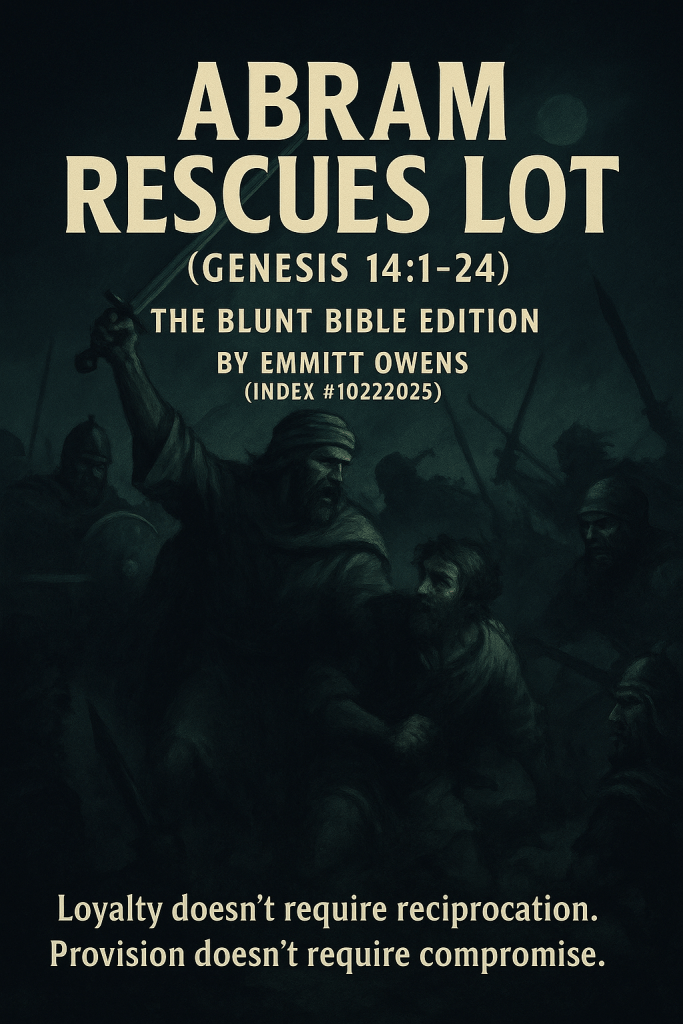
ABRAM RESCUES LOT (Genesis 14:1-24)
The Blunt Bible Edition
By: Emmitt Owens
(Index #10222025)
Loyalty doesn’t require reciprocation. Provision doesn’t require compromise.
—–
✍️ Author’s Note:
I’ve shown up for people who didn’t want me there.
And I’ve walked away from money I could have taken.
Both in the same season of my life.
The first one:
Someone close to me was in crisis. An overdue bill. Working all the time but couldn’t cover everything at once.
They’d pushed me away. Told me to go. Made it clear they didn’t want anything to do with me.
But when I heard they were struggling, I couldn’t just stand by and watch.
So I showed up. Paid the bill. Refused when they offered to pay me back.
I told them: “The day you know someone else is in need, give them what I gave you.”
They thanked me.
And then kept me at arm’s length.
I showed up anyway. Not because they wanted me there. But because that’s what you do when you love someone.
Even when they don’t want you. Even when they won’t let you in. Even when you know they’ll take the help and still keep the distance.
You show up. Because love and loyalty don’t require reciprocation.
The second one:
For 25 years, I’ve been creating. Writing. Music. Art. Multiple other creative things.
And for 25 years, I’ve been offered money. Commissions. Payments. Opportunities to sell.
Every time, I declined.
People said I wasn’t professional. Called me a hobbyist. Thought I didn’t want to “go pro.”
They were wrong.
I wouldn’t let the wrong source take credit for what God gave me.
25 years of saying “no” to money. 25 years of creating freely.
Because where your provision comes from matters.
This is the story of Abram rescuing Lot from four kings—even though Lot chose Sodom over staying with Abram.
And Abram refusing wealth from the King of Sodom—even though he just won a war and had the right to take it all.
Two decisions. Both costly. Both integrity.
Let’s talk about Genesis 14.
—–
PART 1: THE WAR (Genesis 14:1-12)
Four Kings vs. Five Kings (And Lot Gets Kidnapped)
Genesis 14:1-4 (KJV) – “And it came to pass in the days of Amraphel king of Shinar, Arioch king of Ellasar, Chedorlaomer king of Elam, and Tidal king of nations; That these made war with Bera king of Sodom, and with Birsha king of Gomorrah, Shinab king of Admah, and Shemeber king of Zeboiim, and the king of Bela, which is Zoar. All these were joined together in the vale of Siddim, which is the salt sea. Twelve years they served Chedorlaomer, and in the thirteenth year they rebelled.”
The Setup:
Ancient Near Eastern geopolitics.
Four eastern kings (led by Chedorlaomer of Elam):
1. Chedorlaomer (king of Elam) – the main aggressor
2. Amraphel (king of Shinar/Babylon)
3. Arioch (king of Ellasar)
4. Tidal (king of nations/Goiim)
Five Jordan Valley kings (the rebels):
1. Bera (king of Sodom)
2. Birsha (king of Gomorrah)
3. Shinab (king of Admah)
4. Shemeber (king of Zeboiim)
5. King of Bela (Zoar)
At this point, Genesis suddenly becomes Risk: The Board Game.
The History:
For 12 years, the five Jordan Valley kings paid tribute to Chedorlaomer and his alliance.
Basically: “Here’s your protection money. Please don’t invade us.”
Year 13: The five kings rebel. “We’re not paying anymore.”
Year 14: Chedorlaomer says, “Oh really?” and comes back with an army.
Bold strategy. Let’s see how it works out for them.
Spoiler: Not well.
—–
Genesis 14:5-7 – A military campaign of total destruction.
Chedorlaomer and his alliance sweep through the entire region:
– They defeat the Rephaim, Zuzim, Emim (giant peoples)
– They crush the Horites
– They destroy everything in their path
This isn’t just a battle. This is a regional conquest.
They’re sending a message: “You don’t rebel against us and survive.”
—–
Genesis 14:8-10 (KJV) – “And there went out the king of Sodom, and the king of Gomorrah, and the king of Admah, and the king of Zeboiim, and the king of Bela (the same is Zoar;) and they joined battle with them in the vale of Siddim; With Chedorlaomer the king of Elam, and with Tidal king of nations, and Amraphel king of Shinar, and Arioch king of Ellasar; four kings with five. And the vale of Siddim was full of slimepits; and the kings of Sodom and Gomorrah fled, and fell there; and they that remained fled to the mountain.”
The Battle:
The five rebel kings gather in the Valley of Siddim (near the Dead Sea).
Bad tactical decision.
The valley is full of tar pits (slimepits). Not great terrain for a battle.
The four eastern kings crush them.
The kings of Sodom and Gomorrah flee and fall into the tar pits.
Imagine running for your life, only to fall into a slime pit. That’s biblical slapstick at its darkest.
The survivors run to the mountains.
Total defeat.
And now Sodom’s kings are literally stuck in tar while their city gets plundered.
Not their best day.
—–
Genesis 14:11-12 (KJV) – “And they took all the goods of Sodom and Gomorrah, and all their victuals, and went their way. And they took Lot, Abram’s brother’s son, who dwelt in Sodom, and his goods, and departed.”
The Consequences:
Chedorlaomer’s alliance plunders Sodom and Gomorrah.
They take:
– All the goods
– All the food
– All the people (as captives)
And among the captives: Lot.
“Lot, Abram’s brother’s son, who dwelt in Sodom.”
Genesis reminds us: Lot lives in Sodom.
Neighborhood amenities: prosperity, nightlife, occasional invasions.
You know, the city he picked because it looked so nice.
The well-watered plain. The garden-of-Eden vibes. The prosperity.
Turns out living next to wickedness has consequences.
This is the consequence of his choice in Genesis 13.
He looked at the well-watered plain and said, “I’ll take that.”
He pitched his tent toward Sodom (Genesis 13:12).
By Genesis 14, he’s living in Sodom.
And when Sodom gets raided, Lot gets kidnapped.
Your choices determine your proximity to danger.
Lot wanted the best-looking land. He got it.
And he nearly lost everything because of it.
Proximity becomes participation. Participation becomes consequence.
—–
PART 2: THE RESCUE (Genesis 14:13-16)
Abram Mobilizes 318 Trained Men
Genesis 14:13 (KJV) – “And there came one that had escaped, and told Abram the Hebrew; for he dwelt in the plain of Mamre the Amorite, brother of Eshcol, and brother of Aner: and these were confederate with Abram.”
Someone escapes the raid.
Runs to Abram.
“Lot’s been kidnapped.”
Abram’s response:
-Not “Well, Lot chose Sodom. Not my problem.”
-Not “He made his bed, let him lie in it.”
-Not “We separated. I don’t owe him anything.”
-Not “Tell him to call his new Sodomite friends for help.”
Immediate mobilization.
—–
Genesis 14:14 (KJV) – “And when Abram heard that his brother was taken captive, he armed his trained servants, born in his own house, three hundred and eighteen, and pursued them unto Dan.”
—-Wait.—- ABRAM HAS AN ARMY?
318 trained men.
Not just servants. Trained fighters. Born in his household.
Abram’s been running a private military this whole time and Genesis hasn’t mentioned it until now.
Like finding out your mild-mannered neighbor is actually a retired special ops commander.
This is not the Abram we’ve seen so far.
This is not “lie about your wife to save your own skin” Abram (Genesis 12).
This is “Don’t touch my family or I will END you” Abram.
Character development, unlocked.
—–
The Pursuit: Abram chases the four-king alliance all the way to Dan (northern Israel).
That’s over 100 miles. Pursuing a victorious army that just crushed five kings.
This is bold.
Abram doesn’t have a massive army. He has 318 men.
The four kings just defeated five kings and plundered multiple cities.
Math-wise, this should not work.
But Abram goes anyway.
—–
Genesis 14:15-16 (KJV) – “And he divided himself against them, he and his servants, by night, and smote them, and pursued them unto Hobah, which is on the left hand of Damascus. And he brought back all the goods, and also brought again his brother Lot, and his goods, and the women also, and the people.”
The Strategy: Abram divides his forces.
Attacks at night (classic guerrilla warfare tactic).
And defeats the four-king alliance.
The same alliance that just crushed five kings.
Abram—with 318 men—beats them.
Rescues Lot. Recovers all the goods. Brings back the captives.
Let that sink in.
This isn’t just a rescue mission. This is a military victory against a regional superpower.
318 guys vs. an empire. And the empire loses.
Someone should make this into a movie. Call it “318.”
Tagline: “Small crew. Big God.”
Faith doesn’t mean passivity.
Sometimes faith looks like building altars and worshiping.
Sometimes faith looks like mobilizing 318 trained men and pursuing four kings to bring your nephew home.
—–
What Showing Up for Someone Who Doesn’t Want You Actually Feels Like
Before we get to Melchizedek, I need to tell you what Genesis 14:13-16 feels like in real life.
“And when Abram heard that his brother was taken captive, he armed his trained servants… and pursued them.”
Abram didn’t hesitate.
Lot had chosen the well-watered plain. Chosen Sodom. Chosen to separate from Abram.
But when Lot was in danger, Abram mobilized 318 men and went after four kings to bring him back.
I know what that feels like.
—–
Someone close to me was in crisis.
An overdue bill with a cut off notice. Working every day, grinding, trying to keep up—but the math just wasn’t mathing.
And I’d been pushed away. Told to go. Made it clear: they didn’t want me there.
We’d separated. Set boundaries. Walked different directions.
But when I heard they were struggling, I couldn’t just stand by.
I didn’t call first. I didn’t ask permission. I didn’t wait to see if they’d reach out.
I just showed up. Paid the bill. Fixed the crisis.
They offered to pay me back.
I refused.
“The day you know someone else is in need,” I told them, “give them what I gave you.”
They thanked me.
And then kept me at arm’s length.
That’s the part no one tells you about showing up for people who don’t want you.
They’ll take the rescue. And still keep the distance.
Lot didn’t move back in with Abram after being rescued.
Genesis 14:16 says Abram “brought again his brother Lot, and his goods.”
But where did Lot go after that?
Back to Sodom. (We know because he’s still there in Genesis 19 when the city gets destroyed.)
Abram rescued him from four kings.
And Lot went right back to the city that nearly got him killed.
That’s what it feels like.
You show up. You pay the bill. You fight the battle. You bring them back.
And they go right back to the place (or the life, or the pattern) that put them in danger in the first place.
And you’re left standing there, wondering: “Was it worth it?”
Here’s what I learned:
Loyalty isn’t about whether people want you there.
It’s about showing up anyway.
Abram and Lot had separated. They’d gone their separate ways. Lot chose Sodom. Abram got the hill country.
But when Lot was in danger, Abram didn’t hesitate.
Not because Lot deserved it. Not because Lot asked for it. Not because it would repair their relationship.
Because that’s what love does.
Love shows up. Even when it’s not wanted. Even when it won’t be reciprocated. Even when you know they’ll take the help and still keep you at a distance.
You show up anyway.
Because love and loyalty don’t require reciprocation.
Did it cost me?
Yes.
Money. Emotional energy. The dignity of showing up for someone who’d made it clear they didn’t want me around.
But I didn’t do it for thanks. I didn’t do it for reconciliation. I didn’t do it expecting anything to change.
I did it because they were working hard, struggling, and I couldn’t stand by and watch someone I love suffer when I could help.
That’s what humans do when they love someone.
Even when it’s not returned. Even when it’s not appreciated the way you hope. Even when they take the rescue and go right back to Sodom.
You show up.
Because the alternative—standing by and doing nothing—would cost you more.
Not financially. Spiritually.
The cost of not showing up would have been greater than the cost of being rejected again.
So I showed up.
And I felt at peace.
Not because they welcomed me back. Not because it fixed our relationship.
But because I did what I was supposed to do.
I helped. I walked away.
And that was enough.
—–
Abram didn’t rescue Lot to restore their relationship.
He rescued Lot because Lot was family. And family in danger gets rescued.
Even when they chose Sodom. Even when they didn’t ask. Even when they’ll go right back.
You still show up.
That’s loyalty. That’s love. That’s Genesis 14 in real life. ️
—–
PART 3: MELCHIZEDEK APPEARS (Genesis 14:17-20)
The Mysterious Priest-King
Genesis 14:17 (KJV) – “And the king of Sodom went out to meet him after his return from the slaughter of Chedorlaomer, and of the kings that were with him, at the valley of Shaveh, which is the king’s dale.”
Abram returns victorious.
The King of Sodom comes out to meet him.
Probably to say thanks. Maybe to negotiate who gets what.
But before the King of Sodom can speak, someone else shows up.
—–
Genesis 14:18-20 (KJV) – “And Melchizedek king of Salem brought forth bread and wine: and he was the priest of the most high God. And he blessed him, and said, Blessed be Abram of the most high God, possessor of heaven and earth: And blessed be the most high God, which hath delivered thine enemies into thy hand. And he gave him tithes of all.”
Enter: Melchizedek.
Just when you think you’re done with war logistics, a mysterious priest-king shows up with bread and wine (carbs and grace).
No introduction. No “By the way, I’m Melchizedek.” Just appears.
Who is this guy?
– King of Salem (which becomes Jerusalem)
– Priest of the Most High God (El Elyon)
– Brings bread and wine (casual foreshadowing of communion, no big deal)
– Blesses Abram
– Abram gives him a tithe (10%) of everything
—-This is one of the most mysterious and theologically loaded moments in all of Genesis.
And it happens right after a battle, as if Genesis just casually drops the gospel into a war story.
—–
Who Is Melchizedek?
1. He’s a Priest-King
-Not from Aaron’s line (the Levitical priesthood hasn’t been established yet).
-Not from Israel (Israel doesn’t exist yet).
-Not from Abram’s family.
A priest who predates the entire Israelite system.
King and priest in one person.
—–This shouldn’t exist yet.
Moses hasn’t given the Law. The tabernacle hasn’t been built. The priesthood hasn’t been established.
But here’s Melchizedek—priest of the Most High God—already functioning as a priest.
Before the system. Outside the system. Above the system.
Like meeting someone with a PhD in a field that hasn’t been invented yet.
2. He Blesses Abram
Hebrews 7:7 – “And without all contradiction the less is blessed of the better.”
Translation: The greater blesses the lesser.
Melchizedek blesses Abram.
That means Melchizedek has authority over Abram.
Abram—the one with God’s promise, the father of faith, the patriarch of Israel—receives a blessing from Melchizedek.
Melchizedek is greater than Abram.
Which is wild, because Abram is literally the main character of Genesis at this point.
And this random priest-king outranks him.
3. Abram Tithes to Him
Abram gives Melchizedek 10% of all the plunder.
—–This is significant.
Tithing is recognition of authority and priesthood.
Abram recognizes Melchizedek’s priesthood.
Before the Law. Before Moses. Before the Levitical system.
Abram tithes to this mysterious priest-king who just showed up with bread and wine.
No questions asked. Just “Here’s 10% of everything I just recovered from four kings.”
4. He Brings Bread and Wine
Melchizedek brings bread and wine.
Not a coincidence.
—–This foreshadows communion / the Eucharist.
Jesus—at the Last Supper—takes bread and wine and says: “This is my body… This is my blood.”
Melchizedek’s bread and wine points forward to Jesus.
Genesis is planting Easter eggs 2,000 years early.
5. He Has No Genealogy
Hebrews 7:3 – “Without father, without mother, without descent, having neither beginning of days, nor end of life; but made like unto the Son of God; abideth a priest continually.”
Genesis doesn’t tell us:
– Who Melchizedek’s parents were
– Where he came from
– When he was born
– When he died
He just appears. Blesses Abram. And disappears.
Like a theological Keyser Söze.
Hebrews says this makes him a type of Christ: A priest forever. No beginning. No end.
Melchizedek is a Christological foreshadow.
—– Jesus = Priest Forever After the Order of Melchizedek
Psalm 110:4 – “The Lord hath sworn, and will not repent, Thou art a priest for ever after the order of Melchizedek.”
Hebrews 5:6, 10; 6:20; 7:1-17 – Jesus is a priest forever after the order of Melchizedek.
What does that mean?
Jesus isn’t a priest according to the Levitical system (He’s from Judah, not Levi).
But He’s a priest according to Melchizedek’s order:
– A priest-king (King of Kings, Great High Priest)
– Eternal (no beginning, no end)
– Superior to the Levitical priesthood (Melchizedek > Levi because Abram tithed to him)
– Brings bread and wine (communion)
Translation: Jesus holds both offices and breaks our categories.
Melchizedek in Genesis 14 is a preview of Jesus.
-A priest who isn’t from the “right” tribe.
-A king who rules forever.
-A mediator between God and humanity.
Genesis is sneaking the gospel into a war story.
And doing it so subtly that you almost miss it if you’re not paying attention.
—–
PART 4: ABRAM REFUSES THE SPOILS (Genesis 14:21-24)
“I Won’t Let You Say You Made Me Rich”
Genesis 14:21 (KJV) – “And the king of Sodom said unto Abram, Give me the persons, and take the goods to thyself.”
After Melchizedek leaves, the King of Sodom steps up.
His offer: “You rescued all these people and recovered all this wealth. Keep the stuff. Just give me back the people.”
This is a generous offer.
By ancient Near Eastern warfare customs, Abram has the right to keep EVERYTHING.
The captives. The loot. All of it.
The King of Sodom is offering Abram a fortune.
Legitimate spoils of war. No strings attached.
You just defeated four kings. You earned this. Take it.
And Abram says:
Genesis 14:22-23 (KJV) – “And Abram said to the king of Sodom, I have lift up mine hand unto the Lord, the most high God, the possessor of heaven and earth, That I will not take from a thread even to a shoelatchet, and that I will not take any thing that is thine, lest thou shouldest say, I have made Abram rich:”
Abram’s Response: “I’ve made a vow to God. I won’t take a single thing from you. Not a thread. Not a shoelace. Nothing.
Because I don’t want you to ever be able to say, ‘I made Abram rich.’”
Not even a shoelace.
Abram’s refusal is so absolute he won’t even take replacement shoelaces.
That’s commitment to a principle.
Let that sit.
Abram just won a war. He has the right to all the spoils.
The King of Sodom is offering him wealth.
And Abram refuses.
Why?
“lest thou shouldest say, I have made Abram rich”
Abram’s prosperity comes from God. Not from Sodom.
He won’t let his wealth be tied to a wicked city.
He won’t give Sodom credit for what God provides.
—–This is integrity.
And it’s expensive.
Genesis 14:24 (KJV) – “Save only that which the young men have eaten, and the portion of the men which went with me, Aner, Eshcol, and Mamre; let them take their portion.”
Abram makes one exception: His men can take their share. They fought. They earned it.
But Abram? Nothing.
Not even a thank-you gift basket.
—–
Character Arc: Egypt vs. Sodom
Genesis 12: Abram profits from lying about Sarai in Egypt. Keeps all the wealth Pharaoh gave him even after being exposed.
Genesis 14: Abram refuses to profit from Sodom. Won’t let a wicked city claim credit for his wealth.
Abram learned something between Egypt and Sodom.
He learned: Where your wealth comes from matters.
In Egypt, he compromised his integrity and profited.
In Sodom, he had the chance to profit again—but this time, he refused.
This is growth.
Not perfection. Growth.
Abram’s not flawless. But he’s learning.
From “I’ll take the livestock and the servants” to “I won’t even take a shoelace.”
That’s character development.
—–And God honors that.
—–
What 25 Years of Saying “No” to Money Actually Feels Like
I know what Genesis 14:22-23 feels like.
Not once. Not twice. For 25 years.
I’ve been creating for 25 years.
Writing. Music. Art. Multiple other art forms.
And for 25 years, I’ve been offered money.
– Commissions for specific work
– Payments for projects
– Opportunities to sell what I’d made
Every time, I declined.
People didn’t understand.
They said I wasn’t professional.
They categorized me as a hobbyist—because if you’re not monetizing, you must not be serious.
They thought I didn’t want to “go pro.”
They were wrong.
It’s not that I didn’t want to be professional.
It’s that I wouldn’t let the wrong source take credit for what God gave me.
The cost?
Being dismissed. Categorized as “not serious.” Watching others monetize similar work while I stayed free.
But here’s what they didn’t understand: Where your provision comes from matters.
Abram could have taken wealth from Sodom.
He’d earned it. He had the right to it. The King of Sodom was offering it freely.
But Abram knew: if I take this, Sodom gets to say “I made Abram rich.”
And Abram wouldn’t give Sodom that credit.
His wealth came from God. Not from a wicked city.
—–
For 25 years, I’ve created freely.
Writing. Music. Art.
All of it: free.
-Not because I don’t value my work.
-Not because I’m afraid to monetize.
Because I won’t let the wrong source take credit for what God’s given me.
Later in my creative pursuits, I started declaring it from the beginning: “This is free.”
-Not as an apology. Not as a lack of professionalism.
As a declaration of integrity.
Did it feel hard? No.
Did people’s harsh categorizing sting? Yes.
Being called a hobbyist. Being dismissed as “not serious” because I wouldn’t charge.
But it wasn’t hard enough to make me wrestle with the decision.
Because I knew from the start: this is free.
Am I waiting for God to open a door for monetization? No.
If a door was meant to open, it will come in time.
I’m not anxious about it. I’m not striving for it. I’m not sitting here wondering “When will God let me charge for this?”
If it’s meant to happen, it will.
And if it never happens in my lifetime?
The monetization may start with my children after I pass.
Just like Abram.
God promised him land. Descendants. Blessing.
Abram never owned the land.
His children did. His children’s children did.
The promise wasn’t for him to see fulfilled. It was for him to pass down.
-Maybe my work is the same.
-Maybe the monetization isn’t for me.
-Maybe it’s for my children.
And I’m at peace with that.
—–
The Blunt Bible? Free.
Just like everything else I’ve ever created.
Will I ever monetize? Only if I know it’s a work of God that blesses me with the monetization.
The right opportunities would open any monetizing.
But as of right now? I’ll never monetize.
Not because I can’t. Not because I’m afraid.
Because I’m waiting for the provision that comes from the right source.
I won’t let the wrong offer, the wrong opportunity, the wrong door take credit for what God’s building.
—–
The Payoff: When God Shows Up Immediately After You Refuse
Here’s what most people miss about Genesis 14: God didn’t wait to bless Abram later.
He showed up immediately.
Genesis 15:1—right after Abram refuses Sodom’s wealth—God appears: “After these things the word of the Lord came unto Abram in a vision, saying, Fear not, Abram: I am thy shield, and thy exceeding great reward.”
Let that timing sink in.
Abram just turned down a fortune.
Said “no” to legitimate wealth from the King of Sodom.
Walked away with nothing.
And God shows up immediately and says:
“I am your reward.”
-Not “I’ll bless you eventually.”
-Not “Good job, here’s some money later.”
“I am the reward. I’m the shield. I’m the inheritance. I’m the wealth.”
—–
This isn’t poetic language.
This is God validating Abram’s decision in real time.
As if God’s saying: “You wouldn’t let Sodom make you rich? Good. Because I’m your wealth. Not them. Me.”
“You refused their gold? I’m your treasure.”
“You walked away from their offer? I’m the exceeding great reward.”
God Himself became the provision Abram was waiting for.
—–Not money. Not livestock. Not land.
God.
—–
And here’s the thing: Sometimes the refusal is what creates space for God to show up as the reward Himself.
If Abram had taken Sodom’s wealth, would God have shown up in Genesis 15:1 the same way?
Maybe. Maybe not.
But the timing matters.
God didn’t show up before the refusal.
He showed up after.
As if the refusal was the invitation.
“You won’t take wealth from the wrong source? Then let Me show you what provision from the right source looks like.”
—–
48 Years of Blessing When I Had Nothing
I’ve lived this.
For 48 years, I’ve been extremely blessed.
Not always with money. Not always with abundance.
But blessed.
Blessed when I had nothing.
Blessed when I had everything I needed.
Some of my greatest blessings are the times when I had no funds to do extraordinary things—and God provided anyway.
-Not through the doors I expected.
-Not through the opportunities I refused.
Through His presence.
I’ve felt God’s presence with me pretty much all of my life.
Even when I didn’t realize He was there with me.
There have been moments where—because I refused the wrong opportunity—God showed up in unexpected ways.
Not necessarily with money.
But with clarity.
With peace.
With creative breakthrough.
With relationships.
With provision that didn’t come through the door I refused.
I can’t always point to a specific moment and say, “I said no to that, and God gave me this instead.”
But I can say this: Every time I’ve refused the wrong source, I’ve never been left empty.
Not immediately. Not always obviously.
But I’ve never been abandoned.
The blessing didn’t always look like what I thought it would.
But it was always there.
-Sometimes it was peace when I should have been anxious.
-Sometimes it was clarity when I should have been confused.
-Sometimes it was a creative idea that came out of nowhere.
-Sometimes it was a relationship that formed at exactly the right time.
-Sometimes it was provision that showed up from a direction I didn’t expect.
-And sometimes—most of the time—it was just God’s presence.
The sense that He was with me.
That I wasn’t alone.
That refusing the wrong door didn’t mean I’d missed the right one.
That He Himself was the reward I was waiting for.
—–
Genesis 15:1 says: “I am thy shield, and thy exceeding great reward.”
Shield = protection. God covering Abram. Guarding him from the consequences of refusal.
Exceeding great reward = not just “a” reward. Not “some” reward. Exceeding great. More than Sodom could ever offer.
God Himself is the reward.
Not the money. Not the opportunity. Not the recognition.
—–God.
That’s 48 years of learning that the Provider matters more than the provision. ️✨
—–
The Morals
1. Your choices determine your proximity to danger – Lot chose Sodom, got kidnapped when Sodom was raided
2. Loyalty doesn’t require reciprocation – Abram rescued Lot even though Lot chose to separate
3. Separation doesn’t mean abandonment – Abram set boundaries but still showed up when it mattered
4. Faith isn’t passivity – Sometimes faith looks like worship; sometimes it looks like mobilizing 318 men
5. You can set boundaries and still show up in crisis – Abram and Lot separated, but Abram rescued him anyway
6. People will take the rescue and still keep the distance – Lot went right back to Sodom after being saved
7. Showing up is worth it even when it’s not reciprocated – The cost of not showing up is greater than rejection
8. Melchizedek foreshadows Jesus – Priest-king, bread and wine, eternal priesthood
9. The greater blesses the lesser – Melchizedek blessed Abram (Melchizedek > Abram)
10. Where your wealth comes from matters – Abram refused Sodom’s wealth to protect his integrity
11. Integrity after victory – Abram could have profited legitimately but refused
12. God shows up immediately after righteous refusal – Genesis 15:1 comes right after Abram says no to Sodom
13. God Himself is the reward – Not the spoils, not the wealth—God is the exceeding great reward
14. Sometimes the refusal creates space for God to show up – Saying no to the wrong source invites the right Provider
15. Growth isn’t linear but it’s real – Egypt (profited from compromise) → Sodom (refused to compromise)
16. The promise may not be for you to see fulfilled – Abram never owned the land; his children did
—–
The Weirdest Parts
– Genesis suddenly becomes Risk: The Board Game – Four kings vs. five kings in ancient Near Eastern warfare
– The kings fall into tar pits while fleeing – Biblical slapstick at its darkest
– Abram has 318 trained men – He’s been running a private army this whole time?!
– Abram defeats four kings with 318 men – The same alliance that crushed five kings
– “318” – Tagline: “Small crew. Big God.” – Someone make this movie
– Melchizedek appears out of nowhere – No introduction, no genealogy, just shows up with bread and wine
– Melchizedek is both king and priest – This shouldn’t exist yet (no Levitical system)
– Bread and wine – Foreshadows communion 2,000 years early (Genesis planting Easter eggs)
– Abram tithes to Melchizedek – Before the Law, before Moses, before tithing was commanded
– Hebrews says Melchizedek has no beginning or end – “Without father, without mother, without descent” (theological Keyser Söze)
– Lot goes back to Sodom after being rescued – Nearly got killed there, goes right back
– Abram refuses legitimate spoils of war – He had the right to everything, took nothing
– “Not even a shoelace” – Abram’s refusal is absolute
– Genesis 15:1 immediately follows – God shows up right after Abram refuses wealth and says “I am your reward”
—–
Why This Still Matters Today
Loyalty Doesn’t Require Reciprocation
Abram and Lot had separated. Lot chose Sodom. They went different directions.
But when Lot was in danger, Abram showed up.
Not because Lot deserved it. Not because it would fix their relationship.
Because that’s what love does.
We live in a culture that says: “Cut people off. Protect yourself. They made their choice.”
Sometimes that’s wisdom. Sometimes that’s self-preservation.
But Genesis 14 shows us: you can set boundaries and still show up in crisis.
Abram didn’t move back in with Lot. He didn’t undo the separation.
But he also didn’t stand by and let Lot suffer when he could help.
Boundaries ≠ abandonment.
You can have healthy distance and still rescue someone when they’re drowning.
—–
Where Your Provision Comes From Matters
Abram could have taken wealth from Sodom.
Legitimately. No guilt. No compromise.
But he knew: if I take this, Sodom gets credit.
And he wouldn’t give Sodom that credit.
We face this constantly:
– The job that pays well but costs your soul
– The opportunity that compromises your values
– The relationship that benefits you financially but damages you spiritually
– The business deal that’s legal but unethical
Just because you CAN take it doesn’t mean you SHOULD.
Sometimes the cost of the “opportunity” is letting the wrong source take credit for your success.
Abram refused.
He waited for provision from the right source.
And God showed up: “I am your exceeding great reward.”
—–
God Shows Up After You Refuse
This is the part we miss: God didn’t show up before Abram’s refusal.
He showed up after.
Genesis 15:1 happens immediately after Genesis 14:23.
Abram refuses Sodom’s wealth.
God appears: “I am thy shield, and thy exceeding great reward.”
The timing matters.
Sometimes the refusal is what creates space for God to show up as the reward Himself.
If you’re holding onto the wrong opportunity, you might not have room for what God wants to give you.
Not necessarily money. But His presence. His clarity. His peace.
The blessing you’re waiting for might be on the other side of the refusal you’re avoiding.
—–
Melchizedek and the Gospel
Genesis 14 sneaks Jesus into a war story.
-A mysterious priest-king appears.
-Brings bread and wine.
-Blesses God’s chosen.
-Has no beginning or end.
This is Jesus before Jesus.
Psalm 110:4 and Hebrews 5-7 confirm it: Jesus is a priest forever after the order of Melchizedek.
What does that mean for us?
Jesus isn’t a priest according to human systems.
He’s a priest according to a higher order.
Eternal. Superior. Outside the system.
He doesn’t fit the religious categories we create.
He’s bigger than that.
Just like Melchizedek showed up in Genesis 14 before the system existed, Jesus shows up in history as a priest who transcends the system.
That’s the gospel.
Not religion. Not rules.
A priest-king who blesses, provides, and reigns forever.
—–
Growth Isn’t Linear, But It’s Real
Egypt (Genesis 12): Abram lies, profits, keeps the wealth even after being exposed.
Sodom (Genesis 14): Abram refuses wealth, protects his integrity, waits for God’s provision.
That’s growth.
Not perfection. Not “never messing up again.”
Just learning. Adjusting. Doing better next time.
Abram didn’t erase his failure in Egypt.
But he didn’t repeat it in Sodom.
That’s what growth looks like.
You don’t have to be perfect to follow God.
You just have to keep learning from your failures.
—–
TL;DR
Part 1: The War
Four eastern kings crush five Jordan Valley kings (including Sodom). Genesis becomes Risk: The Board Game. Lot—who lives in Sodom—gets kidnapped along with everyone else. The kings of Sodom and Gomorrah literally fall into tar pits while fleeing.
Part 2: The Rescue
Abram hears the news, mobilizes 318 trained men (surprise! Abram has an army!), pursues four kings, defeats them with guerrilla tactics, and rescues Lot. Someone should make this movie: “318” – Tagline: “Small crew. Big God.” Lot goes right back to Sodom.
Part 3: Melchizedek
A mysterious priest-king appears out of nowhere. Brings bread and wine (carbs and grace). Blesses Abram. Abram tithes to him. This guy has no genealogy and foreshadows Jesus as eternal priest-king. Translation: Jesus holds both offices and breaks our categories. Genesis just casually drops the gospel into a war story.
Part 4: Refusing the Spoils
King of Sodom offers Abram all the wealth. Abram refuses: “I won’t let you say you made me rich. Not even a shoelace.” Genesis 15:1 happens immediately after: God shows up and says, “I am your shield and your exceeding great reward.” The refusal created space for God to show up as the reward Himself.
The Lesson: Loyalty doesn’t require reciprocation. Provision doesn’t require compromise. Show up for people even when they don’t want you. Refuse wealth from the wrong source. Trust that God Himself is the reward. Sometimes the refusal is what creates space for God to show up. ️
—–
Final Reflection
Genesis 14 is about two costly decisions:
1. Showing up for someone who doesn’t want you.
2. Refusing to profit from the wrong source.
Both cost Abram something.
Rescuing Lot cost time, resources, risk. And Lot went right back to Sodom.
Refusing Sodom’s wealth cost legitimate money. Spoils of war he’d earned.
But both decisions protected his integrity.
Because loyalty doesn’t depend on reciprocation.
And provision doesn’t depend on compromise.
—–
I’ve lived both of these.
I’ve shown up for someone who pushed me away. Paid their bill. Refused repayment. Watched them thank me and keep their distance.
Was it worth it? Yes.
Not because it changed anything between us.
But because the cost of not showing up would have been greater.
I’ve also turned down money for 25 years. Commissions. Payments. Opportunities to sell.
Was it worth it? Yes.
Not because I’m wealthy now. I’m not.
But because I won’t let the wrong source take credit for what God gave me.
—–
And here’s what I’ve learned over 48 years: God shows up.
Not always with money. Not always with the blessing I expected.
But He shows up.
Sometimes with clarity. Sometimes with peace. Sometimes with a creative breakthrough. Sometimes with relationships. Sometimes with provision from a direction I didn’t expect.
And sometimes—most of the time—just with His presence.
The sense that He’s with me. That I’m not alone. That refusing the wrong door didn’t mean I missed the right one.
That He Himself is the reward I was waiting for.
—–
Genesis 15:1 happens immediately after Abram refuses Sodom’s wealth.
“Fear not, Abram: I am thy shield, and thy exceeding great reward.”
Not “I’ll bless you later.”
Not “Good job, here’s some money eventually.”
“I am the reward. Right now. Me. Not them. Me.”
—–
Abram rescued Lot. Lot went back to Sodom.
Abram refused Sodom’s wealth. God became his reward.
Both decisions honored God even when they didn’t make immediate sense.**
That’s faith.
Not clean. Not easy. Not always rewarded in the way you expect.
But faithful.
And that’s enough.
You show up. You refuse to compromise. You trust that God is the reward.
Even when people don’t reciprocate.
Even when provision doesn’t come immediately.
Even when it costs you something.
You do what’s right.
And you trust that God Himself is enough.
That’s Genesis 14.
That’s 48 years of being blessed when I had nothing.
That’s learning that the Provider matters more than the provision.
That’s faith in real life. ️✨


Leave a Reply