
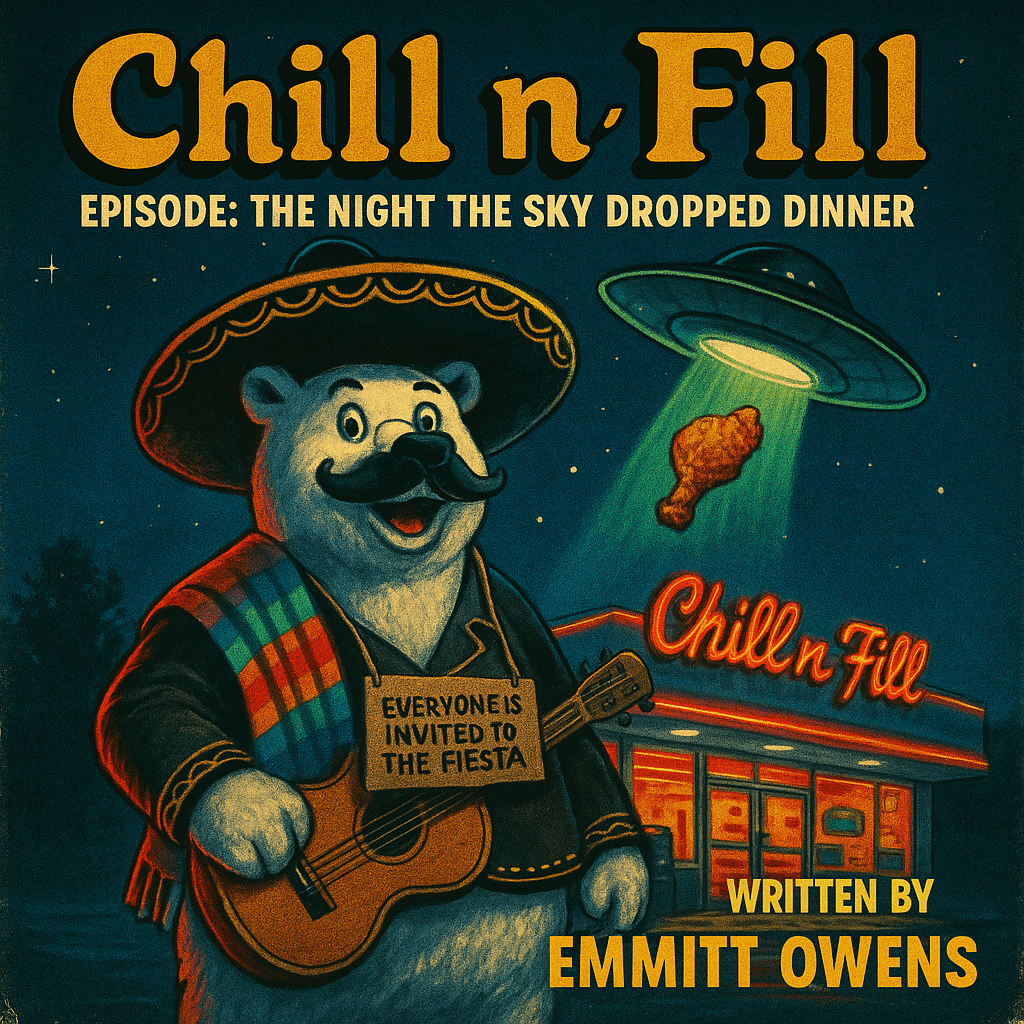
Chill n’Fill
Episode: The Night the Sky Dropped Dinner
Written by: Emmitt Owens (Index #12102025)
They say nothing good happens after midnight. I’ve always thought that was less a warning and more an observation about the kind of people who are still awake to witness it.
It was 11:47 PM on a Wednesday that felt like it had been going on for three days, and I was watching Bob attach a full mariachi band outfit to our twenty-foot polar bear mascot. The sombrero was massive—easily four feet across—and he’d fashioned a tiny guitar from a tennis racket and fishing line. A serape made from what looked like old beach towels was draped across the bear’s shoulders, and he’d even added a fake mustache below the mechanical eye that still bore its “Cheinco 1957” stamp.
“Cultural appreciation, Cindy!” Bob called down from his ladder, securing the last bit of fringe. “The bear represents celebration! Joy! The universal language of music!”
The chalkboard around the bear’s neck read: “LIFE IS A FIESTA—EVEN AT 2 AM.”
I didn’t have the energy to ask why a convenience store in Alabama needed a mariachi bear at midnight on a Wednesday but Bob’s artistic decisions had long since transcended explanation and entered the realm of cosmic acceptance.
Inside, I’d just finished restocking the energy drink cooler when the ancient radio system—the one that seemed to have a mind of its own—crackled to life with WDAR 96.6. Possum’s voice drifted through the speakers with that mix of exhaustion and dry humor that came from hosting the graveyard shift. If you worked nights in Buzzard Roost, you knew Possum—he was the unofficial therapist for anyone awake past midnight, taking calls from folks whose lives always seemed to wobble hardest after dark.
“Buzzard Roost, it’s eleven past one,” Possum said. “The humidity is holding steady at ‘soup you can wear,’ the skeeters are running a blood drive without consent, and you’re rocking with WDAR 96.6—Dead Air Radio.”
I leaned against the counter, half-listening, thinking about how Possum and I were probably the only two people in town who understood what it meant to witness humanity at its most vulnerable—him through phone lines, me through a cash register.
The store was empty except for the hum of coolers and the distant sound of Bob arguing with the ladder about structure. I was reorganizing the candy display—again, because Bob kept rearranging it according to some color theory he’d read about in a 1970s marketing magazine—when the bell above the door chimed.
The woman who entered walked with the distracted energy of someone who’d just received news they were still processing. She was maybe mid-forties, wearing scrubs with Muppet Babies characters on them—the kind nurses wore in pediatric wards. Her eyes had an exhausted look that comes from caring deeply about things that break your heart regularly.
She wandered the aisles like she was looking for something that couldn’t be found on shelves, eventually selecting a bottle of wine, a bag of chocolate, and a pack of tissues with lotion—the holy trinity of emotional first aid.
“Rough shift?” I asked as she approached the counter.
“You could say that.” She set her items down carefully, like they were fragile. “Lost a patient tonight. Nine-year-old. Cancer.”
The radio had shifted to something softer — gentle chords blooming from the static, a song I didn’t recognize at first but that immediately felt like it was eavesdropping on grief.
A man’s voice, low and aching:
“I had all and then most of you…”
The Night We Met — Lord Huron.
The nurse closed her eyes for half a heartbeat, like the universe had just chosen the worst possible soundtrack at the most vulnerable moment. Lord Huron’s “The Night We Met” drifted through the store speakers—that mystical radio choosing its moment with cruelty.
She set her wine and chocolates down as if afraid they might shatter.
“I’m sorry,” I said.
The chorus drifted through the empty aisles — “Take me back to the night we met…” — and I could see in her expression that she was remembering every moment with that kid — Emma — every laugh, every fear she tried to hide behind medical professionalism. Sometimes music doesn’t help. Sometimes it just tells the truth out loud.
“The thing about working pediatric oncology,” she continued, staring at the wine bottle, “is that you know going in that some of these kids won’t make it out. You steel yourself. You prepare. You tell yourself you’ll maintain professional boundaries.” She laughed, but it was the sound of something breaking. “Then you meet them. Learn their favorite colors. Hear about their dogs. Watch them be brave in ways that would shatter most adults.”
I scanned her items slowly, giving her space to talk or not talk.
“Her name was Emma,” she said quietly. “She wanted to be an astronaut. Had this whole plan about going to space, exploring Mars, discovering new things. She had drawings—terrible drawings, the kind kids make—of herself in a spacesuit, planting flags, meeting whatever was out there. She called one of them ‘Mr. Zorbon.’”
From outside, I could hear Bob singing along to his own mariachi music playing from a portable speaker, completely oblivious to the weight settling inside his store.
“She asked me last week if I thought there was anyone else out there,” the nurse continued. “If they had doctors. If they got scared too.” Her voice cracked. “I told her I bet they did, and I bet they had nurses just like me, and I bet those nurses told stories just like I told her.”
“That was kind of you,” I said.
“I don’t know if it was kind or if it was a lie I told because I couldn’t face telling a nine-year-old the truth: that the universe is vast and cold and doesn’t care that she wanted to see the stars.” She paid for her items with shaking hands. “Tonight I stood in the parking lot after my shift and looked up, and I thought—if there’s anything out there watching us, I hope they saw her. I hope somehow the universe knows what we lost.”
She gathered her bag and turned to leave, then paused at the door.
“Sorry for unloading on you,” she said. “It’s been that kind of night.”
“Hey,” I replied. “Some nights the universe feels bigger than we can handle. That’s when we’re supposed to talk about it.”
She left with a sad smile, and I watched her car pull out of the parking lot, thinking about Emma who wanted to see the stars and never would.
The radio crackled again, and Possum’s voice cut through: “WDAR. You’re on the Branch. Tell me what part of your life fell apart tonight.”
Then came Cooter’s breathless voice: “Possum. This is Cooter from over by the VFW. I just seen a spaceship over Buzzard Roost.”
I froze mid-wipe of the counter.
Possum’s response was exactly what you’d expect: skeptical, dry, waiting for the punchline. But Cooter kept talking, describing lights and movement and—
“Box of fried chicken,” Cooter said.
I stopped pretending to clean and just listened.
The conversation spiraled exactly the way conversations on Possum’s show always did—multiple callers, each adding their own piece to an increasingly absurd puzzle. Todd from the logging road. Ms. Speegle pledging allegiance to poultry-delivering aliens. Even the Pickle rapper guy, rhyming about divine takeout.
Bob emerged from his office holding a stapler and looking confused. “Did Possum just say something about UFOs?”
“And fried chicken,” I confirmed.
“Huh.” Bob considered this. “Well, if aliens are real, I hope they appreciate good signage. Our bear would make an excellent interstellar landmark.”
He wandered back to his office, apparently satisfied with this logic.
The bell chimed again, and Cooter himself burst through the door like he’d just run a marathon. He was carrying a Bird King box, grease-stained and clearly recently opened.
“Cindy!” he gasped. “You listening to Possum?”
“Hard not to,” I replied. “You really saw something?”
“SAW IT?” He set the box on the counter with the reverence usually reserved for religious artifacts. “I GOT DINNER FROM IT.”
He placed the box on the counter gently, almost ceremonially — like he was offering up a religious artifact instead of leftover fast-food chicken.
“Cooter,” I said carefully, “did you eat alien chicken?”
“I ate DIVINE chicken,” he corrected. “Best thigh of my life. But now I’m having an existential crisis about whether I just consumed evidence of first contact or if I’m just really high on grease.”
From the radio, I could hear Possum trying to manage the chaos of multiple callers, each with their own UFO story, each describing lights and movement that defied explanation.
“Did you actually see a craft?” I asked. “Or just lights?”
“I saw something that moved wrong,” Cooter said, suddenly serious. “Like somebody was playing a video game with physics turned off. It was there, then it wasn’t, then it was somewhere else. No sound. No engine noise. Just… movement that shouldn’t be possible.”
He grabbed a fountain drink, paid for it, but didn’t leave. Instead, he pulled out his phone and started recording a voice memo: “Day one of potential alien contact. Have consumed the evidence. No regrets. Some bloating.”
Before I could respond, a teenage kid I vaguely recognized from the high school walked in, went straight to the candy aisle, grabbed every single pack of Sour Patch Kids we had—at least a dozen bags—and brought them to the counter.
“Emergency sugar?” I asked.
“My girlfriend just broke up with me via Snapchat,” he said flatly. “With a UFO filter. While telling me she’s been seeing my best friend for two months.”
I scanned the candy. “That’s… impressively terrible timing.”
“She said ‘it’s not you, it’s me,’ but with alien emoji,” he continued, his voice empty of emotion. “Like she wanted to make sure the breakup was both devastating AND on-brand for tonight’s apparent alien invasion.”
From the radio, Possum was now talking to someone named Bunjee McBride about Bird King fryers turning on by themselves.
“You think aliens are real?” the kid asked suddenly.
I looked at him—at his red eyes and his armload of candy and his broken heart—and then at Cooter, who was still recording his alien contact log, and then up at Bob’s mariachi bear watching over the parking lot with mechanical indifference.
“I think,” I said slowly, “that the universe is bigger and stranger than we can imagine, and sometimes it breaks our hearts, and sometimes it drops fried chicken in ditches, and we’re all just trying to make sense of it with the information we have.”
The kid paid for his candy. “That’s the most honest thing an adult has said to me all week.”
He left, and Cooter finally followed, muttering about preserving the remaining chicken for science.
The store fell quiet again except for the radio, where Possum was now fielding theories about government testing and viral marketing and angels with pressure fryers.
I stepped outside for air, standing under Bob’s ridiculous mariachi bear, looking up at the sky. It was clear—no clouds, just stars and a thin moon and the vast nothing that suddenly felt like it might contain anything.
That’s when I saw it.
Not over the store, but in the distance, toward where Slaughter Pen Road cut through the darkness. A light—bright white with a green tint around the edges—moving in ways that lights don’t move. It stopped dead, dropped vertically, shot sideways, all without the arc or momentum that physics demands.
I stood there, frozen, watching this thing that shouldn’t exist write impossible patterns across the sky.
From inside, Possum’s voice continued streaming theories and testimonies, but now his voice had changed. There was something else in it—not quite belief, but not quite skepticism either. The sound of someone whose worldview was actively resizing.
The light hung there for what felt like minutes but was probably only seconds. Then it did something that made my heart forget how to beat properly: it dropped something. I couldn’t see what from this distance, but I saw the silhouette of an object falling, and then the light shot straight up—not in an arc, not with acceleration, just instantly vertical—and vanished.
I stood there in the parking lot, under a mariachi bear, staring at empty sky, thinking about Emma who wanted to see Mars, and Cooter’s impossible chicken, and a teenager whose heartbreak was measured in Sour Patch Kids, and a nurse who asked the universe to witness what we’d lost.
When I went back inside, my hands were shaking slightly.
The bell chimed at 2:04 AM, admitting a man in his early seventies wearing a VFW cap and moving with the uncertain energy of someone who’d just witnessed something that scrambled his understanding of reality.
“You got any of that real strong coffee?” he asked, voice a little shaky.
“Strongest in three counties,” I said, watching him fill the biggest cup we had.
The radio had drifted into Canned Heat’s “Going Up the Country” (that long wailing Woodstock version) — the kind of song that sounded like a memory trying to climb its way out of somebody’s chest.
He stood at the counter, not quite ready to speak, and I didn’t push. Some folks just need to exist near another human while they figure out whether to believe their own eyes.
Finally, he said:
“I was in Vietnam. Real late in it. ’74, ’75. Barely old enough to shave, already too old to be scared. Saw lights in the jungle that moved like they were alive. We called ’em ghosts. Swore Charlie had tech we didn’t. Told ourselves it was swamp gas or exhaustion.”
He sipped his coffee, gaze far away.
“But deep down, we knew we weren’t alone.”
Joe Cocker was still crooning his Woodstock version of “Going Up the Country,” that wandering blues-road ache pouring through the speakers — the kind of song that sounded like it had seen a thousand strange nights and was willing to see a thousand more.
The veteran’s eyes glistened — maybe the coffee steam, maybe the past catching up.
Then—
STATIC—click.
Possum’s voice cut straight through the song like a spotlight slicing fog.
“Sorry to interrupt the tunes, folks, but we’ve got another call. And uh… this one’s weird. Really weird.”
The music faded into the background, unfinished — like the universe had more urgent business than letting the chorus land.
The veteran blinked, straightening a little.
Possum continued, voice tightening as if he was leaning closer to the microphone:
“Caller says he saw a light over the VFW. Says it moved like nothing with a tail number.”
A beat.
“Buzzard Roost, what in God’s name is happening tonight?”
The man exhaled slowly, and his voice returned, rough as gravel:
“See? That’s exactly what I’m talking about.”
From the radio, Possum started talking again — caller after caller — detailing something in the sky that moved like “nothing with a tail number.” You could hear his disbelief trying to catch up to the facts.
“Tonight,” the man continued, voice lowering, “I saw the same kind of light. Over the VFW… then over the ridge. Moved the same way — wrong.”
He swallowed like the truth tasted new again.
“And it hit me — what I saw fifty years ago in that jungle… it wasn’t trauma. Wasn’t tricks. It was real. And it followed us home.”
He paid, but lingered in the doorway — that in-between space where belief and doubt shake hands.
“I convinced myself for five decades that my brain made it up,” he whispered. “But if half the town saw lights tonight… maybe those ghosts were never ghosts at all.”
He stepped out into the warm darkness, the parking lot lights painting him silver on one side and shadow on the other. The door closed behind him with a soft click that felt like a whole lifetime finally being understood.
And I thought about the weight of validation —
how sometimes being believed matters more than being right.
The radio played on, Possum’s voice guiding Buzzard Roost through its collective cosmic moment with humor and honesty and just enough skepticism to keep things grounded while acknowledging that nobody really knew what was happening.
At 2:31 AM, as Possum was winding down his coverage, a final customer entered—a little girl, maybe seven, being led by her exhausted-looking mother. The girl was wearing astronaut pajamas and carrying a stuffed alien.
The radio eased into the soft, lonely opening of David Bowie’s “Space Oddity,” almost like WDAR itself knew this kid was coming.
“Ground control to Major Tom…”
“I’m sorry,” the mother said immediately. “She woke up and heard people talking about aliens outside her window. Won’t go back to sleep unless we ‘check for signs.’”
The girl approached the counter like a scientist on a mission. “Did the aliens come?” she asked.
I looked at her pajamas, at that threadbare alien, and suddenly I was thinking about Emma—how she wanted to go to Mars because the world here didn’t always feel big enough.
“Some people think they saw something unusual tonight,” I said carefully. “Lights in the sky moving in ways that seemed strange.”
“This is Major Tom to Ground Control…”
Bowie’s voice floated through the speaker — curious, brave, a little scared.
“What did they drop?” she asked.
“According to several witnesses… fried chicken.”
Her eyes widened like the cosmos had just introduced a new law of physics.
“FRIED CHICKEN?”
“That’s what people are saying.”
She turned to her mother with absolute conviction:
“Mom. The aliens are sharing their food. That means they’re friendly. That’s what you always say—you can tell if someone’s nice by whether they share their snacks.”
Her mother smiled — tired, but proud.
“I guess that’s one way to interpret first contact.”
The girl chose a chocolate bar like she was preparing a offering.
“When I meet the aliens, I’m going to share this with them. So they know we’re nice too.”
They stepped back into the parking lot darkness — the song following them out the door like a goodbye wave from orbit.
“Planet Earth is blue… and there’s nothing I can do…”
I leaned against the counter, breath catching.
Because the universe had just connected Emma’s dream to a seven-year-old’s chocolate bar through the medium of unexplained lights and Cooter’s divine fried chicken — and somehow that made more sense than anything else tonight.
At 3:00 AM, Bob emerged from his office where he’d apparently been napping. “Did I miss anything?”
“Just the entire town having a collective UFO experience while you slept through it,” I replied.
“Ah.” He considered this. “Well, at least the bear was dressed appropriately. Nothing says ‘welcome to Earth’ like mariachi.”
He went outside to admire his handiwork, leaving me alone with the radio as Possum signed off: “This is Possum, reminding the midnight people: you ain’t crazy for seeing what you saw. Just don’t let it be the only weird thing you ever do anything about.”
I walked outside one more time before my shift ended, standing in the parking lot that smelled like gasoline and morning breakfast. The sky had returned to its normal state of indifferent stars, giving no indication that anything unusual had happened.
But something had happened.
Maybe it was aliens. Maybe it was mass hallucination brought on by too much late-night radio and not enough sleep. But for a few hours, the entire town had looked up at the same sky and wondered if we were alone, and whether the universe cared that we were here.
I thought about the nurse who wanted Emma to be seen, and Cooter’s impossible chicken, and the veteran’s fifty-year validation, and a little girl who thought aliens were nice because they shared their food.
Maybe that’s all any of us want—to be witnessed. To have the universe acknowledge that we exist, that we matter, that our joys and sorrows and weird late-night experiences mean something beyond just the moment we’re living them.
The mariachi bear kept its eternal watch, one mechanical eye blinking at the empty road, its sombrero slightly crooked from the evening breeze. Bob had added one more thing while I wasn’t looking—a small sign taped to the guitar that read: “EVERYONE IS INVITED TO THE FIESTA. YES, EVEN ALIENS.”
By 3:15 AM, my shift was done — or at least my part of the night. I clocked out while the next clerk clocked in, the two of us trading tired smiles like passing a relay baton in some midnight marathon.
The Chill n’Fill lights stayed bright for the delivery drivers, the restless insomniacs, and anyone else who might come wandering down Buzzard Roost’s main drag searching for answers, caffeine, or comfort.
Driving home, I passed houses with porch lights still on, curtains cracked just enough for someone to keep an eye on the sky. Windows glowing with televisions tuned to local news, with radios replaying Possum’s coverage. People awake — not because they wanted to be, but because curiosity had grabbed them by the collar and refused to let go.
Whatever happened tonight…
nobody in Buzzard Roost was quite ready to sleep it off.
WDAR had switched to automated programming—some late-night blues pouring through the speakers like the radio was trying to soothe the whole town at once. B.B. King’s “The Thrill Is Gone” drifted low and smoky, the kind of song that understands confusion and doesn’t ask you to explain it.
The highway was mostly empty, just me and the long stretch of blacktop leading away from the night’s strangeness. A Bird King billboard glowed on the roadside—smugly promising “REAL CHICKEN, ALWAYS FRESH”—as if mocking the cosmic bucket-drop Buzzard Roost had just lived through.
For a few hours tonight, we’d all been united in wonder.
Scared and skeptical and excited and human—
but together.
Looking up at the same impossible sky.
Listening to the same impossible radio calls.
Trying to make sense of the kind of thing you only see in movies and then spend the rest of your life swearing wasn’t a hallucination.
Maybe the miracle wasn’t the chicken.
Or the lights.
Or the physics that didn’t behave like physics should.
Maybe the miracle was that—for once—none of us were alone with our fear.
We looked up, and we wondered together.
Whatever the universe was trying to say tonight…
Buzzard Roost had definitely heard it.
And nobody was going to forget anytime soon.
But I’d been there. I’d seen it. I’d watched the light move wrong and felt my understanding of possible stretch to accommodate it.
I got home at 3:47 AM, made myself a cup of tea, and sat on my porch looking up at stars that suddenly seemed both more distant and more present than they’d ever been before.
Somewhere out there, maybe Emma had gotten her wish. Maybe she’d been seen. Maybe the universe had acknowledged her in ways we couldn’t measure or understand.
Or maybe we’d all just needed something to believe in on a random Wednesday night when the weight of normal life felt too heavy to carry alone.
Either way, I’d been part of it. Witnessed it. Held space for people processing it.
And tomorrow I’d go back to work, and Bob would probably dress the bear in something even more ridiculous, and the radio would play, and people would come in with their stories and their needs and their late-night confessions.
But tonight—just for tonight—the sky had been strange and generous and terrifying and wonderful, and I’d been there to see it.
That had to count for something.


Leave a Reply