
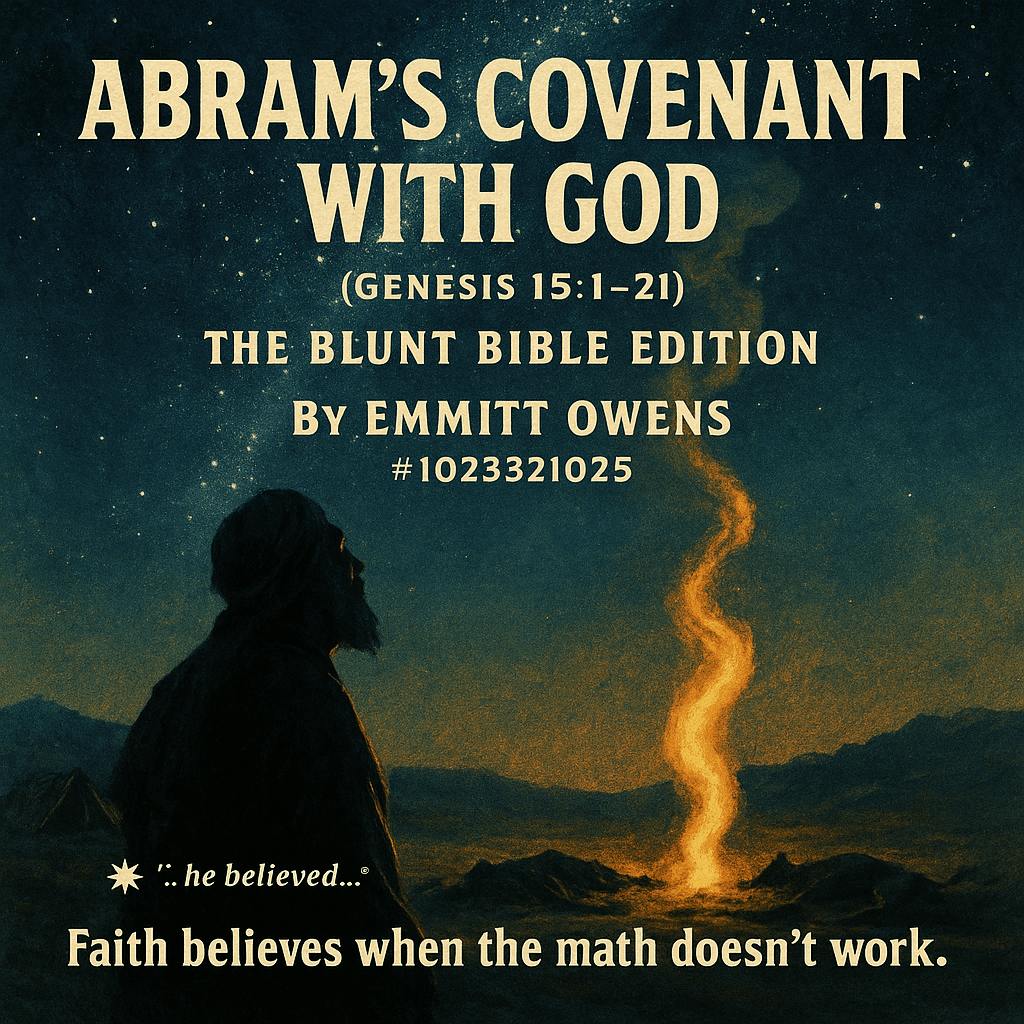
ABRAM’S COVENANT WITH GOD (Genesis 15:1-21)
The Blunt Bible Edition
By: Emmitt Owens
(Index #10232025)
Faith believes when the math doesn’t work.
—–
✍️ Author’s Note:
Genesis 15 is about what happens when you make the right choice and wait for God to show up.
In Genesis 14, Abram refused wealth from the King of Sodom. Said no to a fortune. Walked away with nothing.
And in Genesis 15:1, God appears immediately and says: “I am your reward.”
Not “I’ll bless you later.”
Not “Good job, here’s something nice eventually.”
“I AM the reward. Me. Right now. Not Sodom’s gold. Me.”
But then Abram does something we don’t talk about enough: He asks God a question.
“That’s great, Lord, but I’m still childless. What good is a reward if I have no one to pass it to?”
This is honest doubt within faith.
And God doesn’t rebuke him. God takes him outside, shows him the stars, and says:
“Count them if you can. That’s how many descendants you’ll have.”
The problem?
Abram is 75+ years old. Sarai is barren. They have no children. No realistic path to descendants.
And God says: “Your descendants will be uncountable.”
Faith = believing God’s promise when the circumstances say it’s impossible.
This chapter contains Genesis 15:6—one of the most important verses in the entire Bible:
“And he believed in the Lord; and he counted it to him for righteousness.”
This verse changes everything.
– Paul quotes it in Romans 4 to explain justification by faith.
– James quotes it in James 2 to show that faith produces works.
It’s the foundation of the gospel.
Genesis 15 is also about:
– God making a unilateral covenant (He passes through the pieces alone)
– The 400-year prophecy (slavery in Egypt foretold)
– Promises that aren’t for you to see fulfilled (generational faith)
This is faith when the math doesn’t work.
Let’s talk about Genesis 15.
—–
PART 1: GOD SHOWS UP AS THE REWARD (Genesis 15:1-3)
“I Am Thy Shield, and Thy Exceeding Great Reward”
Genesis 15:1 (KJV) – “After these things the word of the Lord came unto Abram in a vision, saying, Fear not, Abram: I am thy shield, and thy exceeding great reward.”
Timing matters.
“After these things” = after Genesis 14.
After Abram rescued Lot.
After Abram refused Sodom’s wealth.
After Abram said: “I won’t take a thread or a shoelace from you, lest you say ‘I made Abram rich.’”
After Abram walked away with nothing.
And God shows up immediately.
Not days later. Not weeks later. Immediately.
Like God was watching the whole thing thinking, “Okay, the second he turns down that money, I’m showing up. This is My moment.”
Genesis 15:1 is the payoff for Genesis 14:23.
God validates Abram’s refusal in real time.
It’s like turning down a terrible job offer on Friday and getting your dream job offer on Monday morning. Except the dream job is God Himself saying “I’m your compensation package.”
What God says: “Fear not, Abram.”
Why would Abram be afraid?
Because he just turned down a fortune. Because he just said no to legitimate wealth. Because he just walked away from the King of Sodom’s offer.
Maybe Abram’s thinking: “Did I just make a huge mistake?”
You know that feeling when you make a principled decision and immediately start second-guessing it?
“Should I have just taken the money? I mean, I could’ve done good things with it. Built wells. Fed people. Was I being too proud?”
That’s probably where Abram’s head was at.
And God shows up and says: “Fear not.”
You didn’t make a mistake. You made the right choice.
“I am thy shield.”
God is Abram’s protection. His covering. His defense against the consequences of refusal.
The King of Sodom can’t say “I made Abram rich.” Because God is the one who enriches him.
God’s basically saying: “You don’t need Sodom’s money because I’m your defense fund, your insurance policy, your security system, and your 401(k) all in one.”
“And thy exceeding great reward.”
Not “a” reward. Not “some” reward.
Exceeding great.
More than Sodom could ever offer.
God Himself is the reward.
Not the blessing. Not the provision. God.
This is revolutionary theology happening in real time.
Most people think: “If I obey God, He’ll give me rewards.”
God’s saying: “If you obey Me, I am the reward.”
Not what I give you. Me.
This is what Abram was waiting for.
Not gold. Not livestock. Not land.
God’s presence.
The Provider matters more than the provision.
The Giver matters more than the gifts.
And God shows up immediately after Abram demonstrates that he understands this.
—–
Abram’s Honest Question
Genesis 15:2-3 (KJV) – “And Abram said, Lord God, what wilt thou give me, seeing I go childless, and the steward of my house is this Eliezer of Damascus? And Abram said, Behold, to me thou hast given no seed: and, lo, one born in my house is mine heir.”
Abram hears God say “I am your exceeding great reward.”
And Abram’s response? “That’s great, Lord. But I’m still childless.”
Like, imagine the audacity.
GOD HIMSELF just said: “I am your reward.”
Not “a” reward. Not “some blessings coming your way.”
“I. Myself. Am your reward.”
And Abram’s like: “Cool cool cool. But… kids though?”
This is the most relatable thing Abram has done so far.
God offers Himself, and Abram’s still thinking about his inheritance plan.
That’s hilariously human.
Let’s break down what Abram’s actually saying:
“Lord God, what will You give me?”
Translation: “I appreciate the ‘I am your reward’ speech, but I need something tangible here.”
“I go childless.”
Translation: “I have no kids. Zero. None. My family tree ends with me.”
“The steward of my house is this Eliezer of Damascus.”
Translation: “My servant—a guy from Damascus, not even a blood relative—is going to inherit everything I own.”
“You’ve given me no seed.”
Translation: “No children. No offspring. No biological heirs.”
“One born in my house is mine heir.”
Translation: “A servant is going to get everything because I have no sons.”
Abram’s basically saying: “Lord, I appreciate that You’re my reward. But what good is a reward if I have no one to pass it to?”
“You promised me descendants in Genesis 12. It’s been years. I’m still childless.”
“My servant Eliezer is going to inherit everything. Is that the plan?”
Abram’s asking: “How does this work?”
And here’s the thing: This isn’t rejection. This isn’t unbelief.
This is honest doubt within faith.
There’s a difference:
– Unbelief says: “I don’t believe You, and I’m not even going to engage with what You’re saying.”
– Doubt says: “I believe You, but I need help understanding how this is going to work.”
Abram has doubt. Not unbelief.
He’s not saying “You’re lying, God.”
He’s saying “I believe You, but my current reality doesn’t match Your promise, and I’m confused.”
That’s honest faith.
And here’s what’s wild: God doesn’t rebuke him. God doesn’t say, “How dare you question Me?” God doesn’t get offended by Abram’s honest doubt.
God answers the question.
—–
This is refreshing theology.
You can have faith AND questions at the same time.
– Doubt isn’t the opposite of faith. Unbelief is.
– Doubt says: “I believe, but I need help understanding.”
– Unbelief says: “I don’t believe, and I don’t care to.”
Abram has doubt. Not unbelief.
And God meets him there.
God doesn’t shame him for asking. God doesn’t punish him for being confused.
God takes him outside and shows him the stars.
—–
PART 2: THE PROMISE – DESCENDANTS LIKE THE STARS (Genesis 15:4-5)
Faith When Math Doesn’t Work
Genesis 15:4-5 (KJV) – “And, behold, the word of the Lord came unto him, saying, This shall not be thine heir; but he that shall come forth out of thine own bowels shall be thine heir. And he brought him forth abroad, and said, Look now toward heaven, and tell the stars, if thou be able to number them: and he said unto him, So shall thy seed be.”
God’s response to Abram’s question: “Eliezer won’t be your heir. Your own son will be.”
Specific. Clear. Direct.
“He that shall come forth out of thine own bowels.”
Translation: Your biological son. From you. Not adopted. Not a servant elevated to heir status.
Your own flesh and blood.
But then God does something dramatic.
He takes Abram outside.
Picture this: It’s nighttime. Abram’s standing in his tent, asking God existential questions about his inheritance.
And God’s like: “Come outside. I want to show you something.”
This is the biblical equivalent of your dad saying “Let me show you something in the garage” and then giving you a life-changing pep talk while you’re both staring at power tools.
Except instead of power tools, it’s the entire night sky.
“Look now toward heaven, and tell the stars, if thou be able to number them.”
God says: “Look at the sky. Look at the stars.”
“Count them if you can.”
Go ahead. Try.
Abram probably got to like 47 and gave up. “Okay, I get it. A lot.”
Because here’s the thing: You can’t count the stars.
Not with the naked eye. Not even with a telescope.
There are an estimated 100-400 billion stars in the Milky Way galaxy alone.
And there are an estimated 2 trillion galaxies in the observable universe.
You. Cannot. Count. The. Stars.
“That’s how many descendants you’ll have.”
– Not “a few.”
– Not “a nice-sized family.”
Uncountable.
—–
The Problem with the Math
Let’s do the math on God’s promise:
Abram’s situation:
– At least 75 years old (probably older by Genesis 15)
– Married to Sarai, who is barren (Genesis 11:30)
– No children
– No biological pathway to descendants
– Zero sperm motility (probably)
– Zero viable eggs (definitely)
God’s promise:
– “Your descendants will be as numerous as the stars”
– Uncountable
– Generational blessing
The math doesn’t work.
Like, at all.
Biologically, this shouldn’t be possible.
Abram and Sarai are past childbearing age. By a lot.
Sarai’s been barren her entire life. It’s not like she’s just had trouble conceiving. She’s never been able to have children.
– And now she’s old.
– And Abram’s old.
And God says: “Your descendants will outnumber the stars.”
This is not a small promise.
This is not “you’ll have a son.”
This is “your descendants will be uncountable.”
One son? Sure, that’s a miracle.
Descendants like the stars?
That’s not just a miracle. That’s a multi-generational, nation-building, world-changing promise.
And Abram is standing there, childless, looking at the stars, and God says: “That’s your family tree.”
This is the biblical equivalent of someone showing you a picture of a mansion and saying “This is your future house” when you’re currently unemployed and living in your mom’s basement.
Except God actually delivers.
Or like someone handing you a lottery ticket and saying “You’re going to win” when you’ve never even bought a lottery ticket before and you’re pretty sure the lottery is rigged.
Except with God, it’s not rigged. He’s just actually going to make it happen.
—–
What Faith Looks Like
Faith = believing God’s promise when the circumstances say it’s impossible.
Faith isn’t believing when everything makes sense.
That’s not faith. That’s logic.
If your bank account has money in it, and you believe you can buy groceries, that’s not faith. That’s math.
Faith is believing when the math doesn’t work.
When your bank account says “no.”
When your age says “too late.”
When your circumstances say “impossible.”
When the doctors say “it’s not happening.”
When the timeline says “you missed it.”
When your body says “not anymore.”
When everyone around you says “give up.”
And God says: “Trust Me anyway.”
Abram is staring at an impossible promise.
He’s old. Sarai’s barren. They have no kids.
And God says: “Count the stars. That’s your legacy.”
This requires faith that defies logic.
Not blind faith. Informed faith.
Abram knows his situation. He knows the impossibility. He knows the biology doesn’t work.
He just told God: “I’m childless. My servant is going to inherit everything.”
Abram’s not naive. He’s not ignorant of his circumstances.
He knows it’s impossible.
And he chooses to believe God anyway.
That’s faith.
Not believing because you’re stupid or uninformed.
Believing in spite of being fully informed.
Abram knows the facts.
And he believes God’s promise over the facts.
That’s faith when the math doesn’t work.
—–
PART 3: COUNTED AS RIGHTEOUSNESS (Genesis 15:6)
The Verse That Changes Everything
Genesis 15:6 (KJV) – “And he believed in the Lord; and he counted it to him for righteousness.”
This is one of the most important verses in the entire Bible.
If you underline verses, underline this one.
If you memorize Scripture, memorize this one.
If you only read one verse from Genesis 15, read this one.
This verse is the foundation of the gospel.
I’m not exaggerating.
This verse gets quoted by Paul in Romans 4.
This verse gets referenced by Paul in Galatians 3.
This verse gets quoted by James in James 2.
This verse is the theological bedrock of justification by faith.
Martin Luther read this verse and lost his mind. The Reformation started here.
—–
What Does Genesis 15:6 Mean?
“And he believed in the Lord”
Abram believed God’s promise.
Not because he saw evidence.
Not because the circumstances made sense.
Not because the biology worked.
Not because he had a backup plan.
He believed because God said it.
That’s faith.
Pure. Simple. Trust.
“and he counted it to him for righteousness.”
This phrase changes everything.
“Counted” = reckoned, credited, imputed.
It’s an accounting term.
Like when you deposit money into a bank account, and the bank credits your account.
You put $100 in. The bank credits your account $100.
God credited Abram’s faith as righteousness.
Here’s what that means: Abram wasn’t righteous because of what he did.
He wasn’t righteous because of his works.
He wasn’t righteous because he was perfect.
He was counted as righteous because he believed God.
His faith was credited to his account as righteousness.
Let me say that again because it’s easy to skim past this and miss how revolutionary it is:
Abram’s faith was COUNTED AS righteousness.
Not: “Abram’s faith led to righteousness.”
Not: “Abram’s faith plus his good works equaled righteousness.”
Not: “Abram’s faith was nice, but he still had to earn righteousness through obedience.”
His faith WAS COUNTED AS righteousness.
The faith itself. Credited. As if it were righteousness.
This is justification by faith.
Not by works.
Not by perfection.
Not by performance.
Not by keeping the Law (which doesn’t exist yet).
Not by rituals (which don’t exist yet).
Not by ancestry (Abram’s not even “Israel” yet—that’s Jacob’s new name in Genesis 32).
By faith.
Abram believed. God credited it as righteousness.
That’s the gospel 2,000 years before Jesus.
—–
Why Genesis 15:6 Matters (A Lot)
This verse is quoted and referenced all over the New Testament.
Romans 4:3 – “For what saith the scripture? Abraham believed God, and it was counted unto him for righteousness.”
Paul quotes Genesis 15:6 to explain justification by faith.
Romans 4:22-24 – “And therefore it was imputed to him for righteousness. Now it was not written for his sake alone, that it was imputed to him; But for us also, to whom it shall be imputed, if we believe on him that raised up Jesus our Lord from the dead.”
Paul says this principle applies to us too—faith is credited as righteousness.
Galatians 3:6 – “Even as Abraham believed God, and it was accounted to him for righteousness.”
Paul uses Genesis 15:6 to argue that righteousness comes through faith, not the Law.
James 2:23 – “And the scripture was fulfilled which saith, Abraham believed God, and it was imputed unto him for righteousness: and he was called the Friend of God.”
James quotes Genesis 15:6 to show that genuine faith produces works (but the faith comes first).
—–
Genesis 15:6 is the theological foundation for:
– Justification by faith (Romans 3-5)
– Salvation by grace through faith (Ephesians 2:8-9)
– The gospel itself (believe and be saved)
– The Protestant Reformation (Luther’s “sola fide”—faith alone)
This verse is why we say: “You’re saved by faith, not by works.”
Because that’s what happened to Abram.
And Paul says: “It wasn’t written for Abram’s sake alone. It was written for us too.”
—–
What Abram Did NOT Do to Be Counted Righteous
Let’s be clear about what didn’t make Abram righteous:
❌ Circumcision (that doesn’t happen until Genesis 17—two chapters later)
❌ Keeping the Law (the Law doesn’t exist yet—Moses is 400+ years away)
❌ Perfect obedience (Abram lied about Sarai in Genesis 12, compromised in Egypt, and will mess up again in Genesis 16)
❌ Religious rituals (no tabernacle, no sacrifices yet, no temple, no priests)
❌ Ethnic identity (Abram’s not even “Israel” yet—that’s Jacob’s new name in Genesis 32)
❌ Reading his Bible daily (the Bible doesn’t exist)
❌ Going to church (there is no church)
❌ Tithing (he did tithe to Melchizedek in Genesis 14, but that happened AFTER Genesis 15:6 was already true in God’s eyes—Abram was already counted righteous before the tithe)
❌ Posting inspirational verses on social media (no social media, obviously, but you get the point)
❌ Good works (those come later, but they’re not what made him righteous)
So what made Abram righteous?
✅ He believed God.
That’s it.
He took God at His word.
No hoops to jump through. No religious checklist. No “do these 10 things and then maybe God will accept you.”
Just: belief.
Trust.
Faith.
—–
What This Means for Us
If Abram was counted righteous by faith (not works), then righteousness has always been by faith.
The Law didn’t change that. The Law revealed the need for it.
Romans 3:20 – “Therefore by the deeds of the law there shall no flesh be justified in his sight: for by the law is the knowledge of sin.”
The Law shows us we’re sinners. Faith shows us we need a Savior.
Abram believed God’s promise about descendants.
We believe God’s promise about salvation.
Same principle.
Genesis 15:6 is the Old Testament version of John 3:16.
“For God so loved the world, that he gave his only begotten Son, that whosoever believeth in him should not perish, but have everlasting life.”
Believe. Be counted righteous. Be saved.
That’s the gospel.
And it’s right here in Genesis 15:6.
2,000 years before Jesus.
4,000 years before the Reformation.
Right here in Genesis.
Justification by faith.
—–
The Tension: Faith and Works
Here’s where it gets interesting.
Paul quotes Genesis 15:6 to say: righteousness is by faith, not works (Romans 4).
James quotes Genesis 15:6 to say: genuine faith produces works (James 2).
Are they contradicting each other? No.
They’re answering different questions.
Paul’s question: How are we justified before God?
Paul’s answer: By faith, not by works. (Romans 4:1-5)
James’s question: How do we know if someone’s faith is genuine?
James’s answer: Genuine faith produces works. (James 2:14-26)
Paul is talking about the ROOT of salvation: faith.
James is talking about the FRUIT of salvation: works.
Faith alone justifies.
But genuine faith is never alone—it produces works.
Think of it like this:
A tree is saved (justified, made righteous) by its roots.
But you know the tree is alive because it produces fruit.
The roots save the tree.
The fruit proves the tree is alive.
Abraham believed God (Genesis 15:6) = FAITH (the root).
Abraham offered Isaac (Genesis 22) = WORKS (the fruit).
James 2:22 – “Seest thou how faith wrought with his works, and by works was faith made perfect?”
Faith came first. Works followed.
Genesis 15:6 happened before Genesis 22.
Belief happened before obedience.
Justification happened before the test.
That’s the pattern.
You’re not saved by works.
But if you’re saved, works will follow.
Not to earn salvation. To prove it’s real.
Not to become righteous. To show that righteousness has taken root.
—–
Why This Verse Matters So Much
Because everything hinges on Genesis 15:6.
If righteousness is by works, then:
– We’re all doomed (because none of us are perfect)
– Jesus’ death was unnecessary (we could just try harder)
– Salvation depends on us (not on God)
– No one can be sure they’re saved (because you never know if you’ve done enough)
But if righteousness is by faith, then:
– Salvation is possible (because God provides it)
– Jesus’ death makes sense (He paid the price we couldn’t pay)
– Salvation depends on God (not on us)
– We can have assurance (because it’s based on what Christ did, not what we do)
Genesis 15:6 is the gospel 2,000 years before Jesus.
Abram believed. God credited it as righteousness.
We believe. God credits it as righteousness.
Same principle. Same grace. Same God.
This is why Paul keeps coming back to Genesis 15:6.
This is why the Reformers kept coming back to Genesis 15:6.
This is why we keep coming back to Genesis 15:6.
Because this verse answers the most important question in theology: How can a sinful person be made righteous before a holy God?
Answer: By faith.
Not by trying harder.
Not by being good enough.
Not by earning it.
By believing.
That’s Genesis 15:6.
That’s the gospel.
—–
PART 4: “HOW WILL I KNOW?” – HONEST DOUBT (Genesis 15:7-8)
Asking for a Sign Isn’t Unbelief
Genesis 15:7-8 (KJV) – “And he said unto him, I am the Lord that brought thee out of Ur of the Chaldees, to give thee this land to inherit it. And he said, Lord God, whereby shall I know that I shall inherit it?”
Abram just believed God’s promise about descendants (Genesis 15:6).
His faith was credited as righteousness.
One of the most important verses in the entire Bible just happened.
Paul’s gonna quote this in Romans 4. James is gonna reference it in James 2. This is a BIG DEAL.
And then—immediately—Abram asks another question:
“Lord God, whereby shall I know that I shall inherit it?”
Brother.
You JUST believed.
Genesis 15:6 literally just said your faith was credited as righteousness.
And NOW you’re asking for a sign?
This is peak human behavior.
We believe God, get the theological win, and then immediately follow up with: “But can You prove it tho?”
—-Wait—-
Didn’t Abram just believe God?
Didn’t Genesis 15:6 say he had faith?
So why is he asking for a sign?
Faith and Doubt Can Coexist
Here’s what people miss:
Faith isn’t the absence of questions.
Faith is trusting God WHILE asking questions.
Abram believed God’s promise (Genesis 15:6).
And then Abram asked for confirmation (Genesis 15:8).
Both are true at the same time.
Think about it:
In Genesis 15:6, God promises Abram descendants.
In Genesis 15:7, God promises Abram land.
Abram believed the promise about descendants.
Then he asks: “How will I know about the land?”
This isn’t unbelief. This is honest faith seeking understanding.
– Unbelief says: “I don’t believe You, and I don’t want proof because I’ve already decided You’re lying.”
– Doubt says: “I believe You, but I’d love some confirmation because this is a big promise and I’m human.”
Abram has doubt. Not unbelief.
And God doesn’t rebuke him.
God gives him a sign.
The entire covenant ceremony in Genesis 15:9-17 is God’s response to Abram’s question.
God didn’t say: “How dare you ask for a sign after I just credited you with righteousness!”
God said: “You want to know how you’ll inherit the land? Let Me show you.”
—–
God Honors Honest Questions
God could have said: “Abram, I just told you. Why are you asking again?”
“Don’t you trust Me?”
“Have a little faith!”
“I literally just credited you with righteousness in verse 6, and now you’re doubting in verse 8?”
But God doesn’t say any of that.
Instead, God says: “You want to know how you’ll inherit the land? Let Me show you.”
And God gives him the covenant ceremony.
This is the God of the Bible.
He doesn’t demand blind faith.
He invites honest questions.
He meets doubt with grace.
He gives signs to those who ask.
He doesn’t shame people for wanting confirmation.
Other examples:
– Gideon asks for a sign (twice!) in Judges 6. God gives it. Both times. No rebuke.
– Zechariah asks for a sign in Luke 1. God gives it (though Zechariah gets temporarily muted for doubting too much—he straight-up said “How can I be sure? I’m old and my wife is old”).
– Thomas asks to see Jesus’ wounds in John 20. Jesus shows him. No shame. Just: “Here. Touch the wounds. Believe.”
– Moses asks for signs in Exodus 3-4. God gives him three signs: the staff turning into a snake, the leprous hand, and water turning to blood.
Asking for confirmation isn’t unbelief.
It’s faith that wants to grow.
And God honors that.
So if you’ve ever felt guilty for asking God “How will I know?”—don’t.
Abram did it. Right after being credited with righteousness.
And God didn’t rebuke him. God showed him.
—–
PART 5: THE COVENANT CEREMONY (Genesis 15:9-17)
God Alone Passes Through the Pieces
Genesis 15:9-11 (KJV) – “And he said unto him, Take me an heifer of three years old, and a she goat of three years old, and a ram of three years old, and a turtledove, and a young pigeon. And he took unto him all these, and divided them in the midst, and laid each piece one against another: but the birds divided he not. And when the fowls came down upon the carcases, Abram drove them away.”
God tells Abram to prepare a covenant ceremony.
Here’s what Abram does:
1. Takes a heifer, a goat, a ram, a turtledove, and a pigeon
2. Cuts the larger animals in half
3. Lays the pieces opposite each other (creating a path between them)
4. Keeps the birds whole
5. Drives away the scavenger birds (vultures trying to eat the sacrifice)
This is an ancient Near Eastern covenant ritual.
And if you don’t know the context, it seems super weird.
Like, why is Abram out here with a knife cutting animals in half?
Is this a barbecue? A sacrifice? Some kind of ancient ritual that makes no sense?
Actually, it’s a covenant ceremony. And it makes perfect sense once you understand what’s happening.
—–
What Is a Covenant Ceremony?
In the ancient Near East, when two parties made a covenant (a binding agreement), they would:
1. Kill animals
2. Cut them in half
3. Lay the pieces on the ground opposite each other
4. Both parties walk between the pieces
The symbolism:
Walking between the pieces meant: “If I break this covenant, may I end up like these animals.”
It’s a self-curse.
A blood oath.
“If I violate this agreement, may I be torn apart like these animals.”
This is serious business.
This isn’t a handshake deal. This isn’t “let’s agree and move on.”
This is: “If I break this covenant, may I be slaughtered.”
—–
This isn’t unique to Israel.
Archaeologists have found records of covenant ceremonies like this in other ancient cultures.
The Hittites did this. The Assyrians did this. The Babylonians did this.
Jeremiah 34:18-20 even references this practice:
“And I will give the men that have transgressed my covenant, which have not performed the words of the covenant which they had made before me, when they cut the calf in twain, and passed between the parts thereof…”
So this is a recognized, understood practice.
Abram knows what’s happening.
He’s preparing for a covenant ceremony.
He’s not confused. He’s not winging it.
He knows exactly what this ritual means.
—–
The Setup: Abram Prepares and Waits
Abram prepares the animals.
Cuts them in half. (Except the birds—those stay whole.)
Lays them out opposite each other.
Creates a pathway between the pieces.
And then he drives away the scavenger birds.
Because vultures love free food. And Abram’s out here waving his arms like “SHOO! This is a SACRED covenant ceremony! Get out of here!”
Picture Abram standing there in the middle of this dead-animal pathway, flapping his arms at vultures.
That’s not in most Sunday school illustrations, but it’s in the Bible. Genesis 15:11.
And then he waits.
For what?
For both parties to walk through the pieces.
Abram and God.
That’s how covenants work.
Both parties walk through. Both parties take the oath. Both parties say: “If I break this, may I be torn apart.”
Abram’s standing there, ready to walk through.
Waiting for God to show up so they can both take the covenant oath together.
But here’s where it gets weird.
—–
Abram Falls Asleep
Genesis 15:12 (KJV) – “And when the sun was going down, a deep sleep fell upon Abram; and, lo, an horror of great darkness fell upon him.”
Abram’s waiting for the covenant ceremony.
He’s ready to walk through the pieces with God.
The sun is going down. It’s getting dark.
And then a “deep sleep” falls on him.
This isn’t just a nap.
This isn’t “Abram got tired and dozed off.”
This is a supernatural, God-induced sleep.
The Hebrew word is tardemah—the same word used in Genesis 2:21 when God puts Adam into a deep sleep to create Eve.
This is God knocking Abram out.
And along with the sleep comes “an horror of great darkness.”
Some translations say “dreadful darkness” or “terrifying darkness” or “thick and dreadful darkness.”
This is the presence of God—heavy, overwhelming, terrifying in its holiness.
Not a peaceful nap. Not a gentle rest.
A horror of great darkness.
The weight of God’s presence pressing down.
Why does God put Abram to sleep?
Because Abram is not going to walk through the pieces.
Only God is.
Abram’s role in this covenant ceremony?
Sleep.
That’s it.
He prepared the animals. He set up the pieces. He drove away the vultures.
And then God knocked him out and said: “I got this. You just rest.”
—–
God Alone Passes Through
Genesis 15:17 (KJV) – “And it came to pass, that, when the sun went down, and it was dark, behold a smoking furnace, and a burning lamp that passed between those pieces.”
Abram is asleep.
The sun has set.
It’s dark.
And then God appears.
Not as a person. Not as a voice. Not even as a burning bush (that’s Moses later).
As a smoking furnace and a burning lamp (flaming torch).
Fire. Smoke. The presence of God.
Just straight-up FIRE AND SMOKE passing through dead animal pieces in the dark.
That’s the most metal thing in Genesis so far.
And God alone passes between the pieces.
This changes everything.
In a normal covenant ceremony, both parties walk through the pieces.
Both parties say: “If I break this covenant, may I be torn apart.”
But here, only God passes through.
Abram is asleep.
He doesn’t walk through.
He doesn’t take the oath.
He doesn’t say “If I break this covenant, may I be torn apart.”
God does it all.
God makes the covenant unilaterally.
—–
What This Means: A Unilateral Covenant
This is a one-sided covenant.
This is like signing a contract where the other person says: “Actually, you don’t need to sign. I’ll sign for both of us. And if either of us breaks this agreement, I’ll take the penalty for both of us too.”
That’s not how contracts work.
That’s not how covenants work.
But that’s how grace works.
God is saying: “I am making this promise to you, Abram.”
“And if this covenant is broken—I will pay the price.”
“Not you. Me.”
“If anyone violates this agreement, I will take the curse.”
Think about what God is doing: By passing through the pieces alone, God is taking the curse of the covenant upon Himself.
“If this promise fails, may I be cut in pieces.”
God is binding Himself to keep this promise.
And He’s not binding Abram to anything.
Abram’s asleep. He has no obligations here.
This is entirely on God.
This is mind-blowing.
Normally, covenants are conditional: “I’ll do this if you do that.”
“I’ll bless you if you obey.”
“I’ll keep my end if you keep yours.”
But this covenant is unconditional.
God says: “I will fulfill this promise. Even if you fail. Even if you mess up. Even if you don’t hold up your end.”
“I’ll pay the price for both of us.”
And spoiler alert: Abram does mess up.
Genesis 16: He tries to “help” God fulfill the promise by having a child with Hagar. Bad idea.
Genesis 20: He lies about Sarah being his wife. Again.
Abram’s not perfect.
But the covenant stands.
Because it doesn’t depend on Abram’s performance.
It depends on God’s faithfulness.
—–
This Foreshadows the Cross
Fast-forward 2,000 years.
Jesus hangs on a cross.
Torn apart. Broken. Cut down.
Why? Because He took the curse of the covenant on Himself.
Galatians 3:13-14 – “Christ hath redeemed us from the curse of the law, being made a curse for us: for it is written, Cursed is every one that hangeth on a tree: That the blessing of Abraham might come on the Gentiles through Jesus Christ…”
The blessing of Abraham = the covenant in Genesis 15.
And Jesus took the curse so we could receive the blessing.
Genesis 15:17 is a preview of Calvary.
God alone passes through the pieces.
Jesus alone bears the curse.
We contribute nothing. God does everything.
We’re asleep—spiritually dead (Ephesians 2:1).
And God does the work.
God makes the covenant.
God fulfills the covenant.
God pays the penalty for breaking the covenant.
All of it. God.
That’s grace.
That’s the gospel.
That’s Genesis 15 pointing to the cross.
—–
PART 6: THE 400-YEAR PROPHECY (Genesis 15:13-16, 18-21)
The Promise You Won’t Live to See
Before God passes through the pieces, He gives Abram a prophecy.
And it’s not a happy one.
Genesis 15:13-16 (KJV) – “And he said unto Abram, Know of a surety that thy seed shall be a stranger in a land that is not theirs, and shall serve them; and they shall afflict them four hundred years; And also that nation, whom they shall serve, will I judge: and afterward shall they come out with great substance. And thou shalt go to thy fathers in peace; thou shalt be buried in a good old age. But in the fourth generation they shall come hither again: for the iniquity of the Amorites is not yet full.”
God tells Abram:
1. Your descendants will be strangers in a foreign land
2. They’ll be enslaved and oppressed for 400 years
3. I’ll judge the nation that enslaves them (spoiler: it’s Egypt, and it’s gonna be BRUTAL)
4. They’ll leave with great wealth (the Israelites are gonna walk out of Egypt with Egyptian gold and jewels—reparations, basically)
5. You won’t see any of this—you’ll die in peace at an old age
6. In the fourth generation, they’ll return to this land
7. The reason for the delay: the Amorites’ sin isn’t “full” yet (not time for judgment)
—-Wait, what?—-
“You won’t see this, Abram.”
God just gave Abram this incredibly detailed prophecy about:
– His descendants being enslaved for 400 years
– God judging Egypt
– Israel leaving with wealth
– Returning to the land
And then God says: “But you? You’ll be dead before any of this happens.”
Thanks, God. Super encouraging.
—–
This Is the Exodus—Prophesied 400+ Years Early
God is telling Abram about Egypt.
About slavery.
About Moses.
About the plagues.
About the Exodus.
About Passover.
About manna in the wilderness.
About Joshua leading them into the Promised Land.
All of it. Right here in Genesis 15.
400+ years before it happens.
—–
The timeline:
– Genesis 15: God tells Abram about 400 years of slavery
– Genesis 46: Jacob and his family move to Egypt (70 people total)
– Exodus 1: The Israelites are enslaved in Egypt
– Exodus 12: The Exodus (God judges Egypt with 10 plagues, Israel leaves with “great substance”)
– Joshua 1-12: Israel returns to the land (fourth generation after Jacob)
God called it 400 years in advance.
Not approximately. Not “around that time.”
400 years. Exactly.
—–
“Thou Shalt Go to Thy Fathers in Peace”
Here’s the hard part: “You won’t see this, Abram.”
God promises Abram that his descendants will inherit the land.
But not in Abram’s lifetime.
“Thou shalt be buried in a good old age.”
Translation: You’ll die before this happens.
Abram will never see:
– The 400 years of slavery
– The Exodus
– Moses parting the Red Sea
– The Ten Commandments
– The wilderness wandering
– Joshua conquering Canaan
– The return to the land
– The fulfillment of the promise
He’ll die believing God’s promise.
But he won’t live to see it fulfilled.
That’s generational faith.
The Promise May Not Be for You to See
This is generational faith.
Faith that trusts God even when you won’t see the fulfillment in your lifetime.
Faith that plants trees whose shade you’ll never sit under.
Faith that builds for your children’s children’s children.
Hebrews 11:13 – “These all died in faith, not having received the promises, but having seen them afar off, and were persuaded of them, and embraced them, and confessed that they were strangers and pilgrims on the earth.”
– Abram died in faith.
– Isaac died in faith.
– Jacob died in faith.
None of them owned the land.
Genesis 23: Abram had to buy a burial plot. The only piece of the Promised Land he ever owned was a cemetery.
That’s it.
He spent his entire life in tents. Nomadic. Wandering.
Never owning the land God promised him.
But he believed God’s promise anyway.
Some promises are for you.
Some promises are for your children.
Some promises are for your children’s children.
And that’s okay.
Because faith isn’t about seeing the fulfillment.
Faith is about trusting the promise.
Even when you don’t live to see it.
Even when it takes 400 years.
Even when you die before it happens.
You still believe.
That’s generational faith.
—–
Why the Delay? “The Iniquity of the Amorites Is Not Yet Full”
Genesis 15:16 – “for the iniquity of the Amorites is not yet full.”
Why does God wait 400 years?
Why not give Abram’s descendants the land immediately?
Why make them go through 400 years of slavery first?
Because He’s giving the Amorites (the Canaanite nations) time to repent.
God is patient. Long-suffering. Slow to anger.
He doesn’t judge immediately.
He waits.
And waits.
And waits.
But eventually, sin reaches a tipping point.
“The iniquity… is not yet full.”
Implication: One day, it will be full.
And when it is, judgment comes.
This is God’s patience and God’s justice at the same time.
He’s patient—giving nations centuries to turn from wickedness.
He’s just—eventually judging sin when patience has run its course.
By the time Joshua leads Israel into Canaan (400+ years later), the Amorites’ wickedness has reached the tipping point.
Leviticus 18:24-28 describes the Canaanites’ sins:
– Child sacrifice (burning their children alive to Molech)
– Rampant sexual immorality
– Idolatry
– Violence
God waited. They didn’t repent. Judgment came.
God gave them 400 years. They used that time to get worse.
So when Joshua arrives, it’s not genocide. It’s judgment.
Delayed judgment. Patient judgment. But judgment nonetheless.
—–
The Land Grant: Genesis 15:18-21
Genesis 15:18-21 (KJV) – “In the same day the Lord made a covenant with Abram, saying, Unto thy seed have I given this land, from the river of Egypt unto the great river, the river Euphrates: The Kenites, and the Kenizzites, and the Kadmonites, And the Hittites, and the Perizzites, and the Rephaims, And the Amorites, and the Canaanites, and the Girgashites, and the Jebusites.”
God specifies the boundaries of the land: From the river of Egypt to the Euphrates.
That’s roughly:
– South: Egypt (Nile region)
– North/East: Euphrates River (modern-day Iraq/Syria border)
This is a MASSIVE land grant.
Much larger than modern-day Israel.
Way bigger than what most people picture when they think “Promised Land.”
—–
Historical note:
Israel controlled this much territory during Solomon’s reign (1 Kings 4:21).
“And Solomon reigned over all kingdoms from the river unto the land of the Philistines, and unto the border of Egypt…”
So for a brief period—during Solomon’s reign—Israel actually controlled the full land grant.
But for most of Israel’s history, they occupied a much smaller area.
The full promise hasn’t been completely fulfilled yet.
Which means either:
– It was fulfilled symbolically/partially during Solomon’s reign
– It’s still future (some hold this view eschatologically—end times prophecy)
– It’s fulfilled spiritually in Christ (Galatians 3:16, 29—the “seed” is ultimately Jesus, and the inheritance is the whole earth, Romans 4:13)
Different theological perspectives. Genesis doesn’t clarify which interpretation is correct.
—–
But here’s the point:
God made a covenant.
God specified the terms.
God bound Himself to keep the promise.
And God alone took the curse.
That’s Genesis 15.
—–
The Morals
1. God shows up after righteous refusal – Genesis 15:1 comes right after Abram refuses Sodom’s wealth. God validates obedience in real time.
2. God Himself is the reward – Not blessings, not provision—God. “I am your exceeding great reward.”
3. You can have faith and ask questions – Abram believed (15:6) and asked “How will I know?” (15:8). Both are okay.
4. Doubt isn’t unbelief – Honest questions within faith are normal. God doesn’t rebuke them—He answers them.
5. Faith believes when the math doesn’t work – Abram was old, Sarai was barren, and God promised countless descendants. The biology didn’t work. Abram believed anyway.
6. Righteousness is by faith, not works – Genesis 15:6 is the foundation of justification by faith. No circumcision. No Law. No rituals. Just belief.
7. Faith comes first, works follow – Abram believed (15:6), then obeyed (15:9-11, and later Genesis 22). The root produces the fruit.
8. God honors honest questions – Abram asked for a sign. God gave the covenant ceremony. No shame. No rebuke.
9. God makes unilateral covenants – God alone passed through the pieces (15:17). Abram was asleep. God did everything.
10. We contribute nothing to the covenant – Abram’s role? Sleep. That’s it. God made the covenant, took the oath, and accepted the curse—all by Himself.
11. The covenant foreshadows the cross – God took the curse on Himself (Jesus bore the curse for us). Genesis 15:17 points to Calvary.
12. Some promises are generational – Abram wouldn’t see the Exodus or the land inheritance. He died believing without receiving.
13. Faith trusts the promise even without seeing fulfillment – Abram died in faith, not having received. Hebrews 11:13. That’s generational faith.
14. God is patient but just – He waited 400 years for the Amorites to repent before judging them. Patience has a tipping point.
15. God’s promises are specific – From the river of Egypt to the Euphrates—God defines the terms clearly.
—–
The Weirdest Parts
– God appears as a smoking furnace and flaming torch – Not a person. Not a voice. Not even a burning bush (that’s Moses later). Just straight-up FIRE AND SMOKE passing through dead animal pieces in the dark. That’s the most metal thing in Genesis so far. (15:17)
– Abram cuts animals in half – Ancient covenant ceremony where parties walk between pieces. Abram’s out here with a knife like he’s preparing the world’s most disturbing barbecue. (15:9-10)
– Abram falls into a “horror of great darkness” – Supernatural, God-induced sleep. This isn’t a nap. This is God knocking Abram out like a parent carrying a sleeping kid from the car to bed. “Don’t worry, I got this. You just rest.” (15:12)
– God passes through the pieces alone – Abram’s asleep; only God walks through. This is the most important part of the entire ceremony and Abram’s unconscious for it. Typical. (15:17)
– Abram believed and immediately asked “How will I know?” – Faith and doubt in the same conversation. Genesis 15:6 happens, and then Genesis 15:8 happens two verses later. That’s the most human thing ever.
– God prophesies 400 years of slavery – The Exodus predicted centuries early (15:13-14). God just casually drops the entire plotline of Exodus-Joshua in one paragraph.
– “The iniquity of the Amorites is not yet full” – God’s patience has a tipping point (15:16). Translation: “I’m giving them 400 years to repent. If they don’t, judgment’s coming.” Spoiler: they don’t.
– The land grant is HUGE – From Egypt to the Euphrates (15:18)—bigger than modern Israel. Solomon’s kingdom got close during his reign, but the full promise? Still pending (or spiritually fulfilled in Christ, depending on your eschatology).
– Abram drives away vultures – Scavenger birds trying to eat the sacrifice (15:11). Abram’s out here waving his arms at vultures like “SHOO! This is a SACRED covenant ceremony!”
– Genesis 15:6 is quoted all over the New Testament – Paul quotes it in Romans 4 and Galatians 3. James quotes it in James 2. This one verse is the foundation of justification by faith. Martin Luther read this and lost his mind. The Reformation started here.
– This chapter contains one of the most important verses in the Bible – Genesis 15:6 (righteousness by faith). If you only underline one verse in Genesis, underline this one.
– God takes the curse of the covenant on Himself – Foreshadows Jesus taking the curse on the cross. God alone walked through the pieces. Jesus alone bore the penalty. We contributed nothing. God did everything.
—–
Why This Still Matters Today
Faith When the Math Doesn’t Work
Abram’s situation:
– Old
– Barren wife
– No children
– No realistic pathway to descendants
God’s promise:
– Descendants like the stars
– Uncountable
– Nation-building legacy
The math didn’t work.
But Abram believed anyway.
We face this constantly: The finances don’t add up, but you’re called to give.
The timeline doesn’t work, but you’re called to wait.
The circumstances say “impossible,” but God says “trust Me.”
The doctor’s report says “no,” but you keep praying.
The relationship looks dead, but God says “I’m not done.”
The career move makes no sense on paper, but you feel called.
That’s faith.
Not believing when everything makes sense.
Believing when nothing makes sense.
When the math doesn’t work.
When the biology doesn’t work.
When the logic doesn’t work.
When the circumstances scream “IMPOSSIBLE.”
And you believe God anyway.
That’s Genesis 15 faith.
—–
Righteousness by Faith, Not by Works
Genesis 15:6 is the foundation of the gospel.
Abram was counted righteous because he believed.
Not because he was perfect.
Not because he earned it.
Not because he kept the Law (the Law didn’t exist yet).
Not because he was circumcised (that happens two chapters later).
Not because he sacrificed animals (that happens after he’s already counted righteous).
Because he believed God.
That’s it.
That’s the gospel: Romans 4:5 – “But to him that worketh not, but believeth on him that justifieth the ungodly, his faith is counted for righteousness.”
Ephesians 2:8-9 – “For by grace are ye saved through faith; and that not of yourselves: it is the gift of God: Not of works, lest any man should boast.”
We are saved the same way Abram was counted righteous: by faith.
Not by trying harder.
Not by being good enough.
Not by doing more religious activities.
Not by earning God’s approval.
By believing God’s promise.
That’s it.
Believe. Be counted righteous. Be saved.
—–
God Makes Unilateral Covenants
In Genesis 15, God alone passed through the pieces.
Abram was asleep. He didn’t walk through. He didn’t take the oath.
God did it all.
This is grace.
We don’t contribute to our salvation.
We don’t “meet God halfway.”
We don’t “do our part.”
God does it all.
And if the covenant is broken, God pays the price.
This is like signing a contract where the other person says: “Actually, you don’t need to sign. I’ll sign for both of us. And if either of us breaks this agreement, I’ll take the penalty for both of us too.”
That’s not how contracts work.
But that’s how grace works.
Jesus took the curse on Himself.
Galatians 3:13 – “Christ hath redeemed us from the curse of the law, being made a curse for us…”
We broke the covenant.
Jesus paid the penalty.
We were asleep (spiritually dead).
Jesus did the work.
That’s the gospel.
That’s Genesis 15 pointing to the cross.
—–
You Can Have Faith and Ask Questions
Abram believed God (Genesis 15:6).
And then Abram asked God a question (Genesis 15:8).
Both are true.
You don’t have to have perfect, unquestioning faith.**
You can believe and still ask “How will this work?”
You can trust and still ask “Can You give me a sign?”
You can have faith and still have doubts.
God doesn’t rebuke honest questions.
He answers them.
Faith isn’t the absence of questions.
Faith is trusting God while asking questions.
Doubt says: “I believe, but I need help understanding.”
Unbelief says: “I don’t believe, and I don’t care to.”
Abram had doubt. Not unbelief.
And God met him there.
Some Promises Are Generational
Abram never owned the land.
He died believing God’s promise.
But he didn’t see it fulfilled in his lifetime.
And that’s okay.
Some promises aren’t for you to see.
Some promises are for your children.
Some promises are for your children’s children.
Some promises take 400 years.
Faith trusts the promise even without seeing the fulfillment.
You plant trees whose shade you’ll never sit under.
You build for generations you’ll never meet.
You believe promises you won’t see fulfilled.
That’s generational faith.
Hebrews 11:13 – “These all died in faith, not having received the promises…”
They believed anyway.
They trusted anyway.
They died without seeing.
And their faith still counted.
That’s Genesis 15.
—–
Growth Isn’t Linear, But It’s Real
Abram’s not perfect in Genesis 15.
He just had faith credited as righteousness (15:6).
But in Genesis 16, he’s going to mess up big time (taking Hagar as a second wife, trying to “help” God fulfill the promise).
Genesis 15: Faith credited as righteousness.
Genesis 16: Abram tries to take matters into his own hands.
Genesis 20: Abram lies about Sarah being his wife. Again.
Growth isn’t linear.
You can have a huge moment of faith (Genesis 15:6) and still stumble later (Genesis 16).
You can be counted righteous and still make mistakes.
You can believe God and still mess up.
That’s normal.
That’s the Christian life.
Faith isn’t perfection. It’s direction.
You’re not perfect. You’re pointed toward God.
You’re not sinless. You’re trusting in the One who is.
You’re not righteous because of what you do. You’re righteous because of what you believe.
That’s Genesis 15.
—–
TL;DR
Part 1: God Shows Up as the Reward
Genesis 15:1 happens immediately after Abram refuses Sodom’s wealth. Like God was waiting backstage with a “THAT’S MY GUY” sign. God says: “Fear not, Abram: I am thy shield, and thy exceeding great reward.” God Himself is the reward. Not what He gives. Him. Abram asks: “But I’m still childless. What good is a reward with no heir?” Most relatable thing Abram’s done so far.
Part 2: The Promise—Descendants Like the Stars
God takes Abram outside: “Count the stars. That’s how many descendants you’ll have.” The math doesn’t work. Abram’s old (75+), Sarai’s barren, no children, zero biological pathway. But God promises: uncountable descendants. Faith = believing when the math doesn’t work. The biblical equivalent of showing someone a mansion picture when they’re unemployed and living in their mom’s basement. Except God actually delivers.
Part 3: Counted as Righteousness
Genesis 15:6 – “And he believed in the Lord; and he counted it to him for righteousness.” This is one of the most important verses in the entire Bible. Abram’s faith was credited as righteousness. Not his works. Not his perfection. Not circumcision (that’s Genesis 17). Not keeping the Law (Moses is 400+ years away). His faith. Martin Luther read this and lost his mind. The Reformation started here. This is the foundation of justification by faith.
Part 4: “How Will I Know?”—Honest Doubt
Abram just got credited with righteousness in verse 6. Then in verse 8 he asks: “Lord God, how will I know I’ll inherit the land?” Brother. You JUST believed. Now you’re asking for a sign? Peak human behavior. But God doesn’t rebuke him. God gives him the covenant ceremony. **You can have faith and ask questions.**
Part 5: The Covenant Ceremony
God tells Abram to cut animals in half and lay them out (ancient covenant ritual). Abram prepares everything. Drives away vultures like “SHOO! This is SACRED!” Then God puts Abram into a deep sleep—the “horror of great darkness.” God alone passes through the pieces (smoking furnace and flaming torch). This is a unilateral covenant. Abram’s asleep. God does everything. God takes the curse on Himself. Foreshadows the cross. We contribute nothing. God does it all.
Part 6: The 400-Year Prophecy
God tells Abram: Your descendants will be enslaved for 400 years in a foreign land (Egypt). I’ll judge that nation (10 plagues incoming). They’ll leave with great wealth (reparations). You won’t see this—you’ll die in peace. In the fourth generation, they’ll return to this land. Why the delay? “The iniquity of the Amorites is not yet full” (God’s giving them 400 years to repent. Spoiler: they don’t). **Some promises are generational.** Abram believed without seeing the fulfillment.
The Lesson: Faith believes when the math doesn’t work. Righteousness is by faith, not works (Genesis 15:6). God makes unilateral covenants—He does it all, and He takes the curse on Himself. You can have faith and ask honest questions. Some promises you won’t see fulfilled in your lifetime, and that’s okay. Trust the promise anyway.
—–
✍️ Personal Reflection
Faith is easier to preach than to live.
It sounds noble in a verse and impossible in a valley.
There have been seasons where I believed God could do anything—except the one thing I was asking for.
I had faith in His power, but not His timing.
I trusted His promises, but not His silence.
And when the waiting dragged on, I started looking for shortcuts that felt like “helping God out.”
That’s where most of my regrets live—in the in-between, when I got tired of waiting and tried to finish what God hadn’t finished yet.
Abram’s story reminds me that belief isn’t a one-time decision; it’s a muscle that gets sore before it gets strong.
Faith isn’t always loud or certain. Sometimes it’s showing up again with shaky hands, saying, “Lord, I still believe—help my unbelief.”
The math doesn’t work, the clock is ticking, and logic says give up. But faith stays. Faith watches the stars and whispers, “He said it. That’s enough.”
I’ve learned that faith doesn’t exempt you from fear; it just keeps you from being owned by it.
Doubt isn’t the opposite of faith—it’s the reason you need faith in the first place.
And maybe that’s the real covenant lesson: God doesn’t wait for you to be perfect before He walks through the pieces.
He walks while you’re trembling.
He signs His name on both sides of the promise.
Genesis 15 is about faith when nothing makes sense.
Abram just refused a fortune from the King of Sodom.
And God shows up immediately: **”I am your reward.”**
Not “I’ll bless you eventually.”
“I AM the reward. Me. Right now.”
Then God promises Abram descendants like the stars.
The problem? Abram’s old. Sarai’s barren. They have no kids.
The math doesn’t work.
But Abram believes anyway.
Genesis 15:6 – “And he believed in the Lord; and he counted it to him for righteousness.”
This verse is the foundation of the gospel.
Not works. Not perfection. Not trying harder.
Faith.
Abram believed God’s promise, and it was credited to him as righteousness.
That’s how we’re saved too.
Not by being good enough.
Not by earning it.
By believing.
Then Abram asks: “How will I know I’ll inherit the land?”
You just believed, brother. Now you’re asking for proof?
That’s so human.
But God doesn’t rebuke him.
God gives him a sign.
The covenant ceremony.
Abram prepares the animals. Cuts them in half. Lays them out.
And then God puts Abram to sleep.
God alone passes through the pieces.
A smoking furnace. A flaming torch. The presence of God.
God takes the curse of the covenant on Himself.
This is a unilateral covenant.
Abram contributes nothing.
God does everything.
And if the covenant is broken, God will pay the price.
2,000 years later, Jesus hangs on a cross.
Broken. Torn apart. Bearing the curse.
Genesis 15:17 points to Calvary.
God alone passed through the pieces.
Jesus alone bore the curse.
We contribute nothing. God does everything.
That’s grace.
That’s the gospel.
God also tells Abram: “Your descendants will be enslaved for 400 years. I’ll judge that nation. They’ll return to this land.”
“But you won’t see it. You’ll die before it happens.”
Some promises are generational.
Abram never owned the land.
He died believing God’s promise.
But he didn’t see it fulfilled.
And that’s okay.
Because faith isn’t about seeing the fulfillment.
Faith is about trusting the promise.
Even when it takes 400 years.
Even when you won’t live to see it.
You believe anyway.
—–
Genesis 15 teaches us:
Faith believes when the math doesn’t work.
Righteousness comes by faith, not by works.
God makes unilateral covenants—He does it all.
You can have faith and ask questions.
Some promises you won’t see fulfilled in your lifetime.
Trust the promise anyway.
Abram looked at the stars.
Childless. Old. Barren wife.
And God said: “That’s your legacy.”
Abram believed.
And it was counted to him as righteousness.
That’s faith.
Not when everything makes sense.
When nothing makes sense.
And you believe God anyway.
That’s Genesis 15.
That’s faith in real life. ✨

 TumbleDweeeb
Leave a comment