
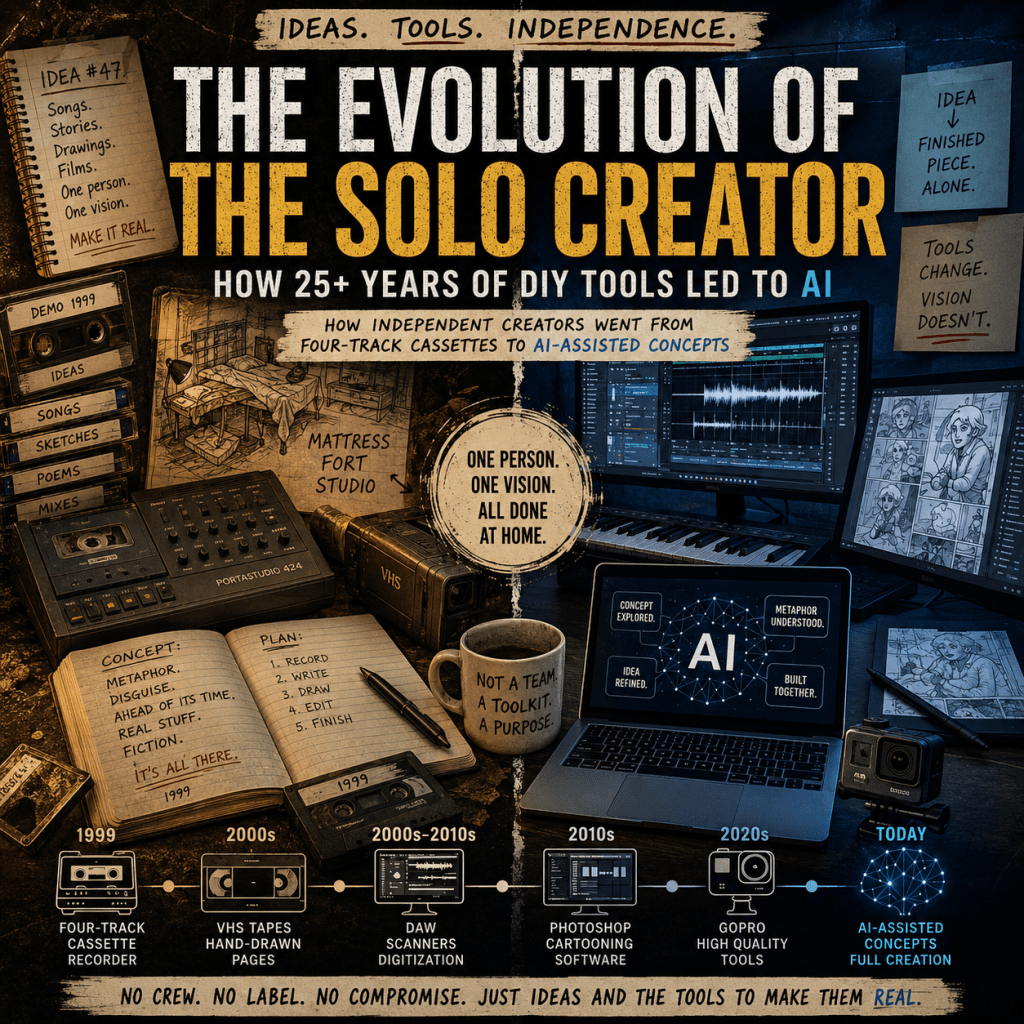
The Evolution of the Solo Creator: How 25 Years of DIY Tools Led to AI
How independent creators went from four-track cassettes to AI-assisted concepts — and how to build a one-person studio at any stage of that timeline
Long before “solo creator” was a category with a name, there were people making full bodies of work — music, art, film, writing — entirely on their own, out of bedrooms and closets and whatever space they had. No studio, no label, no promoter, no crew. Just a person and a project. AI is the newest tool in that lineage, not a break from it, and one creator’s 25-year archive shows how the pattern actually plays out in practice.
Case Study: A 25-Year Solo Archive
One creator, active since 1999, has built an archive spanning writing, music, drawing, and film without ever assembling a team. Collaboration wasn’t off the table entirely — a handful of projects between 1999 and 2007 involved other people — but those partnerships were rare, and the vast majority of the work was made alone, start to finish. This trajectory—from occasional collaboration to an almost entirely solo practice—offers a useful case study for understanding how one independent creator adapted to new tools over twenty-five years.
Step 1: Start with whatever’s on hand
The starting gear is rarely professional. In this case: a four-track cassette recorder, hand-drawn pages, a VHS camcorder. The home setup that results — a bedroom, a closet, a corner of a house, soundproofed with whatever’s available — has an informal name among creators who’ve built one: a “mattress fort studio,” standing in for a real studio because a real studio was never the goal.
How to apply it: Don’t wait for professional equipment to start. The first tools only need to do one job — get the idea out of your head and into a fixed form.
Step 2: Digitize as you go
Analog work is fragile and hard to build on. Getting it digital is what makes an archive usable later. In this case, that meant plugins that pulled video off VHS tape, a plugin that converted cassette audio into digital files, and a flatbed scanner that turned handwritten pages into PDFs.
How to apply it: Whatever your original medium, find the cheapest tool that converts it to digital and use it consistently. This is also what creates a paper trail — dated files that later prove the work predates any tool someone might assume did the creating for you.
Step 3: Upgrade tool by tool, not all at once
The equipment in this archive didn’t jump straight to professional-grade. It moved in increments: the four-track became a DAW, hand-drawn pages became Photoshop and cartooning software, pirated software became purchased software, the camcorder became a GoPro. Each swap solved one specific limitation without changing the underlying method — one person, working alone, closing the gap between concept and finished piece.
How to apply it: Upgrade toward your actual bottleneck, not toward what looks professional. A better microphone doesn’t help if your bottleneck is mixing.
The tools changed over twenty-five years, but so did the creator. Early projects taught recording. Later ones taught editing, storytelling, illustration, and production. Every finished project became practice for the next one. By the time AI arrived as another tool, it wasn’t replacing years of experience—it was building on them.
Step 4: Recognize where solo work hits a wall
Even with better tools, certain gaps have traditionally required another person — scoring music, animating a still image, mixing to a professional standard. For creators whose concepts are metaphorical, ahead of their time, or built from personal material reworked into fiction, that gap is harder to close than it sounds. The issue usually isn’t an inability to work with others; it’s that a highly metaphorical or personal concept tends to change shape once it’s been explained to and filtered through a group, losing the exact hidden meaning or disguise that made it work.
How to apply it: Know which of your gaps are technical (can be solved by a tool) versus conceptual (require someone else to fully “get it” first). AI has significantly reduced many technical barriers and, for some creators, also makes it easier to explore or refine complex concepts without the friction of explaining them repeatedly.
Step 5: Use AI to fine-tune the concept, not replace it
This is the newest step in the timeline, and where this pattern is showing up across long-time solo creators broadly: AI as a tool for refining a concept that’s already formed, rather than generating one from scratch. Creators in this position report that AI can often produce a useful, close interpretation of an idea after a single explanation — sharpening or extending a concept without the back-and-forth a human collaborator typically needs before contributing. That has let older, previously shelved concepts get built out fully for the first time, and lets new ideas move from pitch to working piece within a single session.
How to apply it: Bring AI a fully-formed concept, not a vague one — it works best as a fine-tuning tool on an idea you already understand, not a substitute for having the idea.
The receipts
For creators who’ve been at this for decades, one advantage AI-era skepticism can’t erase is a paper trail that predates it. In this case, that means dated notebooks, cassettes, tapes, and digital files documenting work made years before AI tools became widely available. Because the archive spans decades, it documents not just finished work but the evolution of the ideas themselves over time — evidence that the underlying talent came first, and the tools, AI included, arrived later.
The backlog effect
There’s a side effect to sitting on 25+ years of material that isn’t always obvious from the outside: when a solo creator with a deep archive starts releasing regularly, it can look like a sudden burst of output — like the work is being produced faster than it actually is. In reality, a lot of what’s coming out was gathered over years, sometimes decades, and is only now getting released back to back to back because it finally has the tools to be finished. A concept from 1999, rebuilt with modern software, can look brand new to an audience seeing it for the first time — even though the idea itself has been sitting in a notebook or on a cassette for 25 years.
How to apply it: If your archive goes back years, don’t assume a steady release schedule means steady, recent production. It might just mean the backlog finally has a way out.
The bigger picture
Every tool in this timeline, from a four-track cassette recorder to AI, did the same job: remove one specific barrier between a solo creator and a finished piece, without requiring a team. As the creator behind this particular archive puts it: “AI didn’t make me creative. It didn’t give me my ideas. Those were already there, scattered across notebooks, cassettes, hard drives (personally I have created 2TB’s from 1999-2026), VHS tapes, and years of unfinished projects. What AI gave me was a way to carry those ideas farther without asking someone else to see the picture exactly the way I did.”
Seen that way, AI isn’t the beginning of the solo creator’s story. For a growing number of independent creators with archives like this one, it’s just the latest chapter in one that’s been running for 25 years.


Leave a Reply