
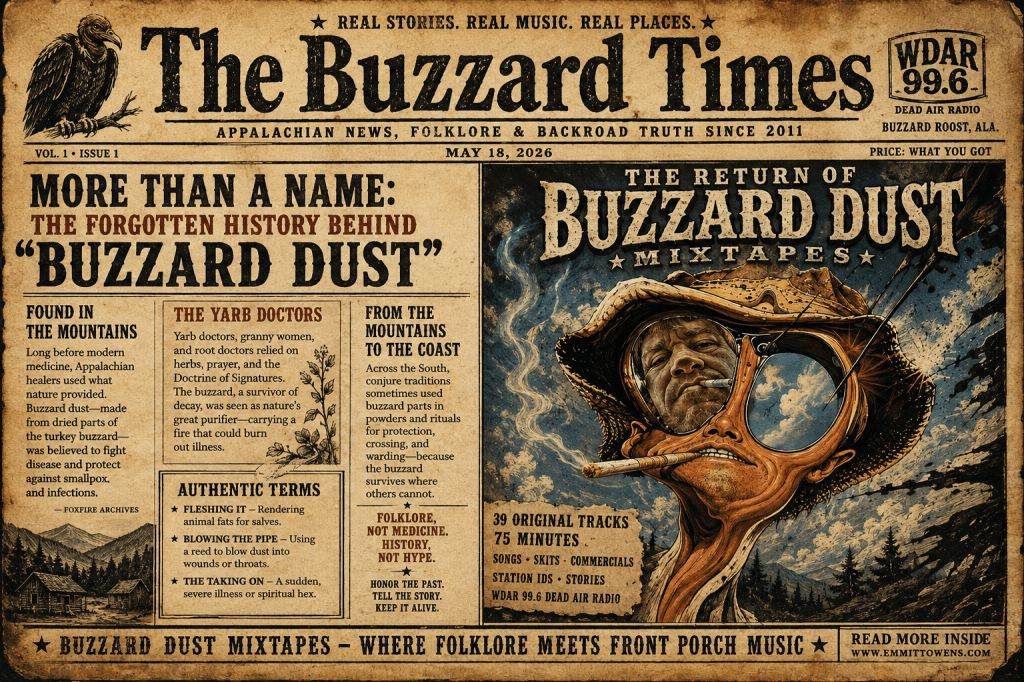
The Buzzard Times
More Than a Name: The Forgotten History Behind “Buzzard Dust”
By Staff Reporter
BUZZARD ROOST, Ala. — To many people, the phrase “Buzzard Dust” sounds like something made up for a band name.
According to Appalachian folklore, it wasn’t.
Long before it became the title of an independent music project, buzzard dust appeared in regional folk traditions as a name associated with old mountain remedies, superstition, and the resourcefulness of rural healers. While many of these practices have long since disappeared—and should be understood today as folklore rather than modern medicine—they remain an important part of Appalachian cultural history.
For Buzzard Dust Mixtapes, the name was chosen for the shock value and because it carries the weight of a forgotten story.
Found in the Mountains
One of the best-known collections of Appalachian traditions, The Foxfire Book series, preserves hundreds of interviews with mountain residents describing everyday life before modern conveniences. Among stories of blacksmiths, moonshiners, basket makers, and herbal healers are references to unusual folk remedies involving local wildlife.
The turkey buzzard—often misunderstood—held a unique place in mountain folklore.
Because the bird could consume decaying animals without appearing to become sick itself, many believed it possessed an extraordinary resistance to disease. Some healers viewed that ability as symbolic, believing the buzzard carried a kind of natural protection that could be transferred through traditional remedies.
Historical accounts describe dried portions of the bird being ground into a fine powder or ash, sometimes referred to as “buzzard dust.” In folklore, these powders were said to be used in attempts to treat wounds or ward off illnesses such as smallpox.
Today, historians view these practices as examples of traditional folk medicine and cultural belief—not treatments supported by modern medical science.
The Yarb Doctors
Long before pharmacies reached isolated mountain communities, people often relied on local healers known as yarb doctors, granny women, or root doctors.
These practitioners combined knowledge of medicinal plants with inherited traditions involving animals, minerals, prayer, and symbolism.
To them, every creature carried meaning.
The buzzard represented endurance.
It survived where other animals could not.
Rather than seeing the bird as something unclean, many mountain healers regarded it as nature’s great purifier—a creature capable of consuming death while continuing to live.
Whether viewed through faith, folklore, or symbolism, that resilience became part of the bird’s reputation.
From the Mountains to the Coast
The idea of protective powders wasn’t limited to Appalachia.
Across parts of the American South, especially within Hoodoo and Gullah traditions, practitioners developed their own ceremonial powders used for protection, blessing, or spiritual work. While goofer dust is the best-known historical example, regional folklore occasionally mentions formulas involving buzzard or vulture symbolism because of the bird’s association with endurance and surviving decay.
These traditions developed independently across different communities, but they shared a common belief: nature itself possessed symbolic power.
A Name Reborn
When musician and writer Emmitt Owens encountered the phrase “buzzard dust” while reading The Foxfire Series, it immediately stood out.
“It sounded like it belonged to the mountains,” Owens has said in previous interviews. “It was strange, unforgettable, and deeply Appalachian.”
That discovery eventually inspired the creation of Buzzard Dust Mixtapes, first launched in 2011 and later reimagined as an Appalachian folk and storytelling project.
Today, the name no longer refers to an old remedy.
Instead, it represents a fictional universe of music, newspaper stories, original characters, and the broadcasts of WDAR 99.6 Dead Air Radio—all celebrating the traditions, humor, and folklore of rural America.
Keeping the Stories Alive
No one is suggesting that centuries-old folk remedies replace modern medicine.
Their value today lies elsewhere.
They remind us how earlier generations explained the unknown, cared for their neighbors with the knowledge they had, and built traditions that became part of Appalachian identity.
Sometimes the most interesting part of history isn’t whether a remedy worked.
It’s that someone believed it might.
And sometimes a forgotten phrase from an old mountain remedy book finds new life—not in a medicine cabinet—but in a song, a story, and a place called Buzzard Dust Mixtapes.
Real Stories. Real Music. Real Places. Real Buzzard Dust.
The Remedy That Still Works
While “buzzard dust” belonged to the world of old Appalachian folk remedies, another form of healing has quietly endured through every generation—music.
Long before scientists began studying music’s effects on the human mind, mountain families already understood something important. When times were hard, people gathered. They sang on front porches after supper, in little white country churches on Sunday mornings, around wood stoves during winter, and beneath shade trees after long days in the fields.
Music wasn’t simply entertainment.
It was comfort.
It was community.
It was medicine for the soul.
A fiddle tune could lift tired spirits. A gospel hymn could carry someone through grief. A simple bluegrass harmony could remind people they belonged to something larger than themselves.
For many people, those songs still carry that same power today.
Bluegrass and Appalachian folk music have a way of awakening memories—even memories we’ve never personally lived. They feel familiar, almost inherited. Many listeners describe them as sounding like home, even if they’ve never set foot in the mountains.
Perhaps that’s because the music carries generations within it.
It echoes family reunions, church dinners, old radios humming in country kitchens, grandparents singing while shelling beans, and neighbors gathering without needing an invitation.
There’s a nostalgia in those sounds that isn’t manufactured.
It feels ancestral.
It feels rooted.
It feels like belonging.
It feels like … home.
Modern research has shown that music can reduce stress, ease anxiety, strengthen social bonds, and help people process emotion. What mountain communities understood through experience is now being explored through science.
Music doesn’t replace medicine.
But it can help heal hearts, calm troubled minds, preserve memories, and remind us that we are not alone.
That realization became the foundation for the modern Buzzard Dust Mixtapes.
After the original releases concluded in 2013, the project slowly transformed. Rather than continuing in hip-hop, it found its true voice in Appalachian folk, bluegrass, gospel, Americana, storytelling, and old-time radio. The goal wasn’t simply to change genres—it was to create music that felt like coming home.
The old folklore surrounding buzzard dust spoke of remedies believed to protect the body.
Today’s Buzzard Dust Mixtapes seeks a different kind of remedy.
Not powders.
Not potions.
But songs that slow us down.
Stories that remind us where we came from.
Laughter shared through fictional radio broadcasts.
And melodies that reconnect us with family, faith, neighbors, and the places that shaped us.
If the old mountain healers searched the forests for remedies, perhaps one of the greatest remedies was there all along—
A banjo.
A fiddle.
A front porch.
And a song worth passing down.
Real Stories. Real Music. Real Places. Real Buzzard Dust.


Leave a comment