
Buzzard Dust Mixtapes
Buzzard Dust Mixtapes: I’m Building an Empire I Keep Telling You Isn’t Real
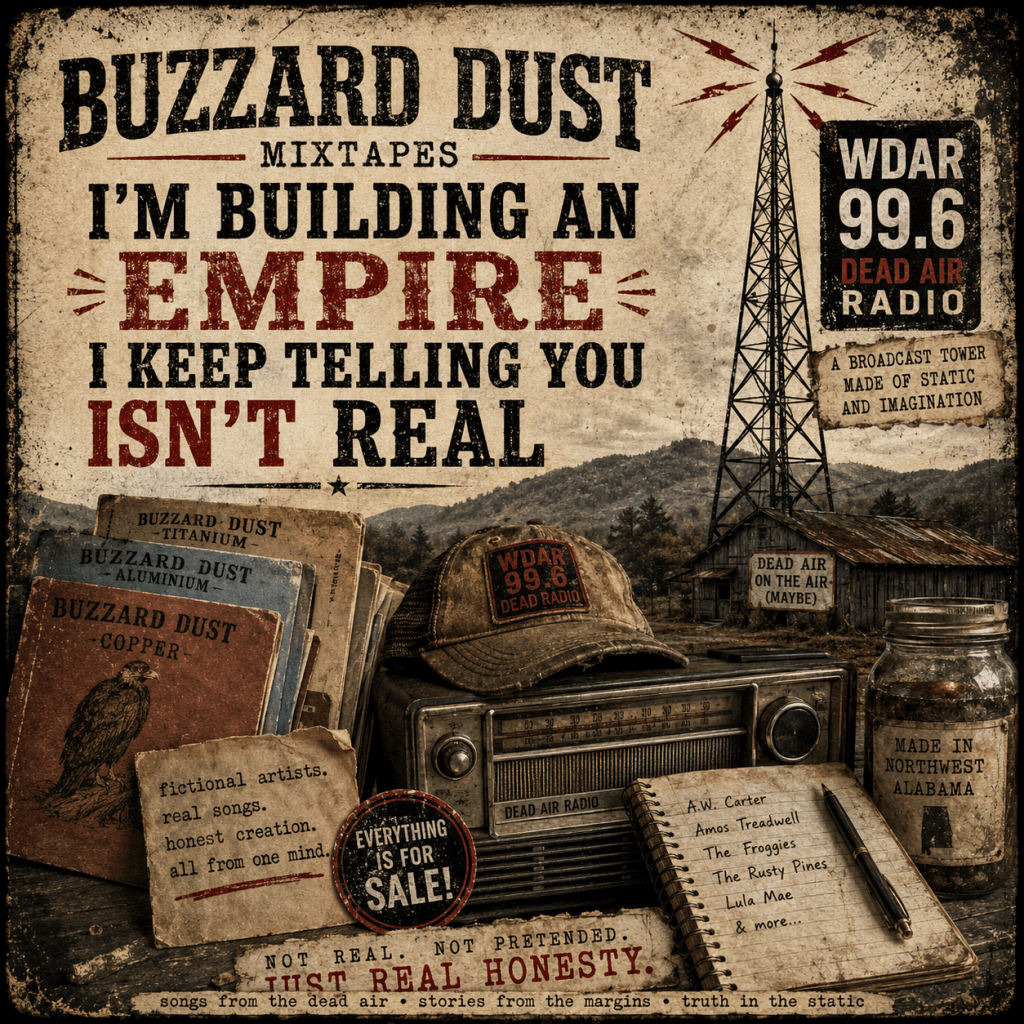
The independent music circuit is full of self-proclaimed “moguls” buying plastic trophies and inflating their stream counts to project an illusion of global stardom. I’ve decided to do the opposite. I’m building a sprawling musical empire out here in Northwest Alabama, and I’m openly telling you that none of it is real.
Through my multimedia project, Buzzard Dust Mixtapes, I’ve quietly put together what I think is one of the more intellectually honest things I’ve made. Instead of manufacturing a fake reality to look famous, I manufacture entire fake universes. That’s the whole trick, and I’m showing you the trick while I do it.
The Architecture of an Honest Illusion
Working in the visual aesthetic of scratchy, field-recorded bluegrass and Appalachian folk, I write, produce, and design multi-album concepts with names like Buzzard Dust: Copper, Aluminum, and Titanium.
The twist is that the artists listed on the tracks don’t exist. The tongue-in-cheek country comedy of “Tweaker Energy” is credited to a fictional character named A.W. Carter—a character you can actually find when you Google the name. The swamp-born bluegrass video for “Ice Cold Beer” is performed by “The Froggies,” a completely imaginary band I dreamed up. All of it is framed as rolling out over the airwaves of WDAR 99.6, “Dead Air Radio,” a broadcast tower made purely of static and imagination.
Every song, lyric, concept, fictional artist, character, advertisement, and radio segment originates from my own writing and creative direction. The fictional artists are characters—not people I’m pretending are real musicians.
By laying all my cards on the table, I get to do something I think is increasingly rare in independent music: be completely transparent about what I’m creating.
A Mirror to the “Google Famous” Culture
I recently put this idea into a song called “Google Famous,” performed by the fictional Amos Treadwell. I wanted it to be a tongue-in-cheek look at a self-made celebrity — buying your own trophies, searching your own name, mistaking echoes for applause, convincing yourself the whole world’s watching. I know that feeling because I used to live inside it.
In a landscape where artists frequently claim major labels are calling just to mask a lack of listeners, fictionalizing the whole thing openly feels like a breath of fresh air. I’m not hiding behind an invisible distribution deal that doesn’t exist. I’m inviting you into a carefully crafted, beautifully designed theater, and telling you up front that it’s a theater.
Why the Fiction Feels So Real
What makes Buzzard Dust Mixtapes work isn’t just the joke — it’s the execution. I put real effort into the vintage single art, into replicating the crackle of old field recordings, into writing songs that actually hold together as Appalachian storytelling. I’m not cutting corners on the music and hiding it behind marketing. The music is real. The honesty is real. Only the wrappers are fictional.
I think the most credible thing an artist can do right now is stop selling shadows as sunshine. By fully embracing the “dead air,” I’ve ended up, ironically, on the most honest frequency I’ve ever broadcasted on.
From a $5 Microphone to the Mattress Fort
Before there was Buzzard Dust Mixtapes, before there was WDAR 99.6 Dead Air Radio, and long before fictional Appalachian musicians started appearing on imaginary radio stations, there was a kid with a $5 microphone, a Windows 98 computer, and a copy of FruityLoops Studio.
It was 1999, and versions 2 and 3 of FruityLoops were enough to get the imagination moving. The recording studio wasn’t a studio at all—it was a bedroom or a dining room or a walk-in closet, and eventually it became something far more sophisticated, or at least it sounded sophisticated when I named it: Plizaya Productions.
The name came from my rap persona at the time, Plizaya Playa. I also released material under another name, Moth Oz. And yes, there was a blanket fort. The blankets weren’t acoustic treatment, the mattress wasn’t studio equipment, and there wasn’t a mixing engineer sitting behind a massive console. There was just a kid trying to figure out how to make a microphone, a computer, and a bunch of software do something that sounded like music. That was my studio — Plizaya Productions, the Mattress Fort — and I loved it.
I Wanted to Be Famous
There’s another part of that story that deserves honesty. Back then, I wanted people to think I was a much bigger deal than I actually was. I was the kid hyping himself up, exaggerating things, making my little operation sound bigger than it was, talking like I was on the verge of becoming famous. I wanted the attention. I wanted people to believe there was something enormous happening behind that bedroom door.
Looking back now, it’s almost hilarious. But it was also incredibly normal for the underground music world. When you’re an independent artist with no label, no marketing department, no publicist, and no industry machine behind you, you become the marketing department. And when you’re young and hungry for recognition, it’s easy to start confusing promotion with reality. A few people listening can become “thousands of fans.” A homemade recording can become a “professional release.” A bedroom studio can become a “production company.” A local following can suddenly sound international.
I know because I did it. For roughly fourteen years, from 1999 through 2013, I lived in that world. I wrote, recorded, experimented, promoted, exaggerated, and dreamed. And eventually, I grew out of it.
Then I Stopped Releasing
After 2013, something unexpected happened: I didn’t stop writing, I stopped releasing. And that turned out to be one of the most productive periods of my creative life.
Years passed, and instead of constantly trying to prove that I was an artist, I simply became a writer. If you want to call what happened next a writing spree, I won’t argue. I wrote constantly. Ideas accumulated. Songs became poems, poems became stories, stories became characters, and characters became worlds. I was creating without worrying about whether anybody was watching, which turned out to be a completely different relationship with creativity. The need to be famous slowly gave way to something much more useful: the need to create.
One Last Trip Back to the Mattress Fort
In 2020, I made a brief return to rap. For a little while, it felt familiar. Then I realized I wasn’t that kid anymore. The mattress fort had served its purpose, the $5 microphone had served its purpose, and the dream of becoming famous through a bedroom recording had served its purpose. It was time to move on.
So I went back to writing. And because apparently I can’t leave anything alone, I eventually found myself doing things like generating Cokehead cards for a Tumblr account. 🤣 At the time, that might have seemed like another completely random creative detour. Looking back, it was actually part of the same evolution. I wasn’t trying to convince anybody I was famous anymore — I was simply building things because building things was fun.
A Hobby, But Everything’s For Sale
I still call this a hobby. I’ve got a real job — I work at a sawmill — and this is what I do when that’s done for the day. But calling it a hobby doesn’t mean I’m not willing to sell it. Everything’s for sale. Those two things aren’t in conflict. A hobby can still have a price tag on it. I just hadn’t pretended it was more than what it was in a very long time.
That honesty cost me something, locally. I’ve watched myself get written out of rooms and conversations because I was the guy who said “hobby” out loud while everybody else in the room was calling themselves a pro. I’ve watched local acts refer to themselves as worldwide when the truth was a lot smaller than that. And I get it — nobody wants to undersell themselves. But somewhere along the way, “amateur” started meaning “pro,” and “local” started meaning “worldwide,” and the words stopped meaning anything at all.
That’s exactly why artistic integrity matters to me now. Not because I’m trying to prove I’m above it. The opposite, actually. I’m not a pro. I’m not worldwide. I’m a guy that works at a sawmill who writes songs and builds fictional radio stations in his spare time, and I’d rather say that plainly than dress it up.
When I went quiet for those years, I didn’t stop. I just stopped trying to convince anybody I was bigger than I was. I kept doing my thing in the background, without an audience, without a pitch. That’s the version of me I trust the most — the one who wasn’t performing for anybody, including myself.
And honestly, I think about it sometimes. How many actual pros might have reached out, might have invited me into something real, if I hadn’t spent so many years playing my part bigger than it actually was? I’ll never know. That’s the cost of the exaggeration — not just that people eventually see through it, but that it can crowd out the real opportunities that honesty might have brought instead.
So these days I try to keep it simple. I’m not selling you a legend. I’m selling you a sawmill worker’s songs, made honestly, priced fairly, exaggerated by nobody. If that’s smaller than what everybody else is claiming, fine. At least it’s true.
Ohhhh yeah! Remember … Everything is For Sale!
From Plizaya Playa to Buzzard Dust
That’s the strange road that eventually leads to Buzzard Dust Mixtapes. The irony isn’t lost on me: the kid who once tried desperately to convince people that he was somebody eventually became the adult who created an entire musical universe where everybody knows the fictional artists aren’t real.
That’s the difference between the old me and the new project. Plizaya Productions wanted you to believe the illusion. Buzzard Dust Mixtapes invites you to enjoy it. The old music was about becoming somebody; the new music is about creating something.
And maybe that’s what growing up actually looks like. You don’t necessarily stop making things — you just stop needing everybody to believe you’re famous for making them. You build the world anyway.
And if somebody wants to come listen? Well… WDAR 99.6 is still broadcasting. The mattress fort is gone. The imagination isn’t.


Leave a comment