
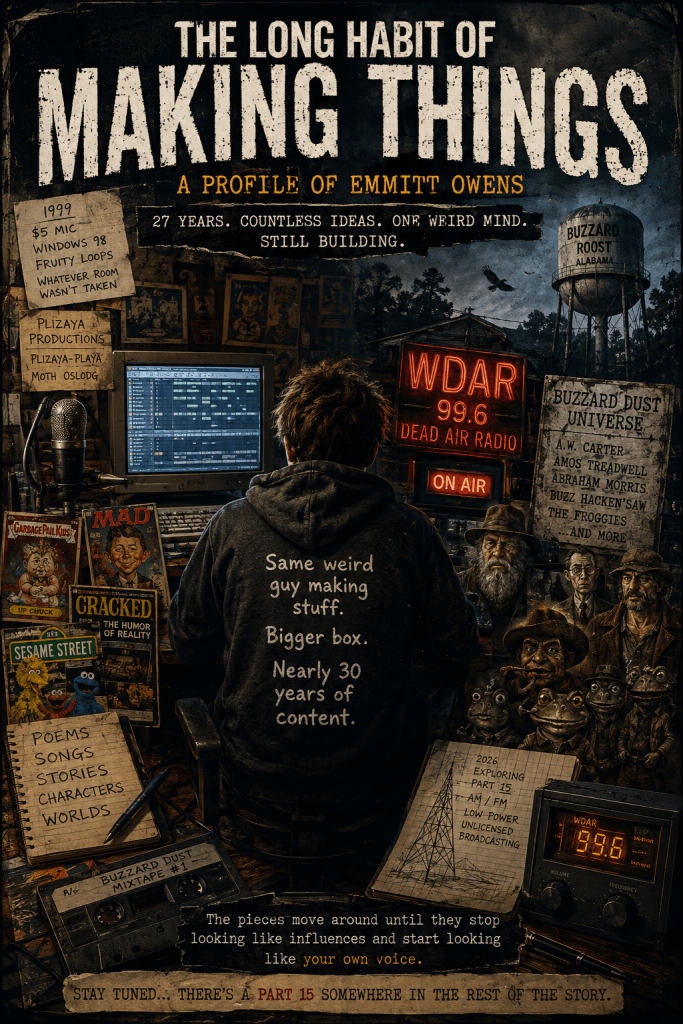
The Long Habit of Making Things: A Profile of Emmitt Owens
In 1999, Emmitt Owens was recording songs on a five-dollar microphone connected to a Windows 98 computer, using FruityLoops to build tracks in whatever room of the house happened to be free. He released the material under a home operation he called Plizaya Productions, using the names Plizaya-Playa and Moth Oslodg.
“Calling what I had a recording studio required a fairly generous definition of the word,” Owens said.
Like many young rappers making music with limited equipment, he promoted the project with considerably more confidence than the setup warranted. That gap between resources and ambition wasn’t unusual for a mattress fort rapper at the time.
On the Comparisons to Eminem and Snoop Dogg
Listeners have long pointed out similarities between Owens’ early cadence and delivery and those of Eminem and Snoop Dogg. Owens attributes the similarities more to the era and its influences than to direct imitation, saying both artists shaped how a generation of young rappers understood what a song could contain — humor, anger, and personality together.
He has faced repeated accusations of copying their style over the years, which he disputes.
“I’m a white kid. We all sound like that,” Owens said. “Have you never heard a white person rap before? Of course, we’re going to sound… white?”
He acknowledges why the assumption gets made but rejects the premise. Sounding similar to an influence, he argues, isn’t the same as deliberately copying one — a distinction he says is difficult to prove from the outside.
“If anybody has actual proof, show me the proof,” he said. “Don’t just stand there with your hands in your pockets acting like you’ve got a federal case and forgot to bring the evidence.”
Owens is willing to poke fun at his own explanation, too, half-joking that some of what people hear as an Eminem influence might actually be him unconsciously imitating Josh — a night shift stocker at Foodland whom he says he spent a lot of time around.
Owens sees the Eminem comparison as an example of a larger misunderstanding about influence. An influence can leave an echo without determining the work that follows. The existence of one successful approach doesn’t make every later creator using elements of that approach an imitator. DC Comics built interconnected fictional universes; that doesn’t mean Sesame Street was trying to be DC Comics. He-Man didn’t own fantasy warriors. Transformers didn’t own transforming robots. Saved by the Bell didn’t own teenagers in a school. Similar ingredients don’t automatically make the same recipe.
“You can hear an echo without hearing the same person,” Owens says.
Formative Influences
Owens says the influences that shaped his work most weren’t musicians. He cites the comedian Andy Kaufman, particularly his willingness to leave a joke’s ending ambiguous, and Richard Pryor’s improvisational speed. He also names Garbage Pail Kids, CRACKED and MAD Magazine, comic books and Sesame Street as early influences, describing them as teaching him to take an ordinary premise and build an exaggerated world around it rather than a single joke.
He says he did not consciously study these influences at the time; he describes recognizing them in his own work only later.
1999–2013: A Period of High Output
Between 1999 and 2013, Owens wrote, recorded, and promoted music consistently. He released significantly more material than others working with or around him, in part because he had continuous access to recording equipment while some peers did not.
“I started feeling bad because I was releasing so much more material than the other artists around me,” Owens said. “Looking back, I shouldn’t have felt bad about it. I wasn’t trying to outwork anybody. I just had a brain that wanted to keep making things, and for once the technology let me keep up with it.”
After 2013, his output shifted away from music toward writing. He describes this less as a deliberate career change and more as a continuation of the same habit in a different form — poems turning into songs, songs into stories, stories into recurring characters.
By 2020, when he briefly returned to recording rap music under the name Hey, Cokehead!, he says he found the material felt disconnected from where his creative interests had moved. He recorded 26 songs during that period, but ultimately released only a very small handful through DistroKid.
“They said I was echoing Eminem again,” Owens said. “So I did the next best thing—I stopped sharing.”
He chuckled. “Problem solved.”
Buzzard Dust, 2025
In 2025, Owens discovered AI-assisted music tools that allowed him to create songs using voices that weren’t his own, while still writing the words himself. After years of hearing comparisons to Eminem, the approach gave him a way to experiment with different voices without having to perform them himself.
That same year, he released several stories centered around Buzzard Roost, Alabama. The idea was there, but the larger fictional universe wasn’t fully formed yet. By 2026, after meeting his wife, the pieces began coming together—music, characters, stories, humor and the fictional world surrounding them.
The emerging Buzzard Dust project began to introduce a cast of fictional figures, including A.W. Carter, Amos Treadwell, Abraham Morris, Buzz Hacken’Saw, and a group called The Froggies. Owens describes these as an intentional way of expressing ideas through invented voices rather than his own—or, as he might put it, Eminem’s echo.
WDAR and a Fictional Universe
A recurring element across Owens’ work is WDAR 99.6 Dead Air Radio, a fictional station he introduced in 2011 as part of the original Buzzard Dust project. It later appeared in four other projects—Mad Mechanics, The Hawks Nest, ZZZeke, and Chill n’ Fill—before being rebuilt as the broadcast setting for the 2025 version of Buzzard Dust Mixtapes.
In 2026, Owens said he began looking into the requirements for operating a real, low-power Part 15 station—a legal category of small-scale, unlicensed broadcasting—as a way of extending the fictional station into an actual signal. The idea remains in its early stages, with Owens exploring both AM and FM possibilities.
On Influence and Originality
Owens draws a distinction between imitating an influence and absorbing one over time. He points to his tribute references in Chill n’ Fill and Mad Mechanics as more direct nods to the artists and media that shaped him, distinguishing those from the more diffuse influence he says shows up unintentionally elsewhere in his work.
“The pieces move around until they stop looking like influences and start looking like your own voice,” he said.
The Tool Argument
One of the stranger encounters in Owens’ creative history came through a rapper from Tuscaloosa who introduced himself, somewhat confidently, as the best rapper in Alabama.
The two crossed paths after the rapper saw a music video Owens had made for a friend. The video was only a small fraction of what Owens describes as a larger Rockstar Games-inspired visual, but it was different enough to get his attention. He called Owens to ask how he had made it.
Owens explained that he had used Vegas Pro along with a plug-in.
That was apparently the wrong answer.
According to Owens, the rapper’s interest changed almost immediately when he learned a plug-in had been involved. What had apparently looked like creative technique a moment earlier now looked, in his eyes, like cheating.
Owens found the reaction absurd.
The irony wasn’t lost on him: the same argument could be applied to almost any modern creative process. Owens had used a tool to create a visual effect; musicians use plug-ins to shape recordings, process vocals, alter instruments, and build sounds that would otherwise require equipment, rooms, or techniques that aren’t available to them.
The tool doesn’t make the idea.
A plug-in doesn’t decide what the video should look like. Software doesn’t decide what the song should say. Technology doesn’t remove creativity simply because it makes something possible that would have been difficult—or impossible—to accomplish without it.
For Owens, the encounter became another example of something he’d seen repeatedly throughout his creative life: people using tools themselves while treating someone else’s use of different tools as somehow illegitimate.
He laughs at the contradiction.
“The weirdest part is using tools to make your own art and then calling somebody else a cheater because they used a different tool.”
The irony extends beyond the argument itself. Owens says the rapper had a conventional home recording setup, yet seemed to regard a video plug-in as somehow crossing a line. Meanwhile, Owens was interested in doing something visually unusual rather than simply reproducing another standard rap video.
For him, that distinction matters more than the technology.
The question isn’t whether you used a tool. It’s what you did with it.
Where the Work Lives
Owens’ catalog is spread across a number of project names rather than consolidated under one, a pattern common to independent artists who release consistently over long stretches of time. Music and beats appear on Bandcamp, SoundCloud, and Internet Archive under Plizaya Productions, Hey Cokehead, NdubN-Glitch, Cap’n Koty, and many others, based out of North Alabama. Fiction and personal writing are published separately on a WordPress blog under his own name. Owens says additional material, including the current Buzzard Dust Mixtapes project, is also distributed on YouTube and Instagram, with future releases planned for distribution through DistroKid.
Why He Keeps Making Things
Owens does not describe his creative work as a career, but he doesn’t consider it a hobby either. The distinction matters to him. Creating has become a place to put his thoughts — a way to work through ideas, observations, frustrations, humor, and whatever else happens to occupy his mind.
He describes the process almost like having a conversation with himself. Sometimes the result is a song. Sometimes it’s a character, a story, an advertisement, or an entire fictional world. The format changes; the underlying impulse doesn’t.
That may explain why the work continued even when there was no obvious career benefit to continuing. The point was never simply to release something. The point was to make something.
Assessment
Over 27 years, Owens’ creative output has moved from music to writing to an interconnected set of fictional characters and settings, most recently converging on a real-world broadcasting plan. What ties it together isn’t genre or format, but a habit of turning ideas into finished things, sustained independent of commercial success or public recognition.
And 27 years later, the weirdest thing is that the kid with the $5 microphone is still doing exactly what he was doing in 1999—he just has a much bigger box to put the ideas in now.
“I’m still the same weird guy making stuff. I just have a bigger box and nearly 30 years of content.”
For now, the fictional station remains fictional. But Owens has never been particularly good at leaving an idea where he found it.
Stay tuned… There’s a Part 15 somewhere in the rest of the story.
“Wait, what? … Part 15?”


Leave a comment