
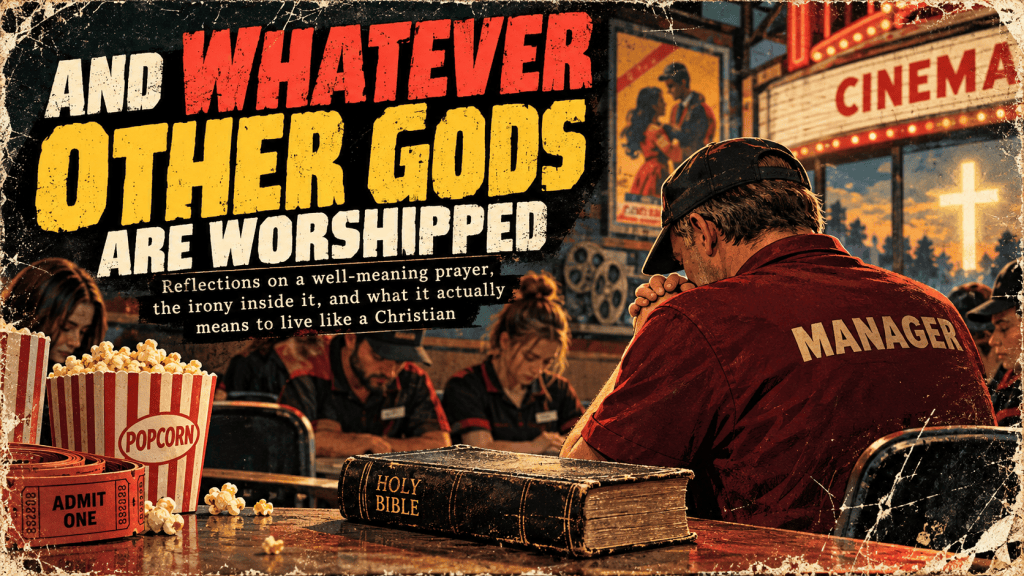
And Whatever Other Gods Are Worshipped
Reflections on a well-meaning prayer, the irony inside it, and what it actually means to live like a Christian
A Prayer Before the Meeting
There is a sentence I hear from time to time that never fails to make me smile.
It usually comes at the start of a staff meeting at the movie theater where I work. The manager gathers everyone together, and before we turn to schedules, staffing, upcoming releases, or concessions, someone offers a prayer. It is almost always a sincere one.
Then comes the closing phrase:
“God, Jesus, and whatever other gods are worshipped…”
I understand why it is said. It is not meant as an insult; quite the opposite. It is an honest attempt at respect from someone who does not know what everyone in the room believes and does not want to assume. There is something genuinely admirable in that instinct.
But there is also something quietly funny about it.
The Irony of a Catch-All Prayer
If we are praying a Christian prayer, addressing God and His Son by name, why are we suddenly leaving the door open to other gods? From a Christian perspective, prayer is not a religious group project where we cover every possible deity just in case someone in the room believes differently.
Scripture is remarkably specific on this point. The very first commandment leaves no room for a footnote:
“Thou shalt have no other gods before me.” (Exodus 20:3)
The prophets repeat it plainly:
“I am the LORD, and there is none else, there is no God beside me.” (Isaiah 45:5)
Jesus Himself spoke to the problem of divided loyalty:
“No man can serve two masters: for either he will hate the one, and love the other; or else he will hold to the one, and despise the other.” (Matthew 6:24)
And Paul draws the line clearly. He acknowledges that the world is full of so-called gods, then states what Christians actually confess:
“For though there be that are called gods, whether in heaven or in earth, (as there be gods many, and lords many,) But to us there is but one God, the Father, of whom are all things, and we in him; and one Lord Jesus Christ, by whom are all things, and we by him.” (1 Corinthians 8:5–6)
So a Christian prayer that ends with “and whatever other gods are worshipped” creates a small but striking contradiction. In effect, it says: We are going to pray to the one true God, but let’s make sure everybody else’s deity is copied on the email, too.
The irony runs even deeper. The prayer is offered in the name of a God who described Himself as jealous (Exodus 20:5), a God who once watched His prophet stand on Mount Carmel and ask the people a pointed question:
“How long halt ye between two opinions? if the LORD be God, follow him: but if Baal, then follow him.” (1 Kings 18:21)
Elijah was not interested in a prayer that hedged its bets. Neither, it seems, is the God of the Bible.
I do not say any of this to ridicule the person praying. The motive is considerate: a desire to be inclusive in a workplace where no one wants to presume. It is simply theologically strange. And perhaps that is exactly what makes it worth thinking about.
An Altar to the Unknown God
This instinct is not new. Two thousand years ago, the city of Athens did something remarkably similar.
When Paul walked through Athens, he found a city crowded with altars and idols. Among them was one with a curious inscription. Having honored every god they could name, the Athenians built one more altar, just in case they had missed someone:
“For as I passed by, and beheld your devotions, I found an altar with this inscription, TO THE UNKNOWN GOD.” (Acts 17:23)
That altar was ancient Greece’s version of “and whatever other gods are worshipped.”
What strikes me most is how Paul responded. He did not mock them or lecture them on their foolishness. He acknowledged their sincerity, calling them “very religious” in many translations, and then used their own altar as an open door:
“Whom therefore ye ignorantly worship, him declare I unto you.” (Acts 17:23)
Paul met people where they were, with respect, and pointed them toward the God they were reaching for without knowing His name. That is a far better model than rolling our eyes at a well-meaning prayer.
I’m Not Worshipping “Whatever Other Gods”
If anyone in that room were curious about what I believe, they would not need to wonder about the “other gods” part.
I am a member of the Church of Christ. I believe in God. I believe in Jesus Christ. Like Joshua, I have settled the question for myself:
“Choose you this day whom ye will serve… but as for me and my house, we will serve the LORD.” (Joshua 24:15)
And I believe the teachings of Jesus are meant to shape how I treat other people, not merely what I say I believe on Sunday.
That distinction matters. Christianity is not a label. It is not a jersey we wear so others know which team we are on. It is supposed to change us:
“Therefore if any man be in Christ, he is a new creature: old things are passed away; behold, all things are become new.” (2 Corinthians 5:17)
Where Faith Becomes Real
The truest test of faith is rarely what happens when we are surrounded by people who agree with us. It is what happens when we are surrounded by people who do not.
It is easy to be kind to someone who is kind to you. Jesus addressed this directly:
“For if ye love them which love you, what thank have ye? for sinners also love those that love them.” (Luke 6:32)
It is an uncomfortable teaching. Loving people who love us is not remarkable. Forgiving someone who never wronged us is not difficult. Showing mercy to someone who has already earned our respect is hardly revolutionary.
The difficult part comes afterward. What do we do with the person who has not earned our mercy? What do we do when someone has treated us badly, or when we are convinced they are wrong? What do we do when we have every opportunity to answer cruelty with more cruelty?
Jesus left no ambiguity:
“But I say unto you, Love your enemies, bless them that curse you, do good to them that hate you, and pray for them which despitefully use you, and persecute you.” (Matthew 5:44)
And Paul echoed it:
“Be not overcome of evil, but overcome evil with good.” (Romans 12:21)
That is where I believe Christianity stops being a label and becomes a life.
Mercy Is Not the Same as Having No Boundaries
I have written before that if you only show mercy to people who deserve it, it is not really mercy. Mercy matters precisely because it is unearned, just as the mercy we have received was unearned:
“And be ye kind one to another, tenderhearted, forgiving one another, even as God for Christ’s sake hath forgiven you.” (Ephesians 4:32)
That does not mean we must become doormats. Forgiveness does not require us to walk back into a harmful situation. Mercy does not mean pretending something never happened. Love does not mean abandoning wisdom; Jesus Himself told His disciples to be “wise as serpents, and harmless as doves” (Matthew 10:16).
You can forgive someone and still set a boundary. You can wish someone well and still walk away. You can refuse to hate someone without inviting them back into your life. Scripture even acknowledges that peace is not always fully in our hands:
“If it be possible, as much as lieth in you, live peaceably with all men.” (Romans 12:18)
These are not contradictions. It is tempting to imagine Christianity as simply being nice. It is not. Sometimes it asks something much harder of us: to refuse to become like the person who hurt us.
Let Your Life Do the Talking
The people around us at work may never ask what we believe. They may not know what church we attend, how we read Scripture, or whether we are Catholic, Protestant, Church of Christ, or something else entirely. That is fine. I have no interest in turning every break-room conversation into a theological dissertation.
But there is something beautiful in the possibility that someone might eventually figure out what you believe simply by watching how you live. Not because you are perfect; I certainly make no such claim. But because your faith gives you something to strive toward. Jesus said this is how the world would recognize His followers:
“By this shall all men know that ye are my disciples, if ye have love one to another.” (John 13:35)
“Let your light so shine before men, that they may see your good works, and glorify your Father which is in heaven.” (Matthew 5:16)
For me, that means taking Christ’s words seriously. It means practicing mercy when mercy is not deserved, understanding that forgiveness and boundaries can coexist, and refusing to add another shovel of dirt to a world already buried under too much hatred. And if someone does ask, it means being ready to answer, as Peter put it, “with meekness and fear” (1 Peter 3:15).
So when the manager at the movie theater prays, “and whatever other gods are worshipped,” I do not take offense. Honestly, I find it a little funny. He does not need to know exactly what I believe.
If someone ever becomes curious enough to ask, the answer is simple: I am a member of the Church of Christ. I believe in God. I believe in Jesus Christ. And I am still learning what it means to truly live like I believe Him.
Perhaps that is a better testimony than correcting someone’s prayer. Sometimes the best way to tell people what you believe is not to interrupt them. It is to let them watch what your beliefs make you become.


Leave a comment