
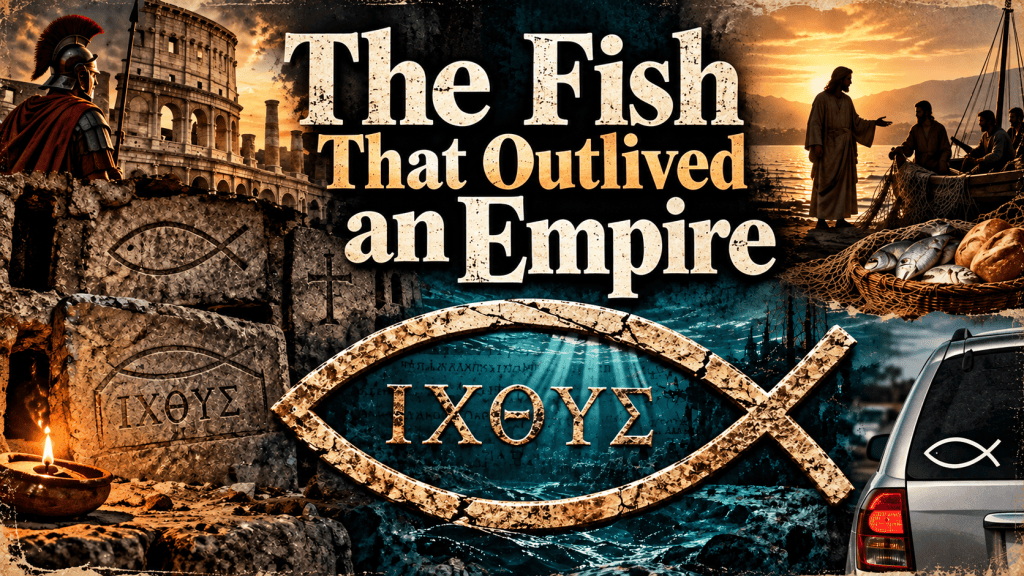
The Fish That Outlived an Empire
Oct 12, 2026 · @Emmitt
You’ve seen it stuck to the bumper of a minivan in a church parking lot: two curved lines crossing at one end, a fish drawn in a single stroke. It looks like something a kid could doodle. But that little fish is one of the oldest Christian symbols in existence, older than the crucifix as a common image of the faith, and it has been carved, painted, worn and argued over for nearly 1,900 years.
Here’s where it came from, what it meant to the people who first drew it, and which parts of its famous origin story are history versus legend.
A creed hidden in a word
The Greek word for fish is ichthys (ΙΧΘΥΣ). Early Christians noticed that its five letters could stand for a five-word statement of faith:
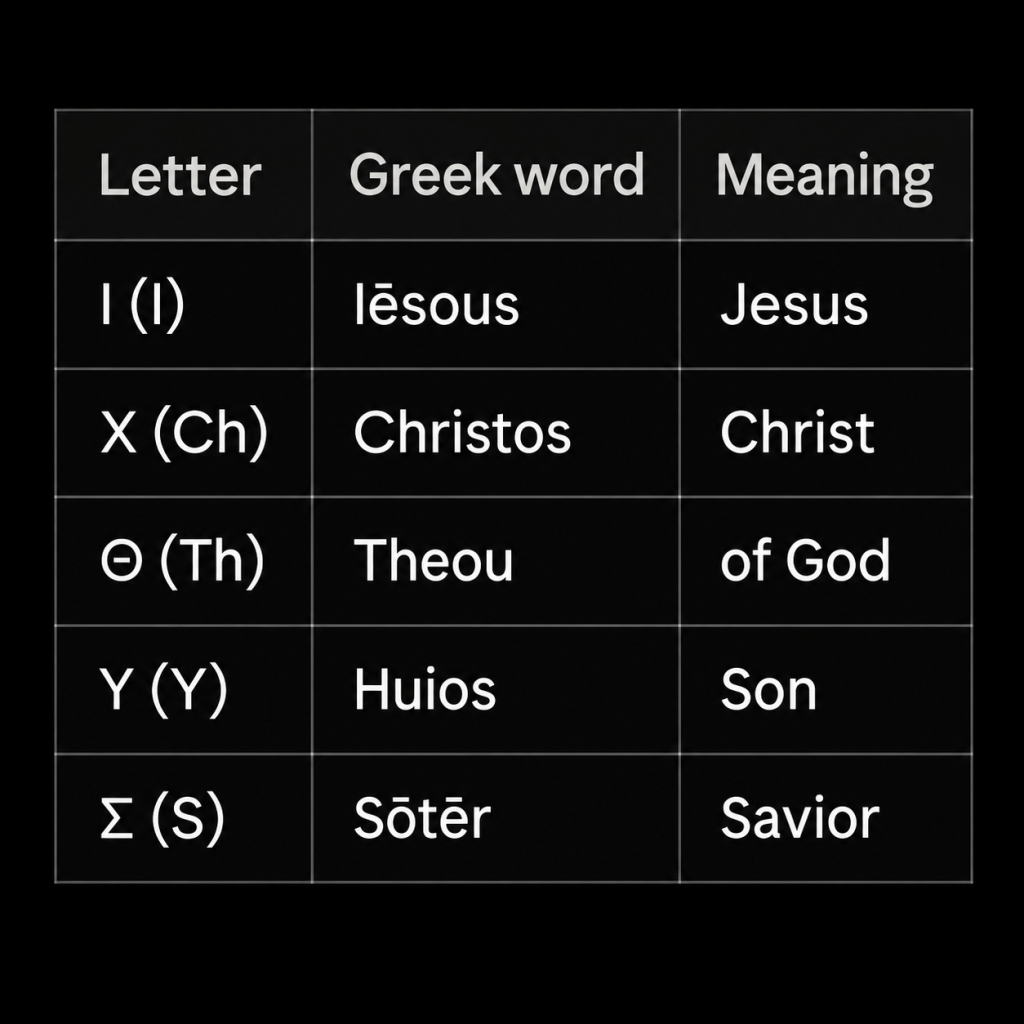
Read together: Jesus Christ, God’s Son, Savior. One ordinary word carried an entire creed (Wikipedia).
By the 4th century, Christians in places like Ephesus were also stacking the five letters on top of each other inside a circle, producing a shape like an eight-spoked wheel. Some scholars think that round version may instead represent a loaf of bread.
The earliest evidence
The fish first shows up in Christian art and writing in the 2nd century. It was popular by the late 2nd century and spread widely through the 3rd and 4th (Wikipedia).
- The catacombs of Rome. Fish appear among the earliest Christian images in underground burial sites such as the Catacomb of Priscilla, the Catacombs of Saint Sebastian, and the catacomb of St. Callistus.
- Clement of Alexandria (late 2nd century) advised believers that a dove or a fish was a fitting image to engrave on their signet rings.
- Tertullian (c. 160–225) wrote that Christians were like little fish, born in the water of baptism after the pattern of Christ, the great Ichthys (Christian History Institute).
- Gravestones. The epitaph of Abercius, a bishop in Asia Minor, and an early-3rd-century Roman tombstone reading “fish of the living” (now in Rome’s National Roman Museum) both use the fish as a sign of faith.
Later, Augustine (354–430) explained why the image suited Jesus: like a fish living unharmed in deep water, Christ lived without sin in the depths of mortal life.
Why a fish?
The acrostic was a bonus. The Gospels were already full of fish:
- Several of Jesus’s first followers were fishermen, and he called them to become “fishers of men” (Mark 1:16–18).
- He fed thousands with five loaves and two fish, a meal early Christians linked to the Eucharist.
- After the resurrection, he ate grilled fish with the disciples (Luke 24) and guided them to a miraculous catch of 153 fish (John 21).
- He compared the final judgment to fishermen sorting a net (Matthew 13).
Baptism sealed the connection. Early Christians were baptized by full immersion, so a new believer literally went under the water and came up again, like a fish (Christianity Today). Ancient sources tie the fish mostly to baptism, communion, and the feeding of the multitude.
The secret sign: history or legend?
The most famous story goes like this. During Roman persecution, a Christian meeting a stranger would draw one curve of the fish in the dirt. If the stranger completed it with the second curve, both knew they were safe. Fish marks supposedly guided believers to hidden meeting places and tombs.
It’s a great story. It’s also probably not true, or at least not provable.
- No ancient source says it. None of the early Christian writers who discuss the fish connect it to persecution or secret recognition. They talk about baptism, the Eucharist and the loaves and fishes instead (Wikipedia).
- The theory is modern. It was argued around 1900 by the scholar Robert Mowat, largely because some early inscriptions use the fish without naming Jesus. That’s an argument from silence, and most historians have since moved away from it.
- Hollywood helped. The dirt-drawing scene was prominently featured in the 1951 film Quo Vadis, which likely did a lot to make the legend popular.
There is one grain of plausibility. Greeks, Romans and other pagans used fish imagery long before Christians did, so a fish drew far less attention than a cross would have (Christianity Today). It could have worked as a low-key sign. We just don’t have evidence that it did.
Before it was Christian
Christians didn’t invent the fish as a sacred image. Fish symbols appear across the ancient world: the zodiac sign Pisces, fish associated with various pagan deities, and Matsya, the fish avatar of Vishnu in Hinduism. Some critics point out that pagans also used the fish to represent fertility and the female body, and argue the symbol still carries that baggage.
Christianity Today’s historians take the opposite view: early believers took a symbol that already carried power and filled it with new meaning, which shows creativity rather than borrowing (Christianity Today).
From catacombs to car bumpers
Once Christianity became legal and then official in the Roman Empire, the cross and the Chi-Rho gradually took center stage, and the fish faded into the background for centuries.
It came roaring back in the 1970s alongside the Jesus Movement. The Ichthus Music Festival in Wilmore, Kentucky, the oldest Christian music festival in the U.S., launched in 1970, and in 1973 believers carried the symbol to the Aquarius Festival in Nimbin, Australia. Soon it was everywhere: decals, pendants, business cards, sometimes with “Jesus” or ΙΧΘΥΣ written inside (Wikipedia).
The car decal turned it into a public statement. Unlike a cross hung inside a car, the fish faces outward for everyone to see.
Then came the parodies. In the early 1980s, Hollywood costume-company owner Chris Gilman came up with the Darwin fish: the same outline with little legs and “Darwin” inside (Daniel Harper, citing the New York Times). Christians answered with the “Truth” fish swallowing the Darwin fish, and the bumper war spawned endless variants, from sushi fish to alien fish (Wikipedia).
A symbol that refused to sink
The fish has outlasted the Roman Empire, centuries of neglect, and a bumper-sticker arms race. Its real history is less cinematic than the dirt-drawing legend, but arguably richer: a single everyday word that held a whole creed, tied to water, bread and new life.
Maybe that’s why it endures. Two curved lines are easy to draw, easy to remember, and hard to erase.
Sources
- Ichthys, Wikipedia
- Variations of the ichthys symbol, Wikipedia
- What is the origin of the Christian fish symbol?, Elesha Coffman, Christianity Today (2008)
- Story Behind, Collin Hansen, Christian History Institute
- Revisiting the Ichthys, Tuomas Rasimus (2011)
- Daniel Harper blog post, summarizing the New York Times (Feb. 11, 2003) on the Darwin fish


Leave a Reply