
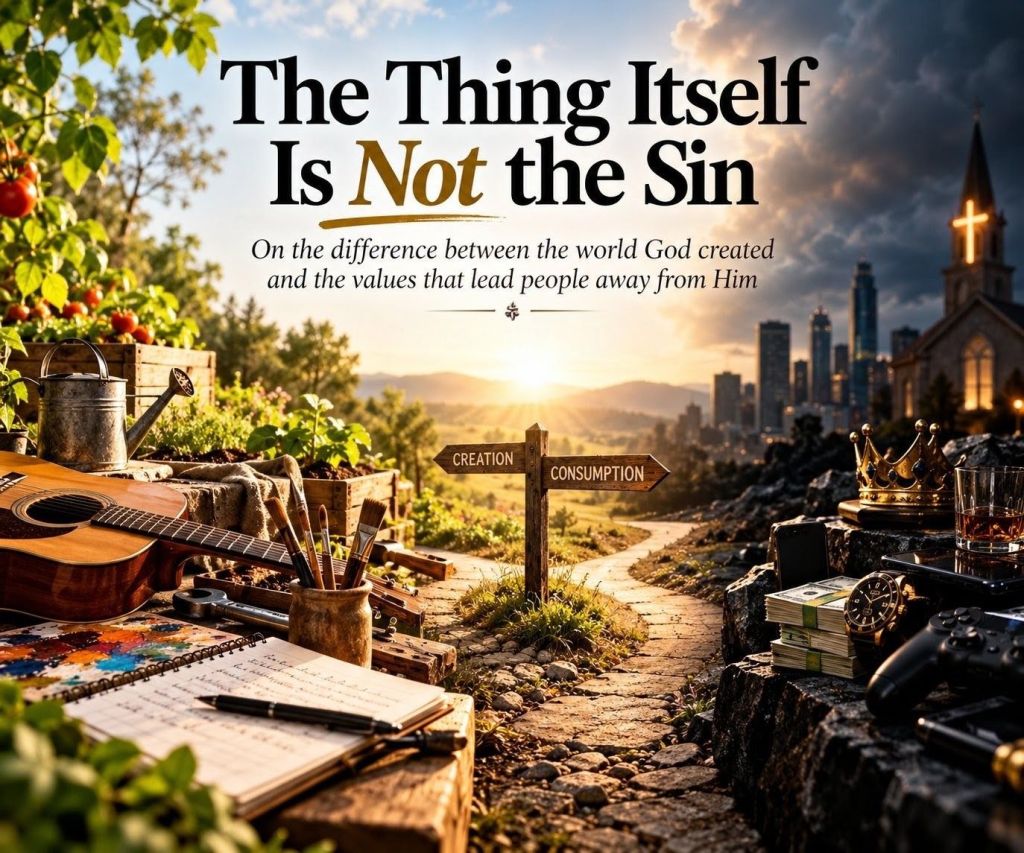
The Thing Itself Is Not the Sin
Oct 16, 2026 · Emmitt Owens
On the difference between the world God created and the values that lead people away from Him
Christians often speak of “worldly things” as though life divides neatly into two categories: religious activity, which is good, and everything else, which is suspect. This essay argues that Scripture does not support so simple a division.
Consider two people on a Saturday morning. One tends a garden, repairs an engine, writes a song, or works on a painting. The other organizes a church event, prepares a sermon, or sings hymns. It is tempting to assume the second is spiritual and the first is worldly.
The argument here is that the label of an activity does not settle its moral character. What matters is what the activity involves, what motivates it, what it produces, and whether it draws a person toward or away from what is good.
1. The World God Made
Genesis 1:31 records that God saw everything He had made and declared it “very good.” In the creation account, the physical world is not presented as a mistake from which humanity must escape. Soil, plants, animals, seasons, and the human capacity to work and create all belong to that creation.
Gardening illustrates the point. It involves labor, but also patience, observation, and attention to natural processes. Building, repairing, composing, and writing likewise use abilities and materials found in the created world.
On this reading, developing a skill or enjoying a craft is not sinful simply because it is not a formal religious activity. A garden does not become sinful because it occupies a Saturday, and a song does not become sinful because it was recorded at home rather than sung in church.
The reverse also holds: an activity does not become holy merely because it takes place inside a church building. The setting alone does not reveal the spiritual character of what is happening.
2. The World as a System of Values
First John 2:15–17 instructs believers not to love “the world” and identifies three things that belong to it: the desires of the flesh, the desires of the eyes, and the pride of life. The passage contrasts these with doing the will of God, which it says endures forever.
The passage names desires and attitudes, not material objects. A common reading, and the one this essay adopts, is that John is warning against values that set a person against God, rather than against soil, music, tools, or art as such.
Under that reading, the same temptation can appear in very different settings. A person with little can be consumed by envy; a person with much can give generously. One person may seek recognition through art, another through religious authority.
Pride is not made righteous by a pulpit, greed is not made generous by a religious project, and a hobby is not made wicked by the pleasure it gives. The more useful questions concern character:
- Is the person becoming dishonest to get what they want?
- Are they neglecting the people in their care?
- Are they seeking admiration at the expense of humility?
- Are their desires governing them, or are they exercising wisdom and self-control?
3. When an Ordinary Activity Becomes Harmful
Affirming the goodness of creation does not mean every use of it is harmless. An ordinary activity can become destructive through its purpose, its content, or the way it is pursued.
Gardening can become an obsession that crowds out responsibilities. Music can celebrate cruelty. Writing can spread falsehoods or manipulate readers. Work can become an idol when a person sacrifices relationships to professional success.
Religious activity is subject to the same distortions. A person may volunteer to gain influence, preach to display superiority, or perform publicly for praise. Jesus addresses this directly in Matthew 6:1–6, warning against practicing righteousness in order to be seen by others.
Because the activity alone does not settle the moral question, discernment is required. Rather than condemning an entire category, it is more accurate to ask specific questions:
- What does this song communicate?
- What is this essay arguing?
- What purpose does this project serve?
- What responsibilities might it crowd out?
- What conduct does it encourage?
These questions allow real moral judgment without blanket condemnation, and they apply to one’s own activities as much as to anyone else’s.
4. The Difference Between Rules and Transformation
In Colossians 2:20–23, Paul criticizes human regulations such as “Do not handle, do not taste, do not touch.” He says they have an appearance of wisdom, with their self-imposed devotion and severe treatment of the body, but are of no value in restraining the indulgence of the flesh.
Paul is not arguing that moral boundaries are unnecessary; Scripture contains real commands, and Christian freedom is not license (Galatians 5:13). His point is that outward restrictions can be mistaken for spiritual maturity.
A person can avoid a long list of disapproved activities and still be proud, unkind, or dishonest. Another can pursue ordinary creative work while showing patience, generosity, and honesty. Appearance alone does not settle the matter.
Rules can establish boundaries, but a list of prohibitions cannot substitute for character. Maturity requires asking more than “Am I allowed to do this?” It also asks: Is this good? Is it truthful? Is it loving? Is it consistent with what God asks of me?
On this view, Christian discernment is not the ability to produce the longest list of things others should avoid. It is the practiced ability to distinguish good from evil and respond accordingly.
5. The Same Standard Must Apply to Everyone
People tend to judge their own activities by their intentions and other people’s by appearances. We know why we pursue our own hobbies. When someone else pursues an unfamiliar interest, we may fill the gaps in our knowledge with suspicion.
Criticism is sometimes justified: creative work can communicate harmful ideas, and sincere religious concerns deserve serious attention. But a fair judgment requires evidence, not just an unfamiliar label.
The same standard applies to religious activity. Singing well does not prove sincerity, and attending every church workday does not prove compassion. Outward devotion does not by itself reveal the condition of the heart.
The Gospels record Jesus challenging the assumption that outward appearance reveals inward righteousness, most pointedly in Matthew 23:25–28, where He compares outwardly religious leaders to whitewashed tombs. The Old Testament makes a similar point in 1 Samuel 16:7: people look on outward appearance, but the Lord looks on the heart.
The answer is not to stop making moral judgments. It is to make them carefully and honestly, without claiming to know more about another person’s motives than we actually do. Jesus’ warning in Matthew 7:1–5 about removing the log from one’s own eye first makes the same demand: if we require evidence before condemning our own conduct, we should require it before condemning someone else’s.
6. Examine the Fruit
In Matthew 7:16–20, Jesus teaches that a tree is recognized by its fruit: a good tree bears good fruit and a bad tree bears bad fruit. In context, He applies this to recognizing false prophets, but the principle of judging by results rather than appearance is widely applied to Christian life more broadly.
This does not mean every pleasant result makes an activity good, or every disappointing result proves it sinful. It means the character and consequences of our choices deserve attention:
- Does our work encourage honesty or deception?
- Does our creativity express something worthwhile, or exploit others?
- Does our leisure restore us for our responsibilities, or consume our attention and damage relationships?
- Are we becoming more patient, truthful, generous, and humble?
Galatians 5:22–23 describes the fruit of the Spirit as love, joy, peace, patience, kindness, goodness, faithfulness, gentleness, and self-control. These qualities can be cultivated, or neglected, in a garden, a recording studio, an office, or a congregation.
No single hobby, occupation, religious vocabulary, or reputation measures a person’s character. The fruit of a life develops through many choices, including the private ones no one else sees.
7. Fact-Checking Is Part of Discernment
Information is now easy to find, but verifying it still takes deliberate effort. A claim heard in a sermon, read in an article, or seen in a video can feel true simply because it is confident, familiar, or often repeated. Feeling certain does not make a claim true.
This matters especially in religious discussion. Biblical passages have historical settings, literary contexts, and original audiences, and a single verse read in isolation can be misread. A quotation can be accurate while the interpretation attached to it is misleading.
Hebrews 5:12–14 is an example. The author rebukes readers who still need “milk”, the elementary principles of God’s word, when they ought to be teachers. Solid food, the passage says, is for the mature, whose powers of discernment have been trained by constant practice to distinguish good from evil. The passage concerns growth in discernment; it does not teach that complex information is superior to simple information, or that anyone who disagrees is spiritually immature.
The same care applies to claims about other religions, church history, the arts, or what counts as worldly behavior. Before declaring a subject sinful, it is necessary to establish what the subject actually involves and to examine the biblical reasoning behind the conclusion.
Using the Tools Available
Artificial intelligence tools can help locate passages, compare translations, summarize historical arguments, and identify disputed interpretations. They are not authorities on truth. AI systems are known to make errors, misattribute sources, fabricate details, and present disputed views with unwarranted confidence. Their answers should be checked against reliable sources and, where possible, the original material.
The same standard applies to human teachers, commentators, authors, and preachers. No one’s confidence or position removes the need to examine what they say.
Acts 17:11 commends the Bereans because they received Paul’s message eagerly and examined the Scriptures daily to see whether what they heard was true. Their scrutiny was not hostility toward teaching; it showed that they took the truth seriously.
In practice, that means:
- When a claim is made about Scripture, read the passage in context.
- When a historical fact is asserted, look for credible historical evidence.
- When another religion is described, consult reliable sources on what its adherents actually believe.
- When an AI supplies an answer, verify the evidence rather than treating fluent language as proof.
- When the evidence is uncertain, say so.
From Receiving Information to Exercising Discernment
No one can investigate every subject exhaustively, and everyone depends on the knowledge of others. Accepting well-supported teaching is reasonable. The problem arises when a person surrenders judgment entirely and refuses to examine a claim even when there is good reason to question it.
Mature evaluation asks what a passage says, what evidence supports an interpretation, whether an argument follows logically, and whether one is willing to change one’s mind when the evidence requires it.
It also means applying the same scrutiny to one’s own beliefs, favorite teachers, and convictions as to those of opponents. The purpose of fact-checking is not to prove oneself right but to become less wrong and more faithful to the truth. That practice is one way to develop the trained discernment Hebrews 5:14 describes.
Conclusion: Judge the Work, Not the Label
Rejecting what is genuinely harmful is different from condemning something because it belongs to an unfamiliar category. The created world offers materials, abilities, and opportunities that people can use wisely or foolishly. The responsibility is not to pretend everything is harmless, but to exercise discernment.
A garden can be cultivated or neglected. Music can communicate truth or deception. Writing can illuminate or obscure. Religious activity can serve others or become a vehicle for pride. The name of the activity does not settle the question; how it is pursued, what it communicates, what responsibilities accompany it, and what fruit it produces do.
Christian faith, as this essay understands it, should move believers past superficial labels toward a mature understanding of goodness, and should lead them to examine their own motives before presuming to know the hearts of others.
An ordinary activity is not sinful simply because it is worldly, and a religious activity is not righteous simply because it is religious. The fruit matters.
Scripture Cited
Genesis 1:31 · 1 Samuel 16:7 · Matthew 6:1–6 · Matthew 7:1–5 · Matthew 7:16–20 · Matthew 23:25–28 · Acts 17:11 · Galatians 5:13 · Galatians 5:22–23 · Colossians 2:20–23 · Hebrews 5:12–14 · 1 John 2:15–17
—————-
✍🏼 Author’s Note: I hold my own writing to the standard described in this section. Before publishing, I check each scripture reference against the passage in context and review my conclusions for theological consistency. I am especially careful with statements that could be taken out of context or used to mislead.
That said, careful checking reduces error; it does not make any author infallible. I encourage you to do what the Bereans did: read the passages cited here for yourself, test my reasoning, and hold this essay to the same standard it asks you to apply to every other teacher.


Leave a Reply