
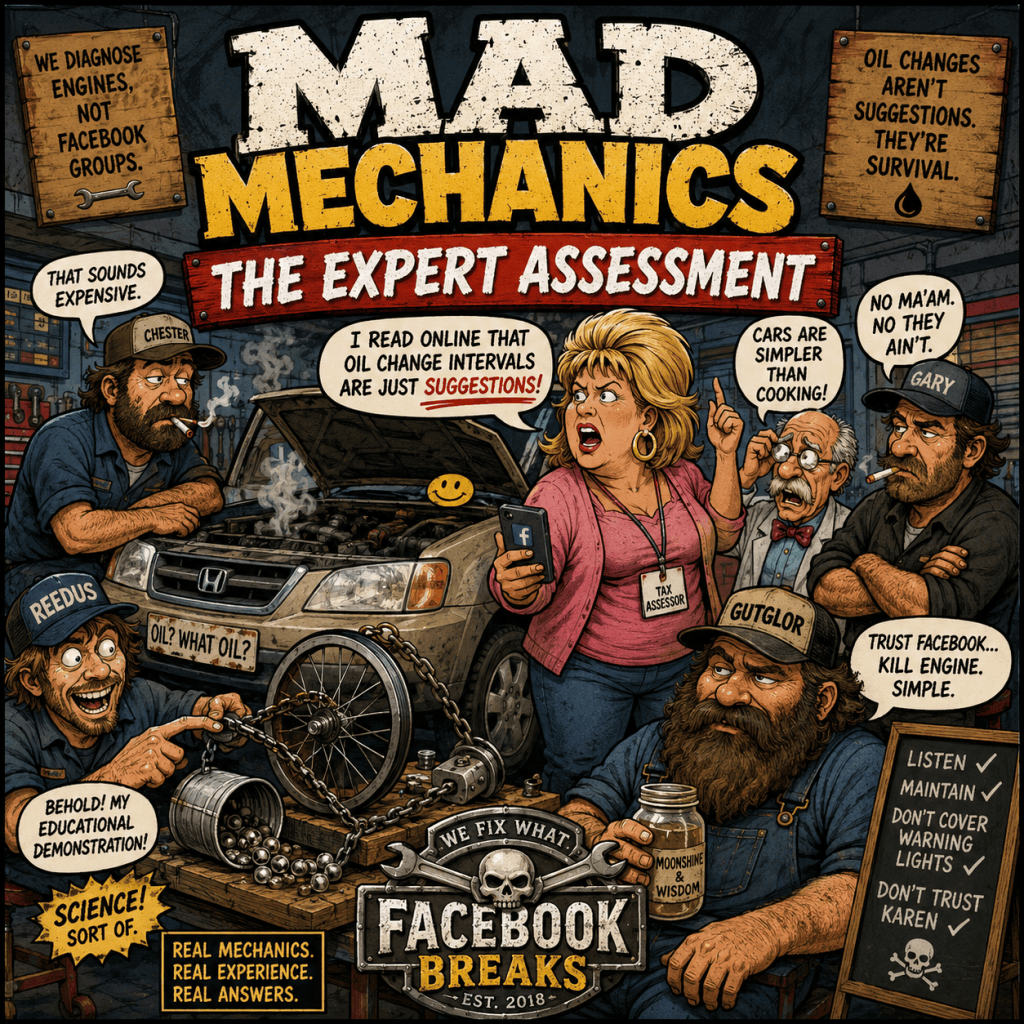
Mad Mechanics: The Expert Assessment
Episode 19.7
Written by: Emmitt Owens
As narrated by: Waylon
Waylon, Intro: “Well now, folks, let me tell you about the day Loni Jackson came into Mad Mechanics with a Honda that sounded like it was being murdered, a head full of Facebook wisdom, and the absolute confidence of someone who’s never been told they’re wrong in their entire life. This here’s a story about assumptions, internet expertise, and the very important question: how do you know an engine’s broke if it don’t send you a certified letter? Settle in, because this one’s gonna test everyone’s patience, especially Gary’s cigarette supply.”
It was a Wednesday afternoon in late July, the kind of day where the heat made the asphalt shimmer and reasonable people stayed inside with the AC cranked high enough to violate their electric bill.
Chester was under a Ford Ranger replacing a fuel pump, Gary was rebuilding a carburetor while maintaining a perfect ash on cigarette number three, and Reedus was in the corner working on what appeared to be a combination oil filter wrench, bottle opener, and possibly a medieval torture device.
“What exactly are you building?” Professor Thibodaux asked, peering over his spectacles at Reedus’s latest creation.
“Universal multi-tool!” Reedus announced proudly. “Removes any size oil filter, opens beer bottles, can be used as a pry bar, AND doubles as a percussion instrument!”
“Why would it need to be a percussion instrument?”
“Why WOULDN’T it need to be a percussion instrument?” Reedus countered. “Sometimes you gotta celebrate getting a stubborn filter off! This baby plays a C-sharp when you tap it right!”
“That’s not how tools work,” Gary muttered.
“It is NOW!”
From the radio, Cody Jinks was singing “Must Be the Whiskey,” which felt appropriate for a day that was already making everyone question themselves.
That’s when they heard it.
The sound was unlike anything that should come from a vehicle that was still technically mobile. It was a combination of grinding metal, desperate knocking, and what might have been the death rattle of internal combustion itself.
A champagne colored Honda CR-V lurched into the parking lot like a drunk person trying to pretend they’re sober, smoke trailing from under the hood, making noises that violated several laws of physics.
“Oh Lord,” Chester muttered, rolling out from under the Ranger. “That sounds expensive.”
The driver’s door opened and out stepped Loni Jackson… mid-forties, hair in the style that suggested she wanted to speak to multiple managers simultaneously, wearing a lanyard from the county tax assessor’s office, and carrying the energy of someone about to explain something to people who didn’t ask.
“Hi!” she called out cheerfully, as if her vehicle wasn’t currently auditioning for a horror movie sound effects reel. “I need you to look at my car. It’s making a little noise.”
“A little noise,” Gary repeated, lighting cigarette number four.
“Well, it’s been making noises for a while, but today it got louder.” She said this like it was a charming quirk, not a mechanical cry for help.
Chester approached the CR-V with caution, that of a man who’d seen this movie before and knew it didn’t end well. “Ma’am, when’s the last time you had this serviced?”
“Oh, I don’t really keep track of that stuff,” Loni replied, waving her hand dismissively. “Cars tell you when they need things. That’s what the dash lights are for.”
“Speaking of lights,” Professor Thibodaux observed, adjusting his spectacles, “is that a smiley face sticker on your instrument cluster?”
“Oh, yeah! That check engine light was so annoying, always on, so I covered it up. Much better!”
Gutglor, who’d been watching from his corner with his ever-present mason jar, took a long drink. “This gonna be one of them days.”
Chester popped the hood, and what he saw made him close his eyes and count to ten. The engine bay was covered in oil. The dipstick, when he pulled it, was bone dry. The oil cap was loose. The valve cover gasket was leaking like a sieve.
“Ma’am,” Chester said carefully, “when’s the last time you changed your oil?”
“Oh, I don’t know. The sticker says I’m due at 142,000 miles.”
“And how many miles you got now?”
“Um…” she leaned in to look at the odometer, “167,000. Why?”
“Because you’re 25,000 miles overdue for an oil change.”
“Oh, that’s fine!” Loni said brightly. “I work at the tax assessor’s office, so I process vehicle registrations all day. I know a LOT about cars. Those oil change intervals are just suggestions. They’re trying to get you to spend money unnecessarily.”
Gary stopped mid-drag on his cigarette. “They’re… suggestions?”
“Yes! I read online that modern engines can go much longer between oil changes. The oil change industry is just a scam.”
“The oil change industry,” Professor Thibodaux repeated slowly.
“Big Oil!” Loni explained, like she was revealing a conspiracy. “They want you to think you need to change oil every 3,000 miles, but modern synthetic oil can last 25,000 miles easy!”
“Ma’am,” Chester said, “even with synthetic, you should be changing it every 7,500 to 10,000 miles at most.”
“Well, that’s just YOUR opinion.”
Waylon’s Intermission: “Now folks… there’s a particular kind of confidence that comes from knowing just enough about something to be dangerous but not enough to be useful. Loni Jackson had that confidence in spades. She worked around vehicles all day, processing their paperwork, seeing their VIN numbers, filing their registration forms. And somewhere in her mind, that translated to understanding how they actually worked. Like thinking you understand surgery because you’ve seen a lot of medical bills. This was gonna be a long afternoon.”
Chester started the engine… or tried to. It turned over with a sound that made everyone within earshot wince.
KNOCK-KNOCK-KNOCK-KNOCK-KNOCK.
Like someone was inside the engine with a ball-peen hammer, trying to escape.
“That’s rod knock,” Gary said immediately. “That engine’s done.”
“How do you know?” Loni asked.
Gary blinked. “I’m sorry, what?”
“How do you KNOW it’s… what did you call it?”
“Rod knock, a knocking rod. It’s when the connecting rod bearings are worn out and there’s metal-on-metal contact between the crankshaft and—”
“But how do you KNOW that’s what’s happening?” Loni interrupted. “Did the engine tell you? Did it send you a message?”
The shop went very, very quiet.
“Did the engine… tell me,” Gary repeated slowly.
“Yes. I mean, you can’t actually SEE inside the engine while it’s running, right? So you’re just guessing based on the sound.”
“Ma’am,” Professor Thibodaux interjected, “diagnostic procedures in automotive mechanics involve observing symptoms… auditory, visual, olfactory… and correlating them with known failure modes based on decades of collective experience and—”
“So you’re making an assumption,” Loni said confidently.
Professor Thibodaux removed his glasses and cleaned them slowly. A bad sign.
“It ain’t an assumption,” Gutglor rumbled from his corner. “It’s a diagnosis. Like when a doctor listens to your lungs and knows you got pneumonia. They can’t SEE inside your lungs, but they know what pneumonia sounds like.”
“But that’s different,” Loni protested. “That’s medicine. This is just a car.”
“Just a car,” Chester repeated. “Ma’am, this ‘just a car’ is your transportation. And right now, it’s telling us… very loudly… that it’s about to die.”
“I just think you’re jumping to conclusions without actually opening it up and looking inside.”
Reedus had wandered over, holding his multi-tool creation. “Ma’am, let me put this in perspective. This tool here can remove oil filters ranging from 2.5 inches to 5 inches in diameter. How do I know it’ll work on filters I haven’t tried yet? Because I understand the PRINCIPLE of the mechanism. Same with engines. We understand the PRINCIPLE of how they fail. We don’t need to see inside your specific engine to know what that sound means. That sound means DEATH.”
“That seems very dramatic,” Loni said.
“Your engine is DYING,” Reedus insisted. “Loudly. Publicly. In our parking lot.”
“You’re all being very negative about this.”
Gary lit cigarette number five. “Ma’am, we’re being realistic. Your engine sounds like a cement mixer full of hammers.”
“How much to fix it?” Loni asked.
“For a rebuild? Three, four thousand. For a used engine swap? Maybe two thousand plus labor.”
Loni’s eyes went wide. “That’s ridiculous! I’m not paying that!”
“Then you ain’t driving this car,” Chester said flatly.
“There’s nothing wrong with it!”
“Ma’am, it sounds like it’s being murdered.”
“That’s just how Hondas sound when they get older!” Loni insisted. “They’re loud engines!”
“No they ain’t,” Gutglor said. “Hondas are some of the quietest engines made. When properly maintained.”
“Well, I’ve been driving it like this for three weeks and it’s been fine!”
Everyone stared at her.
“You’ve been driving it like this for THREE WEEKS?” Chester demanded.
“Yes! See? It’s FINE. You’re overreacting.”
From his workbench, Reedus suddenly perked up. “Wait. Three weeks of driving with rod knock? How is that even possible?”
“Because there’s nothing WRONG with it!” Loni insisted.
“No, no, I mean mechanically,” Reedus said, walking around the CR-V like it was a puzzle. “Rod knock this bad should’ve seized the engine in days. How has this thing not grenaded itself yet?”
“Maybe,” Gary suggested, “because she’s been adding oil every time it runs out?”
“Have you been adding oil?” Chester asked Loni.
“Well… yes,” she admitted. “The low oil light kept coming on, so I’d put in a quart. Then it would come on again a few days later, so I’d add another quart.”
“How many quarts you added in three weeks?”
“I don’t know… ten? Twelve?”
“TWELVE QUARTS?” Professor Thibodaux yelped. “Your engine holds four quarts! Where did the other eight go?”
“It leaked out, I guess.”
“You GUESS?” Gary was on cigarette number six now.
“So what you’re telling me,” Reedus said, his eyes lighting up with the gleam of someone solving a mechanical mystery, “is that you’ve been accidentally maintaining JUST ENOUGH oil pressure to prevent complete catastrophic failure, but not enough to prevent progressive bearing damage, creating a sort of… slow-motion engine death?”
“I have no idea what that means,” Loni said.
“It means you accidentally discovered the WORST way to keep an engine running!” Reedus explained enthusiastically. “This is fascinating! Horrible, but fascinating! You’ve been basically oil-drip-feeding a dying engine! It’s like mechanical life support!”
“Is that… good?” Loni asked hopefully.
“NO!” everyone shouted in unison.
“It just means you’ve been prolonging the death instead of just letting it die quick,” Gutglor explained. “Like dragging out a breakup for three weeks when you should’ve just ripped the band-aid off.”
“I once knew a guy,” Gutglor continued, settling into story mode, “drove a Chevy S-10 with rod knock for six months. Know how? Every single day he’d add a quart of oil, drive real gentle-like, never went over 45 mph. Engine finally gave up on I-65 during rush hour. Locked up solid. Caused a four-car pileup. Don’t be that guy. Or lady.”
“But it still runs!” Loni protested.
“So does a chicken with its head cut off,” Gary muttered. “Don’t mean it’s a good idea.”
“I just think you’re all being very pessimistic about a car that’s clearly still working.”
Chester took a long drag from his Buzzard Dust. “Ma’am, let me ask you something. You work at the tax assessor’s office, right?”
“Yes.”
“You process vehicle registrations?”
“Yes.”
“So you see VIN numbers, make and model, year, mileage, all that?”
“Yes.”
“Does that make you an expert on how vehicles actually operate?”
Loni paused. “I… I know a lot about vehicles.”
“You know about paperwork,” Chester corrected. “That ain’t the same thing. I can read a restaurant menu but that don’t make me a chef.”
“That’s different!”
“How?”
“Because… because cars are simpler than cooking!”
The shop went silent except for the ticking of cooling engines and the sound of Professor Thibodaux’s jaw hitting the floor.
“Cars,” Chester said very slowly, “are simpler. Than cooking.”
“Yes! It’s just an engine and some parts!”
“MA’AM,” Professor Thibodaux said, his voice strained, “a modern internal combustion engine contains hundreds of precisely machined components operating in perfect synchronization at temperatures exceeding 2,000 degrees Fahrenheit, with tolerances measured in thousandths of an inch! Cooking is combining ingredients and applying heat! THESE ARE NOT COMPARABLE!”
“Well you don’t have to be RUDE about it!”
“I’M NOT BEING RUDE! I’M BEING ACCURATE! THERE’S A DIFFERENCE!”
Reedus was frantically sketching something on a shop rag. “Wait, wait, I got an idea. What if we could SHOW her what’s happening inside the engine?”
“How?” Gary asked. “We ain’t got a cutaway engine.”
“No, but we got CREATIVITY!” Reedus announced. He ran to his workbench and started gathering materials: empty oil cans, some chain, ball bearings, and what appeared to be a bicycle wheel.
“What are you doing?” Chester asked.
“Building a demonstration model! A visual representation of what’s happening inside her engine!” Reedus was already assembling pieces with the crazy energy of someone who’d just had a revelation. “See, this chain represents the crankshaft, these bearings are the rod bearings, and this bicycle wheel is the… wait, what’s the bicycle wheel for?”
“You tell me, you’re the one who grabbed it,” Gary said.
“It’s for… aesthetic purposes! Demonstrations need flair!”
Within ten minutes, Reedus had constructed a Rube Goldberg interpretation of engine failure. It involved a bicycle wheel, several chains, some ball bearings in a tin can, and a lot of optimism.
“Okay!” Reedus announced. “This represents a healthy engine!” He spun the wheel, and the chains moved smoothly, the bearings rolled quietly. “See? Everything’s lubricated, everything’s smooth! Now THIS—” he dumped the ball bearings out of the can, “—is your engine WITHOUT oil!”
He spun the wheel again. The chains ground against bare metal, making horrible scraping sounds, the bicycle spokes started bending, and the whole contraption began shaking violently before several pieces flew off in different directions.
One ball bearing shot across the shop and dinged off the side of Gutglor’s mason jar.
“Hey!” Gutglor protested. “That’s moonshine abuse!”
“Sorry!” Reedus called. “But see, ma’am? THAT’S what’s happening in your engine! Metal on metal! Destruction! Chaos! Flying parts!”
“That’s a bicycle wheel and some chains,” Loni pointed out. “Not an engine.”
“IT’S A METAPHOR!”
“But it’s not REAL.”
“THE PRINCIPLE IS REAL!” Reedus insisted, gesturing at his destroyed demonstration model. “Look! I just destroyed this in ten seconds! Your engine’s been destroying itself for three weeks!”
“But my engine is still running.”
“SO WAS THE BICYCLE WHEEL UNTIL IT WASN’T!” Reedus gestured at the now-bent wheel, several spokes missing, chain dangling sadly.
“I think you just proved that things can run even when they’re damaged,” Loni said smugly.
Reedus looked at Chester with desperate eyes. “I tried.”
“I know you did,” Chester said. “And that was… creative.”
“It was EDUCATIONAL!”
“It was definitely something,” Gary agreed, lighting cigarette number seven.
Loni pulled out her phone. “I’m going to post about this experience in my Honda owners Facebook group. I think other Honda owners should know about shops that try to scare customers into unnecessary repairs with bicycle wheel demonstrations.”
“Oh for the love of—” Chester started.
“MA’AM,” Gary interrupted, standing up and walking over, “before you do that, let me ask you ONE question. Just one.”
“Fine.”
“If you don’t trust us to diagnose your engine, if you think we’re lying or guessing or making assumptions, why did you come here?”
Loni blinked. “What?”
“Why did you bring your car to a mechanic if you don’t believe mechanics know what they’re talking about?”
“I… I wanted you to look at it.”
“And we looked at it. And we told you what’s wrong. And you argued with every single thing we said. So what did you actually want? For us to tell you nothing’s wrong when we can HEAR that something’s wrong?”
“I wanted honesty!”
“YOU GOT HONESTY!” Gary snapped. “You got PROFESSIONAL, EXPERIENCED, EXPERT honesty! What you WANTED was for us to tell you what you wanted to HEAR! And those ain’t the same thing!”
The shop fell silent except for the ticking of cooling engines and Reedus quietly trying to fix his demonstration model.
“Also,” Reedus added without looking up, “my bicycle wheel demonstration was TOTALLY valid. Just because it failed catastrophically don’t mean the point wasn’t made. If anything, it PROVED the point.”
“Reedus,” Chester said gently, “maybe sit this one out.”
“I’m just saying, educational tools don’t have to survive the education process—”
“REEDUS.”
“Fine.”
Loni’s phone buzzed. She looked at it, frowned, and her whole demeanor changed.
“That’s my… that’s my coworker,” she said quietly. “Says she can come get me. I should probably… I should go.”
“What about your car?” Chester asked.
“I don’t know. I don’t have three thousand dollars. I don’t even have one thousand dollars.”
“Then what were you planning to do?”
“I don’t know!” Loni’s voice cracked. “I thought… I thought maybe you’d say it was something small. Something cheap. I thought maybe Facebook was right and mechanics DO try to scare you into big repairs when it’s really just… just…”
“Just what?” Gutglor asked, not unkindly.
“Just something I could afford.” She sat down on the curb, suddenly looking much smaller. “My ex-husband always handled this stuff. Car stuff. After the divorce, I just… I didn’t know what I was doing. I looked things up online and believed what people told me because I didn’t know any better. And now my car’s dead and I can’t afford to fix it and I don’t know what to do.”
The crew exchanged glances.
“The Facebook group,” Chester said carefully. “The one that told you oil changes were a scam. Did they also tell you how to fix an engine when it breaks from not changing the oil?”
“No,” Loni admitted.
“Did they offer to help pay for the repairs?”
“No.”
“Did any of those folks who ‘knew a lot about Hondas’ actually know anything useful?”
“I guess not.”
Chester sat down on the curb next to her. “Ma’am, I ain’t trying to be mean. But you came in here with a blown engine because you trusted internet strangers instead of actual mechanics. And when actual mechanics tried to help you, you argued with us because you were embarrassed you didn’t know what you were doing. Am I close?”
Loni nodded miserably.
“Here’s the thing,” Chester continued. “We ain’t mad at you for not knowing about cars. Most people don’t. That’s why we exist. What’s frustrating is when people don’t know about cars but THINK they do because they read something on Facebook. You know what the difference is between a mechanic and a Facebook expert?”
“What?”
“We fix the car AFTER the Facebook expert breaks it.”
Despite everything, Loni laughed a little. “I really messed up, didn’t I?”
“Yes ma’am, you did,” Gutglor confirmed. “But the question is what you’re gonna do about it.”
“I don’t have the money to fix it,” Loni said.
“Then you’re walking,” Chester replied. “Or taking the bus. Or getting rides. But this car ain’t going anywhere without a new engine, and a new engine costs money we can’t just wish into existence.”
“Can you… can you sell it for parts or something? Would that cover towing it out of here?”
Chester looked at the CR-V, calculating. “Yeah. We can do that. Won’t get you much – couple hundred maybe – but it’ll clear the lot and you won’t owe us nothing.”
“That’s it? That’s all it’s worth?”
“Ma’am, it’s worth whatever someone will pay for the parts. Engine’s scrap. Transmission might be okay. Interior’s decent. It’ll part out.”
Loni stood up, looked at her car one last time. “I really loved this car.”
“Then you should’ve changed the oil,” Gary said, not meanly, just factually.
“I know.”
Her coworker pulled up… another Honda, ironically, this one running smoothly and quietly like Hondas are supposed to when properly maintained.
As Loni walked to the car, she turned back. “I’m sorry. For arguing with you. For wasting your time.”
“You didn’t waste our time,” Chester said. “You learned something. Expensive lesson, but you learned. Next car you get, you’ll maintain it proper. Won’t you?”
“Yes,” Loni said firmly. “And I’m leaving those Facebook groups.”
“Good,” Professor Thibodaux said. “Facebook is for pictures of grandchildren and arguing about politics. Not mechanical advice.”
“One more thing,” Gutglor called out as she opened the car door. “That friend of yours driving the Honda? Ask her how often she changes her oil.”
“Why?”
“Because she’s got 200,000 miles on that thing and it purrs like a kitten. That’s what happens when you maintain vehicles instead of listening to internet strangers.”
Loni climbed into her coworker’s car and drove away. The crew watched her go, then looked at the dying CR-V still ticking and smoking in their lot.
“So,” Gary said, lighting cigarette number eight. “Who wants to start stripping parts?”
“I call the stereo,” Reedus announced. “Might be able to incorporate it into a tool somehow. Maybe a diagnostic scanner that plays music?”
“That’s not a thing,” Professor said.
“It is NOW!”
From the radio, Tyler Childers was singing “Nose on the Grindstone,” which felt appropriate for what had just ground itself into oblivion in the form of a Honda CR-V.
“You know,” Chester said, lighting a fresh Buzzard Dust, “I almost feel bad for her.”
“Don’t,” Gutglor said. “She made her choices. Trusted Facebook over professionals. Covered up warning lights. Ignored maintenance. That engine died because she killed it. Feel bad for the ENGINE. It deserved better.”
“Fair point.”
“Although,” Reedus added, examining his destroyed bicycle wheel demonstration, “I think my educational model maybe was a bit too accurate. It failed exactly like I said it would. That’s either really good demonstration design or really poor construction. Possibly both.”
“Definitely both,” Gary confirmed.
Waylon, Outro: “And that, folks, is the story of how Loni Jackson learned that working around cars don’t make you a car expert any more than working in a hospital makes you a surgeon. She came in confident, left in a coworker’s car, and somewhere in between she learned that ‘How do you know?’ is a legitimate question when you’re trying to learn, but it’s just annoying when you’re refusing to accept the answer.
Cost her a whole vehicle to figure it out, which is about as expensive as tuition gets outside of medical school.
The world’s full of people like Loni… folks who know just enough about something to be dangerous, who trust internet strangers over trained professionals, who mistake confidence for competence and proximity for understanding. They work adjacent to a field and think that makes them knowledgeable. They process the paperwork and think they understand the machine. They cover up warning lights and wonder why things go wrong.
And you know what? The mechanics at Mad Mechanics don’t hate people like Loni. They just wish those people would ASK instead of ASSUME. Would admit they don’t know instead of pretending they do. Would trust the folks who spent decades learning their trade instead of trusting Karen from the Honda Facebook group who once changed her own air filter.
Also, Reedus’s bicycle wheel demonstration was actually pretty educational, even if it did result in several flying ball bearings and one bent rim. Sometimes the best demonstrations are the ones that fail exactly the way they’re supposed to. That’s science. Destructive, liability-inducing science, but science nonetheless.
May your engines be well-lubricated, your warning lights be heeded, your Facebook groups be questioned, and may you always know the difference between processing vehicle paperwork and understanding vehicle mechanics. And if you ever find yourself arguing with a mechanic about whether they can REALLY know what’s wrong without taking everything apart first, just remember: they can. They do. And you should probably listen.
Also, modern engines are NOT simpler than cooking. That’s just hogwash. Or mularkey. Or poppycock. Or any of the ten different ways to say ‘that’s complete nonsense.’ Your choice. Amen.”
Dedicated to everyone who’s ever trusted internet strangers over trained professionals, covered up a warning light instead of addressing the warning, and learned expensive lessons about the difference between proximity and expertise. And to every mechanic who’s ever been asked ‘But how do you KNOW?’ when they’re just trying to diagnose an engine that sounds like it’s being murdered.
Mad Mechanics™ – Where we diagnose engines, call out Facebook mechanics, drink alco-haullic beverages when necessary, and occasionally build educational demonstrations that prove their point by failing catastrophically. Also, we part out Hondas that deserved better.


Leave a Reply