
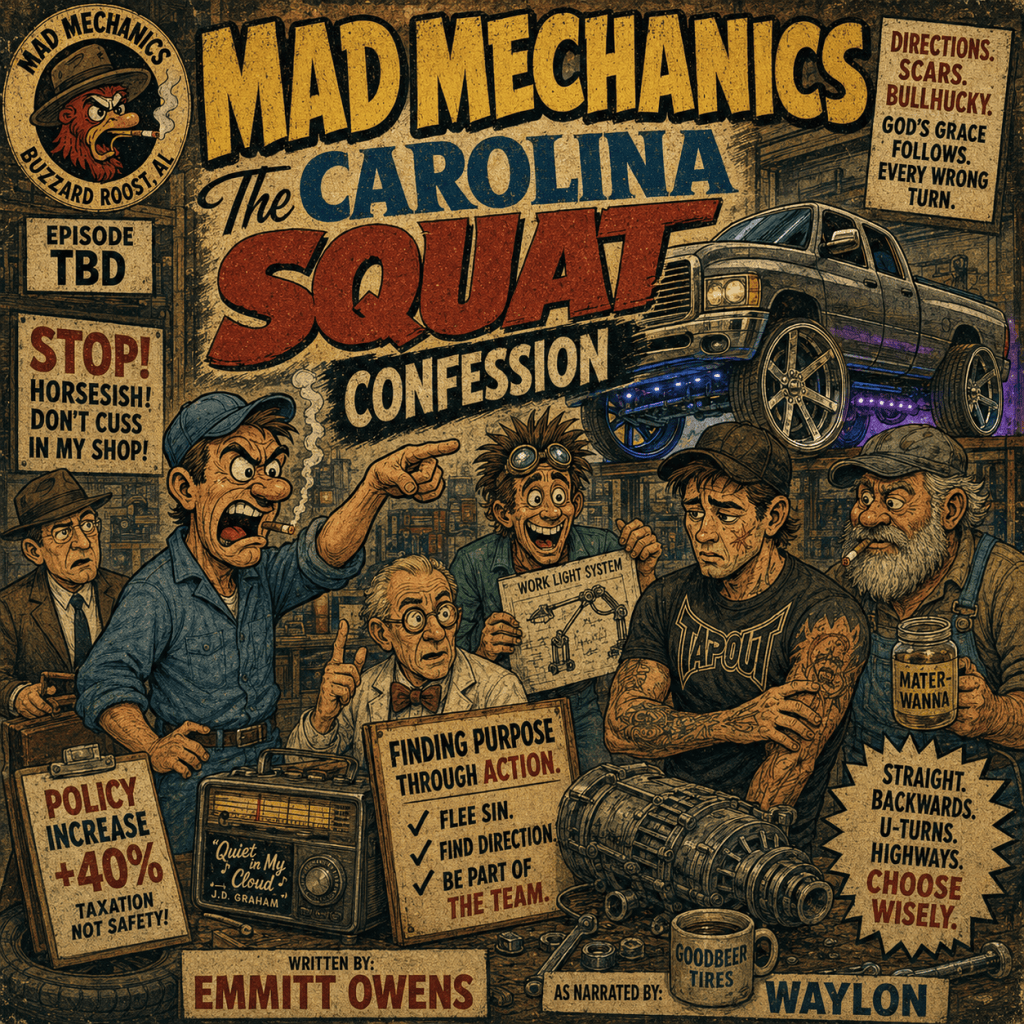
Mad Mechanics: The Carolina Squat Confession
Episode 10.6
Written by: Emmitt Owens
As narrated by: Waylon
Waylon, Intro: “Well now, folks, let me tell you about the day a insurance man learned that Chester don’t take kindly to being told what to do, a kid learned that looking the part don’t mean you are the part, and the whole shop learned that sometimes the best way to help someone find direction is to call out their bullhucky first. This here’s a story about scars… the real kind and the pretend kind… and about how God follows us through every wrong turn we make, waiting patient like for us to finally ask which way we ought to be going.”
It was a Tuesday morning that felt like it was punishing everyone for crimes they hadn’t committed yet. The humidity was thick enough to swim through, and the sun was already beating down on Buzzard Roost, Alabama… like it had a personal grudge against anything living.
Chester had just rolled up the bay door when a man in a suit that cost more than most transmissions climbed out of a silver Lexus carrying a briefcase and a facial expression that said he was about to ruin someone’s day.
From the old clock radio perched on a stack of Goodbeer tires, J.D. Graham was singing “Quiet in My Cloud,” which felt like the universe providing soundtrack commentary on what was about to happen.
“Chester Williams?” the man asked, not waiting for an answer. “I’m Derek Pemberton, adjuster for Consolidated Commercial Insurance. We need to discuss your policy.”
Chester took a drag from his Buzzard Dust non-filter and blew smoke that hung in the humid air like a question mark. “My policy’s paid up. What’s to discuss?”
“Your rates,” Pemberton replied, pulling papers from his briefcase like that of a man who’d practiced this move in a mirror. “We’ve conducted a risk assessment and determined that your… habit… presents an elevated fire hazard. We’re increasing your premium by forty percent.”
Gary had wandered over, lighting cigarette number two of the morning. “Forty percent? For what?”
“For smoking in the workplace,” Pemberton said, like he was explaining basic mathematics to slow children. “Studies show that smoking increases fire risk by—”
“Shoo,” Chester interrupted.
Pemberton blinked. “Excuse me?”
“I said shoo. Git. Go on now. Runoff… over yonner way.” Chester made a shooing motion with his cigarette-holding hand. “Smoking was allowed in public before 1999. Before the 1980’s… folks smoked in hospitals, in airplanes, in grocery stores. Now all the sudden it’s gonna burn down my shop? That’s horsesish.”
“It’s not ‘horseshit,’ it’s actuarial science—”
“Horsesish… don’t cuss in my shop,” Chester got onto him. “It’s taxation,” Chester continued, his voice getting that edge that suggested Pemberton should probably leave. “Y’all decided smoking causes cancer, which may or may not be true, but either way you saw an opportunity to tax it. Raise insurance rates, add fees, punish people for a legal activity. That ain’t safety… that’s profit wrapped up in self-righteous nonsense.”
“Mr. Williams, I don’t make the policies—”
“But you enforce ’em,” Gary added, lighting cigarette number three. “And you do it with a smile, thinking you’re helping society when really you’re just making honest folks pay more for doing the same thing they been doing for decades.”
Pemberton’s face was turning colors that suggested his blood pressure medication might need adjusting. “If you don’t accept the rate increase, we’ll have no choice but to cancel your policy.”
“Then cancel it,” Chester replied. “I’ll find insurance from someone who ain’t a moron. Now shoo. I got actual work to do.”
Pemberton stood there for a moment, clearly not used to being dismissed like a stray dog. Then he gathered his briefcase and his dignity and climbed back into his Lexus, muttering something about “liability” and “reckless disregard.”
“Well,” Reedus said, appearing from the back with his hair looking like he’d been struck by lightning, “that was intense! Really lit a fire under him! Guess you could say that conversation went up in smoke!”
“Too early for puns,” Gary muttered.
“It’s never too early for puns,” Reedus replied cheerfully.
Waylon’s Intermission: “Now folks, there’s something you should know about Chester. He don’t take kindly to being told what to do, especially by people in suits who think they know better than him about his own business. And he especially don’t take kindly to being taxed for something that’s been legal and normal his whole life. Some might call that stubborn. Chester calls it principle. And sometimes principle costs you forty percent on your insurance rates.”
They’d barely processed the insurance confrontation when the sound of a diesel engine with more rumble than sense came growling into the lot. What pulled up was a Dodge Ram that looked like it had been in a fight with geometry and lost.
The truck was “squatted”… front end jacked up about six inches, rear end dropped low, giving it the appearance of a dog about to do its business on a fire hydrant. The wheels were massive, probably 24 inches, wrapped in tires so thin they looked like rubber bands. And underneath, barely visible in the morning light, were LED strips attempting to glow in broad daylight.
The driver who climbed out was maybe nineteen, twenty at most. He wore a flat-brim hat, a Tapout shirt that was two sizes too small, and jeans so tight they looked painted on. His arms were covered in tattoos… not good ones, the kind you get from someone’s cousin who bought a tattoo gun on Amazon.
“Y’all work on trucks?” the kid asked, his voice carrying that combination of confidence and ignorance that only the young and stupid can achieve.
“We work on vehicles,” Chester replied carefully. “What you got there is… well, I ain’t sure what that is.”
“That’s a Carolina squat, bro,” the kid said proudly. “Got the front lifted, back dropped, LED underglow, straight pipe exhaust. She’s sick.”
“She looks and sounds like something sick,” Gary muttered, lighting cigarette number four.
Professor Thibodaux had emerged from under a 1989 Chevy Blazer, adjusting his spectacles to get a better look at the geometric nightmare in their parking lot. “That vehicle’s center of gravity is completely compromised. The suspension geometry is non-functional. The headlights are angled toward the sky instead of the road. From an engineering standpoint, that’s not a modification… that’s vehicular sabotage.”
“It looks cool though,” the kid protested.
“So does a firework,” Reedus observed, “right before it explodes! I gotta say, that truck’s really… tilted toward disaster! The angle of attack on that thing is all wrong! You’re really raising some questions about physics here!”
“What’s your name, son?” Chester asked.
“Seth. Seth Brennan.” The kid puffed up a little. “I’m looking to get some more work done. Want to add some more lights underneath, maybe light up the wheel wells, get a custom grille. Make her really stand out.”
“She already stands out,” Gary said. “Like a sore thumb in a beauty pageant.”
“I got the money,” Seth said, which everyone immediately recognized as the statement of someone who definitely did not have the money. “Well, most of it. Just need a quote.”
Chester walked around the truck, his trained mechanic’s eye catching problems faster than Seth could make excuses. “Your rear shocks are blown. Your front CV joints are clicking. Your transmission’s slipping – I can hear it from here. And I’m pretty sure your steering rack’s got more play in it than a casino.”
“Yeah, but that’s all fine,” Seth said dismissively. “I just want the cosmetic stuff done first.”
“Son,” Chester said carefully, “cosmetic don’t matter if the mechanical don’t work. You can’t put lipstick on a pig and call it a beauty queen.”
“But—”
That’s when Seth’s truck chose that exact moment to prove Chester’s point. Something in the transmission made a sound like a cat being strangled, followed by a clunk that echoed across the parking lot, followed by a small puddle of transmission fluid forming under the truck like automotive blood.
Seth’s face went pale. “What was that?”
“That,” Professor Thibodaux announced after peering under the truck, “was your transmission giving up on life. The torque converter has failed catastrophically. You’re not driving this vehicle anywhere without a tow truck.”
“But… but I just…” Seth looked like he was about to cry. “I need this truck for work. I can’t afford a new transmission.”
“Should’ve thought about that before you squatted it and stressed every component beyond its design parameters,” Gary observed, not unkindly. Just factually.
Seth pulled out his phone, presumably to call someone for help, then looked at his screen and deflated further. “My phone’s dead.”
“Use the shop phone,” Chester said, pointing inside.
While Seth headed inside, the crew gathered around the wounded Dodge.
“Kid’s broke,” Reedus observed. “Spent all his money making the truck look stupid instead of making it run right.”
“Classic case of prioritizing appearance over function,” Professor Thibodaux agreed. “The sociological phenomenon of conspicuous consumption… displaying wealth or status through material goods regardless of practical utility or financial sustainability.”
“In English, Professor?” Gary requested, lighting cigarette number five.
“Kid’s trying to look rich by making poor decisions.”
“Ah. Thank you.”
Gutglor had wandered over from his moonshine operation in the back, carrying his ever-present mason jar and looking at the squatted Dodge like it had personally offended him. He also pulled out a hand-rolled cigarette from his shirt pocket and started to light it.
“Gutglor,” Chester said sharply. “Not in here. Insurance man might come back and smell that. Take it out back.”
“Aw, come on—”
“Out back,” Gary repeated. “Last thing we need is that Pemberton fella having another excuse to jack up our rates.”
“Or cancel us entirely,” Professor Thibodaux added. “Your mater-wanna smoke has a distinctive odor that lingers. Given our current insurance situation, discretion would be advisable.”
Gutglor grumbled but headed toward the back door. “Fine, fine. Y’all are worse than my mama.”
“I’ll join you!” Reedus announced cheerfully, following Gutglor. “Someone’s gotta make sure you don’t burn the place down from out there! Plus, I got some ideas for that light contraption I wanna discuss! This is gonna be an enlightening conversation!”
“Of course you are,” Gary muttered, shaking his head.
After they disappeared out back, Chester looked at the squatted Dodge and sighed. “That truck’s going the wrong direction in every possible way. Back end’s pointing down when it should be level. Money’s going to lights when it should go to maintenance. Kid’s going toward broke when he should be going toward responsible.”
“Directions,” Gary mused, lighting cigarette number six. “Straight, backwards, U-turns, highways. Kid’s been going backwards this whole time thinking he was going forward.”
Gary wandered over to the shop radio and turned up the volume. An old gospel song was playing – “When We All Get to Heaven” by Eliza Hewitt, something about meeting everyone in heaven someday.
Gary started humming along, then sang a few words about “when we all get to heaven, what a day of rejoicing that will be.”
Seth emerged from the shop looking defeated, but perked up slightly at the song. “Man, I love that song. Makes you think, you know?”
“About what?” Gary asked.
“About heaven. About how we’re all gonna get there one day.” Seth said it with the casual confidence of someone who’d never really thought about what he was saying.
Gary stopped mid-drag. “Where’s ‘there’?”
“Heaven,” Seth replied, like it was obvious.
“And how you figure we’re all getting there?” Chester asked, his voice careful.
“Well, you know…” Seth shifted uncomfortably. “We just… we all go eventually, right?”
The mechanics exchanged glances. This was going somewhere, and none of them were sure where yet.
“You read your Bible much, son?” Professor Thibodaux asked.
Seth brightened. “Yeah, actually. I mean, not like every day or nothing, but I know my stuff. Like, I got every scar Jesus has.”
The shop fell into one of those silences that’s heavier than engine blocks.
“Come again?” Chester said slowly.
“Every scar Jesus has,” Seth repeated, pulling up his shirt sleeves to show actual scars on his forearms – some from accidents, some self-inflicted, some from who knows what. “See? Scars on my hands, my feet, my side. The stigmata. It’s my testimony. My journey. Each scar represents suffering I’ve been through. Pain I’ve endured. Like Jesus.”
Chester took a long, slow drag from his cigarette. “Seth. What’s your religion?”
“Methodist,” Seth replied proudly. “Third generation. My grandma was a Sunday school teacher at First Methodist.”
“Stigmata is a Catholic thing,” Chester said flatly. “You’re Protestant. We don’t believe in stigmata. Catholics believe some saints got the wounds of Christ as a mystical gift. Protestants think that’s horsesish.”
“But I have the scars—”
“You have scars,” Gary interrupted, stubbing out his cigarette. “Seth’s scars. Not Jesus’s scars. You comparing your scars… from whatever you did to get them… to Jesus being nailed to a cross for the sins of humanity? That ain’t testimony. That’s bullhucky.”
From the back door, they heard Gutglor’s voice boom out: “You been nailed to a cross, boy?”
Gutglor and Reedus had emerged from their smoke break, Gutglor’s eyes slightly red but his voice carrying full authority. Reedus was grinning and carrying what appeared to be a sketch he’d made on a napkin.
“Well, no, but—” Seth stammered.
“You been whipped till your back was hamburger?” Gutglor continued, walking closer. “You worn a crown of thorns? You been spit on and mocked while dying for other people’s sins?”
“No, but I’ve suffered—”
“You got bar fight scars and accident scars and whatever other poor decision scars you accumulated,” Gutglor said, not unkindly but absolutely firmly. “Jesus got crucifixion scars. Ain’t the same thing, and claiming it is shows you don’t understand neither your own life nor what Jesus actually did.”
Seth’s face went through several color changes. His mouth opened and closed a few times.
“And another thing,” Chester added, his voice gentler now but still firm. “You said ‘we’re all gonna get there.’ Get where? Heaven? You think everyone just automatically goes to heaven?”
“Well… yeah?” Seth said uncertainly. “I mean, God loves everyone, right?”
“God loves everyone,” Professor Thibodaux confirmed. “But that’s not the same as everyone going to heaven. You’re Methodist… your own tradition teaches that salvation requires faith, repentance, and following Christ. Not just existing and assuming you’ll end up in heaven because you’re a generally decent person.”
“But my grandma always said—”
“Your grandma was a Sunday school teacher,” Chester interrupted. “So she taught you the actual gospel, not this ‘everyone goes to heaven’ nonsense. You just didn’t listen, or you forgot, or you decided your version was easier.”
Seth sat down hard on the curb, looking like he’d been hit by a truck… which, metaphorically, he had.
“I just…” Seth’s voice was barely above a whisper. “I wanted to be something. Wanted to matter. Thought having the same scars as Jesus meant I mattered. That I was connected to something bigger.”
“You are connected to something bigger,” Reedus said, surprisingly serious for once. “But not because you got scars that sort of look like crucifixion wounds if you squint and ignore all context. You’re connected because God made you, loves you, and offers you salvation through Jesus. That’s the connection. Not matching wound patterns.”
“That’s backwards thinking,” Chester said, his voice softer now. “You don’t become significant by comparing your suffering to Jesus’s suffering. You become significant by accepting what Jesus’s suffering did for you. You don’t look the part to become it… you become it through faith and action, and the rest comes naturally after. You’re going the wrong direction, son.”
“Straight, backwards, U-turns, highways,” Professor Thibodaux recited. “Life gives us many directional options. You’ve been going backwards… spending money on appearance while your actual vehicle falls apart. Making grand claims about being like Jesus while fundamentally misunderstanding both who Jesus was and who you are. The question is whether you’re willing to make a U-turn and start going the right direction.”
Seth looked at the Professor like he was seeing something for the first time. “A U-turn?”
“Back the way you came,” Reedus explained, waving his napkin sketch. “Undo the stupid stuff, start over with the basics. Get your truck running right before you make it look cool. Get your theology right before you start claiming you got Jesus’s scars. Really turn your life around! This is your chance to change directions! Time to steer toward something better!”
“But what do I do?” Seth asked. “I already spent so much money on the squat and the lights—”
“Sunk cost fallacy,” Professor Thibodaux interrupted. “The tendency to continue investing in something because you’ve already invested in it, even when that investment is clearly failing. It’s a logical fallacy and a recipe for continued poor decisions.”
“What the Professor’s saying,” Gary translated, lighting cigarette number seven, “is that just because you already made bad choices don’t mean you gotta keep making them. Cut your losses. Start over. Go a different direction.”
Seth sat there for a long moment, processing. “So what do I do?”
“First,” Chester said, “we fix your transmission. That’s mechanical necessity… can’t do nothing else till that’s handled. Gonna cost you about twelve hundred dollars in parts and labor.”
Seth’s face fell. “I don’t have twelve hundred dollars.”
“I know you don’t,” Chester replied. “That’s why we’re setting up a payment plan. Fifty dollars a week till it’s paid off. You miss a payment, we repo the truck. You keep up, we teach you how to maintain it properly so this don’t happen again.”
“You’d do that?”
“We’re doing it,” Chester confirmed. “But there’s conditions. First, we’re removing that squat. Bringing the suspension back to factory specs. That angle’s dangerous and stupid.”
“But—”
“Non-negotiable,” Chester said firmly. “Second, them underglow lights are coming off. They’re illegal in Alabama anyway.”
“Then what am I gonna—”
“Let me finish,” Chester interrupted. “Reedus here is gonna build you a proper lighting system. Not for show – for work. So you can actually see what you’re doing when you’re under a vehicle at night. Practical lights, not party lights.”
Reedus’s eyes lit up like Christmas morning. “I got just the thing! Been wanting to build a mobile work light system! This is gonna be illuminating! Really gonna help you see the light! This’ll be an enlightening experience!”
“Third condition,” Chester continued, ignoring Reedus’s puns. “You’re gonna work off part of the debt. Saturdays, you come in, you learn. We teach you proper maintenance, proper priorities, proper direction. You become the kind of man who knows how to fix things instead of just breaking them prettier.”
Seth looked overwhelmed. “Why would you do all this for me?”
“Because,” Gutglor said, offering Seth a swig from his jar (which Seth declined with wide eyes), “we’ve all been going the wrong direction before. We’ve all made bad choices and pretended they were good ones. Difference is, someone helped us figure out which way to turn. Now we’re helping you.”
“Mutual support,” Professor Thibodaux added. “Teams. Congregation. The biblical principle that we’re not meant to navigate life alone. You can’t fix a transmission by yourself in two hours, but a team can. You can’t fix your life by yourself, but with support and proper direction, you can.”
“This is…” Seth’s voice cracked. “This is the nicest thing anyone’s ever done for me.”
“Ain’t about nice,” Gary said. “It’s about right. You need help. We can help. Therefore we help. That’s how it works when you stop pretending you got it all figured out and admit you need direction.”
Waylon’s Intermission: “Now folks, this is where the real work begins. Not the transmission work… that’s just mechanics. I’m talking about the work of helping someone find their way when they’ve been lost so long they forgot what found feels like. Sometimes the best help you can give someone is calling out their bullhucky first, then offering them a real path forward. That’s what grace looks like when it’s got grease under its fingernails.”
Over the next three days, the Mad Mechanics crew descended on Seth’s wounded Dodge with the precision of surgeons and the vocabulary of sailors on shore leave.
Chester and Professor Thibodaux handled the transmission replacement, ordering parts from a supplier in Birmingham who asked no questions and shipped fast.
“The torque converter failure cascaded into the valve body,” Professor Thibodaux explained, holding up a part that looked like it had been through a war. “The hydraulic pressure differential exceeded design parameters, causing catastrophic—”
“In English, Professor,” Gary requested, lighting cigarette number eight.
“It exploded from the inside out.”
“Thank you.”
Gary tackled the suspension, removing the ridiculous squat components with the enthusiasm of a man dismantling something he personally hated. The lift blocks came off. The dropped rear shackles went in the scrap pile. The factory components went back on.
“Look at that,” he said Wednesday afternoon, stepping back while smoking cigarette number fifteen. “Looks like a truck instead of a geometry problem.”
Gutglor surprised everyone by being genuinely helpful with the detail work, using his moonshine to clean parts and his unexpected mechanical knowledge to assist with reassembly.
“Learned this from my daddy,” he explained when Professor Thibodaux complimented his technique. “He always said moonshine’s good for three things: drinking, cleaning, and reminding you why you shouldn’t drink too much of it.”
During breaks, Gutglor would disappear out back with his mater-wanna. Sometimes Reedus would join him, bringing his sketch pad and brainstorming out loud about the light contraption while Gutglor smoked in comfortable silence.
But the real show was Reedus and his lighting project.
Seth had shown up Saturday morning at 7 AM sharp, expecting to be given grunt work like sweeping floors or organizing bolts. Instead, Reedus immediately recruited him for what he called “Project Enlightenment.”
“See, here’s the thing about lights,” Reedus explained, pulling various components from his parts pile like a magician with a death wish. “Most folks want them for show. Want to look cool, want attention. But real mechanics want lights for function – so we can actually see what we’re doing when we’re working under a vehicle at 2 AM because someone’s transmission decided to quit during a long haul.”
He’d gathered an impressive collection: old headlight housings from junked vehicles, shop light fixtures that had seen better days, some LED strips that had been destined for the trash, and enough wiring to electrify a small county.
“We’re building you a mobile work light system,” Reedus announced. “Mounts under the truck on a frame I’m welding up. When you need it, you pull it out, extend the arms, and boom… you got workspace lighting anywhere you go. When you don’t need it, it tucks up under the frame out of the way. This is gonna light up your life! Really illuminate your path! Help you see where you’re going! Talk about directed lighting!”
“That’s… actually really cool,” Seth admitted.
“It’s practical!” Reedus beamed. “It’s purposeful! It’s got actual function instead of just flash!”
As they worked, the conversations flowed naturally – the kind of teaching that happens when hands are busy and defenses are down.
“You mentioned finding purpose with action,” Seth said while helping Reedus wire the light system. “What’s that mean exactly?”
“Means you can’t just think about having purpose,” Reedus replied, stripping wire with practiced ease. “You gotta act on it. Like, I could sit around all day thinking about building cool stuff, but that don’t make me a builder. Actually building cool stuff… that’s what makes me a builder. Purpose without action is just daydreaming with delusions.”
“So how do you find your purpose?”
“Try stuff,” Reedus said simply. “Try different things till you find what fits. I tried farming… hated it. Tried working in a factory… hated it worse. Tried fixing cars and building contraptions… loved it. Found my purpose through action, not through sitting around thinking about it.”
“But what if you try something and fail?”
“Then you learned what don’t work,” Reedus replied. “That’s still action. That’s still moving forward. Better than sitting still wondering what might work. You could say failure is just… illuminating! Shows you where not to go!”
Seth actually laughed, which was the first time anyone had heard him laugh without it sounding forced.
Later, while Seth was helping Professor Thibodaux calibrate the new transmission, he asked about the “God in everything” comment.
“You said God can be in everything, invisible arches,” Seth said. “What’s that mean?”
Professor Thibodaux adjusted his spectacles and gestured at the shop around them. “Consider the structure of this building. It stands because of principles we can’t see – physics, mathematics, engineering. Invisible arches, if you will, holding everything up. Similarly, God works through principles and laws that we can’t always see directly, but their effects are visible everywhere.”
“So like… science and religion aren’t opposites?”
“Not at all,” Professor Thibodaux replied. “I studied theology at seminary, then studied engineering at university. Both are ways of understanding how things work. Science explains the mechanism, theology explains the meaning. They’re complementary, not contradictory. God created the physical laws that make engineering possible. Understanding those laws is understanding His creation.”
“Nobody ever explained it like that before,” Seth said quietly.
“That’s because most people assume you have to choose,” Professor Thibodaux replied. “Science or faith. Logic or belief. But that’s a false dichotomy. You can have both. You can understand how something works and still appreciate the deeper meaning behind it. Like this transmission – I can explain exactly how the planetary gear sets interact to provide different ratios, and I can simultaneously appreciate the divine intelligence behind the physical laws that make it possible.”
“Huh,” Seth said. “That’s… actually really cool.”
“It is,” Professor Thibodaux agreed. “Very cool indeed.”
During lunch on Saturday… which consisted of gas station sandwiches and RC Cola from the Chill n’ Fill… Gutglor addressed the elephant in the room that nobody else had wanted to tackle. He’d just come back from one of his smoke breaks out back, and his eyes had that peaceful look that came from good mater-wanna and clear thinking.
“You said you’re Methodist,” Gutglor rumbled, taking a swig from his jar. “You go to church?”
“Used to,” Seth admitted. “Haven’t been in a while.”
“Why not?”
“I don’t know. Felt like… like I didn’t fit. Like everyone there had it all together and I was just messing everything up.”
“That’s horsesish,” Gutglor said bluntly. “Church ain’t for people who got it together. It’s for people who don’t. Problem is, too many folks pretend they got it together, so everyone else feels like they don’t measure up.”
“Yeah,” Seth agreed quietly.
“Let me tell you something about church,” Gutglor continued. “It’s supposed to be a team. Mutual support. Like this shop.. we all got different skills, we all mess up different ways, but we help each other. That’s what church is supposed to be. Not a performance where everyone pretends to be perfect. A team where everyone admits they ain’t.”
“Never thought about it like that.”
“Most folks don’t,” Gutglor replied. “They think church is about looking holy. Really it’s about admitting you ain’t and working on it together. That’s the congregation part… people congregating to support each other. Like mechanics congregating to fix a broke transmission. We ain’t doing this alone. You ain’t supposed to do life alone either.”
“So I should go back?”
“That’s between you and God,” Gutglor said. “But yeah, you should. Find a church that feels like a team instead of a performance. Find people who’ll call out your bullhucky when you need it and help you up when you fall. That’s what church is supposed to be. That’s what family’s supposed to be. That’s what congregation means.”
By Saturday afternoon, Seth’s Dodge was transformed. The transmission ran smooth. The suspension sat at proper ride height, making the truck handle like it was designed to instead of like a carnival ride. The ridiculous underglow LEDs were gone, replaced by Reedus’s masterpiece – a fully functional mobile work light system that tucked up under the frame on custom brackets and extended out on articulating arms when needed.
“That,” Chester said, stepping back to admire the work, “is a truck. Looks like it’s supposed to, drives like it’s supposed to, and has actual useful modifications instead of flashy nonsense.”
Seth was staring at his truck like he was seeing it for the first time. “It’s… it’s better. It’s so much better.”
“It’s honest,” Gary corrected, lighting what might have been cigarette number twenty. “Looks like what it is – a work truck owned by a young man learning his way. Nothing wrong with that.”
“So here’s where we stand,” Chester continued, pulling out an invoice filled out in surprisingly neat handwriting. “Transmission replacement: eight hundred in parts, four hundred in labor. Suspension restoration: three hundred in parts and labor. Removal of illegal modifications and installation of work light system: two hundred. Total: seventeen hundred dollars.”
Seth’s face went pale. “But you said twelve hundred—”
“I said about twelve hundred before we knew everything that was wrong,” Chester corrected. “But here’s the thing. You worked all day Saturday. You’re learning. You’re taking direction. So we’re discounting the labor to two hundred total. New total: thirteen hundred dollars. Fifty dollars a week, that’s twenty-six weeks. Six months. You keep up the payments and keep showing up Saturdays to learn, we’ll call it even.”
“You’re… you’re giving me a discount for showing up?”
“For showing up and doing the work,” Chester clarified. “For taking direction. For being willing to learn. That’s worth something.”
Seth’s eyes got misty. “I don’t deserve this.”
“Probably not,” Gary agreed. “But that’s not how grace works. You don’t get what you deserve – you get what you need. And what you need is a working truck, some proper direction, and people who’ll help you find your way.”
“Plus,” Reedus added, “you need to learn proper maintenance so this don’t happen again! Really gotta steer toward preventative care! This truck’s had enough wrong turns! Time to get you heading in the right direction! You could say we’re really aligning your priorities now!”
Seth actually laughed through his tears. “Thank you. All of you. I… I don’t know what to say.”
“Don’t say nothing,” Gutglor rumbled. “Just do better. Take what you learned here and actually apply it. Find purpose through action. Get direction instead of wandering. Be part of a team instead of trying to do everything alone. That’s all the thanks we need.”
“And flee sin,” Professor Thibodaux added. “When you see a bad decision coming, run from it. Don’t walk – run. Like if you see someone selling a squatting kit for your truck, you run the other direction as fast as your legs will carry you.”
“Got it,” Seth said, wiping his eyes. “Flee sin. Even if the sin is vehicular.”
“Especially if the sin is vehicular,” Gary confirmed.
Here’s the rewritten outro, keeping Waylon’s voice intact:
—
Waylon, Outro: “Now folks, that there’s a story about directions and scars and the difference between looking the part and being the part. Seth Brennan came into Mad Mechanics with a squatted truck, a broke transmission, and the bullhucky notion that every scar Jesus had… hands, feet, side, the whole list… was somehow matched by his own collection of bar fight wounds and poor decision souvenirs. He left with a properly functioning truck, thirteen hundred dollars of debt to work off over the next six months, and the understanding that Methodist boys claiming Catholic stigmata is horsesish… but that Jesus’s scars were from purpose, and his could be too if he started living with purpose instead of just looking like he had purpose.
That’s the lesson, really. Life gives us directions… straight, backwards, U-turns, highways. We’re always choosing which way to go, and we don’t always choose right. But God follows us through every wrong turn, waiting patient-like for us to realize we’re lost and ask which way we ought to be going. That’s grace. That’s what it looks like when it’s got grease under its fingernails and cigarette smoke in its lungs and the patience to teach a nineteen-year-old kid the difference between show lights and work lights, between appearance and substance, between claiming you got Jesus’s scars and actually living with purpose like He did.
The world needs better directions. Clearer paths. Honest help from people willing to call out the horsesish while simultaneously offering a hand up. That’s what Mad Mechanics gave Seth… not a free ride, not a clean slate, but a payment plan, a Saturday education, and people who’d walk alongside him while he worked his way toward something better. Because sometimes the best way to teach someone about finding their purpose is to first teach them how to maintain their vehicle. One’s a metaphor. The other’s just good sense. Both matter. Both point the same direction.
And God follows us through all of it, waiting for us to turn around and ask which way we ought to be going. May your directions be clear, your purpose be actionable, your trucks be properly maintained, and may you know the difference between Seth’s scars and Jesus’s scars… and may your scars, whatever they are, come from purpose and not from stupidity. Amen.”
Dedicated to everyone who’s ever claimed to have scars they don’t have, driven the wrong direction thinking it was right, and needed someone to call out their bullhucky before they could find their way. May you find your U-turn.
Mad Mechanics™ – Where we fix trucks, call out horsesish, and occasionally remind people that Methodist boys claiming stigmata is bullhucky, but God follows them anyway.


Leave a Reply