
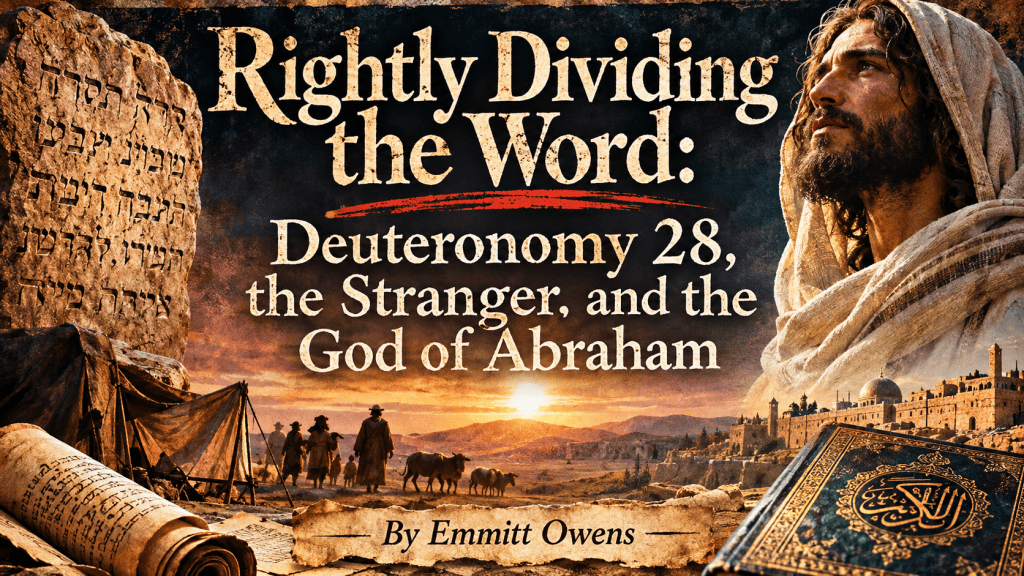
Rightly Dividing the Word: Deuteronomy 28, the Stranger, and the God of Abraham
Nov 12, 2026 · @Emmitt
Introduction
Deuteronomy 28 is a covenant warning to ancient Israel, not a verdict on modern immigrants. That is where a long Facebook discussion eventually landed. People came into it from different directions, and the commenter who first applied the chapter to “illegal aliens” was willing to keep reading, keep talking, and in the end agreed that it “does not have to do with illegal immigrants at all.” That kind of openness is worth honoring.
This essay walks through how the conversation got there. It covers what the chapter actually says, what the Hebrew word for “stranger” means, how the Exodus story fits, and what Jesus taught about who our neighbor is. It closes with a look at how Jesus appears in the Quran, which came up later in the same thread.
The lesson is simple, and it applies to all of us: read Scripture in context before using it to make a point.
What Deuteronomy 28 is
Deuteronomy 28 lays out the blessings and curses of God’s covenant with Israel, spoken by Moses just before the people entered the promised land. Verses 1–14 promise blessing for obedience. Verses 15–68 warn of curses for disobedience: disease, drought, defeat, poverty, siege and finally exile among the nations.
The chapter states its own reason plainly:
“Moreover all these curses shall come upon thee, and shall pursue thee, and overtake thee, till thou be destroyed; because thou hearkenedst not unto the voice of the LORD thy God, to keep his commandments and his statutes which he commanded thee.” (Deuteronomy 28:45, KJV)
In Hebrew, the key phrase is ki lo shamata, “because you did not listen.” Every curse, including the stranger rising in verse 43, is presented as the consequence of Israel’s own unfaithfulness.
Scripture also tells us these curses came true. Daniel 9:11 says the curse written in the law of Moses was “poured upon us” when Israel went into exile in Babylon. When Moses spoke it, it was a conditional warning about the future. Today it is history: a warning given to ancient Israel and fulfilled in the exile.
The stranger in Hebrew
A good point was raised in the thread: Hebrew really does distinguish between kinds of foreigners. Ger means a resident stranger, someone living among the people. Nokri means a foreigner or outsider. That distinction matters when studying the law.
It also helps settle this passage. The word in Deuteronomy 28:43 is ger, the same word God uses when He commands Israel to love the stranger. Literally rendered, the verse says: “The stranger who is in your midst will rise above you higher and higher, and you will go down lower and lower.” The stranger here already lives among Israel. He is not an invader, and his rise is the punishment for Israel’s disobedience, not his own wrongdoing.
The same ger is the one the law protects:
- “Love ye therefore the stranger: for ye were strangers in the land of Egypt.” (Deuteronomy 10:19)
- “The stranger that dwelleth with you shall be unto you as one born among you, and thou shalt love him as thyself.” (Leviticus 19:34)
- “Cursed be he that perverteth the judgment of the stranger, fatherless, and widow.” (Deuteronomy 27:19)
- “Ye shall have one manner of law, as well for the stranger, as for one of your own country.” (Leviticus 24:22)
Leviticus 24:22 cuts both ways. The stranger lived under the same law as the native-born, with the same responsibilities, and he received the same protection and justice. A ger was not defined by paperwork; ancient Israel had no visas. He was someone living among the people without a native’s standing, which is exactly why the law kept singling him out for protection. Nokri does appear elsewhere in Deuteronomy, in places like the lending laws (15:3, 23:20), but not in 28:43.
Israel in Egypt and the promised land
It was also rightly pointed out that Israel did not enter Egypt by force. They came during a famine at Joseph’s invitation, with Pharaoh’s permission to settle in Goshen (Genesis 45–47), and they lived as a distinct people under Egyptian authority.
Generations later, a new king arose who did not know Joseph. Exodus 1:9-10 gives his reason for turning on them: he feared they had become “more and mightier than we.” The oppression came from fear of their numbers, not from any law they broke. The Bible never treats Israel’s presence in Egypt as the problem; it judges Egypt for how it treated them.
It was suggested that deporting Israel would have spared Moses. But God had told Abraham four hundred years earlier that his descendants would be strangers in a land not theirs, and that He would judge the nation that afflicted them (Genesis 15:13-14). The Exodus is the story of God delivering His people and judging their oppressor.
As for the promised land, Israel did not enter at the invitation of its inhabitants. They entered by God’s command. God promised the land to Abraham (Genesis 12:7) and sent Israel in (Joshua 1:2-3). Along the way, they asked Edom for permission to pass through peacefully, and when Edom refused, they went around (Numbers 20:14-21). Their entry rested on a unique divine commission, which is one more reason it cannot serve as a pattern for modern borders in either direction.
From Scripture to politics
The passage was first shared during a season of immigration enforcement in our own community, and early in the thread a commenter called Deuteronomy 28 “the biblical context right there for illegal aliens.” That reading usually rests on verses 43–44, which circulate widely online without verses 45–47 that explain them.
The reading requires two jumps the text does not support. First, it treats a modern nation as covenant Israel, though no modern nation stands under the Sinai covenant. Second, it turns a consequence into a command: the stranger’s rise is the punishment for Israel’s disobedience, not a warning about foreigners.
As the conversation went on, it moved into questions about smugglers, cartels, border agents, and whether crossing a border is like entering a house uninvited. Those are real questions of public policy, and sincere Christians answer them differently. But they are a different conversation from what Deuteronomy says. And whatever side we take, Scripture warns us against judging hearts we cannot see: “for the LORD seeth not as man seeth” (1 Samuel 16:7).
In the end, the same commenter agreed the chapter “does not have to do with illegal immigrants at all,” and added an important point of his own: that the covenant with Israel was fulfilled in Christ.
Who is my neighbor?
That point leads somewhere important. If the covenant is fulfilled in Christ, then Christ’s own teaching settles who counts: everyone. Paul writes, “Now therefore ye are no more strangers and foreigners, but fellowcitizens with the saints, and of the household of God” (Ephesians 2:19), and “There is neither Jew nor Greek… for ye are all one in Christ Jesus” (Galatians 3:28).
Jesus answered the question directly. A lawyer who knew the law well asked Him, “And who is my neighbour?” He was looking for a line he could stand behind.
Jesus told him about a man traveling the lonely road from Jerusalem to Jericho. Thieves stripped him, beat him and left him half dead. A priest came down the road, saw him and crossed to the other side. A Levite did the same. Then a Samaritan came along, a man from the people the crowd looked down on, the last person anyone expected to stop. He knelt, poured oil and wine into the man’s wounds, bandaged them, carried him to an inn and paid for his care.
Jesus asked which of the three was neighbor to the man who fell among thieves. The lawyer could not bring himself to say “the Samaritan.” He answered, “He that shewed mercy on him.” Jesus said, “Go, and do thou likewise” (Luke 10:25-37).
The lawyer wanted a boundary. Jesus never drew one. The outsider was the neighbor, and the religious insiders were the ones who walked past. Elsewhere Jesus even calls a Samaritan “this stranger” (Luke 17:18). God’s love reaches every person: “God is no respecter of persons: but in every nation he that feareth him, and worketh righteousness, is accepted with him” (Acts 10:34-35).
Jesus in the Quran and the God of Abraham
The real dividing line between Christianity and Islam is who Jesus is, not whether Islam honors him. The Quran names Jesus (Isa) 25 times, calls him the Messiah 11 times, and has a whole chapter (Surah 19) named after Mary. It affirms his virgin birth (3:45-47; 19:20), his miracles (5:110) and the Gospel given to him (5:46). It also denies that he was crucified (4:157) and that God has a son (4:171; 112:3). That is where the two faiths part ways.
Some claims made in the thread did not match the sources:
- The covenant. The Quran does not set up a contest giving the covenant to Ishmael over Isaac. It honors both as prophets and calls Isaac a gift to Abraham (37:112). The promise of twelve princes to Ishmael comes from the Bible (Genesis 17:20), and the Bible’s covenant line runs through Isaac (Genesis 17:19-21).
- The Mahdi. The Quran never mentions the Mahdi; that belief comes from later traditions (hadith). The “twelfth Imam” belief belongs to Twelver Shia Muslims, a minority. Most Muslims are Sunni and do not hold it.
- The end times. The Quran says very little about Jesus’ return. Surah 43:61 is commonly read as calling him “a sign of the Hour,” though some translators apply that phrase to the Quran itself. In the hadith, Jesus returns, defeats the Dajjal (the false messiah) and rules justly. He returns as a prophet, not as God. In Revelation, he returns as King of Kings and Lord of Lords (19:16), the risen Son.
Whether Christians and Muslims worship “the same God” is a question Christians themselves disagree on. The Catholic Church teaches that Muslims, “together with us,” adore the one God (Lumen Gentium 16). Many evangelicals hold that a God without a Son is not the same God. What all three major Abrahamic faiths share is the claim to worship the God of Abraham. Judaism is the clearest case of the overlap: Jesus himself was Jewish and worshiped the God of Israel.
Conclusion: rightly dividing the word
Scripture deserves to be read for what it says, not used to support a position we have already decided to defend. That is a temptation for every one of us, on every side of every issue. The Bereans set the example: they “received the word with all readiness of mind, and searched the scriptures daily, whether those things were so” (Acts 17:11). Paul tells Timothy to study as a workman who is “rightly dividing the word of truth” (2 Timothy 2:15), and Peter warns against wresting the Scriptures (2 Peter 3:16).
The discussion also showed what can happen when people keep talking instead of walking away. “Iron sharpeneth iron; so a man sharpeneth the countenance of his friend” (Proverbs 27:17). Several of us came in with firm ideas, raised good points, corrected each other, and came out with a clearer reading than any of us started with. That is what Paul hoped for when he urged believers to be “gentle unto all men… in meekness instructing those that oppose themselves” (2 Timothy 2:24-25), and it is a reminder that the instructing goes both ways.
People can disagree about immigration policy in good faith. But Deuteronomy 28 is not a policy document. Scripture is clear on how God’s people treat the stranger: with one law, equal justice and love. “So then every one of us shall give account of himself to God” (Romans 14:12), and that includes the one writing this.
Sources
- Bible quotations: King James Version.
- Quran references: standard verse numbering; wording varies by translation.
- Second Vatican Council, Lumen Gentium (1964), section 16.
- Names and titles of Jesus in the Quran (Wikipedia)
- The 3 Names of Jesus in the Quran (Explore Islam)
- The word Jesus mentioned in the Quran (The Last Dialogue)


Leave a Reply