
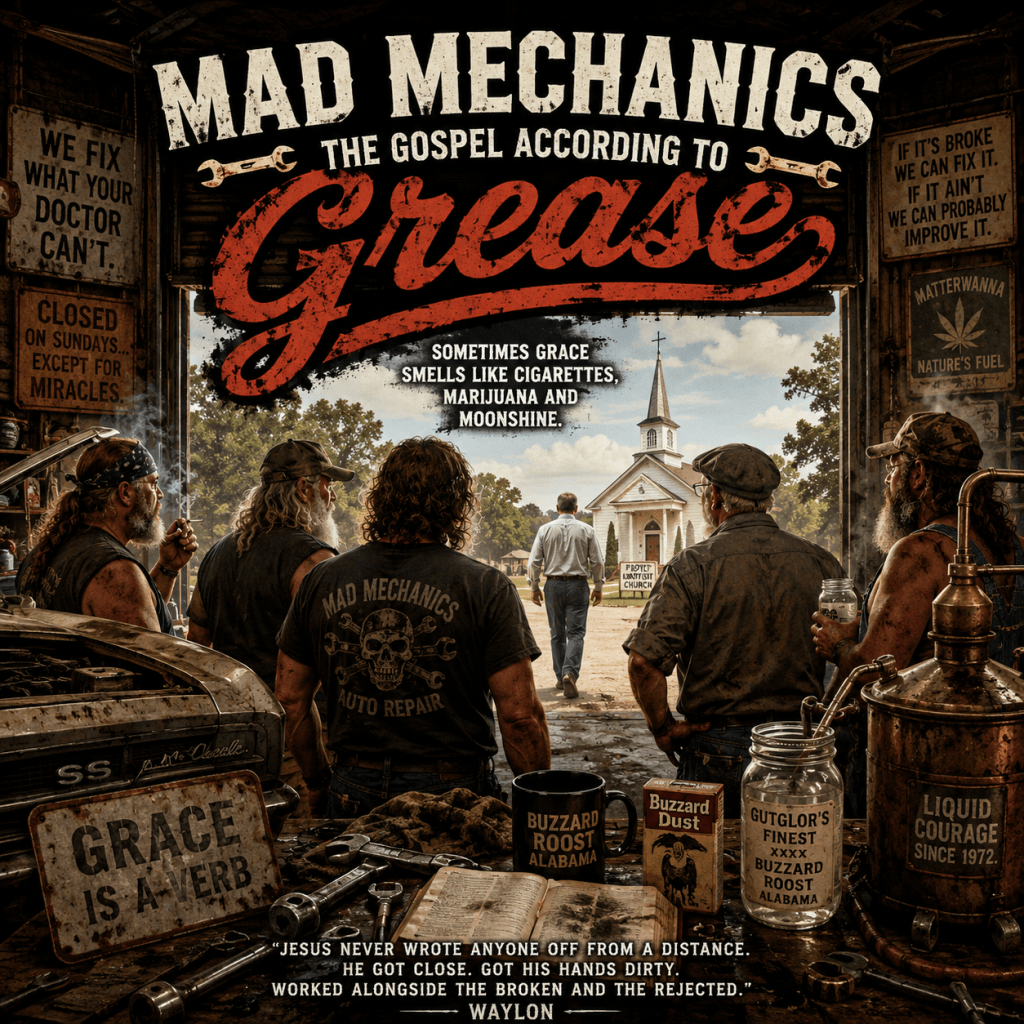
Mad Mechanics: The Gospel According to Grease
Episode 14.3
Written by: Emmitt Owens
As narrated by: Waylon
(Index #05172026)
Waylon, Intro: “Well now, folks, let me tell you about the Sunday morning when a man of the cloth learned that sometimes the best sermons aren’t preached from pulpits … they’re delivered with socket wrenches and cigarette smoke, by men who look like they’d run if the police pulled up, but who understand grace better than most folks sitting in pews ever will.”
The morning sun was barely clearing the pine trees when Chester rolled the shop door open on a Sunday… which was against his own religion of having one day a week where he didn’t have to think about fuel pumps and timing chains. But the 1971 Chevelle sitting in bay two wasn’t going to rebuild its own transmission, and Chester figured the Lord would understand a man finishing what he started.
From the old clock radio balanced on a stack of tire rims, Merle Haggard was singing “Mama Tried” through waves of static… which felt appropriate for a Sunday morning at Mad Mechanics, where most of the crew had mothers who’d definitely tried their best and fathers who’d mostly tried their patience.
Gary was already there, naturally, working on his third cigarette of the morning and his first cup of coffee that was more bourbon than beans. He had that look of a man who’d seen the sunrise from the wrong side… still wearing yesterday’s clothes and squinting at the daylight like it owed him money.
“Thought we were closed on Sundays,” Gary muttered, lighting cigarette number four off the cherry of number three.
“We are,” Chester replied, pulling a Buzzard Dust non-filter from his pack. “But that transmission ain’t gonna rebuild itself, and I got nothing better to do than avoid my ex-wife’s phone calls.”
Reedus wandered in from the back lot, his hair looking like he’d stuck his finger in a light socket and decided to keep the look. “Morning, boys! Beautiful day the Lord has made! Though I gotta say, I’m feeling pretty exhausted from it!”
“It’s 8 AM,” Gary observed. “Day just started.”
“Exactly! And I’m already tired of it! That’s what I call working on the Sabbath… we’re really breaking new ground here! Or should I say, we’re transmission-ing into Sunday mode!”
“It’s too early for puns,” Chester said, though there was no real heat in it.
Professor Thibodaux emerged from under the Chevelle, adjusting his spectacles and holding a transmission pump that had seen better decades. “Gentlemen, I believe we’ve discovered why this vehicle was experiencing such catastrophic failure. The pump mechanism has approximately forty percent more wear than operational specifications would allow.”
“In English, Professor?” Gary requested.
“It’s wore out.”
“Thank you.”
From the back of the shop came the unmistakable sound of Gutglor’s makeshift still bubbling away, followed by the man himself carrying a mason jar of clear liquid that could strip paint or cure what ails you, depending on your perspective and tolerance for agricultural spirits.
“Boys,” Gutglor rumbled, taking a swig that would’ve put a normal man in the hospital, “fine morning for workin’. Even if it is the Lord’s day of rest.”
“You working or resting?” Reedus asked.
“Both,” Gutglor replied, gesturing at his still. “This batch is restin’. I’m workin’ on the next one. It’s what I call multi-tasking in the eyes of the Lord.”
Chester was about to respond when the sound of a car engine… or more accurately, a car engine having a complete mechanical nervous breakdown… came sputtering and coughing from the road outside. The noise was followed by the sound of a vehicle giving up on life entirely, followed by the even more distinct sound of a man using words that probably weren’t in the Bible.
They all looked up to see a silver 2018 Honda Accord coast to a stop right in front of the shop’s bay doors. The car looked showroom clean despite its mechanical death throes… the kind of vehicle owned by someone who got their oil changed every 3,000 miles on the dot and kept the maintenance records in a three-ring binder.
The driver’s door opened and out stepped a man who looked as if he’d been ordered from a catalog called “Generic Pastor Starter Kit.” He was maybe thirty-five, wearing dress slacks, a button-down shirt with the sleeves rolled up exactly one turn, and a tie that had probably been loosened in what he thought was a casual, relatable way. His hair was styled with just enough product to look intentional but not vain, and he had the kind of smile that suggested he practiced it in the mirror before meeting new people.
He stood there for a moment, taking in the scene: Mad Mechanics Auto Repair, with its faded sign and collection of project cars in various states of mechanical resurrection scattered around the lot. His eyes moved from the shop to the men inside… Chester with a Michelob, Gary with his multiple cigarettes, Reedus looking like a electrical fire, Professor Thibodaux covered in transmission fluid, and Gutglor standing next to what was clearly an illegal moonshine operation.
The man’s smile faltered. Just a little. But they all saw it.
Waylon’s Intermission: “Now folks, there’s a look people get when they’re trying real hard not to judge but are absolutely judging. It’s the same look you see when someone says ‘I’m not racist, but…’ or ‘No offense, but…’ – and you know whatever’s coming next is gonna be exactly what they said it wasn’t. This fella had that look down to a science.”
The man approached the shop bay with the careful steps of someone walking through a area they weren’t entirely sure was safe. He cleared his throat.
“Good morning, gentlemen. I, uh… I seem to be having some car trouble.”
“We noticed,” Chester said, not moving from his position by the Chevelle. “Heard you coming from about half a mile away.”
“Right. Yes. Well.” The man glanced at his watch… an Apple Watch that probably tracked his steps and reminded him to hydrate. “I don’t suppose you’re… open? I know it’s Sunday, and I completely understand if you’re closed, and honestly I should probably just call AAA or—”
“What’s wrong with it?” Gary interrupted, lighting cigarette number five.
“Oh. Well. I’m not entirely sure. The engine light came on about ten miles back, and then it started making this terrible noise, and then it just… quit. Right here.” He laughed nervously. “Divine providence, I suppose, that it died right in front of an auto shop.”
“Divine something,” Gutglor muttered, taking another swig from his jar.
The man’s eyes fixed on the moonshine operation, then quickly looked away like he’d seen something he wasn’t supposed to. “I really do hate to impose on a Sunday. I know this is probably your day off—”
“We’re closed,” Gary said flatly.
“Oh. Of course. I completely understand. I’ll just call—” He pulled out his phone, looked at the screen, and his face fell. “Dead. Of course it’s dead.”
Chester took a long drag from his cigarette and exchanged a look with Gary that communicated entire paragraphs about this situation. Then he sighed the sigh of a man who knew he was about to do something against his better judgment.
“Pop the hood,” Chester said. “Let’s see what you got.”
“Oh, I couldn’t possibly—”
“You already are possibly,” Chester interrupted. “Pop the hood.”
The man who still hadn’t introduced himself hurried to his car and released the hood latch. Chester walked over like a man approaching a root canal, followed by Gary, Reedus, Professor Thibodaux, and eventually Gutglor, who brought his moonshine jar because you never knew when automotive problems might require agricultural solutions.
Chester lifted the hood and peered into the engine bay with the eye of a man who’d seen every possible way an engine could fail. He pulled the dipstick, checked the oil, then moved to the coolant reservoir. His expression went from curious to resigned to downright annoyed in about fifteen seconds.
“Well?” the man asked anxiously. “Is it bad?”
“Timing chain’s gone,” Chester announced, wiping his hands on a rag that hadn’t been clean since the Russell Hill’s watermelon festival back in August. “Probably took some valves with it when it went. Maybe bent some valves. Maybe the cam timing is damaged. Won’t know until we get in there.”
“And that means…?”
“Means your engine’s about as useful as a screen door on a submarine,” Reedus chimed in. “It’s got some serious internal damage! Really lost its timing there! This Honda’s more of a Hondon’t run right now!”
The man blinked. “Can you… fix it?”
Professor Thibodaux had pulled out his ever-present notebook and was already calculating. “A timing chain failure with subsequent valve damage would require a minimum of four to six hours of labor, assuming we have the necessary replacement components in stock, which given the specific year and model of this vehicle, we almost certainly do not. We’d need to order parts, which on a Sunday would be impossible, meaning earliest repair completion would be Tuesday afternoon.”
“Tuesday?” The man’s voice went up about three octaves. “I can’t wait until Tuesday. I need this car today. This morning. Right now, actually.”
“Then you got a problem,” Gary said, lighting cigarette number six. “Because that engine ain’t going nowhere fast. Or slow. Or at all.”
The man ran his hand through his carefully styled hair, disrupting the product-to-casual ratio. “You don’t understand. Today is my first Sunday. At First Baptist. Downtown. I’m the new associate pastor, and I’m supposed to give the sermon in—” he checked his dead phone, then his watch “—two hours. The senior pastor is out of town, the congregation is expecting me, and this is my first impression. I can’t be late. I can’t miss this.”
The shop fell into one of those silences that’s heavier than it has any right to be.
“Associate pastor,” Chester repeated, his voice flat.
“Yes. Mark Sheffield. I just moved here from Atlanta. Seminary degree from Columbia. This is my first position, and I really, really need to not screw this up on day one.”
Another silence. Longer this time.
“Well, Pastor Sheffield,” Chester finally said, “you picked a hell of a morning for your timing chain to fail.”
“I know. I’m sorry. I’ll just… I’ll find another way.” Sheffield looked around like another way might materialize out of the humid Alabama morning. “Maybe I could borrow someone’s car? Is there a rental place nearby? A taxi service?”
“Son,” Gutglor rumbled, “you’re in Buzzard Roost, Alabama. We got one gas station, a piggly wiggly, and a post office the size of a bathroom.”
Sheffield’s face went through several interesting color changes. “Right. Of course. Well. I suppose I could… walk? How far is downtown?”
“About eight miles,” Gary offered unhelpfully. “In this heat, wearing them fancy church clothes? You’d arrive looking like a baptism gone wrong.”
“Maybe someone from the church could come get me?” Sheffield was grasping at straws now, and everyone knew it.
“With what phone?” Reedus pointed out. “Unless you’re planning to pray real loud and hope someone hears you? Though I gotta say, that would be some pretty divine intervention! Really calling out for help! This situation’s really testing your faith!”
Sheffield closed his eyes and took a deep breath… the kind of breath people take when they’re trying very hard not to lose their composure in front of strangers. When he opened them again, there was something different in his expression. Something that looked like resignation mixed with the beginning of panic.
“Gentlemen, I’m going to be completely honest with you. This is not how I wanted to start my ministry here. Standing in a…” he gestured vaguely at the shop, “in a place that smells like cigarettes and… moonshine? Is that moonshine?” He didn’t wait for an answer. “But I am desperate. I will pay whatever you want. I will give you a glowing testimonial. I will mention you in my sermon. Whatever it takes. Please. Can you at least look at it? Maybe it’s not as bad as you think?”
Chester took another drag from his cigarette and blew smoke that hung in the morning air like automotive incense. He looked at Gary. Gary looked at Professor Thibodaux. Professor Thibodaux looked at Reedus. Reedus looked at Gutglor. Gutglor took a swig of moonshine and shrugged.
“We’re closed on Sundays,” Chester said slowly, “for a reason.”
“I understand. I’m sorry to have bothered you.” Sheffield’s shoulders slumped in a way that made him look less like a catalog pastor and more like a scared kid who was watching his career end before it started.
“That reason,” Chester continued, grinding out his cigarette under his boot, “is that nobody ever wants our help on Sunday. Churches don’t want folks who smell like cigarettes and moonshine in their parking lots. But I guess if the mountain won’t come to Muhammad…” He trailed off. “Professor, how fast can we swap a timing chain if we all work on it?”
Professor Thibodaux’s eyes went wide behind his spectacles. “Chester, without the proper components—”
“How fast if we improvise?”
The Professor’s pen moved across his notebook like he was calculating the meaning of life. “If we cannibalize parts from the donor vehicles in the lot, modify the timing specifications to accommodate non-OEM components, and all work simultaneously on different aspects of the repair… theoretically… two hours. Maybe.”
“Maybe?” Sheffield latched onto that word like a life preserver.
“Maybe means maybe,” Gary said, already lighting cigarette number seven. “Could be done in ninety minutes. Could take three hours and still not work. Could explode. We won’t know till we know.”
“But there’s a chance?”
“Son,” Chester said, pulling a socket wrench from his toolbox, “there’s always a chance. That’s kind of our whole business model. Boys, we got ourselves a two-hour miracle to pull off. Let’s get to it.”
Waylon’s Intermission: “Now folks, what happened next was the kind of coordinated chaos that only comes from men who’ve worked together so long they don’t need words to communicate. It was like watching a ballet, if ballets involved transmission fluid and creative cursing.”
They descended on the Honda like a pit crew at Talladega, each man knowing instinctively what needed to happen. Professor Thibodaux was already underneath the car with a creeper and a socket set, calling out specifications. Gary had the hood propped open and was removing the engine cover like a man who’d done this approximately ten thousand times. Reedus was sprinting to the parts lot to find a donor timing chain from a vehicle that was close enough to work. Chester was directing traffic and smoking cigarette number… he’d lost count.
Gutglor, surprisingly, was the one who grabbed a spare creeper and rolled under next to the Professor. “Tell me what to hand you,” he rumbled. “I may not know all the fancy words, but I know how to follow directions.”
Sheffield stood there, useless and increasingly aware of how useless he was. He checked his watch every thirty seconds. He paced. He tried to stay out of the way. He kept opening his mouth like he wanted to say something helpful but couldn’t think of what.
“You could make yourself useful,” Gary called out from the engine bay, “and hand me that ratchet. The three-eighths.”
Sheffield looked at the tool bench like it was covered in hieroglyphics. “Which one is…?”
Gary sighed and pointed without looking. “The one that says 3/8 on it.”
Sheffield grabbed what he hoped was the right tool and handed it up. Gary took it, grunted something that might have been thanks, and went back to work.
For the next thirty minutes, Sheffield watched five men perform what could only be described as automotive surgery with the intensity of people who’d been told a patient’s life depended on it. They moved with precision, called out part numbers and torque specs, worked in complete synchronization despite never having planned this job.
“Timing mark at twelve o’clock,” Professor Thibodaux called out from under the car.
“Got it,” Reedus confirmed from the engine bay. “Old chain’s off. Installing new one now. Or, well, new-ish one. It’s from a 2016 but it should work. We’re really making this repair chain out! Threading new life into this engine!”
“Reedus, so help me—” Gary started.
“Can’t help it! This is divine comedy! We’re performing automotive resurrection! Getting this Honda back to its spiritual timing!”
Despite everything… the stress, the time pressure, the catastrophic mechanical failure… Sheffield found himself almost smiling at Reedus’s relentless puns. Almost.
“How much time we got?” Chester asked, checking the alignment of the camshaft.
Sheffield looked at his watch. “Hour and fifteen minutes until the service starts.”
“We’ll make it,” Chester said with more confidence than the situation warranted.
“How can you be sure?”
Chester looked up from the engine bay, his hands black with grease, a fresh cigarette dangling from his lips. “Because we ain’t got a choice. That’s how most miracles work, in my experience. You do what needs doing because it needs doing, and somehow it works out. Or it don’t. But you try anyway.”
Something in Sheffield’s chest twisted uncomfortably at those words.
They worked in silence for another twenty minutes, the only sounds being the clink of tools, the occasional curse when something didn’t fit right, and the radio playing Waylon Jennings singing “Are You Sure Hank Done It This Way” … which felt like pointed commentary from the universe.
Finally, Sheffield couldn’t hold it in anymore. “Can I ask you something?”
“Can’t stop you,” Gary replied, not looking up.
“Do you… do you men go to church?”
The shop fell silent except for the radio. Even the tools seemed to stop moving.
“Sometimes,” Chester said finally, his voice carefully neutral. “It’s been a minute.”
“A minute?”
“Yes, a southern minute,” Gary confirmed, lighting what might have been cigarette number ten or twelve. “Churches don’t much like folks who got grease stained hands and smell like cigarettes.”
“I’m sure that’s not—” Sheffield started.
“It is,” Gutglor interrupted from under the car. “Got asked to leave three different churches in this county. Too rough. Too loud. Moonshine on my breath during communion. Apparently the Lord’s blood is fine but corn liquor ain’t.”
Sheffield opened his mouth, then closed it again.
“I’m a preacher’s son,” Chester said, still working on the timing chain tension. “Grew up in church. Learned every Bible story, every verse, every hymn. Then I turned sixteen, started working on cars, started smoking, started looking like someone the church ladies would cross the street to avoid. Suddenly I wasn’t welcome in the youth group no more. Wasn’t the right kind of Christian.”
“That’s… that’s terrible,” Sheffield said quietly.
“That’s church,” Gary replied with a shrug. “Least in our experience. Lots of talk about grace and love thy neighbor, but only if thy neighbor looks right and smells right and acts right.”
Professor Thibodaux rolled out from under the car, cleaning his spectacles on his shirt. “The theological irony, of course, is that Jesus of Nazareth spent most of his ministry with precisely the kind of people the religious establishment deemed unacceptable. Tax collectors, prostitutes, fishermen who smelled of their trade. The Pharisees criticized him for eating with sinners, and his response was that the sick need a doctor, not the healthy. Matthew chapter nine, verses ten through thirteen.”
Sheffield stared at the Professor. “You… you know the Bible?”
“Seminary training,” Professor Thibodaux replied. “Got my Master of Divinity from Emory. Was going to be a pastor. Then I realized the church didn’t want a pastor who asked too many questions and didn’t fit the mold. So now I fix cars and quote scripture. It’s more honest work.”
The silence that followed was heavier than any engine block.
“I’m sorry,” Sheffield said finally. “I’m sorry that happened to you. To all of you.”
“Don’t be sorry,” Chester said, testing the chain tension. “Just don’t be like them. You’re about to stand up in front of a congregation and tell them about grace and love and Jesus. Maybe mean it. Maybe remember that Jesus never wrote nobody off from a distance. He got close. Got his hands dirty. Worked alongside the folks the religious people wouldn’t touch.”
Sheffield felt like he’d been punched in the chest.
“Timing Chain’s on,” Reedus announced. “Let’s button her up and see if we performed a miracle or just made expensive noise! This repair’s really coming together – we’re in perfect sync! You could say we’re all… on the same timing!”
Despite everything, despite the weight of the conversation, Chester actually smiled. “That one was almost good.”
They finished the reassembly in tense silence, each man working like men who knew that time was not on their side. Forty-five minutes until service. Thirty-five minutes until service. Twenty minutes.
“That’s it,” Professor Thibodaux announced, rolling out from under the car. “All components installed and torqued to specification. Or close enough to specification that the difference won’t matter for at least a few thousand miles.”
“Will it start?” Sheffield asked, his voice tight.
“Only one way to find out,” Chester replied. “Fire her up.”
Sheffield climbed into the driver’s seat with the reverence of a man approaching a altar. He turned the key. The engine turned once. Twice. Three times.
Nothing.
“Come on,” Sheffield whispered. “Please.”
Fourth turn. Fifth turn.
The engine caught, coughed, and roared to life with a sound that was the most beautiful thing Mark Sheffield had ever heard. It ran rough for a few seconds, then smoothed out into a steady idle that sounded like mechanical poetry.
“She’s running!” Sheffield practically leaped out of the car. “She’s actually running! You did it! You actually—” He stopped, looking at the five men standing in the shop bay, covered in grease and sweat and smelling like mater wanna and moonshine. “You saved my life. You saved my career. I don’t know how to thank you.”
“Thank us by getting to your sermon,” Chester said, wiping his hands on a rag. “You got fifteen minutes.”
“Right. Yes. Of course.” Sheffield pulled out his wallet with shaking hands. “What do I owe you? Name your price. Seriously, whatever it costs—”
“Nothing,” Gary said, lighting a fresh cigarette.
“What?”
“You don’t owe us nothing,” Chester confirmed. “Get to your church. Preach your sermon.”
“I can’t just—you spent two hours—you saved my entire career—”
“We know what we did,” Gutglor rumbled. “And we’re telling you it’s free. Go preach about grace, Pastor. Maybe think about what grace actually looks like while you’re driving.”
Sheffield stood there, his wallet still open, looking at five men who had every reason to charge him triple and were charging him nothing. Five men he’d judged on sight. Five men who looked exactly like the kind of people he’d been taught to be wary of.
Five men who’d just shown him more grace than he’d shown anyone in a long time.
“I…” Sheffield’s voice cracked. “I judged you. When I pulled up. When I saw this place. I thought… I thought things I’m ashamed of. And you helped me anyway.”
“Most people judge us,” Reedus said gently. “We’re used to it. But that don’t mean we gotta act like what people think we are. Sometimes grace looks like fixing a stranger’s car for free. Sometimes it looks like giving someone a chance when they don’t deserve it. Kind of like what Jesus did, if I remember my Sunday school right.”
Sheffield nodded, unable to speak.
“Your sermon,” Chester said. “What’s it about?”
“Grace,” Sheffield whispered. “It’s about grace. About how we receive grace we don’t deserve and can’t earn.”
“Well,” Chester said, pulling out another cigarette, “now you got a better story than whatever you wrote. Get out of here, Pastor. Don’t waste it.”
Sheffield climbed into his car, his hands still shaking. He started to pull away, then stopped and rolled down his window. “What are your names? I’d like to… I’d like to tell them. About this. About you.”
Chester shook his head. “Don’t need to tell them our names. Just tell them what happened. Let them figure out what it means.”
Sheffield nodded and pulled away, his Honda running smooth as silk, carrying him toward a sermon he was going to have to completely rewrite in his head during a fifteen-minute drive.
The five mechanics stood in the shop bay, watching him go.
“Think he’ll actually tell them?” Reedus asked.
“Maybe,” Gary said. “Maybe not. Don’t matter much either way.”
“Yes it does,” Professor Thibodaux said quietly. “It matters because we just reminded someone what grace actually looks like. And maybe, just maybe, he’ll remember that the next time he sees someone who doesn’t look like they belong in a church.”
Chester ground out his cigarette under his boot. “Back to work, boys. That Chevelle ain’t gonna fix itself.”
SERMON INTERLUDE:
Mark Sheffield arrived at First Baptist Church with three minutes to spare, his hair disheveled, his shirt untucked, and his carefully prepared sermon notes feeling like they belonged to a different person entirely.
He climbed the steps to the pulpit at exactly 11:00 AM, looked out at the congregation of twenty-two faces waiting to judge whether he was worth keeping around, and made a decision.
He set his notes aside.
“Good morning. My name is Mark Sheffield, and I was supposed to give you a sermon about grace this morning. I had twenty pages of notes. I’d practiced it fifty times. I could quote you statistics about grace, etymology of the word, Greek and Hebrew translations, theological implications.
“But two hours ago, my car broke down right in front of a mechanic shop. And I learned more about grace in those two hours than I learned in four years of seminary.
“The men at that shop… they looked like trouble. They looked like the kind of people you’d cross the street to avoid. One of them was literally operating a moonshine still and smoking some stinky tobacco. They were smoking, drinking at nine in the morning, covered in grease and tattoos. Everything in my training told me to be careful around people like that.
“And I judged them. God help me, I stood there and judged them, even while I needed their help.
“They spent two hours fixing my car. They worked together like a machine, these men who’ve been rejected by churches just like this one. They knew scripture better than most Christians I know. One of them has a seminary degree. Another one’s a preacher’s son who was told he wasn’t good enough for youth group because he worked with his hands.
“And when they finished saving my career, saving my first impression, saving my entire morning… you know what they charged me?
“Nothing.
“Not a dime.
“They told me to go preach about grace and maybe think about what grace actually looks like.
“So here I am. Thinking about what grace actually looks like.
“Because grace doesn’t always wear a tie and smell like cologne. Sometimes grace smells like cigarettes and moonshine. Sometimes grace has grease under its fingernails. Sometimes grace looks exactly like the kind of people we’ve been taught to avoid.
“Jesus ate with tax collectors and sinners. The religious people criticized him for it. And his response was that the sick need a doctor, not the healthy. He didn’t say the respectable people need him. He didn’t say the people who look right and smell right and act right need him.
“He said the sick need him. The broken. The judged. The rejected.
“This morning, I met Jesus in a mechanic shop. I almost walked right past him because he didn’t look like what I expected Jesus to look like.
“How many times have we done that? How many times have we walked past Jesus because he didn’t look respectable enough? Didn’t smell right? Didn’t fit our idea of what godliness looks like?
“I came here to preach about grace. But grace preached to me first. Grace showed me that I don’t get to decide who’s worthy of love based on appearance. Grace reminded me that Jesus never wrote anyone off from a distance. He got close. He got his hands dirty. He worked alongside the people the religious establishment rejected.
“So here’s my sermon: Grace looks like five mechanics fixing a stranger’s car for free, even after that stranger judged them. Grace looks like showing kindness to people who’ve been told they’re not good enough for church. Grace looks like Jesus, who never cared about what people looked like, only what was in their hearts.
“And if we’re going to be a church, then we better start looking less like the Pharisees who judged everyone and more like Jesus who loved everyone.
“Because I learned something this morning: Jesus isn’t in the building. He’s out there in the world, working in mechanic shops and loving people we’ve decided aren’t respectable enough.
“And if we want to find him, we’re going to have to get our hands dirty too.”
Mark Sheffield sat down, his heart pounding, wondering if he’d just ended his career on his first day.
The silence lasted approximately five seconds.
Then Eddie Johnson, who ran the local Piggly Wiggly and had been a member of First Baptist for forty years, stood up and started clapping. Then Miss Eldridge, who ran the Buzzard Roost Historical Society and made eggnog strong enough to level a mule. Then Old Pete, who spent most of his time watching the world from a bench outside the Chill n’ Fill.
Within thirty seconds, the entire congregation was on their feet.
Not because the sermon was polished or practiced or theologically perfect.
But because it was true.
BACK AT THE SHOP:
The Chevelle’s transmission was back in and running by Monday afternoon. Chester was putting the finishing touches on the shifter linkage when a familiar silver Honda pulled into the lot.
Mark Sheffield climbed out, wearing jeans and a t-shirt this time, looking more human and less catalog.
“Afternoon, Pastor,” Chester said without looking up. “Car still running?”
“Like a dream,” Sheffield replied. “I, uh… I wanted to thank you again. And to pay you. I know you said it was free, but I can’t just—”
“Still free,” Gary interrupted, walking past with cigarette number three of the afternoon. “Don’t make us tell you twice.”
“Then at least let me take you all to dinner. Or… do something to say thank you.”
“Don’t need dinner,” Gutglor rumbled from his position by the moonshine still. “But if you got a congregation full of folks with broken cars, feel free to send ’em our way. We’re always open for folks who need help, even if we don’t look like we should be.”
Sheffield smiled. “I can do that. And… I wanted you to know. I told them. The whole story. Not your names, like you asked, but what happened. What you taught me.”
“How’d they take it?” Reedus asked, genuinely curious.
“Standing ovation,” Sheffield said quietly. “Turns out a lot of them have been waiting for someone to say it. That church isn’t about looking right or smelling right. It’s about loving people. All people. Even the ones who look like trouble.”
“Especially the ones who look like trouble,” Professor Thibodaux corrected. “Those were Jesus’s favorite.”
“Yeah,” Sheffield agreed. “Especially those.”
He stood there for a moment longer, like he wanted to say something else but couldn’t find the words. Finally, he just nodded, climbed back in his Honda, and drove away.
“Think he meant it?” Gary asked, lighting cigarette number four.
“Time will tell,” Chester replied. “People say a lot of things on Sunday. Monday’s when you find out what they really believe.”
“Cynical,” Reedus observed.
“Realistic,” Chester corrected. “But… maybe he’s different. Maybe that church’ll be different. We’ll see.”
They went back to work, the radio playing Hank Williams Jr. singing “Family Tradition,” and the afternoon sun casting long shadows across the shop floor.
Waylon, Outro: “Now that there, folks, is what I call the gospel according to grease. Sometimes the best sermons aren’t preached from pulpits… they’re demonstrated with socket wrenches and second chances, by folks who understand grace because they’ve needed it so bad themselves. Jesus never wrote anyone off from a distance. He got close. Got his hands dirty. Worked alongside the broken and the judged and the rejected. And if the church is gonna be the church, it’s gonna have to learn to do the same. Because grace doesn’t always look like we expect it to. Sometimes it smells like cigarettes, marijuana and moonshine. Sometimes it has grease under its fingernails. Sometimes it looks exactly like the people we’ve been taught to avoid. And sometimes, just sometimes, those are exactly the people Jesus would’ve eaten dinner with. Maybe we should too… people say a lot of things on Sunday. Monday’s when you find out what they really believe.”
Dedicated to every mechanic who’s ever been told they weren’t clean enough for church, and every church that figured out too late what they were missing.
Mad Mechanics™ – Where grace is a verb, not a theology.


Leave a Reply