
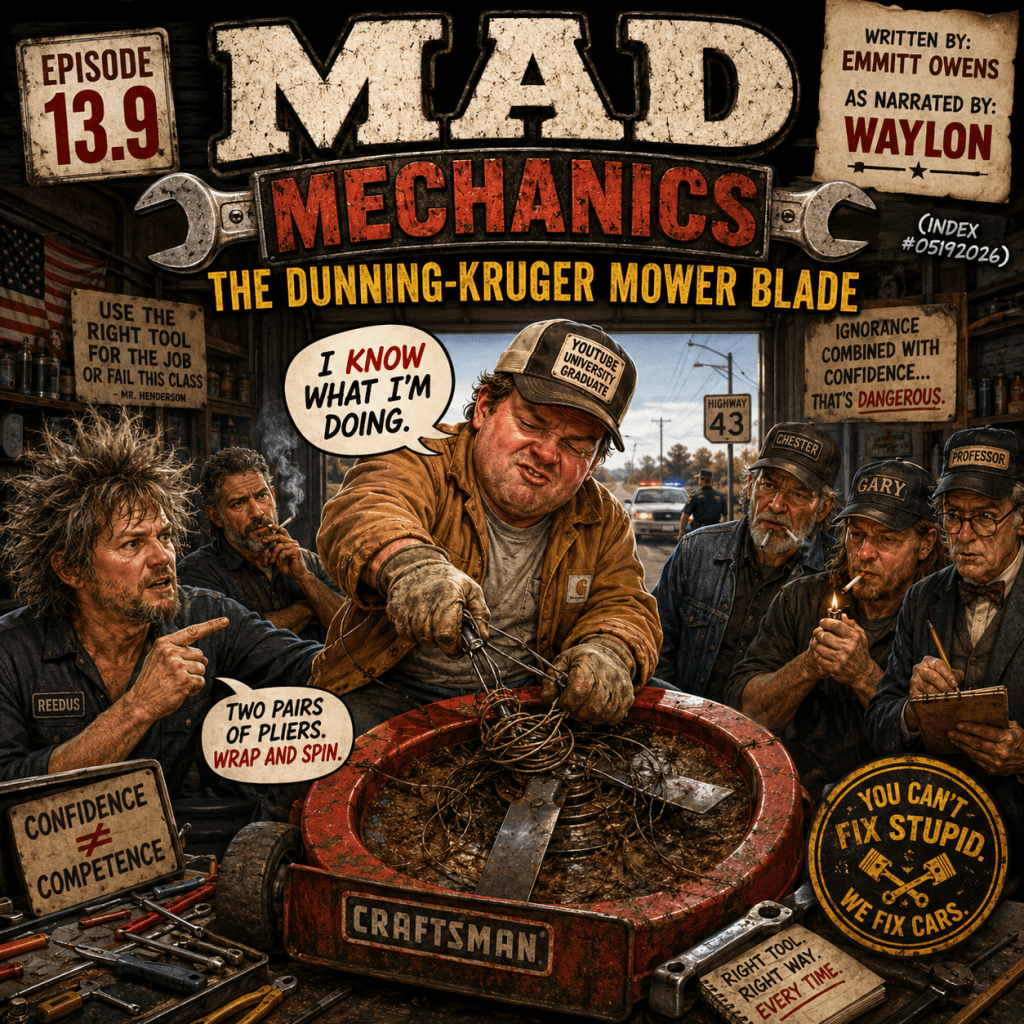
Mad Mechanics: The Dunning-Kruger Mower Blade
Episode 13.9
Written by: Emmitt Owens
As narrated by: Waylon
(Index #05192026)
Waylon, Intro: “Well now, folks, let me tell you about the day Reedus met a man who proved that confidence and competence ain’t always traveling in the same direction. This here’s a story about Jim Patterson – a 45-year-old fellow who thought he knew everything about fixing things, which meant he knew absolutely nothing at all. Sometimes the most dangerous man in a shop ain’t the one who admits he don’t know… it’s the one who thinks he does.”
It was a Tuesday afternoon when Jim Patterson pulled into Mad Mechanics driving a Ford F-150 that sounded like it was gargling marbles and dragging what appeared to be half a riding lawnmower in the truck bed. The mower looked like it had lost an argument with a wire fence and decided to carry the evidence with it.
From the old clock radio perched on the tire stack, Johnny Cash was singing “A Boy Named Sue,” which felt appropriate for what was about to unfold… a story about a man who was about to get an education he didn’t ask for and definitely didn’t want.
Chester was deep in the engine bay of a 1985 Chevy Blazer when Jim climbed out of his truck with a swagger that suggested he thought he belonged there. He was wearing a brand new pair of work gloves that had never seen work, a Carhartt jacket with the tags still partially attached, and boots so clean they could’ve been in a showroom.
“Afternoon,” Jim called out with confidence. “Y’all got a minute? Got a situation with my mower here.”
Reedus looked up from the carburetor he was rebuilding, his wild hair sticking up in its usual electrical-fire pattern. “Boys. Boys. Boys. What kind of situation you got yourself into thur?”
“Got some fencing wire wrapped around the blade,” Jim explained, walking to his truck bed. “Shouldn’t be too hard to fix. Just need to use your shop for a few minutes. Got most of the tools I need, just missing a couple things.”
“Wrapped around the blade how?” Gary asked, not looking up from his cigarette-lighting ritual. He was on number three of the morning.
“Well, I was mowing near the property line and there was some old fence wire in the tall grass. Sucked it right up into the deck. Made a hell of a noise.” Jim laughed like this was a funny story instead of a cautionary tale. “But I know what I’m doing. Won’t take long.”
Waylon’s Intermission: “Now folks, there’s a particular kind of man who shows up at a mechanic shop and immediately starts telling the mechanics how things work. This man right here was that kind of man squared. The kind who thinks confidence and competence are the same thing, and that watching YouTube videos makes you qualified to teach a class.”
Jim wrestled the mower out of his truck bed… which infact the lift on the truck was to much to carry things for haulin’. The mower was a Craftsman riding mower that had definitely seen better days and was currently seeing some of its worst. Sure enough, there was fencing wire wrapped around the blade assembly tighter than Austin Mack’s grip on a football.
But instead of unwrapping it methodically, Jim grabbed the wire with both hands and started YANKING on it. Just pulling. Hard. Like the wire was going to get intimidated and unwind itself out of respect for his determination.
“Sir,” Reedus said after watching this for about thirty seconds, “two pairs of pliers, wrap and spin. It’s not rocket science.”
Jim looked up, slightly annoyed at the interruption. “I got it. Just need to get a good grip on it.”
He went back to yanking. The wire didn’t move. It had been wound around that blade by the laws of physics and torque, and it wasn’t going to be unwound by brute force and stubbornness.
“Two pairs of pliers,” Reedus repeated, a little louder this time. “Grab the wire on both sides of the tangle, spin it the opposite direction it went on. It’ll come right off. Do it like you’re reeling in a fishing line.”
“I know what I’m doing,” Jim replied, still yanking. His face was starting to turn red from the effort.
Reedus exchanged a look with Gary that communicated entire encyclopedias about the situation they were witnessing.
“Your funeral,” Gary muttered, lighting cigarette number four.
After another five minutes of aggressive yanking that accomplished absolutely nothing except making Jim sweat through his Carhartt, he finally stopped and looked around the shop.
“Y’all got a screwdriver I can borrow? Need to take this cover plate off.”
“What size?” Reedus asked.
“Just a regular screwdriver. Phillips head.”
Reedus walked to the tool bench and grabbed a basic screwdriver from the collection… nothing fancy, just a standard Phillips that had been in the shop for probably fifteen years and had done its job perfectly fine for all of them.
He handed it to Jim, who looked at it like Reedus had just handed him a toy from a Cracker Jack box.
“You got a better screwdriver?” Jim asked, his voice dripping with the kind of condescension usually reserved for people explaining things to customer service representatives.
“Better how?” Reedus asked, his voice carefully neutral.
“I mean a good one. A real tool. Something professional.”
Reedus felt something twitch behind his eye. “A screwdriver is a screwdriver. It doesn’t take a fifty-dollar screwdriver to unscrew a damned screw.”
“Well, I just think if you’re going to do professional work, you should use professional tools,” Jim replied, like he was teaching Reedus something instead of insulting him in his own shop.
Chester stopped what he was doing and looked over. Gary’s cigarette paused halfway to his mouth. Professor Thibodaux looked up from his notebook. Even Gutglor, who was in the back smoking his materwanna and working on his moonshine still, seemed to sense the disturbance in the force.
“That screwdriver’s been turning screws since before you knew what a screwdriver was,” Chester said quietly. “It’ll do the job just fine.”
“If you say so,” Jim replied with a shrug that said he very much did not believe so.
He took the screwdriver and went back to the mower, removed the cover plate, and then stood there staring at the wire-wrapped blade like it was a quantum physics problem instead of basic mechanics.
“Need those pliers yet?” Reedus called out.
“I got it figured out,” Jim replied.
What he had “figured out” was apparently to go back to yanking on the wire with his bare hands, this time at a slightly different angle, as if the wire was going to care about geometry.
“Two pairs of pliers,” Reedus said again, his voice taking on the patient tone of someone explaining basic concepts to a particularly stubborn child. “Wrap and spin. Reel it in like fishing line.”
“I heard you the first time,” Jim said, irritation creeping into his voice. “I know what I’m doing.”
“Evidence suggests otherwise,” Gary muttered, loud enough for everyone except Jim to hear.
Another ten minutes of Jim wrestling with physics and losing. Finally… FINALLY… he walked over to the tool bench and grabbed two pairs of pliers. But instead of using them to spin the wire off like Reedus had suggested three times now, he used them to try to pull harder, like the pliers were just extensions of his already ineffective hands.
“That’s not—” Reedus started.
“I got it!” Jim snapped.
He did not, in fact, got it.
After another fifteen minutes of watching Jim work twice as hard to accomplish nothing, Reedus was starting to understand how murder happens. Not that he would do anything about it, but he understood the motivation.
Jim finally managed to get most of the wire off through sheer stubborn persistence and what might have been divine intervention from a God who felt sorry for the mower. Then came the next problem: the blade bolt.
It was a standard 5/8″ bolt. Any mechanic worth their salt would grab a 5/8″ socket or wrench and remove it in about thirty seconds. Jim, however, grabbed a 15mm socket… which is close to 5/8″ but absolutely not the same thing… and tried to force it onto the bolt.
When it didn’t fit properly, he did what any reasonable person would do.
He started hammering on it.
With… a pair of pliers.
Not a hammer. A pair of pliers. Using pliers as a hammer to pound a wrong-size socket onto a bolt.
Reedus stood there, frozen, watching this happen. His mind flashed back to high school, to Mr. Henderson’s shop class, to the sign on the wall that read: “Use the right tool for the job or fail this class.”
He remembered Mr. Henderson’s voice: “Boys, you can fail my tests and still pass this class. But if I catch you using the wrong tool for the job – using pliers as a wrench, using a screwdriver as a pry bar, using a wrench as a hammer… you fail automatically. Because that’s how you hurt yourself and break everything around you.”
Reedus had never failed shop class. He’d gotten an A.
He watched Jim hammering on a wrong-size socket with a pair of pliers and felt his shop teacher’s ghost judging him for allowing this to happen in his presence.
“Stop,” Reedus said.
Jim looked up, annoyed. “What?”
“You’re fired.”
“What?”
“You’re fired. From this mower. From this repair. From being in this shop. You’re done.”
“I’m not even—I’m doing this myself—”
“And you’re doing it wrong,” Reedus interrupted. “That’s a 15mm socket on a 5/8 bolt. They’re not the same. And pliers are not a hammer. You’re fired from being inside this shop.”
Jim stood up, his face red… though whether from exertion or anger was hard to tell. “Now look here—”
“No, you look here,” Reedus said, his voice calm but carrying the weight of seventeen years of dealing with people who thought they knew better. “You’ve been in this shop for forty-five minutes. In that time, you’ve yanked on wire instead of unwrapping it properly, insulted our tools, ignored advice from actual mechanics, and used pliers as a hammer. That ain’t confidence. That’s dangerous stupidity.”
“I know what I’m doing—”
“Do you?” Chester interrupted, walking over with a Buzzard Dust non-filter dangling from his lips. “Because from where I’m standing, you’re working twice as hard to accomplish nothing. That wire could’ve been off in two minutes if you’d listened. That blade bolt would be off by now if you’d grabbed the right socket. But instead, you’re hammering with pliers and wondering why nothing’s working.”
Jim opened his mouth, closed it, opened it again. “I’ve been working on cars and equipment for twenty years—”
“Then you’ve been doing it wrong for twenty years,” Gary said, lighting cigarette number five. “And instead of learning, you’re doubling down on wrong.”
The shop fell into one of those silences that’s heavier than it should be.
Jim looked at the mower, at the bolt he’d been trying to hammer, at the improper socket, at the pliers in his hand. For just a moment, something flickered across his face… maybe the beginning of realization, maybe the first crack in his confidence.
Then it was gone, replaced by defensive anger.
“Fine,” he said, throwing the pliers down. “I’ll take it to someone who appreciates initiative.”
“Initiative ain’t the problem,” Reedus said. “Ignorance combined with confidence… that’s the problem. That’s dangerous.”
Jim started loading his mower back into his truck, struggling with it, refusing help because accepting help would mean admitting he needed it. It took him ten minutes to get it loaded… a job that would’ve taken two minutes with a second pair of hands.
He climbed into his truck, started the engine, then rolled down his window. One last attempt to save face.
“Hey, Reedus,” he called out. “I’m heading to Birmingham this weekend to check out a motor for my car. You want to come with? That’s if you’re mechanically inclined.”
The shop fell silent.
Reedus tilted his head like a dog hearing a frequency only it could detect. “You want to know if I’m mechanically inclined? You should shop for a motor for that old 1982 Ford Bronco that has weeds grown up around it.”
“Yeah. Figured you might know something about engines, it’s for a Chevy Cavalier.”
“You figured I might know something about engines?”
“That’s what I said.”
Reedus looked at Chester. Chester looked at Gary. Gary looked at Professor Thibodaux. Professor Thibodaux looked at Gutglor. Gutglor took a long swig of his moonshine and looked at Axl who shook his head slowly.
“Jim,” Reedus said carefully, “I’ve been rebuilding engines since I was twelve years old. I can tell you the torque specs on a small block Chevy from memory. I can diagnose a misfire by sound from fifty feet away. I just spent the last hour watching you use pliers as a hammer and telling me how to do my job.”
“So is that a yes or—”
“That’s a ‘you need to leave my shop before I use improper tools in ways Mr. Henderson would definitely not approve of.’”
Jim’s face went through several interesting color changes. Then he put his truck in gear and drove away, his mower rattling in the bed, the blade still attached because he never did get that bolt off.
They watched him go in silence.
“That,” Professor Thibodaux said finally, “was a textbook example of the Dunning-Kruger effect. A cognitive bias wherein people with limited competence in a particular domain overestimate their own ability.”
“In English, Professor?” Gary requested.
“He’s too stupid to know he’s stupid.”
“Thank you.”
Reedus was still staring at the road where Jim’s truck had disappeared. “He asked if I was mechanically inclined. In a mechanic shop… Where I work… As a mechanic.”
“He did indeed,” Chester confirmed.
“And he was using pliers as a hammer.”
“That too.”
“And he insulted our tools.”
“Yep.”
“And he yanked on that wire for thirty minutes instead of just spinning it off like I told him.”
“All true.”
Reedus shook his head slowly. “You know what the worst part is?”
“What’s that?” Gary asked.
“He’s gonna go to Birmingham, buy that engine, install it wrong, blow it up, and blame the guy who sold it to him. He’s gonna go through his whole life thinking he knows what he’s doing, and he’s never gonna learn, because you can’t teach someone who thinks… that they already know everything.”
“Probably,” Chester agreed, lighting a fresh cigarette. “But that ain’t our problem. We tried. He didn’t want to learn. Some folks are like that.”
“Still turns my lug nuts the wrong way.”
“I know it does. But you can’t fix stupid, Reedus. We fix cars. Stupid’s above our pay grade.”
Waylon’s Intermission: “Now folks, I need to pause here and tell you something true. The most dangerous man in any shop ain’t the one who admits he don’t know… it’s the one who thinks he knows everything. Because the man who admits ignorance can be taught. The man who refuses to admit it will hurt himself and everyone around him, and blame everyone but himself when it all goes wrong. Jim Patterson was that man. And there’s at least one in every town.”
The rest of the day passed without incident, unless you counted Gary going through two full packs of Buzzard Dust non-filters, which wasn’t really an incident so much as a Tuesday.
Around 4 PM, they heard it.
A sound like a lawnmower eating itself. Coming from down the road. Getting closer.
“No,” Reedus said.
“Can’t be,” Gary agreed.
“It is,” Chester confirmed, walking to the bay door.
Sure enough, here came Jim Patterson, riding his Craftsman mower down Highway 43 at approximately 3 miles per hour, the engine making sounds that suggested it was composing its own eulogy. Behind him, cars were backed up for half a mile, all of them trapped behind a man on a mower who was determined to get home without asking for help.
The deputy sheriff’s cruiser pulled up alongside Jim, lights flashing. They could hear Deputy Morrison’s voice through his loudspeaker.
“Sir, you cannot operate a riding mower on a state highway.”
“It’s the only way to get home!” Jim yelled back over the dying engine.
“Sir, I’m going to need you to pull over.”
“I am pulled over! I’m going as far right as I can go!”
“Sir, that’s not what pulling over means.”
The Craftsman chose that moment to make a sound like a garbage disposal eating a handful of ball bearings, belched smoke, and died completely. Jim coasted to a stop right in front of Mad Mechanics.
Of course.
Deputy Morrison pulled up, got out of his cruiser, and walked over to Jim with the weary expression of a man who’d dealt with this particular brand of nonsense before.
“Jim,” Morrison said, “what are you doing?”
“Mower quit on me coming back from trying to fix it at home. Figured I’d ride it to town, get it looked at properly.”
“By ‘properly,’ do you mean by the same mechanics you insulted and walked out on two hours ago?”
“That was a misunderstanding.”
Morrison looked at Chester, who was watching this unfold like a nature documentary about stupid animals.
“Chester, you want to deal with this or should I call a tow truck?”
Chester took a long drag from his cigarette. “What’s wrong with it, Jim?”
Jim, still sitting on his dead mower in the middle of the highway, had the decency to look slightly embarrassed. “Engine seized up. About a mile back. Started making bad noises, then just stopped.”
“You check the oil before you rode it two miles on public roads?”
Silence.
“Jim,” Chester said patiently, “did you check the oil?”
“I was going to check it when I got home.”
“So you rode a mower that had been sitting in your truck bed, that had wire wrapped around the blade causing God knows what kind of damage, without checking if it had oil in it.”
“It had oil when I put it in the truck.”
“And you know that how?”
More silence.
Professor Thibodaux had walked over and was peering at the Craftsman like it was a archaeological artifact. “This engine is completely seized. The cylinder walls are likely scored beyond repair. You’ll need a complete engine replacement.”
“How much is that gonna cost?” Jim asked weakly.
“More than it would’ve cost to check the oil,” Gary said helpfully, lighting cigarette number nine.
Morrison looked at his watch. “Jim, I’m gonna need you to get this mower off the highway. You can either push it into Mad Mechanics’ lot or I can cite you for impeding traffic and call a tow truck that’ll charge you a hundred dollars.”
Jim looked at the shop, at the five mechanics who’d watched him be wrong for hours, at the deputy sheriff who was not impressed, at the line of cars behind him full of people who were even less impressed.
“Can I…” Jim started, then stopped. Started again. “Can I get some help pushing it?”
“No,” Reedus said immediately.
“Reedus,” Chester said quietly.
“Chester, he insulted our tools, ignored our advice, used pliers as a hammer, asked if I was mechanically inclined in a shop where I work as a mechanic, and then destroyed his engine because he was too proud to check the oil. Why would we help him?”
“Because,” Chester said, grinding out his cigarette, “we’re better than that.”
“Are we though?”
“Yes,” Chester said firmly. “We are.”
He walked out to the highway, grabbed the front of the mower, and started pushing. Gary sighed, put out his cigarette, and grabbed the other side. Reedus stood there for a moment, waging an internal war between pettiness and principle.
Principle won, but barely.
He grabbed the back of the mower and helped push it into the lot, away from the highway, away from the line of angry drivers who immediately hit their gas pedals and left Jim Patterson behind in clouds of exhaust and judgment.
Morrison tipped his hat. “Appreciate it, boys. Jim, get a ride home. Don’t ride any more equipment on public roads. And for God’s sake, check your fluids before you operate machinery.”
“Yes sir,” Jim said quietly.
After Morrison left, Jim stood in the Mad Mechanics lot looking at his seized engine like a man contemplating his life choices.
“How much to fix it?” he finally asked.
“More than the mower’s worth,” Chester replied. “You seized the engine solid. It’s done.”
“So I need a new mower.”
“Or a new engine. But a new engine’s gonna cost almost as much as a new mower, so…”
Jim nodded slowly. “And if I’d just… if I’d checked the oil before I rode it…”
“It might’ve still been seized from the blade damage,” Professor Thibodaux said. “But you would’ve known before you destroyed it completely on the highway. That’s the thing about proper maintenance and using proper tools… they prevent catastrophic failures.”
“Like using the right size socket instead of hammering a wrong one with pliers,” Reedus added, because he couldn’t help himself.
Jim looked at Reedus. “You were right. About all of it. The wire, the tools, the socket. I should’ve listened.”
“Yeah,” Reedus said. “You should’ve.”
“I just… I’ve been doing things my way for so long, I thought…”
“You thought wrong,” Gary finished. “Happens to everyone. The trick is learning from it.”
Jim pulled out his wallet. “What do I owe you for pushing it off the road?”
“Nothing,” Chester said. “But next time someone who does this for a living tells you you’re doing something wrong, maybe consider the possibility that they know what they’re talking about.”
“I will,” Jim said. Then, quieter: “I’m sorry. For being… for acting like I knew better. You were trying to help and I was too proud to accept it.”
The shop fell quiet. Even Reedus had to admit, grudgingly, that apologizing took more guts than using pliers as a hammer took stupidity.
“Apology accepted,” Chester said. “Now get a ride home and think about whether you want to fix this mower or buy a new one. If you decide to fix it, bring it back and we’ll give you an honest quote. And if we tell you something, maybe listen this time.”
“I will,” Jim promised. He pulled out his phone, called someone – probably his wife, based on the tone of the conversation and the amount of apologizing involved – and waited for his ride in the kind of humble silence that only comes from being publicly wrong and having to admit it.
After Jim left, the boys went back to their various projects. The Blazer still needed work. The Chevelle’s transmission wasn’t going to rebuild itself. Life at Mad Mechanics continued as it always did.
“Think he learned anything?” Reedus asked, wiping grease from his hands.
“Maybe,” Chester replied. “Maybe not. Some people need to fail hard before they learn. Some people never learn at all. We’ll see which one Jim is.”
“Mr. Henderson would’ve given him an F,” Reedus said.
“Mr. Henderson gave half the school Fs,” Gary pointed out. “That’s why everyone who passed his class actually knew what they were doing.”
“Exactly,” Reedus said. “Standards matter. Using the right tool matters. Knowing when you don’t know matters. All of it matters.”
“It does,” Chester agreed. “But you can’t force people to care about standards. You can only show them what happens when they don’t. Jim just got shown. Whether he learns from it is up to him.”
From the radio, Willie Nelson started singing “My Heroes Have Always Been Cowboys,” and somehow it felt appropriate for a day when they’d tried to help someone who didn’t want help, then helped them anyway when pride and ignorance collided with physics.
Waylon’s Outro: “Folks, there’s a lesson in here somewhere about pride and ignorance being dangerous traveling companions. About how confidence without competence is just a recipe for expensive mistakes. About how the right tool for the job ain’t optional… it’s essential. But mostly, this is a story about how sometimes people need to fail hard before they’re ready to learn. And how good people help anyway, even when the person doesn’t deserve it, because that’s what good people do.”
Dedicated to every shop teacher who failed students for using improper tools, and every student who eventually understood why.
Mad Mechanics™ – Where using pliers as a hammer will get you fired, but admitting you were wrong will get you a second chance.


Leave a Reply