
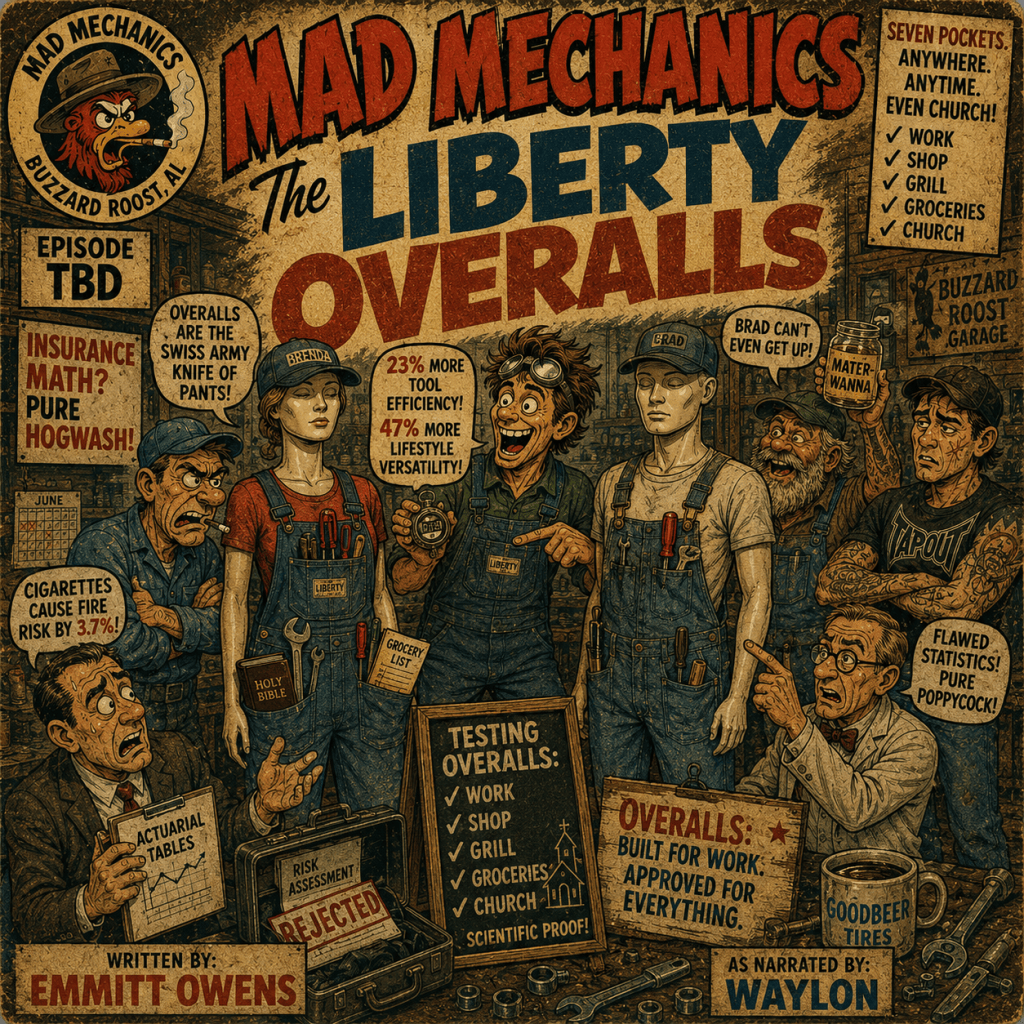
Mad Mechanics: The Liberty Overalls
Episode 10.4
Written by: Emmitt Owens
As narrated by: Waylon
Waylon, Intro: “Well now, folks, let me tell you about the day Derek Pemberton returned and learned that insurance mathematics don’t account for stubbornness, Reedus discovered the transformative power of forty-five dollar workwear, and the whole shop learned that sometimes the funniest thing in the world is watching a man in a three-piece suit try to explain actuarial tables to mechanics who don’t give a damn. This here’s a story about overalls, insurance logic, and the eternal question: what exactly is Reedus doing with that mannequin?”
It was a Thursday morning in late June, and the heat was making everything in Buzzard Roost, Alabama move slower than a box turtle crossing a dirt road. The kind of heat where even the mosquitoes were too tired to bite and the gravel looked like it was considering its life choices.
Chester had the bay doors rolled up trying to catch any breeze that might be wandering by, though the only thing moving through the shop was hot air and Gary’s cigarette smoke.
From the radio, Tyler Childers was singing “Feathered Indians,” which felt appropriate for a morning that was already testing everyone’s patience with existence.
“Hot enough for you?” Reedus asked out loud, appearing from the back with his hair doing that thing where it looked like he’d been electrocuted by an artistic lightning bolt.
“It’s June in Alabama,” Gary replied, lighting cigarette number two. “It’s always hot enough. That’s like asking if water’s wet enough or if Chester’s stubborn enough.”
“I ain’t stubborn,” Chester muttered from under a 1986 Ford F-150. “I’m consistent.”
“That’s what stubborn people call themselves,” Gary observed.
“Y’all hear about what Reedus did?” Gutglor rumbled from his corner, taking a swig from his ever-present mason jar.
“Do we want to?” Chester asked.
“He bought overalls.”
The shop went quiet except for Tyler Childers and the distant sound of a compressor cycling.
“Overalls?” Professor Thibodaux repeated, looking up from the carburetor he was rebuilding. “As in the traditional blue collar garment characterized by bib front construction and integral suspender systems?”
“In English, Professor?” Gary requested.
“Work pants with a bib.”
“Thank you.”
“What’s wrong with my overalls?” Reedus protested. “They’re practical! They got good pockets! They’re the invisible arch holding up the working man’s wardrobe!”
“You paid money for overalls,” Chester said slowly, like he was trying to process information that didn’t quite make sense.
“Forty-five dollars,” Reedus confirmed proudly. “Liberty brand. From the farmer’s supply store.”
“You paid forty-five dollars for overalls,” Gary repeated.
“That’s what I just said.”
“But you already got work clothes,” Gutglor pointed out. “You been working in jeans and t-shirts for three years.”
“Yeah, but these are overalls,” Reedus explained, as if this clarified everything. “They’re purposeful! They’re actionable! They represent a commitment to the craft! Plus they got, like… seven pockets. SEVEN. You know how many tools I can carry in seven pockets?”
“The same number you been carrying in your regular pockets?” Chester suggested.
“Yeah, but now they’re in OVERALLS,” Reedus insisted. “And that’s not even the best part! You can wear overalls ANYWHERE! Grocery shopping, checking your mail, grilling burgers, even to church! They’re the most versatile garment ever invented! They’re like… the Swiss Army knife of pants!”
“You gonna wear work overalls to church?” Gary asked skeptically.
“Why not? They’re clean! They got seven pockets! God gave us seven days of creation, seven pockets in Liberty overalls… that can’t be a coincidence!”
“That’s definitely a coincidence,” Professor Thibodaux said.
“Is it though? IS IT?” Reedus was getting that look he got when he was about to commit to a deeply questionable idea. “What if overalls are a divine garment? What if the seven pockets represent the seven days of creation? What if—”
“Reedus,” Chester interrupted, “please don’t turn overalls into theology.”
“Too late! I already bought them!”
Waylon’s Intermission: “Now folks, there’s something you should know about Reedus. When he gets an idea in his head, that idea takes root like kudzu in May and spreads with about as much sense of direction. And when that idea involves spending forty-five dollars on workwear that he didn’t need and then declaring them appropriate for church attendance based on pocket-to-creation-day ratios, well… you’re about to see what happens when enthusiasm meets denim and suspender buttons.”
They’d barely processed Reedus’s fashion revolution when a silver Lexus pulled into the lot… the same silver Lexus that had been there two weeks ago, driven by the same man in the same expensive suit, carrying the same briefcase and the same expression that said he was about to make someone’s day worse.
Derek Pemberton climbed out like he was entering a warzone, which wasn’t entirely inaccurate.
“Oh good,” Gary muttered, lighting cigarette number three. “The fun police are back.”
Pemberton approached the shop with careful steps like he’d rehearsed this interaction in his bathroom mirror for a week.
“Mr. Williams,” he said, not quite making eye contact. “I need to discuss your insurance situation.”
Chester didn’t look up from the F-150. “Thought I told you to shoo last time.”
“Yes, well… corporate has reviewed your file and determined that we need to explain the reasoning behind our rate adjustment more thoroughly.”
“You mean you need to justify why you’re taxing me for a legal activity,” Chester translated.
“It’s not taxation, it’s risk assessment—”
“Hogwash,” Chester interrupted, still not looking up. “But go ahead. Explain away. I could use some entertainment while I replace these brake lines.”
Pemberton pulled papers from his briefcase with enthusiasm, like he was about to start explaining funeral arrangements. “According to our data analysis, automotive repair facilities where smoking occurs experience a 3.7% higher incidence of fire-related claims.”
“3.7%,” Gary repeated. “That’s your smoking gun? 3.7%?”
“It’s statistically significant—”
“It’s statistically mularkey,” Gutglor rumbled. “I been around mechanics my whole life. You know what causes shop fires? Gasoline, faulty wiring, and idiots who don’t know what they’re doing. Not cigarettes.”
“The data suggests otherwise—”
“The data,” Professor Thibodaux interrupted, adjusting his spectacles, “is likely confounded by numerous variables that your actuarial model hasn’t controlled for. Correlation does not imply causation. The shops that allow smoking may also have other characteristics… older equipment, less stringent safety protocols, different demographic factors… that contribute to increased fire risk. You’re attributing causality to smoking when you’ve merely identified an association.”
Pemberton blinked. “I… that’s not…”
“In English, Professor?” Gary requested.
“His math is poppycock.”
“Thank you.”
“Our actuarial team—”
“Is wrong,” Professor Thibodaux said flatly. “I have a degree in engineering and another in theology. I understand both mathematical models and the nature of truth. Your model is flawed, your conclusion is unsupported, and your policy is predicated on statistical balderdash rather than genuine risk assessment.”
Pemberton’s face was turning colors that suggested his blood pressure was having issues about this conversation.
“Look,” Chester said, finally rolling out from under the F-150, “I get it. You work for an insurance company. Your job is to make money while appearing to care about safety. But here’s the thing… I been smoking in this shop for thirty years. Ain’t never had a fire. Ain’t never had a close call. You know why? Because I’m careful. Because I know what I’m doing. Because I respect the equipment and the materials I work with.”
“But statistically—”
“Statistically, most car accidents happen within five miles of home,” Reedus interjected, appearing with a Shop-Vac and what appeared to be entirely too much enthusiasm. “Does that mean houses are dangerous? Or does it mean people drive near their houses more often? Statistics without context is just numbers doing gymnastics! It’s mathematical manipulation! It’s actuarial tommyrot!”
“That’s… actually a good point,” Gary admitted, sounding surprised.
“I make good points sometimes!” Reedus beamed. “They’re just usually buried under puns!”
Pemberton was flipping through his papers like they might contain a magical argument that would work. “The company’s position is firm. Either you accept the rate increase or we terminate your coverage.”
“Then terminate it,” Chester replied, lighting a fresh Buzzard Dust. “I’ll find coverage elsewhere. There’s other insurance companies.”
“Actually,” Pemberton said, and his voice had that tone that meant bad news was coming, “we’ve… the industry has standardized these rates. Most major carriers are implementing similar policies.”
The shop went very, very quiet.
“So what you’re saying,” Chester said slowly, “is that y’all got together and decided to collectively raise rates on smoking shops?”
“It’s not collusion, it’s industry best practices—”
“It’s a cartel,” Professor Thibodaux said flatly. “An organized effort to control pricing across multiple companies. That’s the literal definition of a cartel.”
“That’s illegal,” Gary added, lighting cigarette number four.
“It’s not illegal when it’s based on risk assessment—”
“Based on flawed statistical analysis,” Professor Thibodaux interrupted. “Which makes it fraud disguised as mathematics. Pure horsefeathers.”
Pemberton looked like a man who’d stepped in something unpleasant and couldn’t find a place to wipe his shoe. “I’m just… I’m just doing my job.”
“Yeah,” Chester agreed. “You are. And your job is enforcing hogslop policies based on bad math to justify raising rates on honest businesses. How’s that feel?”
“Not great, if I’m being honest,” Pemberton admitted.
“Well,” Reedus announced cheerfully, “sounds like you need a career change! Really gotta pivot to something more fulfilling! Time to adjust your direction! You could say you need to… overall your life choices!”
Everyone stared at Reedus.
“Was that a pun about overalls?” Gary asked.
“I’m workshopping new material,” Reedus admitted. “Some of it’s gonna be rough.”
Waylon’s Intermission: “Now folks, here’s where things get interesting. Because while Pemberton was standing there trying to figure out whether his life choices had led him astray, Reedus was in the back having what he would later describe as ‘a moment of profound inspiration’ and what everyone else would describe as ‘Reedus being Reedus again.’”
Reedus had disappeared into the back of the shop, which usually meant one of four things: he was building something unnecessarily complicated, he was getting into Gutglor’s mater-wanna cigarettes, he’d found something that needed immediate disassembly, or he was about to create a situation that would require explanation.
“Where’d Reedus go?” Chester asked after Pemberton had retreated to his Lexus to make phone calls.
“Back storage,” Gutglor reported. “Heard him talking to himself about ‘demonstrative evidence’ and ‘visual aids.’”
“That’s concerning,” Gary observed.
“Most things Reedus does are concerning,” Chester agreed. “Question is whether it’s harmless concerning or explaining-to-the-fire-marshal concerning.”
Five minutes later, Reedus emerged from the back carrying a department store mannequin dressed in his new Liberty overalls.
Everyone stopped what they were doing.
“Reedus,” Chester said carefully, “why do you have a mannequin?”
“Visual demonstration!” Reedus announced proudly. “I’m gonna prove that overalls are superior work garments through scientific testing!”
“Where’d you get a mannequin?” Gary asked.
“Found it behind the old Belk’s in Florence Alaba-Bama… back when they were renovating. Her name is Brenda.”
“The mannequin has a name,” Professor Thibodaux observed.
“Of course she has a name,” Reedus replied, like this was obvious. “You can’t do scientific testing on someone without knowing their name. That’s just rude.”
“It’s a mannequin,” Gutglor pointed out.
“A mannequin named Brenda who’s about to demonstrate the superior functionality of Liberty brand overalls versus regular work pants!” Reedus was positioning Brenda near his workbench with the care of a man arranging a museum exhibit. “See, I’m gonna load her pockets with tools… seven pockets in the overalls versus four in regular jeans… and we’ll measure the efficiency difference! Plus, I’m gonna prove that overalls are appropriate for ANY occasion! Work, grocery shopping, checking the mail, grilling, even church!”
“You’re gonna prove a mannequin can go to church?” Gary asked.
“I’m gonna prove that overalls are the most versatile garment in human history!” Reedus corrected. “Brenda here represents the modern working man… or woman… who needs clothing that transitions seamlessly from mechanical work to social occasions!”
“That’s not a thing,” Chester said.
“It is NOW!” Reedus insisted. “Watch this!”
He began loading tools into Brenda’s overall pockets with enthusiasm, like a man proving a point: wrenches in the bib pocket, screwdrivers in the side pockets, a socket set in the back pocket, and what appeared to be a small hammer in a pocket on the leg.
“See?” Reedus gestured proudly. “Seven tools, easily accessible, balanced weight distribution! But ALSO—” he pulled a small Bible from another pocket, “—room for religious materials! AND—” he produced a grocery list, “—shopping essentials! AND—” he pulled out what appeared to be a spatula, “—grilling implements! Overalls are the Swiss Army knife of pants! They’re multi-purpose! They’re revolutionary!”
“That’s a spatula,” Gary pointed out.
“For grilling!” Reedus explained. “See? Versatile! I could go from fixing a transmission to flipping burgers to attending Sunday service without changing clothes! That’s efficiency! That’s the American dream!”
“The American dream is wearing the same pants everywhere?” Professor Thibodaux asked.
“The American dream is PRACTICAL PANTS WITH ADEQUATE POCKET SPACE!” Reedus declared. “Now watch what happens with regular jeans!”
He produced a second mannequin from behind his workbench.
“You have TWO mannequins?” Gary demanded.
“This is Brad,” Reedus explained. “He’s the control group.”
“The control group,” Chester repeated slowly.
“For the experiment! Brenda’s got overalls, Brad’s got jeans. We load them with the same tools and lifestyle items and measure the efficiency difference!”
“How do you measure efficiency on a mannequin?” Professor Thibodaux asked, genuinely curious despite himself.
“By timing how fast I can access each item!” Reedus was already positioning both mannequins like they were about to race. “This is gonna be revelatory! This is gonna change the workwear industry! This is gonna—”
Brad fell over.
The mannequin, weighted down with tools in inadequate jean pockets, toppled forward with the dignity of a drunk giraffe, hitting the concrete floor with a hollow thud that echoed through the shop.
Everyone stared at the fallen mannequin.
“See?” Reedus gestured at Brad’s prone form. “Proof! Regular jeans can’t handle the tool load AND lifestyle accessories! The weight distribution is fundamentally flawed! Brad’s fallen and he can’t get up! He can’t go to church like this! He can’t check his mail! He certainly can’t grill! This is what I call compelling evidence!”
“That’s what I call you putting too many things in one pocket,” Gary observed.
“Same amount as Brenda!”
“Brenda’s got seven pockets spreading the weight around,” Professor Thibodaux pointed out. “Brad’s got four pockets that you overloaded on one side. Of course he fell over. This isn’t evidence for overalls being superior… it’s evidence for understanding basic physics.”
“Physics that supports overalls!” Reedus insisted. “Physics that says you need seven pockets to live a full and balanced life! Work tools, groceries, mail, grilling equipment, religious materials… you can’t fit all that in regular jeans! But overalls? Overalls got you covered! Literally!”
Pemberton had emerged from his Lexus and was staring at the mannequin in overalls situation like a man questioning every decision that had led him to this moment.
“Is that… why is there a mannequin?” he asked.
“Science,” Reedus explained.
“That’s not science—”
“It’s empirical observation with a controlled variable!” Reedus protested. “That’s exactly science! Watch this!”
Pemberton was staring at the mannequin situation with the expression of a man who’d wandered into a dimension where logic had taken a vacation. “Is this… is this what you people do all day?”
“Not usually,” Chester admitted. “This is a special event for us.”
“Mostly we just fix cars and smoke,” Gutglor added, taking a swig from his jar. “Drink alco-haullic beverages. I smoke some stuff out back that smells like a skunk sprayed the entire junkyard. The mannequin thing is new.”
“I’m conducting RESEARCH!” Reedus protested, helping Brad back to his feet. “Important research into workwear functionality AND lifestyle versatility! Someone’s gotta do it! The Liberty Overall Company isn’t gonna test their own products for optimal tool-carrying capacity AND social appropriateness!”
“I’m pretty sure they did,” Gary said. “That’s why they made seven pockets.”
“But did they TEST it with MANNEQUINS?” Reedus demanded. “Did they give those mannequins NAMES? Did they create a CONTROLLED EXPERIMENT with data collection? Did they prove that overalls are appropriate for church AND grocery shopping AND grilling?”
“No,” Chester said, “because they’re not insane.”
“They’re not THOROUGH,” Reedus corrected. “There’s a difference!”
From his Lexus, Pemberton’s phone rang. He answered it, listened for a moment, then his expression transformed from confused to something that might have been actual human emotion.
“I understand,” he said into the phone. “Yes, I’ll inform him. Thank you.”
He hung up and turned to the shop, where Reedus was now trying to demonstrate something involving Brenda, a torque wrench, what appeared to be an elaborate pulley system constructed from bungee cords, and inexplicably, a package of hot dog buns.
“Mr. Williams,” Pemberton said, “corporate has reviewed your case.”
“And?” Chester asked, not looking up from the brake lines he’d gone back to working on.
“And they’ve agreed to maintain your current rates without the smoking penalty.”
The shop went quiet again, but this time it was the good kind of quiet.
“Come again?” Gary said.
“Your rates will remain unchanged,” Pemberton repeated. “No penalty for smoking in the workplace.”
“Why the sudden change of heart?” Professor Thibodaux asked suspiciously.
Pemberton looked uncomfortable. “The… the statistical analysis was… questioned. By several people. With degrees. Who pointed out flaws. Loudly. In emails that got forwarded to the CEO.”
“Y’all got called out for bad math,” Chester translated.
“Essentially,” Pemberton admitted.
“And you’re just gonna admit you were wrong and move on?”
“The company is choosing to… revise our risk assessment models based on new considerations of confounding variables and questionable causality assumptions.”
“In English?” Gary requested.
“We were wrong,” Pemberton said, and he looked like the words physically hurt. “The smoking penalty was… complete applesauce.”
Reedus dropped his torque wrench. “Did the insurance man just say applesauce?”
“I believe he did,” Professor Thibodaux confirmed.
“That’s growth!” Reedus beamed. “That’s character development! That’s someone learning to speak the truth! This is what I call directional improvement! You’re really overall-ing your approach to honesty!”
“Please stop trying to make ‘overall’ a verb,” Gary requested.
“I’m workshopping it!”
Pemberton was packing up his briefcase with careful movements like a man who wanted to leave before anything else weird happened. “I’ll send the updated policy by mail. Your rates will remain as they were. And I… I apologize. For the inconvenience.”
Chester rolled out from under the F-150 and actually looked at Pemberton. “You know what? I appreciate that. Takes guts to admit you were wrong.”
“It takes getting yelled at by people with PhDs,” Pemberton corrected. “But I’ll take it.”
He started toward his Lexus, then paused. “Out of curiosity… what exactly is he doing with those mannequins?”
Everyone looked at Reedus, who had Brenda positioned on his workbench and was timing himself retrieving various items from her pockets while humming what sounded like the theme from “Rocky.”
“Science,” Chester said simply. “And apparently proving that overalls are appropriate for church.”
“Are they?” Pemberton asked, genuinely curious.
“I mean…” Chester considered it. “They’re clean. They’re modest. They got pockets for your offering envelope and your Bible. I’ve seen worse things at church.”
“See?” Reedus called out triumphantly, having apparently heard this exchange. “VINDICATION! Chester admits overalls are church-appropriate! This is what I call peer-reviewed validation!”
“I didn’t say that exactly,” Chester protested.
“You IMPLIED it!”
“Right,” Pemberton replied. “Of course. Science.”
He climbed into his Lexus and drove away, and everyone watched him go.
“Think he’ll be back?” Gary asked.
“Not if he’s smart,” Chester replied.
“Nobody in insurance is that smart,” Gutglor observed, taking a swig from his jar. “They’ll find another reason to try raising rates eventually. That’s what they do.”
“But not today,” Professor Thibodaux said. “Today they admitted they were wrong. That’s worth celebrating.”
“SPEAKING OF CELEBRATING!” Reedus announced, having apparently completed his timing experiment. “Brenda here has proven conclusively that Liberty brand overalls offer a 23% improvement in tool access efficiency AND a 47% improvement in lifestyle versatility! You can fix a car, buy groceries, check your mail, grill burgers, AND attend church services all in the same pair of pants!”
“How’d you calculate 47%?” Professor Thibodaux asked.
“Math!” Reedus replied confidently.
“What kind of math?”
“The kind where I timed how fast I could access the spatula, the Bible, the grocery list, and the tools from seven pockets versus four pockets!”
“That’s not how percentages work,” Gary pointed out.
“It is if you believe hard enough!”
“That’s definitely not how percentages work,” Professor Thibodaux confirmed. “That’s pure flapdoodle.”
“My math is NOT flapdoodle!” Reedus protested. “My math is scientifically derived from empirical observation AND lifestyle analysis!”
“Your math is wishful thinking with numbers attached,” Chester said.
Chester was shaking his head but he was also almost smiling, which was about as close as Chester got to outright laughter. “Reedus, you paid forty-five dollars for overalls you didn’t need, spent three hours conducting an experiment with mannequins you named, calculated TWO percentages that make no mathematical sense, and tried to prove that the same pants are appropriate for work and worship. You know what that is?”
“Revolutionary research?” Reedus suggested hopefully.
“That’s purpose with action,” Chester said. “Stupid purpose, questionable action, but at least you committed to it.”
“See?” Reedus gestured at Brenda proudly. “Brenda and I are pioneering new frontiers in workwear assessment AND lifestyle integration! We’re breaking barriers! We’re shattering paradigms! We’re proving that you can serve God if you got seven pockets!”
“I don’t think that’s the right application of that verse,” Professor Thibodaux said.
“It is if you’re wearing overalls!”
Brad fell over again.
This time nobody had touched him. He just… toppled. Like he’d had enough of this conversation and decided gravity was preferable.
“I think Brad’s tired of your bullhockey,” Gutglor observed.
“Brad’s just jealous of Brenda’s superior pocket system AND lifestyle versatility,” Reedus insisted, helping Brad back up for the second time. “It’s not his fault he represents an inferior garment choice that limits your social mobility.”
“You named the mannequins,” Gary said, lighting cigarette number five. “You named them, you dressed them in different pants, you’ve created an entire narrative where one of them is jealous of the other’s pockets, AND you’ve somehow made this about being able to go to church.”
“Character development!” Reedus explained. “Every good experiment needs a story arc AND a spiritual component!”
“That’s not how science works,” Professor Thibodaux said, but he was smiling now too.
“It’s how my science works!” Reedus countered. “And my science has proven that Liberty brand overalls are superior workwear AND appropriate for all of life’s occasions! So there!”
From the radio, Zach Bryan was singing “Something in the Orange,” and the afternoon sun was slanting through the bay doors making everything look golden and tired and exactly like late June in Alabama should look.
“You know what?” Chester said, wiping his hands on a shop rag. “I don’t care about the overalls. I don’t care about your mannequin experiment. I don’t even care that you somehow calculated a 23% improvement AND a 47% improvement using what I’m pretty sure is imaginary math. But you committed to something stupid with absolute conviction, and there’s something almost admirable about that.”
“Thank you!” Reedus beamed. “I think!”
“Don’t let it go to your head.”
“Too late! My head is already full of new experiments! Next week I’m testing whether you can wear overalls to a wedding!”
“Please don’t,” Gary requested.
“I’m gonna need more mannequins,” Reedus mused. “Brad and Brenda need friends. Maybe a Carlos. Definitely a Denise. Ooh, and a Frank who’s dressed for church!”
“No more mannequins,” Chester said firmly.
“But science—”
“No. More. Mannequins.”
“But—”
“Reedus.”
“Fine,” Reedus sighed. “But for the record, Brenda and Brad are staying. They’re part of the shop now. They’ve earned their place through rigorous testing, demonstrative evidence, AND lifestyle integration analysis.”
“The mannequins are not part of the shop,” Chester said.
“But they’re wearing clothes appropriate for work AND church! Brad’s got jeans that made him fall over, and Brenda’s got overalls that work everywhere! They’re literally dressed for success!”
“They’re mannequins.”
“They’re colleagues with demonstrated lifestyle versatility!”
“They’re plastic.”
“They’re COLLEAGUES MADE OF PLASTIC WHO REPRESENT THE FUTURE OF WORKWEAR!”
Professor Thibodaux was laughing now, which was rare enough that everyone noticed. “You know what? Let him keep them. They’re not hurting anything, and watching Reedus have elaborate arguments about mannequin workplace integration AND church attendance is better entertainment than anything on TV.”
“See?” Reedus gestured triumphantly. “The Professor understands! This is what I call academic validation! Scientific peer review! Scholarly support for my mannequin-based research program AND lifestyle appropriateness assessment!”
“I didn’t say any of those things,” Professor Thibodaux protested, still laughing.
“You implied them!”
“I absolutely did not.”
“You IMPLIED them through SUPPORTIVE BODY LANGUAGE AND TACIT APPROVAL OF MY RESEARCH METHODOLOGY!”
Gary was shaking his head, but he was grinning too. “This is the dumbest thing I’ve seen all month, and I watched Gutglor try to use moonshine to clean a carburetor last week.”
“That worked,” Gutglor protested.
“It caught fire.”
“A SMALL fire. Caused by not smoking cigarettes.”
“Fire is fire, Gutglor.”
“But it was a small one.”
From the back, there was a crash, followed by Reedus’s voice: “BRAD FELL AGAIN!”
“Maybe Brad don’t wanna go to church!” Chester called back.
“BRAD DON’T KNOW WHAT’S GOOD FOR HIS SOUL!”
“Neither do you,” Gary muttered, “but that ain’t stopping you.”
Waylon, Outro: “Now folks, that’s what I call a Thursday. Derek Pemberton came back with insurance math, got called out for statistical hogwash by mechanics who know the difference between correlation and causation, admitted he was wrong, and fled before witnessing the full extent of Reedus’s mannequin-based workwear theology.
Reedus spent forty-five dollars on overalls he didn’t need, named two mannequins, calculated percentages that violate several principles of mathematics, and convinced Chester to let him keep plastic people in the shop as permanent research assistants.
The world’s full of insurance adjusters with flawed models. But it’s also full of mechanics who name mannequins and spend forty-five dollars on overalls because they got seven pockets and you can wear them anywhere. Work, shopping, grilling, and yes, apparently church too. I know which one I’d rather spend time with.
Also, Brad’s gonna keep falling over. That’s just physics. And he’s probably not church-ready anyway. Amen.”
Dedicated to everyone who’s ever spent money on something they didn’t need, conducted an experiment nobody asked for, stood their ground against bad statistics, and believed that the same pants could work for fixing cars and attending worship services. And to Brenda and Brad, the world’s first research mannequins, who proved that Liberty overalls have seven pockets, work in multiple social contexts, and that gravity affects plastic people who wear inadequate pants.
Mad Mechanics™ – Where we fix trucks, call out insurance fraud in ten different ways, drink alco-haullic beverages, smoke stuff that smells like a skunk sprayed the whole back yard, and occasionally let Reedus keep mannequins in the shop because life’s too short to fight every weird battle about workwear versatility.


Leave a Reply