
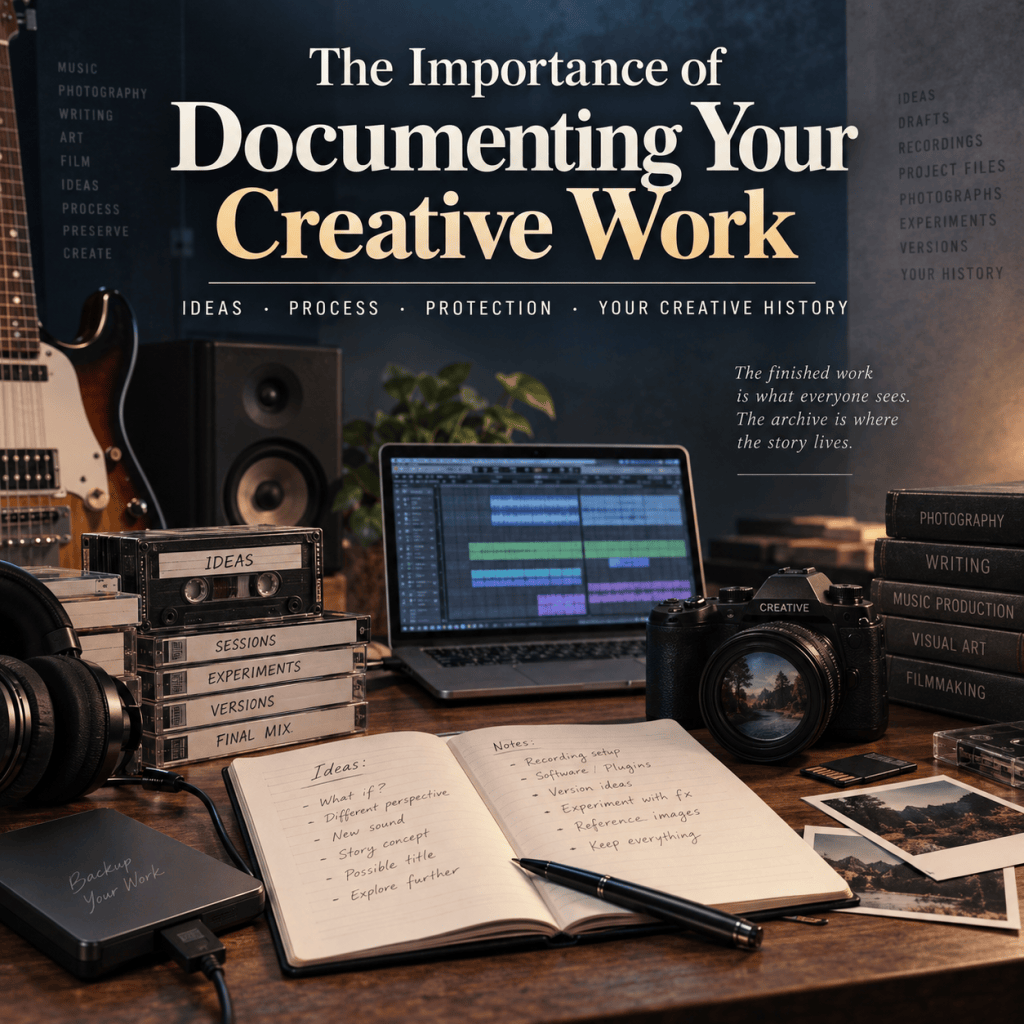
The Importance of Documenting Your Creative Work
In the old days, a musician might keep a box of master tapes, handwritten session notes, track sheets, and a stack of receipts sitting in a closet. It wasn’t glamorous, but that paperwork could tell the story of how a recording came to exist.
Today, things are different.
A song might pass through a computer, an AI tool, a digital audio workstation, an old cassette recorder, several generations of exported files, and a dozen different editing sessions before it becomes the finished recording.
A photograph might begin as an ordinary picture and eventually become a completely different image through cropping, compositing, color adjustments, textures, filters, and digital manipulation.
A story might begin as three sentences scribbled in a notebook.
That’s why documenting your creative work has become more important than ever.
And this isn’t just for professional musicians. Independent producers, writers, photographers, graphic artists, filmmakers, digital artists, and anyone else creating something should consider documenting the creative process from beginning to end.
Keep the Evidence of Your Work
If you create independently, don’t just keep the final MP3, JPEG, video, or PDF. Keep the things that came before it.
Save your original compositions, MIDI files, DAW projects, instrumental recordings, vocal recordings, individual stems, effects-processed versions, cassette recordings, raw recordings, final mixes, master files, lyrics and notes, artwork and project files, original photographs, Photoshop files, layered images, drafts and sketches, story outlines, research notes, rejected versions, and experimental recordings.
Even if you never need them, they establish a history of how the work was produced. They can also become valuable references when you return to an old project years later and need to understand how something was created.
Document the Idea, Not Just the Finished Product
One of the most overlooked parts of the creative process happens before the actual work begins. An idea might exist for months or years as nothing more than a note — a sentence in a notebook, a strange observation, a sketch, a lyric, a voice memo, or a ridiculous thought you wrote down on a whim. Don’t underestimate those things; some of the most interesting projects start from an idea that didn’t look important at the time.
If an idea occurs to you, document it — don’t trust yourself to remember it later. Write down what you were thinking, where it came from, and what you imagined it could become. A notebook full of strange sentences may eventually become a collection of stories. A folder of unfinished lyrics may become an album. A series of random photographs may become artwork.
The original idea is often the first piece of documentation for the finished work. Without it, you may have the finished product but no record of where the creative process actually began.
Document the Weird Ideas Too
Some creative ideas begin in unusual places — sitting around thinking about something ordinary and suddenly wondering, “what if something absurd happened here?” is often enough to start a story.
I still have documents containing ideas that eventually became some of my short stories. Some began as notes I took during church lessons. Sometimes the original note wasn’t even intended to become a story — it was simply an observation or an idea that made me think about how absurd it would be if a completely different situation happened.
The important part was writing it down. The original note becomes a timestamp in the creative process, so years later you can see where an idea came from and how far it traveled.
This is one of the reasons I believe creators should document ideas even when they don’t yet know whether those ideas will become anything. You don’t always know which note will eventually become a song, story, photograph, illustration, or larger project.
Document the Accidents
Don’t automatically throw away the mistakes. Maybe a microphone picked up something unexpected, a piece of equipment distorted, a file became corrupted, or you recorded a sound you originally considered useless. Keep it.
Some strange sounds produce incredible music. A weird noise might become percussion; a distorted recording might become atmospheric texture; accidental feedback might define an entire section of a song. Creative experimentation doesn’t always come from knowing exactly what you’re doing — sometimes you discover something because you did something wrong.
This applies to other creative work as well. A photograph that was technically imperfect might contain an interesting composition. An unusual Photoshop artifact might become part of an effect. A sentence removed from a story might eventually become the beginning of another story.
Not every mistake needs to be corrected or deleted immediately. Sometimes it needs to be preserved long enough for you to discover what it can become.
Weird Sounds Can Become Great Songs
This is especially true for experimental music. Not every recording needs a perfectly clean signal. Sometimes the interesting part is the imperfection.
Record the strange noise, save it, keep the original — then slow it down, reverse it, distort it, sample it, chop it up, record it onto another medium, or layer it with something completely different. You may discover that the sound you almost deleted becomes the foundation of something unexpected.
This is also why documenting experimental recordings is important. If you find an unusual sound by accident and later build a song around it, having the original recording allows you to return to the source rather than trying to recreate something that may never happen the same way twice.
Document Your Photoshop and Visual Work
This isn’t limited to audio. If you’re creating artwork in Photoshop or another editor, document the process there too — the original photograph, the untouched image, the layered project file, the individual elements of a composite, and the major stages of manipulation.
For example: original photograph → crop → background removal → compositing → texture → color adjustment → final artwork. That sequence tells the story the final JPEG can’t.
You don’t necessarily need to document every single click you made while working. What matters is preserving the original materials and the significant stages of the creative process. A layered project file can sometimes tell you more about how an image was created than the finished exported image ever could.
Document Photography
Photographers should keep the original file, not just the Instagram-ready version. A history such as original → exposure adjustment → crop → color correction → retouching → final can be valuable later, and can reveal how much your editing style has changed over time.
The original photograph is also important because editing decisions can always change. An image that was processed one way five years ago might look completely different if you revisit it today with different knowledge, software, or creative preferences.
Keeping the original gives you that opportunity.
Document Writing
Writers should preserve notebook entries, story concepts, character ideas, outlines, research, early drafts, deleted scenes, alternate endings, abandoned ideas, and finished manuscripts. The original idea is sometimes more interesting than the finished product because it shows where the journey began — and an idea that didn’t work five years ago might be exactly what a different project needs today.
The process of writing can involve substantial changes between the original concept and the finished work. Characters may change, scenes may disappear, endings may be rewritten, and entire ideas may be abandoned. Those earlier versions are still part of the creative history of the project.
Document Experiments That Failed
Failure is part of the creative process, so your archive shouldn’t contain only successes. Keep the terrible mix, the photograph that didn’t work, the rejected design, the story that went nowhere, and the recording that sounded awful.
You may never use any of it, but it documents what you tried — and something that failed in one project can become useful in another.
A creative archive shouldn’t be a museum containing only finished accomplishments. It should also contain evidence of experimentation, because experimentation is how creators discover new techniques and develop their individual style.
Document the Tools
Write down the software, hardware, versions, recording equipment, camera, microphone, plugins, and effects you used — even the operating system. Technology changes fast, and an old project built in an obsolete tool can become impossible to open. Knowing what created the original file makes preservation much easier.
This is particularly important for older creative work. A project created on an older computer with an older version of a program may contain files, effects, formats, or settings that newer systems don’t reproduce exactly.
Documenting the tools provides context for the finished work and can make it easier to preserve or reconstruct the project later.
Keep Your Production History
A finished song doesn’t magically appear — there’s a chain of decisions behind it: writing the music, playing an instrument, programming in an old DAW, recording onto tape, chopping it apart and building a new arrangement, adding effects, recording additional sounds, and eventually creating the final mix.
All of those steps are part of the creative process. The final WAV file doesn’t necessarily tell that story. Your project files can.
The same principle applies to visual art, photography, writing, video, and other forms of creative work. The final product represents the destination, but the project files and documentation preserve the route taken to get there.
Don’t Rely on AI Detectors
An AI detector isn’t a recording-history database — it doesn’t know what happened during your production session. One detector may find no evidence of AI while another disagrees entirely, and neither result substitutes for real documentation.
If questions ever arise about how a recording was produced, your production records — the original project, intermediate exports, recordings, stems, and dated versions — tell a far clearer story than any detector score.
The same principle applies to visual art and writing. A collection of original photographs, layered project files, drafts, sketches, and dated versions provides substantially more context than simply presenting the finished image or document.
A detector result can change depending on the software, the version of the detector, and the material being analyzed. Your own records provide something different: a history of the actual creative process.
Old Hardware Still Matters
A cassette deck can still be part of a modern production. An old computer may hold sounds and compositions that eventually feed a new recording. Outdated software can serve as a creative instrument in its own right. A cheap microphone or an old camera can produce characteristics that modern equipment doesn’t reproduce the same way.
That physical and digital history is worth preserving.
If you record onto cassette, keep the cassette, not just the digital transfer. It may become part of the history of exactly how a sound was created. The physical recording can also preserve characteristics that may be difficult to reproduce later.
Older equipment isn’t necessarily obsolete simply because newer equipment exists. Sometimes its limitations are precisely what make it useful creatively.
Give Your Projects a Paper Trail
You don’t need a complicated archival system. Even a simple folder structure helps:
01 — Original
02 — Ideas & Notes
03 — Working Files
04 — Stems / Layers
05 — Experiments
06 — Effects
07 — Intermediate Versions
08 — Tape Transfers / Physical Media
09 — Final Master
10 — Documentation
Add dates to key versions — SongName_2026-09-20_original.wav, SongName_2026-09-20_tape_transfer.wav, SongName_2026-09-21_final_mix.wav — and now you have a timeline.
The same idea works for images: Artwork_Original.jpg, Artwork_Composite_v01.psd, Artwork_Final.jpg.
And for writing: Story_Original_Notes.txt, Story_Draft_01.docx, Story_Final.docx.
You don’t need to make it complicated — you just need to make it consistent.
Don’t Delete the Weird Versions
Sometimes the strange version you almost deleted becomes the most interesting one later. Keep the ugly mix, the distorted take, the failed experiment, the raw recording.
Storage is cheap compared to recreating something you destroyed by accident — and you never know when an old mistake becomes a new idea.
The same applies to photographs, artwork, writing, and other creative projects. A discarded version may contain an element that becomes useful later, even if the original project itself is never completed.
Your Process Is Part of Your History
Beyond disputes or authenticity questions, documentation preserves your own creative history.
Years from now you may wonder what computer, software, camera, or instrument you used, where a story idea came from, what the first draft looked like, or why you changed direction. If you didn’t document it, you may never remember.
The archive can also reveal things about your creative development that weren’t obvious while you were working. Looking through older projects can show recurring ideas, techniques, sounds, subjects, or approaches that gradually became part of your personal style.
You Don’t Have to Reveal Every Secret
Documenting your work doesn’t mean publishing your entire recipe. You can keep private techniques private while still maintaining your own records.
You don’t have to explain every production technique, reveal every preset, or provide unfinished material simply because someone wants to know how you achieved a particular result.
The public experiences the finished work; your private archive holds the story behind it.
There is nothing wrong with keeping certain aspects of your process private. A creator can document a technique for personal records without publishing the technique itself.
You Don’t Have to Prove Yourself to Everyone
There’s an important distinction between documenting your work and proving it to everybody else.
You don’t have to hand someone your entire creative archive just because they question how you made something. You don’t have to show unfinished projects, notes, presets, source files, or experiments on demand.
Your documentation is primarily for you and your records.
There are situations where detailed documentation matters — entering a professional agreement, working with a label, licensing music, collaborating with other creators, or dealing with a formal rights dispute — where organized records become extremely valuable.
Outside of those circumstances, you don’t owe anyone an explanation of your entire process.
Be Careful When You Work in Someone Else’s Studio
This matters especially for independent musicians moving between home studios, friends’ studios, and other people’s production environments.
Walking into somebody else’s studio means using their equipment, but it can also mean exposing your own methods — how you manipulate a sound, arrange a track, process vocals, layer instruments, or build a particular effect.
Those techniques may have taken years to develop.
Be conscious of what you demonstrate. A piece of hardware doesn’t own the technique. A DAW doesn’t own the idea. A microphone doesn’t create the arrangement. The person making the creative decisions does.
This doesn’t mean that creators should avoid collaboration or become suspicious of everyone they work with. It simply means that you should understand what you’re revealing when you demonstrate your methods to another creator.
Don’t Let Your Creative Process Bleed Into Someone Else’s Work
You might bring an unfinished song into somebody else’s studio, demonstrate a production trick, build a unique effect chain, or show someone how you achieved a particular sound. Weeks or months later, you may hear something remarkably similar in another person’s work.
Sometimes that’s intentional, and sometimes it isn’t. Ideas naturally spread between people who work together, and someone may absorb a concept without realizing how much they were influenced by it.
Think about what you demonstrate and what you keep private. You don’t have to be paranoid — just aware.
The same principle applies beyond music. A photographer, graphic artist, writer, or filmmaker can reveal techniques and unfinished ideas simply by showing another person how a project was created.
Protect Every Piece of the Work
The finished recording is only one piece of the creative process.
The original idea, the lyrics, the instrumental, the arrangement, the stems, the effects chain, the artwork, the discarded versions, the original photograph, the layered project file, the early draft, and the production techniques developed over years can all be part of the creative history.
The entire process has value.
That doesn’t mean hiding everything from everyone. Collaboration is one of the most important parts of creative work. It simply means knowing what you’re sharing, who you’re sharing it with, and what you want to keep as your own private creative knowledge.
Collaboration Requires Trust
Working with another creator is different from working alone. For serious collaborations, it’s worth putting agreements in writing: who created what, who owns the finished work, who owns the original material, who can use the stems, who receives credit, and what happens if the project is abandoned.
These questions can feel unnecessary in a friend’s living room or home studio. They become much more important once a project succeeds.
Ownership and authorship can depend on the specific contributions, agreements, and applicable law, so don’t assume that simply having a file, using someone’s equipment, or being present during a session automatically settles those questions.
The goal isn’t distrust. It’s avoiding confusion later.
Keep Your Originals
One of the simplest rules is also one of the most important: keep your original files.
If you take a project to somebody else’s studio, don’t make their computer the only place your work exists. Bring your own copy and take your files home when the session ends.
Keep your recordings, project files, stems, notes, and versions.
If something happens later, you still have your original creative material.
This is particularly important when working with other independent creators. A shared project should not mean that one person becomes the only person who possesses the source material.
Your Secrets Are Part of Your Craft
Every creator develops techniques that become part of their identity — a way of photographing subjects, editing images, developing characters, recording sounds, arranging music, or making an ordinary recording sound completely different.
Those techniques don’t need to be published.
You can document them privately, preserve them, teach them to someone you trust, or keep them entirely to yourself.
Not everything you know has to become public information.
The finished work can speak for itself. Your archive can preserve how you got there. Your private techniques can remain yours.
Preserve the Archive Itself
There is one final part of documentation that is easy to overlook: protecting the documentation itself.
A hard drive can fail. A computer can die. A memory card can become corrupted. A cloud account can disappear. A physical recording can deteriorate.
Don’t let the archive become another thing that exists in only one place.
Keep important projects in more than one location when possible. Make backup copies of irreplaceable recordings, photographs, project files, manuscripts, and notes. For particularly important work, consider keeping one copy separate from your primary computer or studio.
This is especially important for older projects. A physical tape, optical disc, external drive, or old computer may eventually become difficult to access, so preserving both the original material and a usable backup can make a significant difference.
And don’t wait until a project becomes valuable to start backing it up.
The time to preserve something is when you realize you don’t want to lose it.
Make the Archive Before You Need It
The best time to document a project is while you’re making it.
Don’t wait until somebody asks how the work was created.
Save the files, the versions, the recordings, the photographs, and the project files. Write down the important details. Keep the original material, including the strange experiments and discarded ideas.
Once a project is finished, it’s easy to forget how much work went into it.
And someday that archive may be just as valuable as the finished work itself.
The Creative Archive
Your archive eventually becomes a record of how you think — the strange notes, the failed experiments, the accidental sounds, the half-finished stories, the ideas that seemed ridiculous at the time, and the projects that changed direction along the way.
Years later, these can reveal patterns you didn’t recognize while creating them. An idea from one project may quietly influence another; an old sound may fit a new song; an abandoned concept may suddenly make sense.
You may even discover that the things you considered mistakes were part of the development of your creative style.
That’s why documentation isn’t just about proving you made something. It’s about preserving the creative journey itself.
The finished work is what everyone sees. The archive is where the story lives.
The recording is the finished product. The archive is the evidence of the journey.
 TumbleDweeeb
Leave a comment