
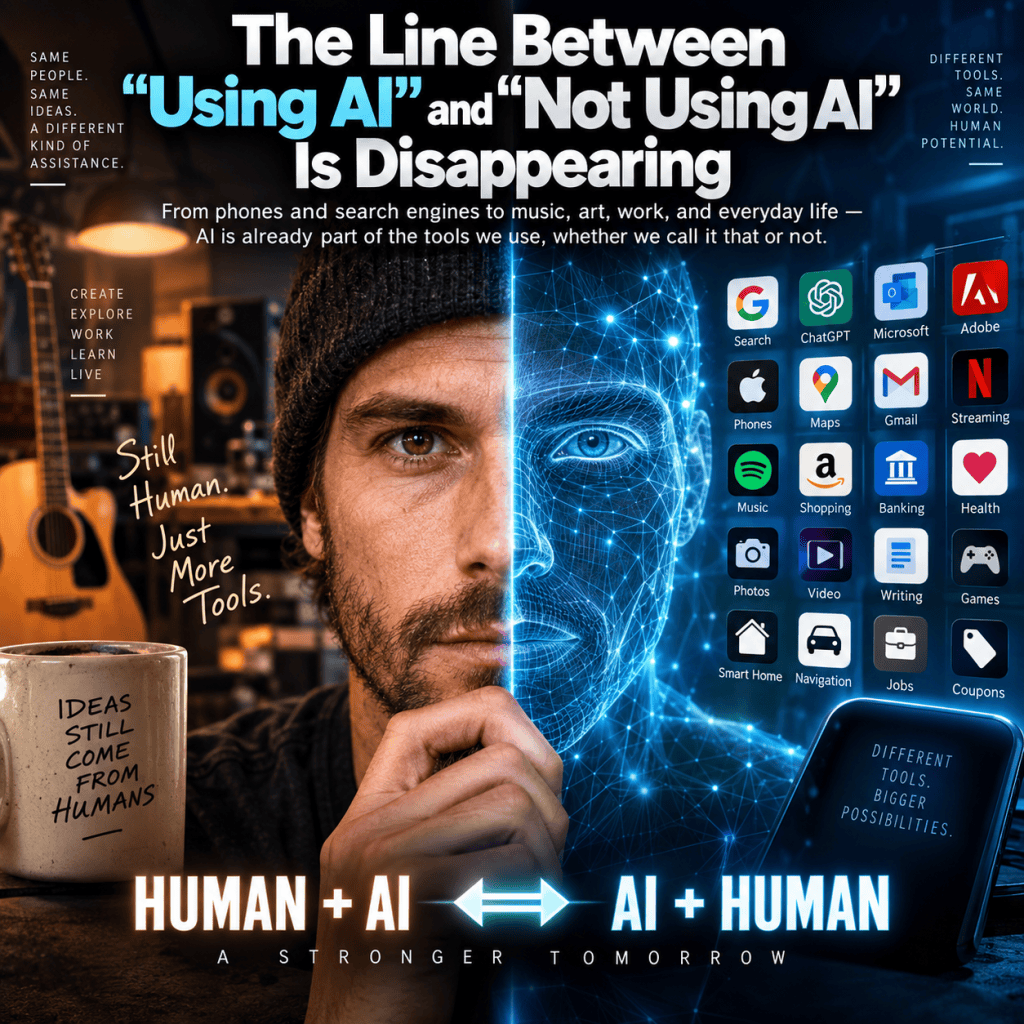
The Line Between “Using AI” and “Not Using AI” Is Disappearing
The conversation about artificial intelligence is usually framed as a binary: humans on one side, AI on the other. But that framing is increasingly out of step with how people actually interact with technology. A more accurate picture is starting to look like human-plus-AI systems interacting with other human-plus-AI systems — because nearly everyone is already inside that loop, whether they intend to be or not.
The gap between what people think they do and what they actually do
In a January 2025 Gallup survey, only 36% of Americans said they’d used an AI-enabled product in the past week; 50% said no, and 14% weren’t sure. But when Gallup then listed six specific categories of AI-enabled apps and platforms and asked again, 99% of respondents had used at least one. That’s not a small gap — it’s the entire premise of this piece in one data point.
Most people already use AI, whether they call it that or not
A February 2026 Pew Research Center survey of 5,119 U.S. adults found that about half now use AI chatbots at all — up from a third in 2024 — including roughly one in four who use them daily. Broken down by platform: 44% had used ChatGPT, 24% Gemini, 17% Copilot, 14% Meta AI, 8% Grok, and 6% Claude. Those figures overlap, since many people use more than one tool. Separately, 36% of adults say they interact with AI at least several times a day, and awareness has become nearly universal — 96% of adults say they now know at least a little about AI, up sharply from a few years ago.
More striking is that 60% of U.S. adults say they’ve read an AI-generated summary at the top of a search result, while 30% say they haven’t and 10% aren’t sure. Someone can honestly say “I’ve never used ChatGPT” while having already consumed AI-generated content through an ordinary Google search.
At the infrastructure level, the scale is larger still. By mid-2026, Google’s AI Overviews had reached more than 2.5 billion monthly users worldwide, while AI Mode had surpassed 1 billion — making it one of the most widely used AI products on earth, even though most of those users never opened a dedicated chatbot app.
AI in the home
It’s not confined to screens, either. About a third of U.S. adults now say they own a smart speaker, and smaller shares have a smart doorbell or thermostat with AI features built in — devices that listen, predict, and adjust without ever being labeled “AI” on the box.
AI is now embedded inside the software people already use
This is the part that’s easy to overlook: AI isn’t just something you seek out. It’s increasingly built into the tools people use for work, health, creativity, and daily errands.
Office software
● Microsoft Word
● Microsoft Excel
● Microsoft PowerPoint
● Microsoft Outlook
● Microsoft Teams
● OneNote
Copilot is now integrated across Microsoft’s core productivity suite, so a full day of work in Word and Excel can involve AI assistance without a single visit to a chatbot.
Photo and design software
● Adobe Photoshop
● Adobe Lightroom
● Adobe Illustrator
● Adobe Premiere
● Adobe Acrobat
● Adobe Express
● Canva
Photoshop’s Generative Fill and Generative Expand, Acrobat’s AI-assisted summarization, and Canva’s built-in AI design tools are now standard, not optional add-ons.
Music production
● FL Studio
● Logic Pro
● Ableton Live
● Pro Tools
● Cubase
● Studio One
● REAPER
● GarageBand
● Bitwig
Logic Pro alone ships with Stem Splitter, Mastering Assistant, Chord ID, and Session Players — AI-assisted tools sitting directly inside the production workflow, not bolted on as a separate step.
Video editing
● Premiere Pro
● DaVinci Resolve
● CapCut
● Final Cut Pro
● Descript
AI handles transcription, captioning, background removal, scene detection, and audio cleanup in most modern editing suites.
Writing and communication
● Grammarly
● Google Docs
● Gmail
● Outlook
● Notion
● Slack
Voice assistants
● Siri
● Google Assistant
● Alexa
Tens of millions of Americans use one of these on a regular basis, on phones, speakers, cars, and TVs — usually without thinking of it as “using AI” at all, just as “asking the phone.”
Streaming, shopping, and getting hired all run on it too
● On Netflix, roughly 80% of what people watch comes from the platform’s recommendation algorithm rather than active searching — an internal figure the company has cited for years and that still holds up as the mechanism behind the “For You” experience on nearly every streaming and social platform.
● In hiring, a 2026 survey of 1,000 U.S. hiring managers found that 79% of companies have automated at least part of their hiring process, 71% use applicant tracking software, and about one in five hiring managers use AI to filter out applications before a human ever sees them.
● In health, roughly a quarter of U.S. adults now say they use AI chatbots to help interpret symptoms or make sense of a diagnosis or lab results, according to a 2026 Pew survey — alongside the roughly 85% who still say they get health information from a clinician at least some of the time.
Shopping and coupons
● Amazon
● Walmart
● Google Shopping
● eBay
● Etsy
● Target
● Best Buy
Then there’s the coupon and price-comparison layer running underneath: Honey, Capital One Shopping, RetailMeNot, Ibotta, Rakuten, and the browser extensions that automatically apply codes at checkout. Not every feature on these platforms is AI, but product recommendations, price comparisons, and deal-matching increasingly run on machine-learning models — and retailers are now piloting AI agents that shop on a person’s behalf.
Banking and money
● Bank websites and apps
● Credit-card apps
● Fraud detection systems
● Transaction alerts
● Customer-service chat
● Budgeting and credit-monitoring tools
Ask a bank’s app why a charge went through, and increasingly the answer comes from an automated system rather than a person at a branch.
Navigation
● Google Maps
● Apple Maps
● Waze
Modern navigation doesn’t just draw a route. It’s continuously analyzing traffic, road conditions, and destination patterns, and Google has been layering conversational, Gemini-powered features like Ask Maps on top of standard turn-by-turn directions.
Email and inboxes
● Gmail
● Outlook
● Yahoo Mail
● Apple Mail
Spam filtering, smart replies, thread summaries, and priority sorting are AI-driven by default in most major email clients — meaning an inbox can contain AI assistance well before someone decides to “use AI.”
Photos
● Google Photos
● Apple Photos
● Samsung Gallery
Face grouping, object recognition, automatic organization, and generative background removal are now routine parts of how phones handle photo libraries.
Social media
● TikTok
● YouTube
● X
These platforms rely on automated ranking, personalization, content moderation, and increasingly generative features to decide what each person sees. Someone can refuse to open ChatGPT while spending hours inside systems where machine-learning models are actively shaping their feed.
Everyday systems most people don’t think of as “AI” at all
● Spam filters
● Predictive text and autocorrect
● Fraud detection on bank cards
● Traffic and navigation prediction
● Face recognition in photo apps
● Customer-service chatbots
● Streaming and shopping recommendations
● Package tracking and delivery estimates
● Smart thermostats and security cameras
Why this matters for the AI-generated content debate
The same logic that applies to office software applies to music, writing, and art. Someone raising concerns about AI-generated music may, in the same week, have used an AI-powered search summary, an AI-sorted resume screen, an algorithm-driven Netflix queue, and a voice assistant — without registering any of it as “using AI.” Meanwhile, a musician using AI-assisted mixing tools inside a DAW is still doing most of the creative work by hand.
The old question — “Did a computer touch this?” — is becoming almost unanswerable, because the honest answer is usually yes, somewhere in the pipeline. The more useful question is what a person actually did with the tools available to them: what they decided, what they edited, what they chose to keep or discard.
The feedback loop
This is the part worth sitting with. AI systems were built using human knowledge and human-created culture — human music, writing, art, photography, language, and accumulated science. People now use AI to create new work. That new work becomes part of the material the next generation of systems trains on and responds to.
The result is a loop that runs roughly like this: human culture feeds AI systems; humans use AI to create new work; that work becomes new culture; new culture feeds the next generation of AI; and the cycle repeats, with humans still making the decisions at each turn even as the volume of AI-touched material keeps growing underneath them.
So what are we actually fighting about?
Maybe the honest framing isn’t AI versus humans. It’s closer to human-plus-computer systems interacting with other human-plus-computer systems — because the computer stopped being a tool that sits on a desk a long time ago. It’s in people’s pockets, cars, banks, cameras, music studios, offices, shopping carts, and entertainment feeds. It has become part of everyday infrastructure, largely without anyone voting on it.
The person arguing against AI-generated content may be researching that argument with an AI-powered search summary. The person posting about it may have an algorithm deciding who sees the post. None of that makes the underlying concerns illegitimate — questions about consent, compensation, and authenticity in creative work are real and worth taking seriously. But it does mean the debate rarely divides as cleanly into “human-made” and “AI-made” as the framing suggests.
The bigger picture
AI systems were built on the back of human-created material — music, writing, art, and accumulated knowledge. People are now using AI to create new work, which becomes part of the material future systems will draw on. That’s a real feedback loop worth examining critically. But it isn’t a fight between two clean, separable camps. It’s a messier and more interesting question about how much of the process is deliberate, and how much of it is just the water everyone is already swimming in — at a rate that, per Gallup, now sits closer to 99% than most people would guess.
Sources
Pew Research Center — Americans and AI 2026
Pew Research Center — AI summaries in search
Pew Research Center — AI chatbots for health
Resume Genius — 2026 Hiring Insights Report
Google Search product usage figures
Netflix recommendation-engine case study
Gallup, January 2025 AI product usage survey


Leave a comment