
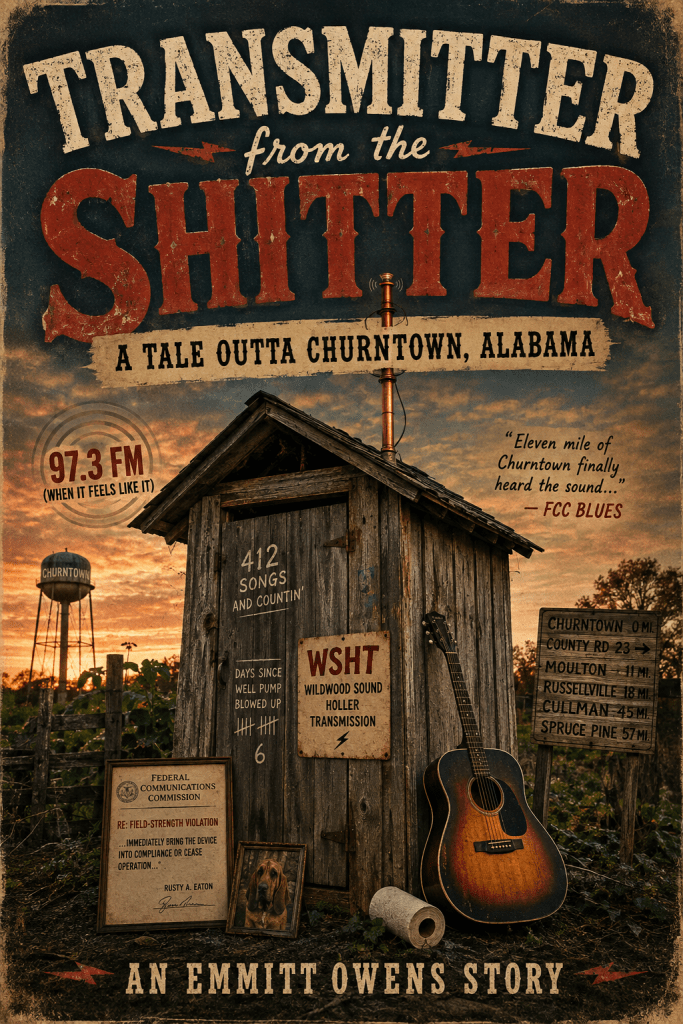
Transmitter from the Shitter
A tale outta Churntown, Alabama
I. The Man, The Myth, The Outhouse
Now Rusty Eaton had wrote him four hundred and twelve songs, and he knowed it exact, on account of he numbered every last one in Sharpie marker on the inside of the outhouse door, right up next to his cousin Paul’s tally of “days since the well pump blowed up” (which was settin’ at six, a personal best for the Eaton family).
Wasn’t nobody heard a single one of them songs. Not on purpose noway. His wife Charlene heard ’em through the bathroom wall of an evenin’, and she’d asked the good Lord more’n once for patience, a second bathroom, and — failin’ that — some manner of ear protection rated for structural use.
Rusty worked the second shift down at the chicken plant outside Russellville, which left him every mornin’ free to set up in what he called his “studio” and what the rest of Churntown called “that outhouse,” or if they was feelin’ charitable, “the shed with the hole in it Rusty won’t quit hollerin’ in.” It’d been took outta service as a real outhouse back when the Eatons got indoor plumbin’ put in, but Rusty’s granddaddy wouldn’t hear of tearin’ it down on principle, so it just sat back there behind the garden, weathered gray, leant two degrees to the left like it was still recoverin’ from somethin’ it seen.
Rusty come into ownership of it along with the rest of the property, and he took one look and thought to hisself: “now that there’s got acoustics.”
Wasn’t wrong neither. That outhouse had insulation, of a sort — a 1987 Carhartt catalog stapled up on the walls for warmth, pages gone soft and swole from thirty years of Alabama humidity settin’ up in there. Had itself a natural reverb too, four foot by four foot of plywood, bouncin’ every note back at him twice over. And it had privacy, which Rusty figured his art required, on account of Charlene had a habit of walkin’ past the kitchen window durin’ his more emotional choruses and mouthin’ the words “oh Lord” without so much as breakin’ stride.
“Ain’t that your singin’s bad,” she told him one time, not even lookin’ up from her crossword. “It’s that it’s specific. A man don’t need to sing that specific about a possum.”
“Possum on My Porch (You Left Me For)” was, Rusty would maintain till the day he died, one of the finer things he ever wrote.
II. The Forum Post That Changed Everything
It was a Saturday, two in the mornin’, and Rusty was doin’ what he always done when sleep wouldn’t come, which was fall down one a them internet holes about subjects he had no business researchin’ in the first place. This particular hole started out with “how loud can a guitar amp legally be at 2am” and ended up, four hour later, on a forum thread that read PART 15 BROADCASTING — LEGAL LOW POWER RADIO (NO LICENSE NEEDED!!), posted by a feller callin’ hisself RadioRon88.
Rusty read it through three times.
Best he could make of it — and Rusty’s grasp of federal regulation topped out around “speed limit’s more of a suggestion out on County Road 23” — there was some kinda rule, Part 15 of somethin’ called the FCC code, that let a regular man broadcast a little bit of FM and AM radio without havin’ to get no license for it. Long as he kept the power down low. Few watts. Maybe a couple hundred feet of range, RadioRon88 said, if a feller done it right.
Rusty did not intend on doin’ it right.
What Rusty heard, down in his soul, wasn’t “a couple hundred feet of range.” What Rusty heard was: the government done give me a radio station.
He woke Charlene up to tell her.
“I’m gettin’ me a radio station,” he said, shakin’ her shoulder gentle, the way a man wakes somebody to tell ’em the house is afire, if the house catchin’ fire was the best news you ever heard.
Charlene cracked one eye open. “That a metaphor.”
“No ma’am. Real one. Legal one too. Forty dollar off the internet.”
“Go on back to sleep, Rusty.”
He did not go back to sleep. He ordered that transmitter kit at 6:47 in the mornin’ with confidence like a man who ain’t never once read a instruction manual clean through in his life, and come sunup he was out at the outhouse with a tape measure, mutterin’ about “range” and “coverage area” like he was fixin’ to invade somebody.
III. Paul Gets Drug Into It, Regrettable-Like
Paul Eaton — first cousin, part-time hay hauler, full-time doubter of anything Rusty ever proposed goin’ back to about 1984 — come by around ten that mornin’ aimin’ to borrow a socket wrench, and instead found Rusty standin’ up on a overturned bucket, screwin’ a six-foot length of copper pipe onto the outhouse roof.
“What in the ever-lovin’ world is that.”
“Antenna.”
“Antenna for what.”
“My radio station.”
Paul set that socket wrench down real slow, the way a man sets down a weapon in front of a bear he just asked polite to please back off. “Your radio station.”
“WSHT,” Rusty said. “Wildwood Sound, Holler Transmission.”
“That there spells shit. Like … who shit?”
“It spells WSHT.”
Paul chewed on that a spell. “Rusty. It’s four letters. It spells shit.”
Rusty considered this the way he considered most criticism of his art — real brief, and then not at all. “Well,” he allowed, “it’s memorable.”
Paul clumb up to check the wirin’, mostly on account of he didn’t trust Rusty within ten foot of a live outlet unsupervised, and he did not care one bit for what he found. That transmitter — little black box ’bout the size of a deck of cards, with a sticker on it warnin’, in mighty small print, that improper antenna modification could violate FCC limits — had got itself wired straight into that six-foot copper pipe, which had got wired into a spliced-together extension cord, which run clear across the yard, over the garden fence, and into the porch outlet through a hole Rusty had drilled in the sidin’ “for ventilation purposes.”
“This here says three feet,” Paul said, tappin’ the sticker.
“Roundin’ error.”
“It’s double, Rusty, that ain’t roundin’, that’s just—”
“Paul. I have wrote four hundred and twelve songs. Ain’t nobody heard ’em. Tonight, folks is gonna hear ’em. Now I need you to be helpful or I need you to be gone.”
Paul, against every ounce of good sense thirty-one years of knowin’ Rusty Eaton had beat into him, chose to stay on and help, mostly outta plain morbid curiosity, and maybe some small evil part of him wanted to see just how bad this here was fixin’ to get.
It was fixin’ to get real bad.
IV. WSHT Goes Live Over Churntown
At seven o’clock sharp — Rusty had it circled on the calendar like it was the moon landin’ — he settled hisself down on his overturned five-gallon bucket, guitar layin’ cross his knee, roll of paper towels within arm’s reach on account of they’d been outta the real kind since March and a man’s got to prioritize, and he keyed that little microphone with a hand that was, he’d admit to it later, shakin’ some.
“This here’s Rusty Eaton,” he said, “broadcastin’ live from — from a undisclosed location somewhere in beautiful Churntown, Alabama, and this first song’s called ‘Diesel Tears.’”
For eleven mile in every direction — eleven mile, on a device rated for maybe two hundred feet, on account of copper pipe don’t give one hoot ’bout what your sticker says — radios crackled to life right in the middle of the weather forecast.
Old Man Pruitt was the first to catch it. He was runnin’ sixty down County Road 23 in his F-150, radio locked on WKEL outta Moulton, the only country station come in clear out past the ridge, half payin’ attention to talk of a frost advisory, when the signal folded up on itself like a lawn chair and got replaced, no warnin’ whatsoever, with the sound of a man singin’, with tremendous feelin’, about diesel fuel and a woman named Kim.
Pruitt pulled hisself over. Not on account of bein’ scared. On account of he needed to think.
Two hollers over, at the Baptist church’s potluck, Ruth Anne Coble’s kitchen radio — tuned permanent to the gospel station on account of Ruth Anne didn’t believe in variety — cut straight outta “How Great Thou Art” into what she’d later describe to the sheriff’s dispatcher as “somebody a-singin’ ’bout a possum in a manner I did not care for, and there was a echo to it, like the man was down in a cave, or maybe a well.”
By the third song — “Possum on My Porch (You Left Me For),” a fan favorite of exactly one household in all Churntown, that bein’ Rusty’s own — the sheriff’s non-emergency line had done took four calls. Two folks wanted to know if the radio’d been hacked by terrorists. One wanted to know, real concerned-like, if Jesus radio had “gone secular on us.” One elderly caller, name of Miz Vera Higgins, simply asked the dispatcher would she please tell that man his rhyme scheme was fightin’ him somethin’ fierce.
Paul, settin’ outside the outhouse in a lawn chair with a beer sweatin’ in his hand, keepin’ watch on the whole affair through his truck radio, watched Rusty’s voice roll out over Churntown like a slow-movin’ weather system, and thought, somewhere between horror and pure family pride: “he done it. That fool actually done it.”
V. The Trucker
By the seventh song — “Gravel Road Heart,” a real weeper — the signal had gone and done somethin’ nobody, not even RadioRon88 on the forum, could rightly explain: It skipped. Not skipped like a scratched record. Just started showin’ up places it had no earthly business bein’.
A long-haul trucker name of Gary, haulin’ lumber down 78 a full forty mile east, had his CB and his AM both runnin’ for company on the drive, and ’round 8:15 that evenin’ he keyed that CB and said:
“Anybody else got some feller singin’ outta what sounds like a well on 97.3? I ain’t foolin’ with y’all. There’s a echo to him like he’s — hang on now — no, I do believe he’s inside a pipe. Structurally speakin’. This man is broadcastin’ from inside a pipe.”
Six other truckers confirmed it. One of ’em, a woman name of Dolores who’d drove these roads eleven years and heard some things in her time, said only: “That boy needs him a producer and a lawyer, and I ain’t necessarily sayin’ in that order neither.”
Rusty would never know a thing about that exchange, which is a cryin’ shame, on account of “singin’ from inside a pipe” was, geographically and structurally speakin’, a whole lot closer to the truth than he’d ever cop to, seein’ as how he was basically singin’ straight into that copper antenna the entire time.
VI. Charlene’s Take on Things
Inside the house, Charlene was watchin’ the whole business unfold with the particular kinda calm belongs only to a woman been married to Rusty Eaton nineteen year and had, somewhere ’round year four, made her peace with the fact her husband was gonna do whatever the most Rusty-possible version of a thing was, every single time, no exceptions whatsoever.
She was out on the porch, glass of sweet tea in hand, when the neighbor’s dog — a bloodhound name of Colonel who ain’t never once showed a lick of interest in music of any kind — commenced to howlin’ in what you could generously call harmony with “Gravel Road Heart,” and less generously call protest.
Her phone buzzed. Her sister, over in Cullman, forty-five minute away.
Charlene you know theres a man on the radio singin about a possum
that’s Rusty, she typed back.
THAT’S RUSTY
yes ma’am
IS HE ALRIGHT
he ain’t never been better in his whole life unfortunately
She set the phone down, took her a long pull of tea, and let herself feel, just for a minute, somethin’ close to pride. He was terrible. Truly, structurally terrible, in a way went past simple lack of talent and turned into somethin’ closer to a act of God. But he’d built hisself somethin’ — badly, illegal, with a pipe he had no business puttin’ up there — and eleven mile of Churntown was, whether they cared for it or not, gettin’ a earful of her husband’s heart, unfiltered, at a volume the FCC never once had in mind and Rusty had never once thought to hold back.
She was not, she told herself, fixin’ to cry about it. She cried a little about it anyhow.
VII. The Complaints Pile Up
By nine o’clock the sheriff’s non-emergency line had logged eleven calls, which for Churntown — population three-forty, one blinking yield light, ain’t had a crime worth mentionin’ since the Founder’s Day pie thievin’ of 2019 — amounted to a full-blown situation.
Deputy Wilkins, twenty-six year old, two year on the job, which mostly meant noise complaints and the odd loose cow, got dispatched to go “investigate a pirate radio situation,” a sentence he had not once expected to say out loud in his career and repeated to hisself the whole drive out, tickled despite hisself.
He found Rusty mid-song, Paul in a lawn chair, Charlene up on the porch, and Colonel the bloodhound settin’ right outside the outhouse door, howlin’ on the choruses like somebody’d hired him special.
“Evenin’,” Deputy Wilkins said.
Rusty, catchin’ them cruiser lights bouncin’ red and blue off the plywood walls, done the only thing a true artist could do in that moment, which was finish the song. All four minute and thirty second of it. Deputy Wilkins waited him out. He’d tell his wife later it wasn’t, unfortunately, half bad, for what it was.
When Rusty finally come on out, guitar strap still slung over his shoulder, Deputy Wilkins explained, gentle as a twenty-six-year-old with a badge is able, that broadcastin’ was fine — legal, even, technically, under this here Part 15 — but that eleven mile of range off a device advertised for two hundred feet suggested Rusty’d gone and “engineered beyond spec,” and that several folks, while not exactly filin’ formal complaint, had strongly implied they’d be much obliged if the possum song stopped existin’ in their airspace altogether.
“So I ain’t in no trouble,” Rusty clarified.
“Not with me,” Deputy Wilkins said. “But I wouldn’t be one bit surprised somebody bigger’n me hears tell of this.”
He was right. Somebody bigger’n him was already hearin’ tell of it.
VIII. The FCC Comes Callin’
Turns out the Federal Communications Commission does read complaints, even ones worded the way Miz Vera Higgins had worded hers to the dispatcher, who — bored, and more’n a little tickled by the whole thing — passed it along to the regional FCC field office as a favor to a friend worked there, mostly as a funny story to tell.
Wasn’t no funny story to the field office. It was a field-strength violation with a documented eleven-mile radius, four separate confirmed listener reports, and — this here’s the part got it flagged — interference with a Baptist church’s designated gospel frequency durin’ a Wednesday night potluck, which the agent handlin’ the case noted dry as a bone in his report “raises the stakes considerable in this particular jurisdiction.”
Two week later a letter come to the Eaton place. Cream envelope, government seal, the kind of letter makes a man’s stomach drop ‘fore he’s even got it opened.
Rusty read it out on the porch, Charlene settin’ beside him, Paul leant over his shoulder uninvited as ever.
It was, all things considered, a mighty polite letter. Informed one Mr. Rusty A. Eaton that his Part 15 transmitter, as configured, “substantially exceeded permissible field-strength limitations, most likely as a result of unauthorized antenna modification,” and that he was required to “immediately bring the device into compliance or cease operation,” and further complaints could bring on “escalated enforcement action,” which the letter never did define but which Paul, readin’ over his shoulder, interpreted immediate and loud as “prison time.”
“It don’t say prison,” Charlene said.
“It don’t not say prison,” Paul said.
Rusty read that letter through twice, same as he’d read the forum post that started this whole mess, and then he done somethin’ nobody was expectin’: he laughed. A real laugh, the kind comes up outta the chest, on account of somewheres in the last two week, eleven mile of strangers had heard “Diesel Tears” and “Gravel Road Heart” and “Possum on My Porch (You Left Me For),” and a whole federal agency had gone and wrote him a entire letter about it, addressed to him personal, Rusty A. Eaton, like he mattered, like them songs mattered, like the four hundred and twelve numbers wrote on the inside of that outhouse door added up to somethin’ after all.
“Well,” he said, foldin’ the letter up careful. “I’m framin’ this here.”
IX. FCC Blues
He did frame it too. Hangs in the outhouse to this very day, right above the Carhartt catalog, next to a photograph of Colonel the bloodhound lookin’, as ever, deeply unimpressed by the whole affair.
That same night, runnin’ at reduced power — antenna cut back down to regulation length, Paul supervisin’ with all the seriousness of a man defusin’ a live bomb — Rusty wrote and recorded song number four hundred and thirteen. Called it “FCC Blues.” Went, in part, somethin’ like:
“They sent me a letter, said I broadcast too far,”
“said my pipe was illegal, well ain’t that just par,”
“for a man and his music and a hole in the ground,”
“eleven mile of Churntown finally heard the sound…”
Paul maintained, and maintains to this day, it was structurally the finest thing Rusty ever wrote, mostly on account of it was the first song of his that rhymed on purpose in every single verse. Rusty maintained right back that this here was pure accident and that his other four hundred and twelve songs was also, technically, on purpose.
WSHT, Wildwood Sound Holler Transmission, ain’t never again broadcast at no eleven-mile range. That copper pipe come down. The regulation antenna — three foot, exact, measured twice by Paul outta pure spite — went up in its place, and the new coverage area, per the sticker’s original promise, topped out around two hundred feet, which was to say: the garden, the chicken coop, and, on a real clear night, the very edge of the porch, where Charlene set most every evenin’ now with her sweet tea, not turnin’ the volume down no more, listenin’ to her husband sing about diesel fuel and possums and gravel roads, through a wall that had, over nineteen year, got a whole lot thinner than either one of ’em remembered it bein’.
Old Man Pruitt still tells it at the diner down in Spruce Pine. Ruth Anne Coble still calls that one Wednesday “the night the devil got on the church radio,” though she has, grudgin’-like, admitted the rhyme scheme come along some with time. Deputy Wilkins keeps a copy of his incident report — Subject: Pirate Radio, Possum-Related — filed away in his desk drawer, just for the morale of it.
And should you drive by County Road 23 come dusk, real slow, past that leant-over gray outhouse with the copper pipe long gone and the framed federal letter glowin’ faint through a gap in the boards, you might just still catch four minutes of Rusty Eaton, broadcastin’ legal now, low and proud, exactly two hundred feet in every direction out there over Churntown, Alabama — which, turns out, was always exactly enough.


Leave a comment